

Key Takeaways:
- Pricing model: Acumatica charges by resource consumption with unlimited users, which can favor businesses with many occasional users. Business Central charges per named user, which is easier to forecast for a defined core team.
- AI: Business Central ships Microsoft Copilot natively across the platform. Acumatica has no built-in generative AI assistant, only third-party connections through its open API.
- Ecosystem fit: Business Central connects directly to Excel, Outlook, and Teams with no middleware. Acumatica's REST APIs are a stronger fit if your stack sits outside Microsoft 365.
- Canadian support: Business Central has a larger pool of experienced Canadian partners who already know GST, HST, and QST configuration. Acumatica offers Canadian localization, but with fewer local partners to draw from.
If you're comparing Acumatica vs Microsoft Dynamics 365 Business Central, here's the short version: Acumatica charges by usage and gives you unlimited users, while Business Central charges per named user and gives you the deepest native connection to the Microsoft tools your team already runs every day. Neither answer is wrong. The right one depends on how your business is built, how it grows, and what your team already knows how to use.
We work with Canadian companies on this decision every week, so this isn't a theoretical exercise for us. Below, we'll walk through pricing, AI capability, deployment, ease of use, implementation, and industry fit, so you can weigh Acumatica vs Microsoft Dynamics 365 Business Central against your own numbers instead of someone else's marketing page.
What Acumatica vs Microsoft Dynamics 365 Business Central Covers
Both platforms are cloud ERP systems built for small and mid-sized businesses, and both cover the fundamentals: general ledger, accounts payable and receivable, inventory, and reporting. Beyond that, the two products come from different design philosophies.
Business Central grew out of Navision, a European accounting platform Microsoft acquired in 2002 and rebuilt as a true SaaS product in 2018. Acumatica launched in 2008 as a cloud-native platform from day one, with no legacy codebase underneath it. That history shapes how each system feels today. Business Central inherits decades of financial and inventory depth along with a UI that mirrors Excel, Outlook, and Teams. Acumatica inherits a more open, developer-friendly architecture with fewer assumptions baked in about which ecosystem you're already using.
Neither history determines the winner on its own. The question for your team is which set of tradeoffs fits how you already operate, and that's the thread running through every section below.
Every Acumatica vs Microsoft Dynamics 365 Business Central decision needs a real conversation, not a demo script
Book a free session with a Gestisoft advisor and get honest answers on cost, timeline, and fit before you commit.
 Book a free consultation
Pricing Acumatica vs Microsoft Dynamics 365 Business Central: Consumption-Based vs Per-User Licensing
This is where Acumatica vs Microsoft Dynamics 365 Business Central gets concrete fast, because the two licensing models produce very different bills depending on your headcount and usage.
Acumatica prices by resource consumption, not by user count. You pay based on the volume of transactions and data your business processes, and every employee, customer, and vendor can log in without adding a per-seat cost. For companies with a lot of occasional users (warehouse staff checking inventory, field techs logging hours, external partners pulling reports) this can work out cheaper than licensing each person individually.
Business Central flips that model. You pay per named user, per month, split across two tiers: Essentials (roughly $80 USD per user) and Premium (roughly $110 USD per user, adding manufacturing and service management), plus a lower-cost Team Member tier for read-only access. Costs are predictable and scale directly with headcount, which finance teams tend to appreciate when budgeting a year out. Our ERP pricing breakdown covers what typically gets left out of vendor quotes, including implementation and support costs on top of licensing.
Here's the practical test for anyone weighing Acumatica vs Microsoft Dynamics 365 Business Central on price alone: if your business has a small core team but hundreds of occasional users touching the system lightly, Acumatica's model may cost less. If your team is a defined group of named users doing daily work inside the platform, Business Central's per-user pricing is usually easier to forecast and control. Our breakdown of personalized ERP vs standard ERP is a useful next read if you're trying to work out which pricing model fits how customized your setup needs to be.
AI and Automation: Copilot vs Third-Party Add-Ons for Acumatica vs Microsoft Dynamics 365 Business Central
AI capability has become one of the sharper dividing lines in the Acumatica vs Microsoft Dynamics 365 Business Central conversation, and it's not close.
Business Central ships with Microsoft Copilot built directly into the platform. Copilot drafts sales lines from a pasted email, matches bank transactions during reconciliation, flags invoices likely to pay late, and summarizes records on request. None of it requires a third-party add-on or a separate contract. Our breakdown of AI in ERP covers how these capabilities have moved from demo features to production tools inside the full Business Central module set over the past two release cycles.
Acumatica takes a different path. It offers OCR for invoice capture and some machine learning for expense categorization, but no native generative AI assistant comparable to Copilot. Acumatica's open API does let developers connect third-party AI tools from AWS or Azure, so the capability exists, just not out of the box. For a business that wants AI working on day one without a custom build, that gap is a real factor when you're weighing Acumatica vs Microsoft Dynamics 365 Business Central for a 2026 rollout, and it's one of the clearest differences in this whole Acumatica vs Microsoft Dynamics 365 Business Central comparison.

Acumatica vs Microsoft Dynamics 365 Business Central: Deployment and Architecture
Acumatica was built cloud-native from the start and can also run on private cloud, AWS, or on-premises, giving IT teams more control over where data physically lives. Business Central runs primarily as SaaS on Microsoft Azure, with on-premises deployment available for specific compliance needs, though most Canadian SMBs run the cloud version.
On the deployment axis of Acumatica vs Microsoft Dynamics 365 Business Central, the deeper difference is what each platform connects to once it's live. Business Central plugs directly into Word, Excel, Outlook, Teams, and Power BI without middleware, because it's built on the same Microsoft stack those tools already run on. Acumatica's REST APIs connect cleanly to a wide range of outside systems, which is a real advantage if your stack is Salesforce, Shopify, or a custom-built tool rather than Microsoft 365. Our comparison of SaaS ERP vs cloud ERP breaks down these deployment models in more depth, and our piece on the benefits of cloud ERP covers what businesses typically gain by moving off local servers entirely.
Ease of Use and the Learning Curve for Acumatica vs Microsoft Dynamics 365 Business Central
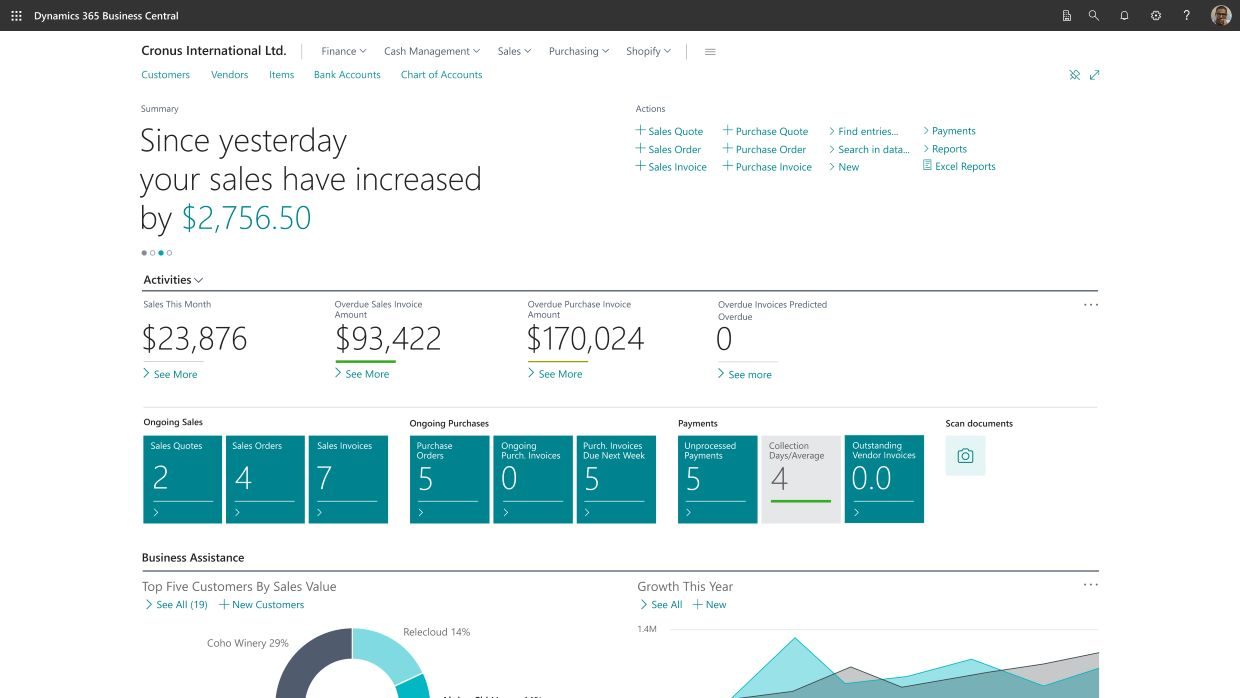
On the usability side of Acumatica vs Microsoft Dynamics 365 Business Central, independent review data on G2 tends to favor Acumatica, with users rating its ease of use noticeably higher than Business Central's. Part of that gap comes down to interface design philosophy: Acumatica built its dashboards from scratch for a modern browser experience, while Business Central's interface deliberately echoes Excel and Outlook, which helps existing Microsoft users but can feel less polished to someone who has never touched a Microsoft product.
In practice, the learning curve depends heavily on what your team already knows. A finance department that lives in Excel every day tends to pick up Business Central fast, because the menu logic and keyboard patterns feel familiar. Teams with no prior Microsoft exposure sometimes find Acumatica's cleaner, purpose-built dashboards more intuitive on day one. We cover role-based onboarding paths in our Business Central training services overview, and for teams that want the platform shaped around their own workflows before rollout, our guide to customizing Business Central walks through what's configurable out of the box versus what needs a developer.
What clients tell us "It's user-friendly. Any manager, without training, can find information easily."
That's Lucie Leclerc, an accountant at AmNor Industries, describing life after her team moved off a patchwork of Excel files and disconnected systems and onto Business Central. If you're still comparing Acumatica vs Microsoft Dynamics 365 Business Central on ease of use, a story like AmNor's is a good one to hear firsthand.
Implementation Timeline and Canadian Compliance for Acumatica vs Microsoft Dynamics 365 Business Central
Implementation timelines are one more factor to weigh in Acumatica vs Microsoft Dynamics 365 Business Central, and both platforms run anywhere from three to nine months depending on complexity, customization, and how much historical data needs migrating. Neither system has a clear speed advantage on paper. What separates a smooth rollout from a painful one, especially in Canada, is whether your implementation partner has configured the system for Canadian requirements before, on a real project, not just in training.
GST, HST, and QST rules differ by province and by whether you're selling goods or services. Payroll rules differ from CRA requirements south of the border, and businesses operating in Quebec have French-language obligations for interfaces, reports, and documentation. Our overview of Business Central consulting in Canada covers these requirements in detail, and our implementation partner checklist is built specifically to help you vet a partner before committing budget and timeline to a project. If your team is planning a phased rollout rather than a single go-live, our breakdown of the five implementation phases shows what happens at each stage.
Acumatica offers native localizations for Canada, the US, the UK, and Mexico, with additional country support available through third-party vendors. It's a workable option for Canadian businesses, but the pool of experienced Canadian Acumatica partners is smaller than the pool of Canadian Business Central partners, which can affect how quickly you find someone who has solved your specific compliance problem before. If your company is coming off an older Microsoft product rather than starting fresh, our piece on migrating from NAV to Business Central covers that specific transition path.
Industry Fit: Manufacturing, Distribution, and Professional Services Acumatica vs Microsoft Dynamics 365 Business Central
Industry fit is where Acumatica vs Microsoft Dynamics 365 Business Central gets less abstract. Acumatica ships with industry-specific editions for distribution, manufacturing, retail, professional services, and construction, each with functionality built in rather than bolted on. That depth is a real strength for manufacturers who need production planning and shop floor tracking without buying a separate module.
Business Central covers the same ground through its Premium tier, which adds production orders, bills of materials, routing, and capacity planning on top of the core finance and inventory functions already included at the Essentials level. Our guide to ERP systems for manufacturing and our list of 30 manufacturing ERP benefits both cover what that Premium tier includes in practice. For distribution-focused businesses specifically, our ERP for distributors piece breaks down warehouse, supply chain, and fulfillment functionality across both platforms.
The honest read: Acumatica's industry editions arrive with more built in from the start. Business Central closes most of that gap through its Premium tier and its marketplace of Microsoft-vetted ISV solutions, so the practical difference by go-live is often smaller than the marketing pages suggest.
How the Acumatica vs Microsoft Dynamics 365 Business Central Comparison Holds Up Against Other ERP Options
Acumatica vs Microsoft Dynamics 365 Business Central isn't the only comparison you should run before you commit budget. If your shortlist includes larger enterprise platforms, our breakdown of SAP vs Dynamics 365 and our NetSuite vs Business Central comparison cover where those systems fit relative to both Acumatica and Business Central. The point of running these side by side isn't to complicate your Acumatica vs Microsoft Dynamics 365 Business Central decision, it's to confirm you're picking between the right two finalists in the first place.
If your team is currently on spreadsheets or a starter accounting tool like QuickBooks, our comparison of Business Central against QuickBooks, Xero, and FreshBooks shows what changes when you outgrow entry-level software. And if you want the fuller field before narrowing down to Acumatica vs Microsoft Dynamics 365 Business Central specifically, our roundup of Business Central alternatives lays out fifteen options ranked by use case, including Odoo, which we cover separately in our Odoo vs Business Central piece.
Acumatica vs Microsoft Dynamics 365 Business Central: Building Your Own Decision Framework
Rather than declaring a universal winner, here's a short framework to run against your own numbers before you decide between Acumatica vs Microsoft Dynamics 365 Business Central:
- Map your user count against both pricing models using real headcount, not estimates, so the cost comparison reflects the bill you'll receive
- List every Microsoft 365 tool your team already depends on daily, since heavy use of Outlook, Excel, or Teams tips the scale toward Business Central
- Identify whether your industry needs manufacturing or service management functionality on day one, or whether it can wait for a Premium upgrade later
- Check which platform has stronger local partner coverage in your province, particularly if you're in Quebec and need bilingual support
- Confirm your implementation partner has handled GST, HST, or QST configuration before, regardless of which platform you choose
Our full ERP selection guide covering ten criteria expands each of these into a scoring exercise you can run internally, and our overview of what it costs to purchase an ERP walks through the full buying process from first vendor call to signed contract.
Bring us your Acumatica vs Microsoft Dynamics 365 Business Central shortlist
Send us your numbers and we'll give you a clear, no-pressure recommendation based on your business, not a template.
 Book a free consultation
Acumatica vs Microsoft Dynamics 365 Business Central: The Bottom Line
There's no single correct answer to Acumatica vs Microsoft Dynamics 365 Business Central. Acumatica wins on unlimited users, deployment flexibility, and out-of-the-box industry editions. Business Central wins on native AI through Copilot, deep Microsoft 365 integration, and a larger pool of experienced Canadian implementation partners who already know how to configure GST, HST, and QST correctly the first time.
If your team already runs on Microsoft 365 and wants AI working from day one, Business Central is usually the stronger fit. If you have a large number of occasional users and want deployment flexibility across cloud, private cloud, or on-premises, Acumatica deserves serious consideration. Either way, run the numbers against your own headcount and workflows before trusting a vendor's comparison page, including this one.
If you’re ready to talk Acumatica vs Microsoft Dynamics 365 Business Central, need more information, or really weigh your options, Gestisoft representatives are available now to answer your questions and have the conversation your business needs. Book a free consultation today and make moves for your business.
-
The core difference in Acumatica vs Microsoft Dynamics 365 Business Central is licensing and ecosystem. Acumatica charges by resource consumption with unlimited users, while Business Central charges per named user and connects natively to Microsoft 365 tools and Copilot AI.
Explore More:
- Top 10 Business Central Partners to Consider in 2026 — how to shortlist a Microsoft partner beyond a Google search
- Business Central Consultant: Definition, Benefits, Services — what to expect from a consulting engagement before you sign
- Business Central Partner: Definition, Benefits, Services — how to evaluate a Microsoft partner beyond the badges on their website
- What Makes Business Central Such a Good Fit for Small Businesses? — a closer look at the SMB use case specifically
- ERP Implementation Cost for Mid-Market Businesses — real budgeting numbers beyond the license price
Liked what you just read? Sharing is caring.

July 16, 2026 by Conni Guido by Conni Guido Copywriter and Brand Strategist
I started with a degree in Professional Communications and never looked back. Now, I'm a professional storyteller who believes every brand has a story to tell, and every good story should leave you wanting more. You can find me lost in a book club or a writing sprint, baking words into pies...probably both.
