

Choosing a Business Central implementation partner looks straightforward until you start the process.
There are dozens of certified partners in Canada. Most of them have Microsoft badges on their websites, a list of modules they support, and a sales team ready to schedule a call. So how do you tell the difference between a partner who will genuinely set your business up for success and one who will deliver a technically functional system that nobody uses, or worse, a project that runs over budget, misses your go-live date, and leaves your team cleaning up the mess for the next two years?
That’s where this guide comes in!
It’s not a generic checklist, but an honest look at what a Business Central implementation partner does, what separates the good ones from the rest, and what the wrong choice costs you in real terms.
The Role of a Business Central Implementation Partner
It’s good to know as much as you can while on your research journey, because a lot of buyers don’t fully understand the scope until they’re already mid-project.
A Business Central implementation partner is a Microsoft-certified firm that takes responsibility for deploying Dynamics 365 Business Central within your organization. That means more than switching on a license.
A qualified partner covers the full arc of the project: understanding how your business works, designing a system that reflects those workflows, migrating your historical data, building integrations with the other tools you depend on, training your team, and supporting you after you go live.
Each of those phases carries real risk. Data migration done carelessly can corrupt years of financial records. Poor system design can lock you into workarounds from day one. A training plan that treats your team like an afterthought produces a system that people use reluctantly, or avoid entirely.
This is why who you choose matters as much as the software itself. You're not buying a product. You're entering a working relationship that will shape how your business operates for years.
The Business Central Implementation Partner Canadian Businesses Trust
Book a free consultation and speak to a Gestisoft representative today to find one that’s right for your business.
 Free discovery call
Business Central Implementation Partner: What Can Go Wrong
Let's be direct about this, because most articles skip it.
Implementation is the major cause of why so many projects fall short of their original goals. Not the platform they’re on. If you’re finding yourself over budget, past your deadline, or delivering less than what was promised, there’s a high probability of implementation being the culprit.
Here's what a poor Business Central implementation partner experience looks like in practice:
- A mid-sized Canadian distribution company shortlists three partners
- They go with the lowest quote
- Discovery is rushed (two sessions, mostly PowerPoint)
- Configuration starts before anyone has fully mapped their warehouse workflows
- Six months in, the inventory module doesn't reflect how their locations operate
- The workarounds accumulate
- By go-live, the finance team is running parallel processes in spreadsheets "just in case."
- Eighteen months later, they're having a conversation with a different Business Central implementation partner about cleaning it up
This is the predictable result, what can happen when treating partner selection as a price comparison rather than a strategic decision.
The financial cost of a troubled implementation is real. According to Panorama Consulting, 47% of ERP implementations run over budget, and those are first-time projects. A re-implementation, starting from a broken foundation, compounds every one of those risks. But the organizational cost, the lost confidence in technology, the team frustration, the delayed productivity gains are harder to put a number on and arguably larger.
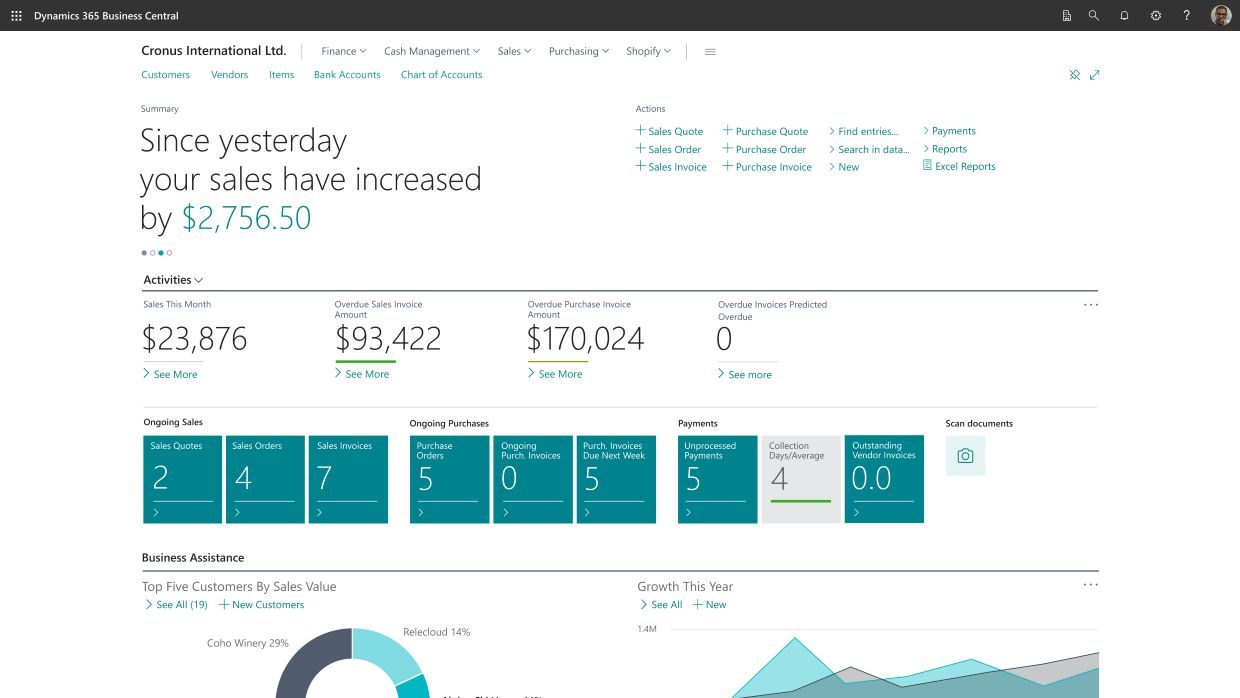
What to Look for in a Business Central Implementation Partner
This is one decision you don’t want to rush. Here are 7 things to look for and check off your list when evaluating a Business Central implementation partner:
1. Microsoft Certification and What It Means:
Microsoft's Cloud Partner Program (formerly the Microsoft Partner Network) is how you verify a partner's credentials. The current standard is the Solutions Partner for Business Applications designation. The legacy Gold certification, which Microsoft phased out in 2022, is still recognized for partners who held it.
Beyond the base designation, look for the Advanced Specialization for Small and Mid-market Business Management. That credential is specific to Business Central and requires documented successful deployments, passing technical assessments, and verified customer satisfaction scores. It's not handed out easily.
Any professional you speak with should be able to show you their current certification tier clearly. If they're vague about it, verify through Microsoft's official partner directory before going further.
2. Canadian-Specific Knowledge
This is the benchmark that gets under-weighted the most, especially when buyers are comparing Canadian firms against large international partners with impressive client lists.
A partner who primarily serves US clients will configure GST/HST differently than a Canadian-first team. They may not have built QST configurations before. They may not understand PIPEDA requirements around where your financial and HR data can live.
And if your business operates in Quebec or serves clients across both official languages, a Business Central implementation partner without real French-language capability isn't just inconvenient, it's a gap that will show up in your training materials, your support interactions, and your user adoption numbers.
The specifics matter: CRA payroll tables, ROE processing, provincial tax calculations, Nethris or Desjardins integrations. A Business Central implementation partner who has built these dozens of times brings a distinct quality of outcome than one who's doing it for the first time on your project.
3. Real Industry Experience. Not Just Claimed Expertise.
There's a difference between a Business Central implementation partner who has implemented Business Central in your industry and one who has implemented Business Central and will learn your industry on your dime.
Manufacturing has specific requirements around lot tracking, production orders, and capacity planning that a partner without that background will underestimate. Distribution needs multi-location inventory logic and automated purchasing that only reveal their complexity mid-project if the partner hasn't done it before. Professional services firms need project accounting and resource scheduling handled precisely, or the billing consequences are immediate and painful.
Ask any prospective Business Central implementation partner for 2-3 client references in your sector, specifically in Canada, and preferably within the last 24 months. A partner with genuine industry depth will produce those references without hesitation.
4. A Method That's Specific, Not Generic
Every partner will tell you that they follow a structured implementation method. What you want to understand is what that method involves.
A solid approach covers discovery, solution design, configuration, testing, training, go-live, and a hypercare period with defined deliverables and stakeholder sign-off at each stage. The discovery phase, in particular, is where future problems are either caught or planted. Someone who moves quickly through discovery, or skips a formal business process review, is setting the project up for scope creep and mid-implementation surprises.
Ask them:
- To walk you through their method step by step.
- What happens when requirements change mid-project.
- What the deliverables are at the end of each phase. If the answers are vague, that's informative.
5. Post-Go-Live Support: the Part Most Buyers Don't Evaluate Carefully Enough
Go-live is not the finish line. For most businesses, it’s where work begins.
Microsoft releases two major Business Central updates every year. Every update brings new features, changed interfaces, and occasionally deprecated functionality.
A Business Central implementation partner who helped you go live but has no structured process for managing those updates is leaving you to navigate them alone.
Ask specifically:
- What does your support model look like 90 days after go-live?
- Do you have dedicated support SLAs with defined response times?
- How do you communicate upcoming release wave changes to your clients?
- What's your client retention rate at 12 months post-implementation?
That last question is one of the most honest signals you can get. A partner with a high retention rate is delivering real, ongoing value. One that doesn't track it, or deflects the question, is telling you something.
6. The Team That Will Work on Your Project
The people who sell you the engagement and the people who deliver it are not always the same people. This is worth verifying explicitly.
Ask:
- The Business Central implementation partner who will specifically be assigned to your project.
- For their certifications and the number of similar implementations they have led.
- What happens if a key consultant leaves mid-project. Does the firm have bench depth to maintain continuity?
A smaller partner may give you more senior attention per project. A larger firm may have deeper specialization for complex enterprise needs. Neither is universally better. What matters is whether the team assigned to your account has the right depth for your specific situation.
7. How They Ask Questions
This one is harder to quantify, but it matters.
In your initial conversation, pay attention to who's doing most of the talking.
Are they asking thoughtful questions about how your business operates, your approval workflows, your multi-entity structure, your reporting needs, your seasonal demand patterns?
Or are they walking you through a slide deck about their company?
The best Business Central implementation partner for your business is one that wants to understand your situation before proposing a solution. That dynamic in the sales process is a reliable preview of how the implementation itself will feel.
Business Central Implementation Partner Red Flags
A few things that should slow you down when evaluating a Business Central implementation partner:
They lead with customization
Business Central covers the majority of SMB and mid-market needs out of the box. A partner who responds to most of your requirements with "we'll build a custom extension for that" may be generating unnecessary services revenue, and creating upgrade headaches you'll be paying for years from now.
They quote without discovering
A fixed price before a proper discovery session is a sign that the scope isn't real yet. It will become real mid-project, usually as change orders.
Their references are all international
A credible Business Central implementation partner operating in Canada should produce Canadian client references in your industry without hesitation.
They don't talk about what happens after go-live
If support is an afterthought in the sales conversation, it will be an afterthought in the relationship.
The Cost of a Business Central Implementation Partner
Most buyers don't get a realistic number until they're already in a proposal process. Here's an honest range:
A straightforward Business Central implementation for a small Canadian, business finance and basic operations, with clean data, and limited customization, typically starts around $15,000 to $30,000 CAD in implementation fees.
A mid-market deployment with manufacturing modules, multi-entity consolidation, payroll integration, and data migration from a legacy ERP can run $75,000 to $200,000 CAD or more.
Licensing is separate. Business Central Essentials runs $109 CAD per user per month. Premium is $149 CAD per user per month. Team Member licenses for read-only users are $11 CAD per user per month.
The right partner won't give you a reliable number before understanding your environment. Be appropriately skeptical of any partner who does.
Choosing the Wrong Business Central Implementation Partner is a Major Red Flag…
Getting it wrong costs everything. A 30-minute conversation with Gestisoft costs nothing.
 Free discovery call
Why Gestisoft is a Different Business Central Implementation Partner
There are excellent Business Central implementation partners in Canada. What we'd say about Gestisoft specifically is this:
We've been doing this for 29 years, through over 500 implementations across manufacturing, distribution, professional services, retail, and more. Our team of 110+ specialists supports over 6,200 users across Canada, running 220+ projects per year. We're headquartered in Montreal, we deliver in both French and English, and we understand the Canadian regulatory environment, GST/HST, QST, PIPEDA, CRA payroll, because we've been configuring Business Central around it for decades.
Our approach is built around understanding your business before we touch configuration. That sounds obvious, but really, it's the thing most implementations skip when they're under schedule pressure, and it's where most of the problems come from.
If you're evaluating Business Central and want to have an honest conversation about what your project would involve, we're available for a free consultation. No slide decks. Just a genuine conversation about your situation.
-
A Business Central implementation partner is a Microsoft-certified firm that manages the full deployment of Dynamics 365 Business Central for your organization, from needs assessment and data migration through configuration, training, and post-go-live support. They're not just reselling a license. The right Business Central implementation partner designs the system around how your business operates and stays engaged after launch to help you get ongoing value from it.
Liked what you just read? Sharing is caring.

April 29, 2026 by Conni Guido by Conni Guido Copywriter and Brand Strategist
I started with a degree in Professional Communications and never looked back. Now, I'm a professional storyteller who believes every brand has a story to tell, and every good story should leave you wanting more. You can find me lost in a book club or a writing sprint, baking words into pies...probably both.
