

If you're reading this, you've probably heard the name come up in a vendor demo, a consultant pitch, or a comparison article, and now you're trying to get a clear, no-jargon answer to one straightforward question: what is Business Central?
Here's the short version. Business Central (full name Microsoft Dynamics 365 Business Central) is Microsoft's cloud-based Enterprise Resource Planning (ERP) software designed specifically for small and mid-sized businesses. It unifies finance, sales, inventory, supply chain, project management, and operations into one platform that connects natively to Microsoft 365 (Outlook, Excel, Teams) and Microsoft Copilot AI.
That's the elevator pitch. But if you're a Canadian business owner, CFO, operations director, or IT lead trying to figure out whether Business Central is right for your company, you need more than the elevator pitch. You need to understand what it does, how it compares to what you already have (QuickBooks? Sage? NetSuite? a stack of spreadsheets?), what it costs in CAD, and how it handles the things Canadian businesses deal with: bilingual operations, GST/HST/QST, Canadian payroll, multi-currency.
So to answer, what is Business Central? Let's break it down.
What Is Business Central, Exactly?
So what is Business Central when you strip away the marketing language?
It's the modern successor to Microsoft Dynamics NAV (formerly Navision), rebuilt for the cloud and re-released in 2018 under the Dynamics 365 umbrella. Where NAV was an on-premises, IT-heavy ERP that needed servers, careful upgrades, and dedicated admins, Business Central is a Software-as-a-Service (SaaS) application that runs on Microsoft Azure, updates automatically, and is accessed through a browser, the desktop client, or mobile apps.
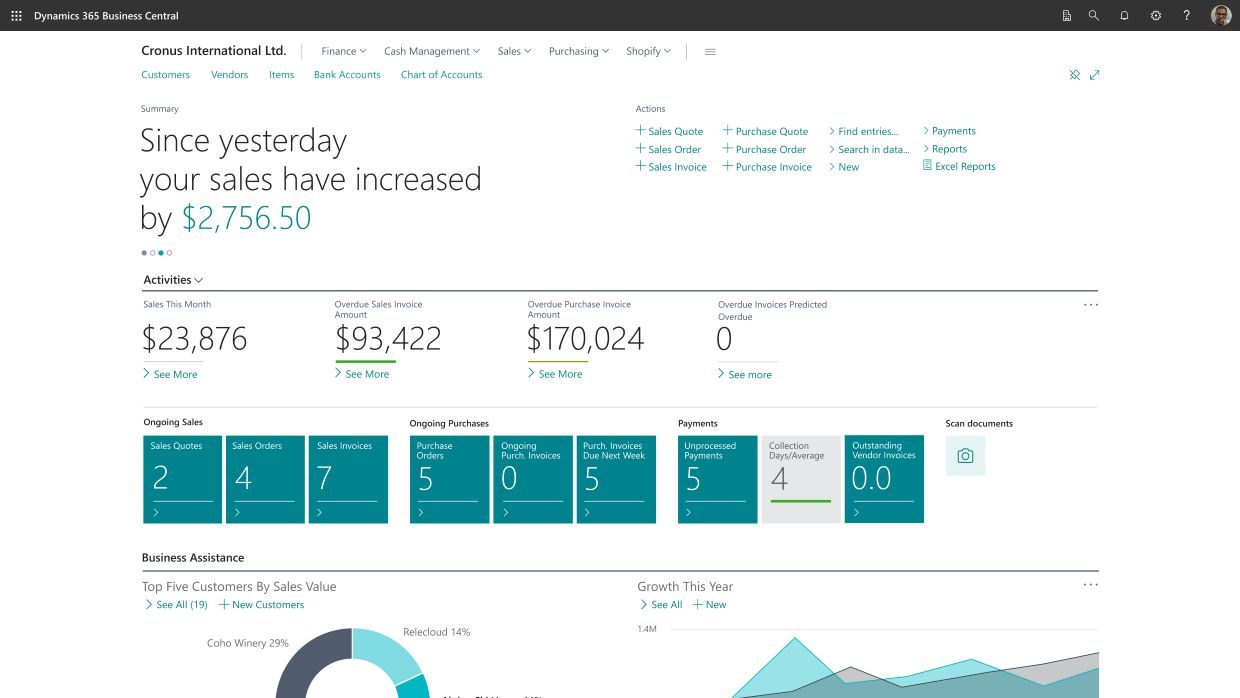
Functionally, Business Central is a single source of truth for the operational data your company runs on. Instead of having your accounting in one tool, your inventory in a spreadsheet, your purchase orders in another system, and your customer information in a third, Business Central pulls all of those records into one connected database. When a sales order is created, it automatically reserves inventory, generates the picking ticket, updates your accounting books, and surfaces the data in a Power BI dashboard. No re-keying, no syncing tools, no end-of-month reconciliation rituals.
That single-database design is the entire point. ERP software, at its core, is about replacing a stack of disconnected tools with one shared system, and what is Business Central if not Microsoft's modern answer to that need for the SMB market specifically?
If you're already using Microsoft 365, Business Central feels familiar within minutes; it's built with the same UI patterns, the same authentication, and the same Excel and Teams integration. That familiarity is one of the most underrated reasons businesses choose it. (For a deeper read on why it lands so well in this segment, see our breakdown of why Business Central fits small businesses so well.)
Not sure if Business Central is the right fit for your business?
Still asking what is Business Central? Book a free consultation today! Our team has guided Canadian SMBs through Business Central for 25+ years as a certified Microsoft Partner.
 Free discovery call
What Is Business Central Designed to Do? The Core Modules
When buyers ask what is Business Central capable of, what they're really asking is: what work does it replace?
Here are the core functional areas Business Central covers out of the box:
- Finance and accounting → General ledger, accounts payable, accounts receivable, fixed assets, bank reconciliation, cash flow forecasting, and multi-currency handling. This is the foundation — most companies start here.
- Sales and customer management → Quotes, sales orders, invoicing, customer records, and pricing rules. Native integration with Dynamics 365 Sales (CRM) extends this into a full pipeline.
- Purchasing and vendor management → Purchase orders, automated vendor payments, approvals, and EFT processing.
- Inventory and warehousing → Real-time stock levels, item tracking, multiple locations, picking and put-away, lot and serial numbers, and barcode support.
- Project management → Project budgets, time and expense tracking, work-in-progress posting, and resource allocation. Gestisoft's guide to projects in Business Central walks through this in detail.
- Manufacturing (Premium tier) → Production BOMs, routings, capacity planning, MRP, and shop floor reporting.
- Service management (Premium tier) → Service contracts, service items, dispatch, and field service workflows.
- Reporting and analytics → Built-in financial reports, native Power BI integration, and the new analysis mode that lets you pivot data without leaving the screen.
- AI and automation → Microsoft Copilot is embedded across Business Central for sales line suggestions, marketing text, bank reconciliation matching, and the late-payment prediction model.
That's a lot of ground for one platform, and that breadth is exactly the main differentiator versus point tools like QuickBooks (accounting only) or basic order management software.
What Is Business Central's History? From NAV to the Cloud
A bit of context helps because some buyers run into Business Central and assume it's a brand-new product.
Microsoft Dynamics NAV (the predecessor) has been around since 1987, originally built in Denmark by a company called Navision before Microsoft acquired it in 2002. NAV had over 110,000 customers globally at peak. In 2018, Microsoft rebranded and re-architected NAV into a cloud-first SaaS product and launched it as Dynamics 365 Business Central.
So what is Business Central in lineage terms? It's a 30-year-old ERP codebase that people have continuously refined and now deliver as modern cloud software. The underlying functional depth, especially in finance and inventory, is mature. You're not getting a v1 product written last year. You're getting decades of accounting, manufacturing, and distribution logic, packaged in a modern shell.
If you're currently running NAV, migrating to Business Central is a well-trodden path, Microsoft has end-of-life timelines for NAV, and Business Central is the official successor.
What Is Business Central's Place in the Microsoft Ecosystem?
This is one of the most important parts of understanding what is Business Central versus, say, NetSuite or Acumatica.
Business Central is one piece of the Microsoft Dynamics 365 family, which also includes:
- Dynamics 365 Sales, Customer Service, and Marketing (the CRM products)
- Dynamics 365 Finance & Operations (the enterprise-grade ERP, for companies $500M+ revenue)
- Dynamics 365 Field Service, Project Operations, and others
Business Central is the SMB ERP in that lineup. Where it gets interesting is the integration story:
- Microsoft 365 → Open a customer record in Business Central from inside Outlook, post a sales quote from inside Excel, share a report in Teams.
- Power Platform → Build automations with Power Automate, custom apps with Power Apps, and dashboards in Power BI without writing code.
- Microsoft Copilot → AI assistance inside Business Central for everything from drafting marketing text to surfacing slow-moving inventory (Copilot in Business Central guide).
- Azure Active Directory → One login across the entire stack.
Compare this to choosing a standalone ERP (say, Odoo or NetSuite) and you're either replicating Microsoft's stack inside that vendor's ecosystem or living with a permanent integration tax. For businesses already on Microsoft 365 (which is most of Canadian SMB), Business Central is the path of least friction.
What Is Business Central Like for Canadian SMBs?
Here's where most "what is Business Central" articles fall short. They explain the product, but they don't explain how it lands in a Canadian context, and Canada has enough specificity.
Bilingual Operations
Business Central supports French and English natively, with bilingual invoicing, document layouts, and user interface. For Québec-based companies, or any business with a French-speaking customer base, this is non-negotiable, and Business Central handles it without third-party add-ons.
Canadian Sales Tax Handling
GST, HST, PST, and Québec's QST are not afterthoughts in Business Central. The system supports proper tax groups, reverse charges, and the ability to handle businesses operating across provinces with different tax rules. Built-in workflows handle CRA-compliant reporting and remittance.
Multi-Currency (CAD/USD)
Most Canadian SMBs deal with US suppliers or customers. Business Central handles dual-currency posting cleanly, with daily exchange rate updates and proper FX gain/loss accounting.
Canadian Payroll Integration
Business Central does not include native Canadian payroll, but it integrates with Canadian-specific payroll providers (e.g., ADP Workforce Now, Ceridian Dayforce, Payworks) so payroll data flows back into the GL.
Canadian Microsoft Partners
Business Central is sold and implemented by Microsoft Partners, not by Microsoft directly. That means the implementation experience depends heavily on the partner you choose. A Canadian Business Central partner brings local tax expertise, bilingual support, and time zone-aligned project teams, all of which matter once you're past go-live and into year-one usage.
In Gestisoft's experience, Canadian SMBs migrating from QuickBooks Online or Sage 50 to Business Central typically consolidate 4–6 disconnected tools into one platform: accounting, inventory spreadsheets, a separate purchase-order tool, a CRM, a reporting/dashboard add-on, and often a manual project-tracking workbook. That consolidation is usually where the ROI shows up first.
Wondering how Business Central would run in your business?
Get a tailored walkthrough from a Gestisoft consultant. We'll map Business Central modules to your real processes: finance, inventory, sales, projects, ops.
 Free discovery call
What Is Business Central's Pricing Model?
Pricing is one question buyers ask immediately after what is Business Central, so let's address it directly.
Business Central is sold per named user per month under three licensing tiers (prices in USD, billed in CAD by Canadian partners, confirm current rates with your partner since Microsoft updates them periodically):
- Team Members (~$8 USD/user/month) → read-only plus light data entry. Good for staff who only consume reports or approve transactions.
- Essentials (~$70 USD/user/month) → full access to finance, sales, purchasing, inventory, project management, and basic warehousing. Most users sit here.
- Premium (~$100 USD/user/month) → Essentials plus manufacturing and service management modules. Required for companies that produce or service.
There are no setup fees from Microsoft, but implementation is a separate professional services line item. Implementation costs vary dramatically based on company complexity, Gestisoft's breakdown of Business Central implementation cost gives a realistic range for Canadian mid-market projects.
So what is Business Central going to cost you over year one? A small business with 10 Essentials users runs roughly CAD $11,000–$12,000 in licensing per year, plus implementation (typically CAD $25,000–$80,000 for SMBs depending on scope). For most companies, that's offset within 12–24 months by the tools and manual work it eliminates.
How to Know if Business Central Is Right for Your Business
Now that you’re aware, the real question isn’t what is Business Central? Or what it costs. The real question becomes, is it right for your business?
Business Central is likely a strong fit if:
- You're between $1M and $300M in annual revenue. Below $1M, the licensing cost is hard to justify versus QuickBooks. Above $300M, you should be evaluating Dynamics 365 Finance & Operations instead.
- You're already on Microsoft 365. The integration depth makes the experience radically smoother.
- You've outgrown your current accounting tool. If you're hitting the ceiling on QuickBooks, Sage 50, FreshBooks, or Xero — meaning you need real inventory, multi-entity, project costing, or workflow approvals — Business Central is the natural next step. (See Business Central vs QuickBooks, Xero & FreshBooks for a head-to-head.)
- You're using disconnected tools that need to talk to each other. If your team is exporting CSVs, copy-pasting between systems, or maintaining the same data in three places, Business Central's unified database directly solves that pain.
- You operate in Canada and need bilingual + Canadian tax compliance. Business Central handles this natively where many US-built ERPs treat Canada as an afterthought.
“The software is our working tool. With our previous solution, it was like having a stone hammer. We could accomplish our tasks, but the tool was outdated. With Business Central, if we decide to move into the Industrial 4.0 era, it’s possible. We now have an up-to-date solution that meets our needs. We’ve really taken a step forward, and we can see all the possibilities we could do in the future.”
Business Central is likely not the right fit if:
- You're a service-only consultancy with simple billing, QuickBooks Online may be enough.
- You're an enterprise with massive transaction volumes or 1,000+ ERP users, look at F&O.
- You need extremely industry-specific functionality (e.g., process manufacturing, pharma, large-scale retail POS), those are usually better served by industry verticals or a specialized add-on layered on Business Central.
Get the 10 Key ERP Selection Criteria
A practical guide that walks you through what to evaluate when choosing an ERP — built from 25+ years of Gestisoft implementation experience with Canadian SMBs.

What Is Business Central Replacing? Common "Before" States
If you're wondering what Business Central typically replaces in Canadian SMBs, here are the three most common "before" states:
- The QuickBooks/Sage starter stack. Accounting is fine, but inventory lives in Excel, purchase orders are manual, and reporting is fragile. The QuickBooks-to-Business-Central migration path is the most common in Canadian SMB.
- A legacy NAV or GP installation. Solid functionality but on-premises, IT-heavy, and aging. The NAV migration guide and GP-to-Business-Central comparison lay out the considerations.
- A patchwork of SaaS tools. A CRM, an accounting tool, a project tracker, an inventory app, and a BI dashboard, each from a different vendor, each with its own admin. The pain isn't any single tool; it's the integration tax.
If any of those sound familiar, that's exactly the situation Business Central was built to fix.
What is Business Central in One Sentence?
Let's bring it home. What is Business Central? It's Microsoft's cloud ERP for small and mid-sized businesses, a single connected system for finance, inventory, sales, purchasing, projects, and operations, deeply integrated with Microsoft 365 and Copilot, and well-suited to Canadian SMBs that need bilingual capability and proper Canadian tax handling.
If you've been wondering what is Business Central going to do for a company like yours, the honest answer is: it depends on where you're starting from. For a $5M Canadian distributor stuck on QuickBooks plus spreadsheets, it's transformative. For a $400M enterprise, it's probably the wrong size of tool. The decision framework above should give you a quick read on where you fit.
When you're ready to look at it seriously, the next steps are straightforward: get a real walkthrough mapped to your processes (not a generic demo), get a transparent implementation quote from a Canadian Microsoft Partner, and use the 10 ERP selection criteria guide above to validate the choice against alternatives.
The shortest answer to what is Business Central, the one we'd give in an elevator, is this: it's the connected business platform Canadian SMBs reach for when spreadsheets and starter accounting tools have stopped scaling. And once you've moved past asking what is Business Central, and started asking how to roll it out, you've already made the most important decision.
Ready to take the next step with Business Central?
Whether you're sizing up an ERP for the first time or migrating off QuickBooks or NAV, our team can scope your project in one conversation, no commitment required.
-
Business Central is used to manage finance, accounting, inventory, sales, purchasing, project management, and operations in one cloud-based platform. SMBs use it to replace fragmented tools like QuickBooks plus spreadsheets plus a separate inventory app, with everything running in a single connected database.
Explore More
- What makes Business Central such a good fit for small businesses? — A deeper look at why SMBs specifically benefit from Business Central's design.
- 15 Best Business Central Alternatives for 2025 (Ranked & Compared) — If you want to validate what is Business Central against the field, start here.
- NetSuite vs. Dynamics 365 Business Central — The most common head-to-head SMB ERP comparison.
- Business Central Partner: Definition, Benefits, Services — How to choose the right Canadian Microsoft Partner for your implementation.
- ERP Implementation Cost for Mid-Market Businesses Using Dynamics 365 Business Central — Realistic budget expectations for a Canadian SMB rollout.
Liked what you just read? Sharing is caring.

May 21, 2026 by Conni Guido by Conni Guido Copywriter and Brand Strategist
I started with a degree in Professional Communications and never looked back. Now, I'm a professional storyteller who believes every brand has a story to tell, and every good story should leave you wanting more. You can find me lost in a book club or a writing sprint, baking words into pies...probably both.
