
Managing cash flow is one of the most critical financial processes for any organization. Whether you operate a mid-market business or a fast-growing SMB, understanding your liquidity position—today and in the coming weeks—is essential for maintaining solvency, planning investments, and anticipating potential shortages. The cash flow forecast in Business Central offers a powerful, integrated way to visualize future cash movements and make informed decisions with confidence.
In this guide, we walk through everything you need to know about the cash flow forecast in Business Central—from data sources to setup, Azure AI integration, best practices, and common mistakes to avoid. You’ll also find a step-by-step demo video early in the article to help you get started quickly.
Demo – How to create a cash flow forecast in Business Central?
If you’re new to cash flow forecasting in Business Central, watching the demo first will give you a practical foundation for the detailed explanations that follow.
What is the cash flow forecast in Business Central?
At its core, the cash flow forecast in Business Central is a forward-looking financial tool that models expected cash inflows and outflows across your organization. It considers a mix of historical data, open transactions, budget information, and—if enabled—machine learning from Azure AI to project your future liquidity position.
This feature helps you:
- Assess whether your business can meet its financial obligations
- Detect cash surpluses or deficits before they occur
- Make proactive decisions regarding borrowing, investing, or adjusting spending
- Improve long-term financial planning
- Respond to seasonal or cyclical variations in cash flow
Unlike manual spreadsheets or disconnected tools, Business Central centralizes all relevant data and updates forecasts automatically based on your real-time operational activity.
Book a free consultation session with our experts today
Contact our team for more details on Business Central and our other Microsoft solutions including CRM, Copilot, Microsoft 365 and more.
 Free discovery call
How the cash flow forecast works in Business Central?
Business Central aggregates data from a wide range of operational and financial sources to calculate a detailed projection of your future cash position. What sets the system apart is its flexibility—you decide which sources to include and how each one impacts the forecast.
All supported data sources
Business Central allows you to build a highly accurate projection by pulling from several distinct areas of the system:
- Receivables – Expected customer payments based on open customer ledger entries
- Payables – Forecasted vendor payments from open vendor ledger entries
- Liquid funds – Cash and bank accounts
- Manual revenues and expenses – One-time or ad-hoc cash movements
- Sales orders – Pending customer sales that will convert into future cash
- Purchase orders – Commitments for upcoming vendor payments
- Fixed assets budgets and disposals – Planned capital expenditures and asset sales
- Service orders – Scheduled operations that impact cash inflow/outflow
- G/L budgets – Planned financial activity from your budgeting process
- Jobs/Projects – Ongoing project-related revenues and costs
- Taxes – Tax liabilities and payment schedules
- Azure AI Forecast – Machine-learning-based predictions from historical data
Including all relevant sources ensures you get a comprehensive and realistic view of upcoming cash activity.
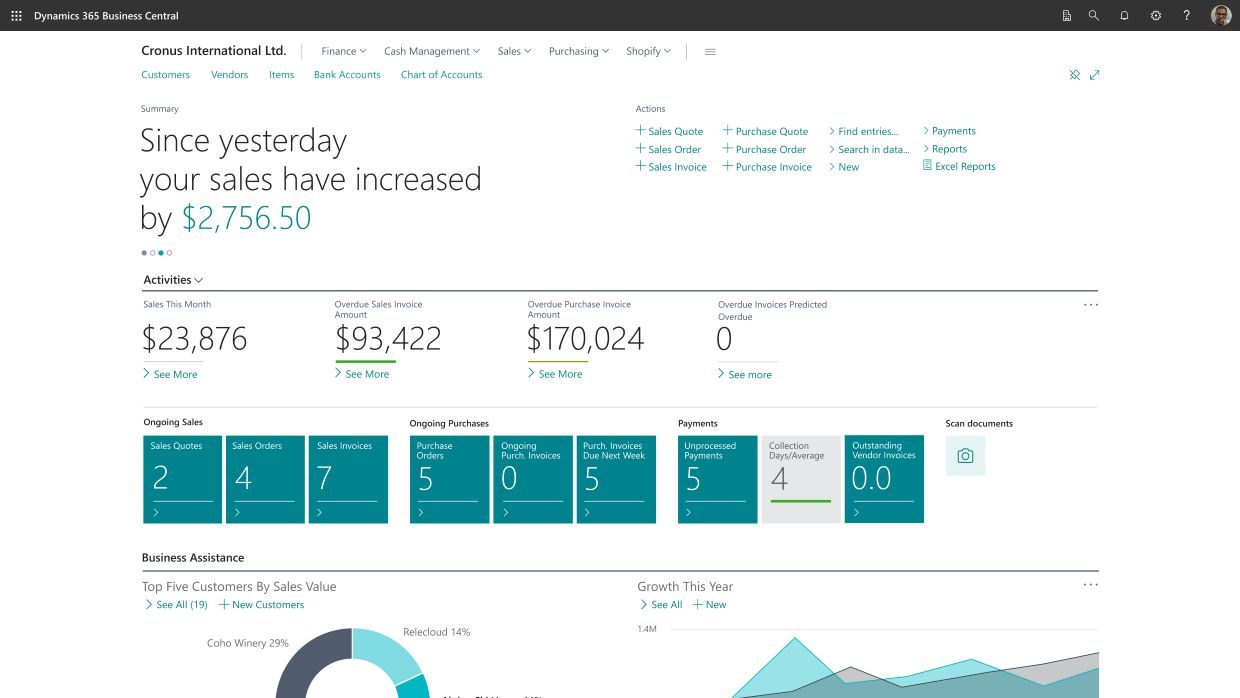
Forecasting periods in Business Central
Business Central gives you full control over how forecasts are structured. You can forecast on:
- A daily basis (ideal for cash-sensitive businesses)
- A weekly basis (common for SMBs and operational teams)
- A monthly basis (useful for long-term planning and financial reporting)
Periods can span short-term tactical needs or extend into multi-month strategic projections.
Cash flow accounts
Cash flow accounts in Business Central serve as the framework for organizing forecast data. Think of them as a parallel structure to your general ledger—but designed specifically for liquidity planning.
Their roles include:
- Categorizing incoming and outgoing cash activities
- Grouping forecast data into meaningful financial segments
- Defining how specific sources (receivables, payables, taxes, etc.) map into the forecast
Business Central supports several account types:
- Entry – Standard detail lines
- Heading – Labels used for grouping
- Total – Summarizes ranges
- Begin-Total / End-Total – Defines calculation ranges
Each account must be mapped to a Source Type to determine the type of cash movement it represents.
You can also configure G/L Integration, which determines how account balances influence the forecast:
- Balance – Pulls real-time G/L account balances
- Budget – Pulls budget entries
- Both – Combines current balance and budgeted transactions
A G/L Account Filter can be added to limit the scope to a specific set of accounts, giving you fine control over what flows into your cash flow forecast.
How much can you save with Business Central?
Download your free Excel calculator to discover the ROI you can expect when you implement Business Central today.

How to set up cash flow forecasting in Business Central?
Setting up the cash flow forecast in Business Central is easy and quick. These configurations ensure accurate calculations and help the system pull the right information from each financial component.
Step 1 — Set up the chart of cash flow accounts
The chart of cash flow accounts is the backbone of the entire forecasting system. It dictates how forecast entries are categorized and displayed.
To create these accounts:
- Go to Search → Chart of cash flow accounts.
- Select New.
- Fill in the No. and Name fields (structure them logically).
- Set the Account Type (Entry, Heading, Total, etc.).
- Choose a Source Type (Receivables, Payables, G/L Budget, Taxes, etc.).
- If needed, configure G/L Integration.
- Add a G/L Account Filter to specify the accounts used for balance or budget figures.
You must create at least one account for each source you intend to include in the forecast. Organizing these accounts properly ensures clarity and accuracy when generating and analyzing the forecast.

Step 2 — Create cash flow payment terms
Standard payment terms aren’t always enough for forecasting. Cash flow payment terms let you apply alternate payment expectations to customers or vendors—especially valuable if certain partners consistently pay early or late.
To set payment terms for a customer:
- Open the Customer Card.

- Go to the Payments FastTab.
- Select Show more.

- Fill in the Cash Flow Payment Terms Code field.

Payment terms can drastically affect the timing of cash inflows or outflows, making them a critical piece of an accurate forecast.
Step 3 — Configure the Cash Flow Setup page
The Cash Flow Setup page centralizes all parameters needed for ongoing forecasting.
Here’s what you can configure:
Automatic Update Frequency
Determines how often the system recalculates the forecast:
- Never
- Daily
- Weekly
Accounts FastTab
Allows you to assign default accounts for:
- Sales
- Purchases
- Fixed assets
- Jobs
- Taxes
These mappings influence how Business Central will classify and display forecasted activities.
Cash Flow Forecast No. Series
Defines the numbering format for forecast records.
Taxable Period & Tax Payment Window
These fields control:
- How often tax liabilities are calculated
- When tax payments are due relative to the end of each tax period
This directly impacts cash outflows—especially for businesses with significant tax obligations.
Azure AI Setup
You can manually configure Azure AI here, though most users prefer the guided assisted setup. Once activated, AI becomes a powerful forecasting source that learns from your historical G/L patterns.

Azure AI cash flow forecasting: how it enhances accuracy
One of the most advanced capabilities of the cash flow forecast in Business Central is its integration with Microsoft Azure Machine Learning.
Azure AI helps improve forecasting accuracy by:
- Learning from historical cash movements
- Identifying recurring patterns
- Predicting seasonality
- Modeling fluctuations based on past behaviors
- Automatically updating forecasts without manual data entry
Where AI shines
Azure AI produces the best results when:
- You have at least 6–12 months of clean financial data
- Your business has recurring billing or predictable cycles
- Transaction volume is high enough for statistical interpretation
Limitations to consider
While powerful, AI is not a replacement for financial oversight.
Accuracy depends on:
- Clean data
- Sufficient historical information
- Proper configuration of cash flow accounts and source types
For many users, combining traditional forecasting with Azure AI yields the strongest results.
Using the Cash Flow Forecast Worksheet
Once all setup steps are complete, the Cash Flow Forecast Worksheet becomes your central workspace for generating and reviewing forecasts.
Generate the forecast
- Select the sources you want to include
- Identify the forecasting period
- Let the system calculate upcoming inflows and outflows
- Review manual adjustments if needed
Run “what-if” scenarios
The worksheet allows you to simulate different possibilities, such as:
- A customer paying late
- Delaying a purchase order
- Adding a one-time large expense
- Investing in new equipment
- Upsizing or downsizing planned jobs
Scenario modeling is invaluable for CFOs and controllers who must plan for best-case and worst-case outcomes.
Review results in charts and reports
Business Central offers several visualization methods:
- Role Center charts
- Detailed tables and ledger views
- Financial Reports
- Power BI dashboards for deeper insight
Power BI, in particular, gives finance teams advanced trend analysis, drill-throughs, and visual forecasting capabilities.
Want more information about Business Central and its functionalities?
Contact our team for a free consultation to find out what Business Central can accomplish more for your business.
 Free discovery call
Best practices for accurate cash flow forecasting in Business Central
To get reliable projections, consider adopting the following best practices:
- Keep receivables and payables updated: Overdue invoices or unposted vendor bills distort future projections.
- Review payment terms regularly: Ensure your cash flow payment terms reflect actual partner behavior—not just contractual obligations.
- Update G/L budgets monthly: Budget accuracy directly influences long-term forecasting.
- Add manual revenue or expense entries when needed: Business Central supports ad-hoc adjustments, which are critical for one-time costs, rare cash inflows and capital investments.
- Enable automatic updates: Weekly or daily updates ensure the forecast reacts to operational activity.
- Use Azure AI for enhanced precision: If your historical data is clean, AI offers strong predictive capabilities.
- Visualize your forecast with Power BI: Helps contextualize patterns and identify potential bottlenecks before they occur.
Common mistakes companies make with cashflow forecast in Business Central (and how to avoid them)
Even with a powerful forecasting engine, poor setup or maintenance leads to inaccurate projections. Watch out for these common issues:
1. Not mapping all required cash flow accounts
Missing accounts results in incomplete or misleading forecasts.
2. Incorrect G/L filters
Filters determine which balances flow into forecasting. One incorrect filter can distort results significantly.
3. Forgetting to configure tax payment schedules
Taxes often represent large periodic outflows—ignoring them leads to unrealistic forecasts.
4. Relying on outdated budgets
Budgets should be living documents, especially during volatile periods.
5. Not enabling automatic updates
Manual updates allow gaps to form between actuals and forecasted movements.
6. Under-using what-if scenarios
Scenario planning helps prevent surprises and prepare for variability.
Why work with a Business Central partner for cash flow forecasting?
While Business Central’s forecasting tools are powerful, proper setup and ongoing optimization are essential for accuracy. Working with a certified partner like Gestisoft ensures:
- Clean, structured cash flow accounts
- Comprehensive source mapping
- Accurate G/L integration
- Correct configuration of tax windows and payment terms
- Proper Azure AI enablement
- Custom Power BI dashboards for deeper cash insight
- Training for finance teams
- Ongoing support and optimization
At Gestisoft, our experts help you configure Business Central for real-world financial planning—not theoretical models.
Book a consultation with our Business Central experts to optimize your cash flow forecasting setup.
-
You set up cash flow accounts, configure payment terms, define sources in the Cash Flow Setup page, and then generate the forecast through the Cash Flow Forecast Worksheet.
Conclusion
The cash flow forecast in Business Central is a powerful tool for any finance team aiming to maintain control over liquidity and plan confidently for the future. By combining operational data, G/L budgets, and Azure AI intelligence, Business Central provides financial leaders with a clear, actionable view of upcoming cash inflows and outflows.
With proper configuration—and support from a knowledgeable partner like Gestisoft—you can turn cash flow forecasting into a strategic asset that empowers smarter decision-making and long-term financial stability.
Liked what you just read? Sharing is caring.

November 25, 2025 by Kooldeep Sahye by Kooldeep Sahye Inbound Marketing Manager
Specializing in SEO-driven pipeline growth, I combine keyword strategy, content optimization, and inbound tactics to turn organic search into a reliable source of qualified leads. I work at the intersection of traditional SEO and AI search — optimizing for LLMs and AI Overviews alongside Google — pairing data-informed strategy with sharp, story-led copywriting.