

The Dynamics GP vs Dynamics 365 Business Central decision is one of those questions that looks simple until you actually dig into it.
Both are Microsoft ERP platforms built for small and mid-sized businesses. Both handle core financials, inventory, purchasing, and operations. So when a Canadian business asks which one they should be on, the answer isn't a features checklist. It depends on where your business is today, what you're carrying from years on GP, and what the next five years actually demand from your ERP.
Get the Dynamics GP vs Dynamics 365 Business Central decision wrong, and the consequences go beyond the invoice. Stay on GP longer than you should and you'll be migrating under deadline pressure, competing for partner availability with every other Dynamics GP customer in Canada who left it too late. Rush to Business Central without the right preparation and you end up paying for a system that isn't built around how you actually work.
At Gestisoft, we've had this conversation with Canadian businesses for over 29 years, through over 500 ERP implementations from coast to coast. This guide reflects what that experience has taught us. Not a spec sheet comparison, but an honest look at what the Dynamics GP vs Dynamics 365 Business Central question really involves.
Dynamics GP vs Dynamics 365 Business Central: What Each Platform Actually Is
Microsoft Dynamics GP (originally Great Plains) has been the backbone of financial management for Canadian SMBs since the 1990s. It's an on-premise ERP built around a strong accounting core: general ledger, accounts payable and receivable, fixed assets, multi-currency, Canadian payroll, and manufacturing. Businesses that have been running Dynamics GP for a decade or more have often built significant processes around it and come to rely on workflows that, mostly, work exactly as designed.
The honest thing to say about Dynamics GP is that it has been genuinely reliable. The reason the Dynamics GP vs Dynamics 365 Business Central conversation is happening isn't because GP stopped working. It's because Microsoft decided it's time to move on. New license sales have ended. A retirement date is set. And the clock is running.
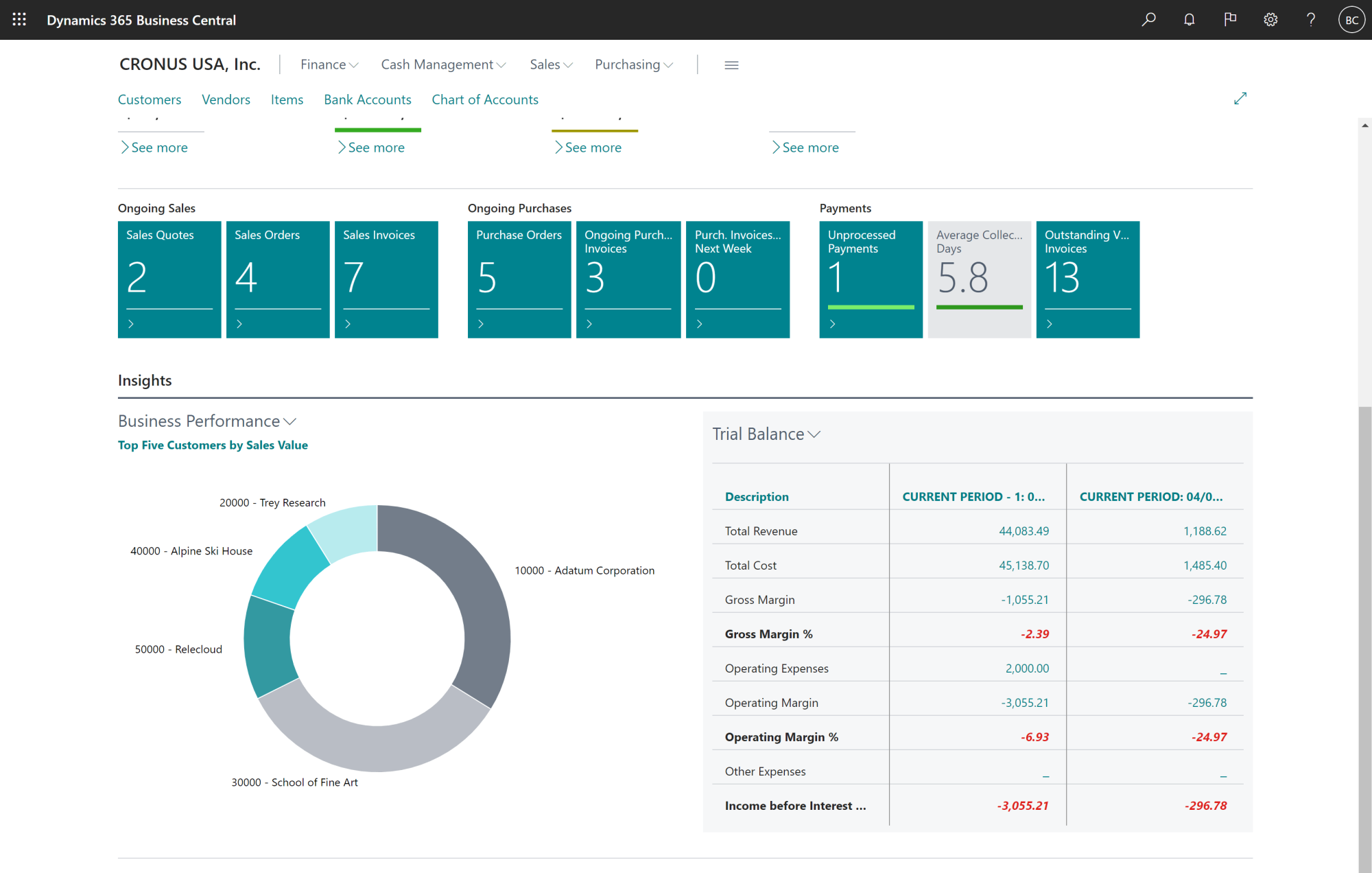
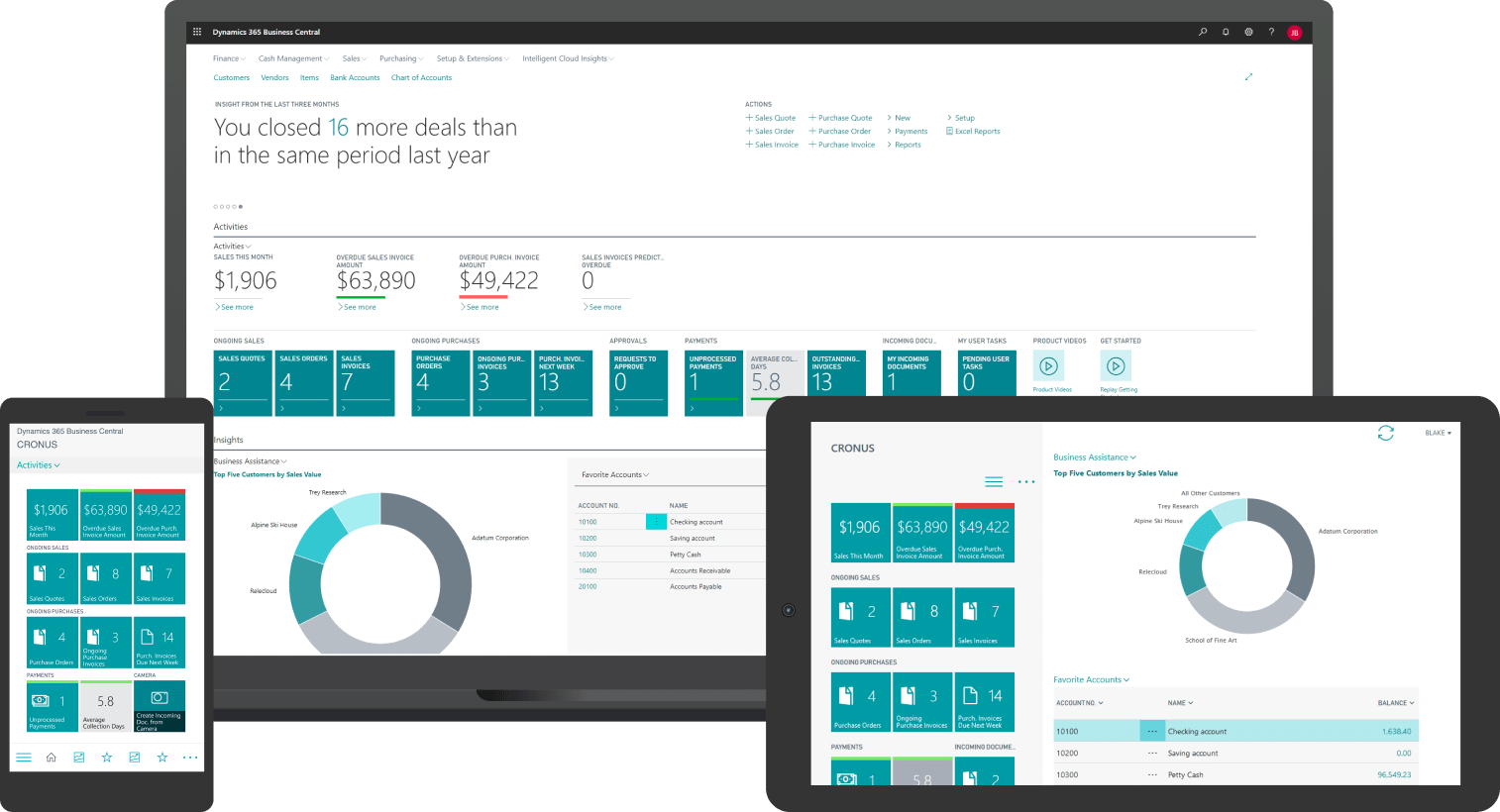
Dynamics 365 Business Central is Microsoft's cloud ERP, released in 2018 and built from the ground up for the cloud, not retrofitted to it. Microsoft Azure hosts it, Microsoft provides automatic updates twice a year, and Microsoft licenses it as a true SaaS product. Microsoft handles infrastructure, security, and backups. There are no upgrade projects, no server maintenance windows, and no version compatibility headaches. For a Canadian business already running Microsoft 365, Dynamics 365 Business Central sits inside the same ecosystem: Outlook, Teams, Excel, Power BI, with connections that work out of the box.
The simplest summary of the Dynamics GP vs Dynamics 365 Business Central difference is this:
- With Dynamics GP, you manage your ERP infrastructure
- With Dynamics 365 Business Central, Microsoft does
The right Dynamics GP vs Dynamics 365 Business Central decision starts with the right conversation
Feeling overwhelmed? Want to make a decision but prefer to go over all of your options first? A Gestisoft representative is available now for a free consultation to help start the conversation of Dynamics GP vs Dynamics 365 Business Central.
 Free discovery call
What the Dynamics GP vs Dynamics 365 Business Central comparison looks like side by side
This chart is a sneak peek of what you get between Dynamics GP vs Dynamics 365 Business Central so you can make the best choice for you.
Architecture
- Dynamics GP: You have on-premise (legacy cloud IaaS)
- Dynamics 365: You have cloud-native SaaS (on-premise option available)
Hosting
- Dynamics GP: You manage the servers
- Dynamics 365: Microsoft manages Azure hosting
Updates
- Dynamics GP: you schedule and pay for upgrades manually
- Dynamics 365: Microsoft pushes updates twice a year automatically
Licensing Model
- Dynamics GP: You have perpetual licensing or subscription for existing customers only
- Dynamics 365: Offers a subscription-based model
Starting Price (CAD)
- Dynamics GP: Starts around ~$6,200 (perpetual for 3 users)
- Dynamics 365: Starts at ~$109/user/month
Canadian Payroll
- Dynamics GP: Has built-in Canadian payroll
- Dynamics 365: Offers Canadian payroll via third-party apps on AppSource
AI/Copilot
- Dynamics GP: Does not offer AI/Copilot
- Dynamics 365: Offers built-in AI/Copilot
Microsoft 365 Integration
- Dynamics GP: Requires configuration
- Dynamics 365: Native, minimal effort
Support End Date
- Dynamics GP: Ends December 31, 2029
- Dynamics 365: Active development, no end date
New Sales:
- Dynamics GP: Ended April 1, 2026
Dynamics 365:Fully available
Dynamics GP vs Dynamics 365 Business Central: Where the Features Actually Differ
Both platforms cover the core financial suite: general ledger, accounts payable and receivable, bank reconciliation, fixed assets, multi-currency, and intercompany processing. For most Canadian SMBs, both are capable. The Dynamics GP vs Dynamics 365 Business Central feature comparison gets more interesting where they diverge.
How Your Financial Data is Structured
- Dynamics GP builds financial structure into the account number itself; department, cost centre, and project codes are all baked into a segmented chart of accounts.
- Dynamics 365 Business Central uses dimensional accounting, where transactions are tagged with dimensions that sit independently from the account number. The result is that you can run reports across any combination of dimensions without restructuring your entire chart of accounts.
For businesses that have spent years working around GP's segment limitations, this shift alone is a significant improvement.
Canadian Payroll
- Dynamics GP has built-in Canadian payroll: T4s, ROEs, CRA remittances, and provincial tax calculations. It's one of GP's genuine strengths.
- Dynamics 365 Business Central doesn't include payroll natively, but mature Canadian payroll applications are available through Microsoft AppSource, including Ceridian Dayforce, ADP, and Nethris.
Gestisoft has handled this transition for dozens of Canadian clients. It's a solved problem; it just needs to be planned for.
Reporting and Analytics
- Dynamics GP relies on Management Reporter for financial reporting. It works, but changing a report requires IT involvement.
- Dynamics 365 Business Central connects natively to Power BI, so finance teams can build and update dashboards themselves without waiting on a developer. For businesses where reporting is slow because every change goes through IT, this is a practical day-to-day improvement.
AI and Copilot
- Dynamics GP has no AI capabilities.
- Dynamics 365 Business Central includes Microsoft Copilot built directly into the platform, summarizing customer history, drafting follow-up emails, suggesting inventory replenishment, reconciling bank statements.
As Microsoft continues investing in Copilot, the gap between Dynamics GP and Dynamics 365 Business Central in this part of the Dynamics GP vs Dynamics 365 Business Central comparison will widen with every release.
Dynamics GP vs Dynamics 365 Business Central: What Canadian Businesses Actually Pay
Pricing comparisons in the Dynamics GP vs Dynamics 365 Business Central space are often shown in USD, or without accounting for the full cost of staying on Dynamics GP. Here's what the numbers look like in Canadian dollars.
Dynamics GP's perpetual licensing starts at approximately $6,200 CAD for a three-user starter pack, with additional full users at roughly $3,100 CAD each. That's followed by an annual maintenance fee of 19-20% of the original license value every year. Cloud hosting through IaaS adds $300 to $800 or more per month. And every major Dynamics GP version upgrade requires a partner engagement. Budget $5,000 to $20,000 CAD, depending on how customized your environment is.
Dynamics 365 Business Central Essentials is $109 CAD per user per month. Business Central Premium is $149 CAD per user per month. Team Member licenses, for users who only need read access, are $11 CAD per user per month. Hosting and updates are both included. There are no upgrade fees.
For a business with 10+ on Dynamics 365 Business Central Essentials, licensing runs approximately $13,080 CAD per year with no server costs, no upgrade bills, and no maintenance surprises.
For Dynamics GP, that same business is likely paying $3,000 to $6,000 per year in maintenance fees alone, before hosting, and before the next upgrade engagement. Over five years, the Dynamics GP vs Dynamics 365 Business Central total cost comparison is often much closer than Dynamics GP users expect, and in many cases, Dynamics 365 Business Central comes out lower.
Microsoft's Bridge to Cloud 3 promotion makes the move even more financially straightforward for Dynamics GP customers who are ready. It offers a 30% discount on Dynamics 365 Business Central licensing for a three-year term, plus the ability to run both at the same time during your transition. It runs through the end of 2027. Ask your Gestisoft advisor whether you qualify.
Dynamics GP vs Dynamics 365 Business Central: Four Signals That Mean it's Time to Move
Not every Canadian business needs to migrate immediately, and we'd rather give you an honest read of your situation than push you toward a project that isn't right for your timing. That said, four signals in the Dynamics GP vs Dynamics 365 Business Central decision consistently mean the window for a well-managed migration is closing:
1. Your Dynamics GP Version is Falling Behind
If your environment is two or three releases behind the current version, you're already carrying risk. Staying current on Dynamics GP is a requirement for receiving tax updates and support. Businesses on older versions may already be past their support date without realizing it.
2. Your Team is Struggling with GP's On-Premise Model
Remote and hybrid work exposed a long-standing truth about Dynamics GP: developers designed the software for users who worked in the same building as the server. Dynamics 365 Business Central is accessible from any browser on any device. For businesses where the workforce has permanently shifted, this isn't a feature preference; it's a daily operational problem.
3. Your IT Team is Spending Too Much Time on Dynamics GP Infrastructure
Server patching, backup management, compatibility testing, performance troubleshooting; for businesses without a dedicated IT function, this overhead lands on people whose time is better spent elsewhere. The Dynamics GP vs Dynamics 365 Business Central comparison looks different when you account for what maintaining an on-premise environment actually costs internally.
4. You've Outgrown Dynamics GP's Reporting and Multi-Entity Capabilities.
Dynamics GP's segmented account structure works well within its limits. When businesses add entities, expand into new regions, or need consolidated reporting across structures that weren't designed together, workarounds accumulate fast. Business Central's dimensional accounting and native Power BI integration handle exactly this kind of complexity.
The Dynamics GP vs Dynamics 365 Business Central retirement timeline every Canadian business needs to understand
If the four signals above resonated, this section turns consideration into urgency.
Microsoft's retirement timeline for Dynamics GP has four milestones. New perpetual license sales ended April 1, 2025. New subscription sales ended April 1, 2026. Mainstream support: Product updates, regulatory patches, tax table updates, and technical support, ends December 31, 2029. Security patches end on April 30, 2031.
For Canadian businesses, the December 31, 2029 date carries specific weight. After that point, there will be no further CRA payroll updates, no GST/HST reporting changes accommodated, and no provincial tax table releases. A business running Canadian payroll through Dynamics GP after 2029 is running it on 2029 rules, regardless of what CRA actually requires. That's not a theoretical risk. It's a compliance problem that affects every payroll run from January 2030 onward.
Here's what waiting too long actually looks like in practice:
- A mid-sized Canadian manufacturer decides in mid-2028 that it's finally time to move.
- They contact their Dynamics GP partner, only to find they've shifted focus to Dynamics 365 Business Central and can't start a new migration until Q1 2029.
- They find another partner, kick off the project, and six months in they're testing a half-configured system under pressure with a December deadline that isn't moving.
- Go-live happens on time, but the system isn't right.
- The next twelve months are spent fixing what a calmer, better-planned migration would have gotten right the first time.
That scenario plays out when businesses treat 2029 as the start date rather than the end date. A typical Dynamics GP vs Dynamics 365 Business Central migration takes four to nine months. If you intend to be off Dynamics GP before December 2029 and you haven't started planning, the window is narrower than it looks.
Don’t Wait to Decide Between Dynamics GP vs Dynamics 365
If you’re considering migrating from Dynamics GP to Dynamics 365 Business Central, don’t wait! A Gestisoft representative can help guide you today in a free consultation.
 Free discovery call
Dynamics GP vs Dynamics 365 Business Central: What Happens to Your Dynamics GP Add-ons
The add-on question is the one we hear most from Canadian businesses working through the Dynamics GP vs Dynamics 365 Business Central decision. Dynamics GP's ecosystem is deep, and many businesses have built real functionality into third-party tools that run alongside it. The concern is legitimate.
Most common Dynamics GP add-ons have mature Business Central equivalents. Canadian payroll moves to AppSource applications from Ceridian Dayforce, ADP, or Nethris. Jet Reports carries across to a Business Central version from the same vendor. Management Reporter is replaced by Business Central's built-in financial reporting tools and Power BI. Document management moves to native SharePoint integration. Project Accounting becomes Business Central's Jobs module. Analytical Accounting, one of the most frequently asked-about Dynamics GP add-ons, is replaced by Dynamics 365 Business Central's Dimensions functionality, which most clients find more capable once they've worked with it.
Some add-ons require more evaluation, particularly in manufacturing. The honest answer is that the mapping isn't always one-to-one, and assuming everything will transfer cleanly is one of the most common mistakes businesses make going into a Dynamics GP vs Dynamics 365 Business Central migration.
Gestisoft conducts a full add-on assessment at the start of every migration engagement, before project scope is defined, before timelines are set, and before a single line of data is moved. Knowing exactly what you're working with upfront is what prevents surprises mid-project.
Getting the Dynamics GP vs Dynamics 365 Business Central decision right with Gestisoft
There are many Microsoft partners who can implement Business Central. The Dynamics GP vs Dynamics 365 Business Central migration is a different kind of engagement, it requires understanding the environment you're leaving, not just the platform you're moving to.
Gestisoft has supported Canadian GP customers for over 25 years. We know Dynamics GP environments, the modules, the add-ons, the reporting structures, and the customizations because we've helped build and maintain many of them. That history means a faster, lower-risk migration because the assessment phase starts with actual knowledge of where the complexity lives.
Today, our team of 110+ specialists supports over 6,200 users across Canada, running 220+ projects per year. When you start a Dynamics GP vs Dynamics 365 Business Central migration with Gestisoft, you're working with a team that has the depth and the capacity to see it through properly.
-
The core difference in the Dynamics GP vs Dynamics 365 Business Central comparison is architecture. Dynamics GP is a legacy on-premise system; Business Central is a cloud-native SaaS ERP. Business Central includes automatic updates, built-in Microsoft Copilot AI, native Microsoft 365 integration, and dimensional accounting. Dynamics GP offers built-in Canadian payroll and a mature add-on ecosystem, but reaches the end of mainstream support December 31, 2029.
Liked what you just read? Sharing is caring.

April 24, 2026 by Conni Guido by Conni Guido Copywriter and Brand Strategist
I started with a degree in Professional Communications and never looked back. Now, I'm a professional storyteller who believes every brand has a story to tell, and every good story should leave you wanting more. You can find me lost in a book club or a writing sprint, baking words into pies...probably both.
