

AI in ERP has moved from buzzword to business lever. With Microsoft Dynamics 365 Business Central, AI is no longer a bolt-on—it’s woven into daily work through Copilot experiences, embedded predictive models, and a clear roadmap to autonomous agents that orchestrate multi-step processes. This article lays out what AI in ERP means in practice for Business Central, what’s available right now, what’s coming next, and how common pitfalls to avoid —so you can turn ambition into results with Gestisoft.
What AI in ERP means—specifically for Business Central?
At a high level, AI in ERP augments core finance, supply chain, sales, service, and operations with prediction, generation, and automation. In Business Central, that looks like:
- Generative assistanceembedded where you work (Copilot) to draft content, answer “how do I…?” questions, and accelerate tasks.
- Predictive models that warn you about late payers and stock-outs so you can act before problems snowball.
- A near-term path to AI agents—digital colleagues that follow rules, respect approvals, and complete multi-step work (think collections cadences or order exceptions) with minimal human intervention.
Microsoft’s momentum here isn’t theoretical: Copilot features for Business Central are already in market, and the company has publicly outlined how agents will connect to ERP data through a standard called the Model Context Protocol (MCP).
Ready to adopt AI in ERP?
Contact our team for a free consultation and discover what our solutions are.
 Free discovery call
The evolution of AI in ERP — assist → predict → orchestrate
ERP AI maturity is unfolding in three very clear phases:
Phase 1 — Assistive AI (already live today)
AI behaves like a smart assistant that helps you work faster:
- Copilot drafting product descriptions from item attributes
- “How do I…?” conversational guidance inside Business Central
- Data lookup and explanation in plain language, no training manuals needed
Phase 2 — Predictive AI (business risk reduction)
AI anticipates what’s about to break before it does:
- Late Payment Prediction → flags invoices likely to be paid late
- Sales & Inventory Forecasting → detects upcoming stock-out risk
- Cash flow and working capital alerts before the month closes
Phase 3 — Autonomous agentic AI (next maturity leap)
AI doesn’t just advise — it executes:
- Follows your existing business rules
- Takes actions with required approvals
- Logs every step with full auditability
This last leap is where ERP AI becomes an operational co-worker — not a tool.

AI in ERP today: what Copilot and built-in AI already deliver
1) Copilot speeds up work where it happens
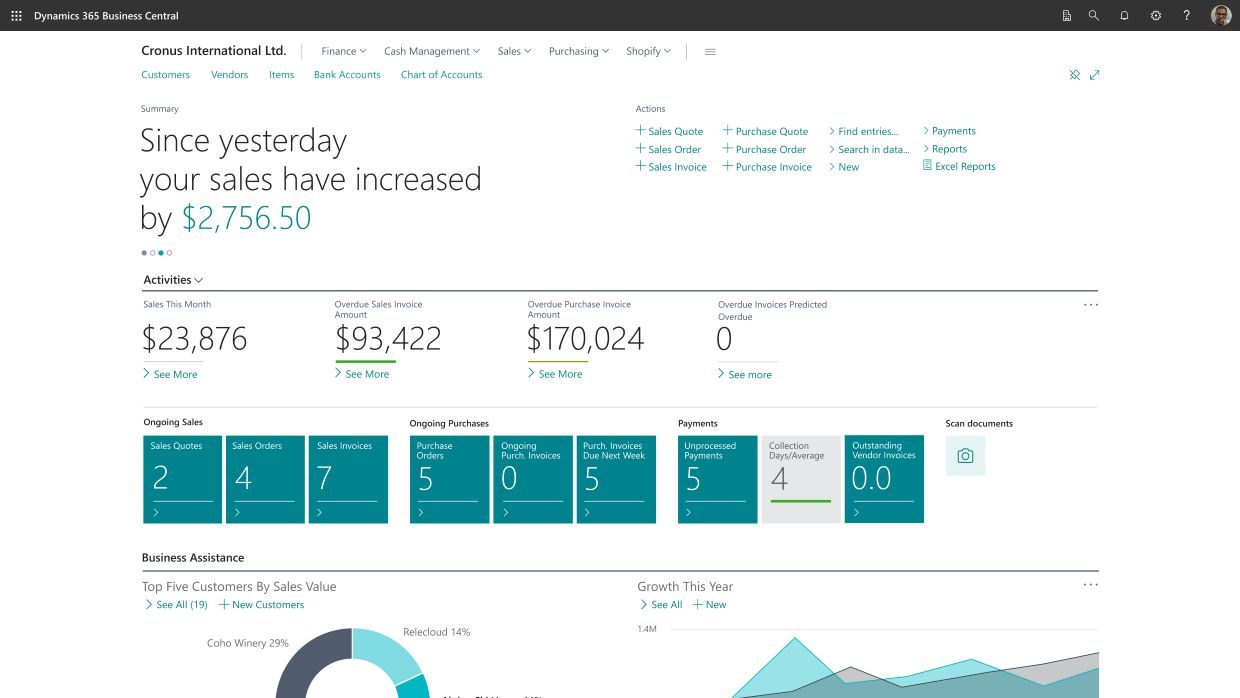
Business Central includes Copilot experiences that help teams find, learn, and do faster. Typical wins include conversational help to locate records or answer how-to questions and AI-assisted content creation—such as product descriptions sourced from item attributes and images—so ecommerce teams can publish faster and keep catalogs consistent.
2) Late payment prediction for smarter collections
Finance teams can prioritize outreach based on which invoices are likely to pay late. Business Central’s Late Payment Prediction uses a standard model optimized for SMB patterns and adapts as you post more invoices; if your flow differs, you can continue using it while the model learns on your data. Outcome: fewer surprises, better cash planning, and fewer manual touches per receivable.
3) Sales & inventory forecasting to protect service levels
The Sales and Inventory Forecast extension leverages historical data and an Azure AI connection to predict demand, surface potential stock-outs, and streamline replenishment requests—helping you balance working capital with service levels.
Bottom line: even before agents arrive, AI in ERP for Business Central can reduce content busywork, strengthen cash flow discipline, and cut avoidable stock-outs—three quick, measurable wins.
From Copilot to autonomous agents: the next stage of AI in ERP
Microsoft has announced AI agents for ERP—specialized, policy-aware digital workers that complete end-to-end tasks across finance and operations. Early agent scenarios include account reconciliation, supplier communications, and time/expenses/approvals—exactly the sort of repetitive, rule-based work that bogs teams down today.
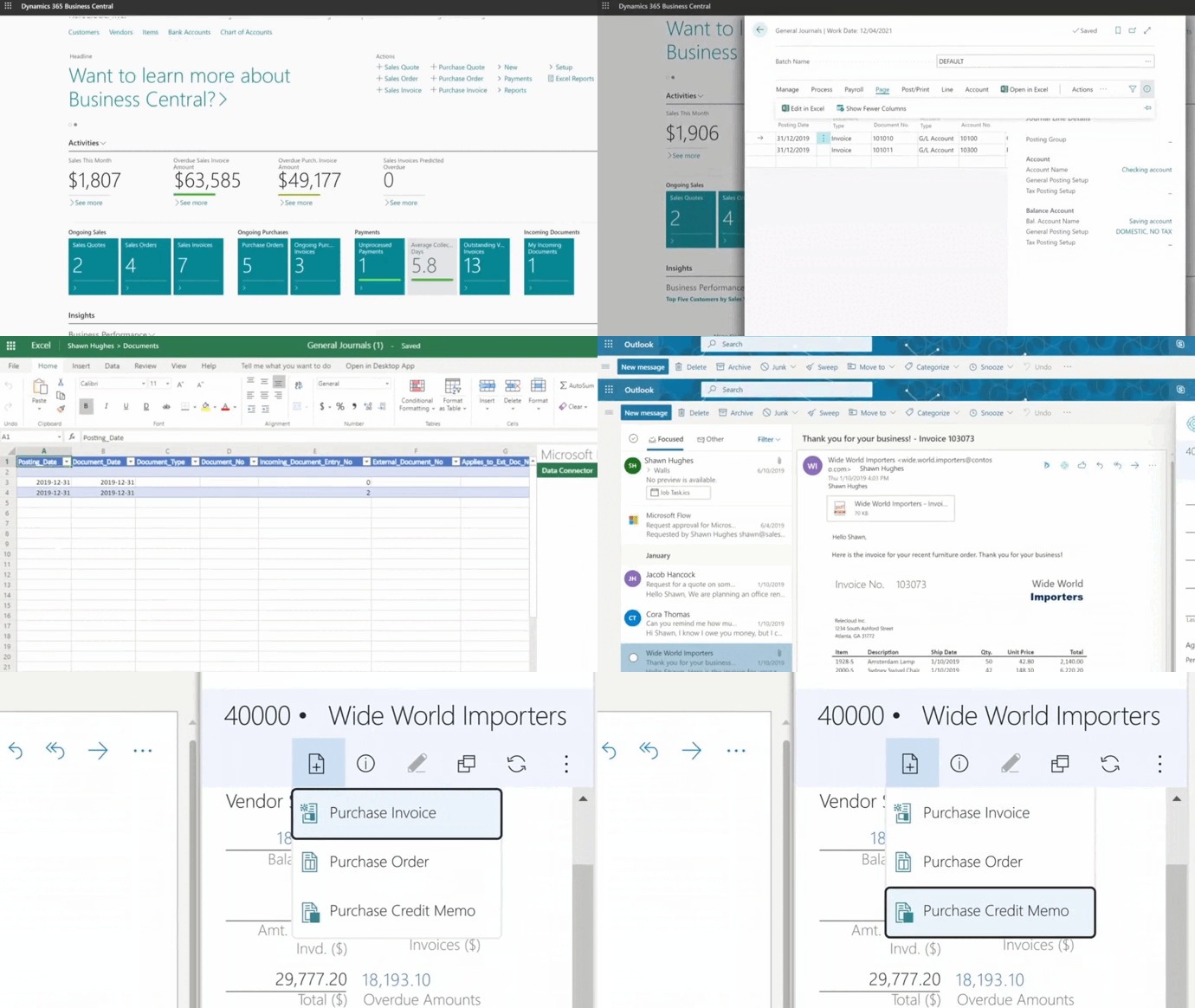
The critical enabler for Business Central is the MCP server. MCP (Model Context Protocol) exposes ERP entities (customers, items, sales orders) through a standardized API so agents—whether built with Azure OpenAI, Copilot Studio, or other MCP-capable platforms—can interact conversationally and safely with your ERP. This capability appears in the official 2025 wave 2 release plan for Business Central, signalling Microsoft’s commitment to agentic workflows.
What changes for you? Copilot assists people; agents complete work. Think “monitor credit risk → predict late payers → launch the right outreach → log results → summarize for the controller” with approvals and guardrails intact.

High-impact use cases to target first (and why they work)
Finance: collections efficiency with AI in ERP
- What to automate: prioritizing at-risk invoices, nudging reminders, proposing term changes, and summarizing outcomes.
- Proof point: Late Payment Prediction identifies likely delinquencies early; an agent can then follow your playbook for outreach and log the trail.
Supply chain: forecast-driven replenishment
- What to automate: exception-driven buy recommendations when predicted demand and current stock levels threaten service.
- Proof point: The Sales & Inventory Forecast signals stock-outs and helps draft vendor requests—ideal for agent-driven orchestration.
Want to know how much you can save?
Download your free ROI Excel calculator to discover how much you can save by implementing Business Central today.

Product operations: faster, consistent item content
- What to automate: generating item descriptions, marketing blurbs, and updates to sales channels.
- Proof point: Copilot already creates descriptions from item attributes and images; agents can standardize copy across channels and ensure governance.
Knowledge & onboarding: answers on demand
- What to automate: conversational “how do I…?” guidance, record lookups, and SOP reminders.
- Proof point: Copilot reduces ramp-up time and internal support tickets by answering in context.
How to implement AI in ERP without chaos or risk?
Most failure stories come from trying to “do AI everywhere at once.”
The right strategy is simpler:
Step 1 — pick ONE process + ONE KPI
Example: Late payment reduction via collections prioritization
Step 2 — do a 2-week hygiene sprint
Clean up customers, posting groups, payment terms — nothing fancy
Step 3 — turn on ONE AI feature with guardrails
Copilot? Late Payment Prediction? Inventory Forecast? Just one.
Step 4 — observe the impact weekly, not quarterly
DSO dropping? Faster approvals? Fewer manual pings? Expand only then.
This is exactly how we implement with clients — AI with control, not chaos.
Governance and change management: keeping AI in ERP trustworthy
- Data ownership: assign owners for customer, item, and vendor masters; schedule monthly completeness checks.
- Least privilege: restrict who can run which AI-assisted tasks; when agents arrive via MCP, ensure actions are logged for audit.
- Guardrails & prompts: standardize phrasing for Copilot requests; define “read only,” “suggest,” and “auto-execute with approval” boundaries for agents.
- Human-in-the-loop: keep approvals for credit limits, returns, pricing, and write-offs.
- Model monitoring: periodically compare predictions (late payments, forecasts) with outcomes; adjust thresholds to reduce noise.
- Adoption: provide two-page job aids and 10-minute video walkthroughs; celebrate early wins.
KPIs: prove that AI in ERP is paying off
- Finance: DSO, % invoices predicted late vs. actually late, write-offs, manual touches per invoice.
- Supply chain: forecast MAPE/MAE, stock-out count, inventory turns, expedite ratio.
- Operations: time to find a record, time-to-publish for item content, internal “how-to” ticket volume.
Set targets up front, measure weekly, and publish a simple dashboard so stakeholders see the trend line—not just anecdotes.
Buying and IT considerations for Business Central customers
- Licensing & readiness: Copilot usage varies by feature; agent previews and related licensing are evolving—keep an eye on Microsoft’s guidance as it rolls out.
- Security & privacy: when enabling the MCP server, document which entities an agent can access and what it can do; map these to Entra roles and BC permissions to avoid privilege creep.
- Integration posture: list the non-ERP systems your process touches (e.g., ecommerce, WMS); plan for agents to call out to these via MCP or existing APIs.
- Change backlog: budget time for small configuration changes that remove friction (posting groups, terms codes, replenishment parameters) so AI recommendations translate cleanly into actions.
Contact us for your free consultation today
Our team will be happy to talk to you about your specific needs when it comes to AI in ERP.
 Free discovery call
Common pitfalls to avoid with AI in ERP (and how to dodge them)
- Automating chaos: If masters are messy or processes are inconsistent, AI will multiply noise. Do a two-week hygiene sprint before go-live.
- No success criteria: “Let’s try AI” isn’t a plan. Pick one metric that matters (e.g., DSO) and design the pilot around it.
- Over-promising the agent leap: Agents are coming fast, but governance matters more than novelty. Start with Copilot + predictions, then add agentic steps with approvals and audit.
- Shadow AI usage: Unapproved chatbots and scripts creep in when official options are clunky. Give people a sanctioned, easy path with Copilot and document the do’s and don’ts.
How Gestisoft helps you win with AI in ERP on Business Central?
For over 25 years, Gestisoft has helped SMB and mid-market organizations modernize operations on Microsoft platforms. As a long-standing Microsoft partner with a deep Business Central practice, we combine functional expertise (finance, supply chain, service) with a pragmatic approach to AI in ERP—so you get outcomes, not experiments.
-
Yes. Copilot experiences (e.g., conversational help, item descriptions) and predictive features like Late Payment Prediction and Sales & Inventory Forecast are available today.
Liked what you just read? Sharing is caring.

September 02, 2025 by Kooldeep Sahye by Kooldeep Sahye Inbound Marketing Manager
Specializing in SEO-driven pipeline growth, I combine keyword strategy, content optimization, and inbound tactics to turn organic search into a reliable source of qualified leads. I work at the intersection of traditional SEO and AI search — optimizing for LLMs and AI Overviews alongside Google — pairing data-informed strategy with sharp, story-led copywriting.