

Microsoft Dynamics 365 Business Central is modular by design. You don't have to buy everything upfront. You activate what you need, when you need it, and the system grows alongside your business. That's the promise of Business Central Modules List. And for most Canadian SMBs, it holds up.
But before you can evaluate whether Business Central is the right fit, you need to understand what's in the box of Business Central modules list. Every competitor page you've likely read gives you a list of module names and calls it a day. This article does more than that.
Below, you'll find the complete Business Central modules list: what each module covers, what it unlocks in practice, how Copilot fits into the picture, and what the Essentials vs. Premium split means for your budget. We've written this specifically for Canadian businesses, including CAD pricing context and notes on GST/HST handling where it's relevant.
Not sure which Business Central modules your business needs?
Gestisoft works with Canadian SMBs to map Business Central modules to real operations, not just a feature checklist. Our consultants have done this across manufacturing, distribution, professional services, and more.
 Book a free consultation
What Is the Business Central Modules List?
Business Central organizes its functionality into distinct modules, each one covering a specific business process. Finance lives in one module. Inventory in another. Manufacturing in another. You don't have to configure everything at once, and you definitely don't pay for functionality you'll never use.
Microsoft packages Business Central modules list into two licensing tiers: Essentials and Premium.
The Essentials license covers the core modules in Business Central modules list most businesses need: Finance, Sales, Purchasing, Inventory, Project Management, Supply Chain planning, and basic Warehouse management.
The Premium license adds two modules in Business Central modules list that Essentials doesn't include: Manufacturing and Service Management. If your business produces goods or manages service orders, contracts, and warranties at scale, Premium is where you'll live.
As of 2026, Canadian partners bill Business Central in CAD. The approximate starting prices (confirm current rates with your partner, since Microsoft updates them periodically) are around $110 CAD per user per month for Essentials and $157 CAD per user per month for Premium. There's also a Team Members license at roughly $11 CAD per user per month for read-only users or staff who only approve transactions.
Now let's go through the full Business Central modules list, one by one.
The Essentials Business Central Modules List
1. Finance and Accounting
This is the foundation of Business Central. Every company that implements it starts here, regardless of industry.
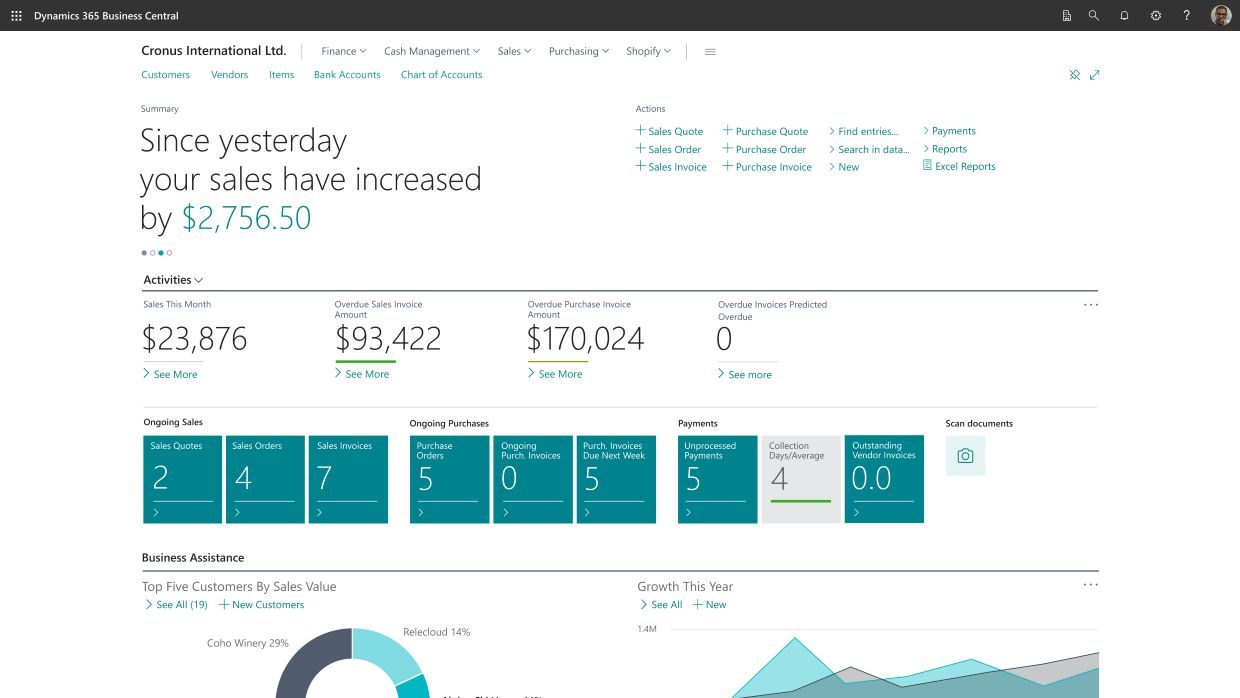
The Finance module in Business Central modules list covers your general ledger, accounts payable, accounts receivable, bank reconciliation, fixed assets, multi-currency transactions, cash flow forecasting, and financial reporting. For Canadian businesses, this module handles GST and HST natively, including tax setup by province, tax group codes, and automated tax calculations on sales and purchase documents. If you operate in Quebec, your partner will configure the QST layer within this same module.
Copilot plays an active role here. The late payment prediction feature in Business Central uses AI to flag invoices likely to arrive late, so your AR team can act before they become a collections problem. The bank reconciliation assistant can auto-match transactions, cutting down what used to be a tedious manual process. If you've ever spent a Friday afternoon reconciling bank statements by hand, you'll understand how much finance teams appreciate this.
The Finance module also connects directly to your Business Central CRM integration, meaning sales data, customer transactions, and financial reporting all talk to each other without manual exports.
2. Sales and Customer Management
The Sales module in Business Central modules list manages your entire sales order process, from quotes to invoices. You can set up customer pricing tiers, configure discount structures, handle returns and credit memos, and track every transaction against a customer record.
One thing that separates this module from a basic accounting tool: it connects sales activity to inventory in real time. When a sales order is entered, stock availability updates immediately. No more overselling products you don't have. Understanding how to set up sales price lists in Business Central is one of the first practical skills your team will develop after go-live.
The module also tracks customer interaction history, which feeds into reporting dashboards and helps sales managers understand which accounts need attention.
3. Purchasing and Payables
Purchasing in Business Central modules list manages vendor relationships, purchase orders, receipts, and payables. You can set up approval workflows so purchase orders above a certain value require sign-off before going out. Vendor payment runs can be automated, which is a significant time save for companies processing high volumes of invoices.
Automated vendor payments in Business Central reduce manual payment processing and help Canadian businesses stay on top of EFT and cheque runs without custom workarounds in spreadsheets. The Payables Agent, one of Business Central's newer AI features, can process and categorize incoming invoices with minimal human review.
4. Inventory Management
The Inventory module tracks your items across locations, manages costing methods (FIFO, average, standard), and provides real-time visibility into stock levels. You can run cycle counts, set reorder points, and trace items by serial number or lot number, which is important for businesses in regulated industries.
Canadian distribution companies tend to get a lot of value from this module early. Once accurate, real-time inventory data feeds your sales and purchasing processes, the number of "we're out of stock" calls drops noticeably.
5. Project Management
The Project Management module in Business Central modules list (historically called the Jobs module) is built for companies delivering services, consulting, construction, or any type of project-based work. You can create project budgets, assign resources, track time and expenses against specific tasks, and invoice customers based on actual usage or fixed fees.
There are 7 strong reasons to adopt Business Central Project Management, but the biggest one for most companies is the finance connection. Project costs flow directly into the general ledger without manual journal entries. You see real profitability per project, not an approximation.
Copilot can now assist with project planning by suggesting resource allocations and flagging tasks trending over budget. For professional services firms in Canada, this module often becomes the centre of their entire Business Central setup.
6. Warehouse Management
The basic Warehouse module handles bin management, pick and put-away processes, and shipment tracking. It's included in the Essentials license at a foundational level, though companies with complex multi-warehouse operations often need the Advanced Warehousing capabilities added.
For most SMBs, the base Warehouse module covers inbound receiving, outbound shipping, and internal transfers. Companies scaling into larger distribution operations (multiple locations, cross-docking, high-SKU environments) will want to review advanced configurations with a Business Central consultant before go-live.
7. Supply Chain Planning
The Supply Chain Planning module in Business Central modules list handles demand forecasting, replenishment planning, and material requirements. It allows you to run "what-if" scenarios on your inventory: projecting stockouts, suggesting purchase orders, and planning production runs before a crisis hits.
For Canadian businesses dealing with long lead times from overseas suppliers, this module adds real operational value. Planning your purchasing 8 to 12 weeks out based on actual demand data beats buying on gut instinct or last year's spreadsheet.
8. Human Resources
The HR module in Business Central modules list covers employee records, absence tracking, and basic organizational data. It's not a full payroll system. Canadian payroll typically requires an integration with a dedicated payroll solution like ADP, Nethris, or Payworks, but the HR module serves as the employee data hub that connects to time tracking, project assignments, and resource planning.
The Premium-Only Modules
9. Manufacturing
The Manufacturing module is exclusive to the Business Central Premium license, and for companies that produce goods, it's the reason to upgrade.
This module covers production orders, bills of materials, routing, capacity planning, work centres, and subcontracting. You can manage simple assembly operations all the way up to multi-stage manufacturing with parallel routing and machine scheduling. Finished goods costs are calculated automatically based on material, labour, and overhead, giving you accurate product costing without a separate system.
Copilot's role in manufacturing is expanding with each release wave. AI-assisted demand planning and predictive maintenance integrations are becoming part of the conversation, particularly for companies already using Microsoft's broader Dynamics ecosystem.
Gestisoft has worked with Canadian manufacturers across Quebec and Ontario. One consistent pattern: businesses migrating from a combination of spreadsheets and older MRP systems typically consolidate 5 to 7 disconnected tools into Business Central modules list within the first 18 months of go-live.
“Anytime I have requests, I've never had a problem with Gestisoft's team. I always get quick answers, and we always manage to solve what we wanted to solve.”
10. Service Management
Service Management is the second Premium-only module in the Business Central modules list. It's built for companies that deliver post-sale services: maintenance contracts, repair orders, warranty management, and service scheduling.
With this module in the Business Central modules list, you can create service agreements tied to specific customers and equipment, dispatch technicians against service orders, track parts consumed during a service visit, and invoice for time and materials or fixed fees. Service histories attach to customer records, so your team always knows what was done and when.
For companies that have been managing service operations in a separate system, this module is often the one that delivers the fastest return. Service orders that used to take hours to process and invoice can be completed in minutes.

How Canadian Businesses Decide Essentials vs. Premium in Business Central Modules List
The question Gestisoft hears most often during discovery calls: "Do we need Premium, or will Essentials cover us?"
Here's the truth:
If you manufacture physical goods, you need Premium. The Manufacturing module isn't an optional upgrade. It's the reason the system can connect production to finance and inventory accurately. Starting on Essentials and hoping to add Manufacturing later works in theory, but it creates migration complexity you don't need.
If you run a service business with formal service contracts and repair workflows, Premium is also the right call. The Service Management module fills a gap that Essentials leaves open.
For everyone else (distribution, wholesale, professional services, retail, non-profit), Essentials handles the full Business Central modules list you'll realistically need. Most of Gestisoft's Canadian distribution and professional services clients run the entire operation on Essentials.
How Microsoft Copilot Fits Into the Business Central Modules List
Copilot is no longer a separate add-on to Business Central. It's embedded across the platform, and its capabilities vary by module.
In Finance, Copilot assists with bank reconciliation matching and late payment forecasting. In Sales, it can draft email responses to customers and suggest next-best actions based on opportunity data. In Inventory, it can flag anomalies and suggest reorder points based on usage patterns. In Project Management, it supports budget variance analysis and resource planning.
The AI in ERP space has moved fast. What was a demo feature 18 months ago is now production-ready in Business Central. For Canadian businesses evaluating ERP options, the Copilot integration is a meaningful differentiator, especially for teams trying to do more with fewer people.
Analysis mode in Business Central is another capability to understand before go-live. It lets users pivot and analyze data across any module without leaving their workflow, and no Power BI license is required for basic reporting.
Ready to map these Business Central modules to your operations?
Gestisoft's implementation team helps Canadian businesses configure the right Business Central modules for their specific workflows, without overbuilding or paying for functionality they won't use.
 Book a free consultation
Business Central Modules List: What the Generic Module Pages Miss
Most articles covering the Business Central modules list are written by US-based Microsoft Partners. They list the same modules in the same order and stop there. For Canadian businesses, a few things deserve explicit attention.
Tax handling. The Finance module in Business Central modules list supports GST, HST, and QST natively. Your partner will configure tax posting groups by province during implementation. This isn't a custom build. It's standard configuration, but it needs to be done correctly from day one.
Canadian payroll. Business Central does not include a Canadian payroll module out of the box. Most Canadian businesses integrate it with a payroll provider. ADP, Nethris, and Payworks are the most common choices. This integration is standard and well-documented, but it's a project item your implementation partner needs to plan for.
Bilingual operations. For businesses operating in both English and French, especially in Quebec, Business Central's language layer allows the system to display in either language per user preference. Customer-facing documents (invoices, quotes, statements) can also be generated in the customer's preferred language.
Understanding what makes Business Central a strong fit for small businesses in Canada goes beyond the feature list. The Microsoft ecosystem's depth (Teams, Power BI, Outlook, SharePoint) is a significant advantage for Canadian companies already running on Microsoft 365.
For businesses migrating from older platforms, moving from QuickBooks to Business Central is one of the most common upgrade paths we see at Gestisoft. For businesses coming from NAV, the migration from NAV to Business Central is equally well-documented and follows a structured module-by-module approach. The Finance and Inventory modules do the heaviest lifting in that transition.
For more information on Business Central Modules List, contact a Gestisoft representative today by booking a free consultation. We meet your business where it’s at.
-
Business Central has nine functional modules: Finance, Sales, Purchasing, Inventory, Project Management, Warehouse Management, Supply Chain Planning, Human Resources, and two Premium-only modules (Manufacturing and Service Management). Extensions from Microsoft AppSource can add further capabilities on top of these.
Explore More
- Business Central Consultant: Definition, Benefits, Services: What a Business Central partner does and how to choose the right one for your Canadian business.
- 7 Reasons to Adopt Business Central Project Management: How project-based businesses in Canada use Business Central to connect time, cost, and invoicing.
- AI in ERP: From Copilot to Autonomous Agents in Business Central: How Copilot is changing what's possible inside each Business Central module.
- QuickBooks to Business Central Migration: What Canadian businesses need to know about migrating from QuickBooks to Business Central.
- Business Central vs. QuickBooks, Xero & FreshBooks: How Business Central's Finance module stacks up against standalone accounting tools.
Liked what you just read? Sharing is caring.

June 12, 2026 by Conni Guido by Conni Guido Copywriter and Brand Strategist
I started with a degree in Professional Communications and never looked back. Now, I'm a professional storyteller who believes every brand has a story to tell, and every good story should leave you wanting more. You can find me lost in a book club or a writing sprint, baking words into pies...probably both.
