

Key Takeaways: Dynamics 365 Business Central vs Epicor Kinetic:
- Cost: Business Central starts around $95 CAD per user per month with implementation from $40,000 to $150,000. Epicor Kinetic runs higher on both licensing and implementation, often reaching six figures.
- Industry fit: Business Central suits distribution, e-commerce, professional services, and light-to-moderate manufacturing. Epicor Kinetic is built for complex discrete manufacturers with intricate BOMs and multi-plant production.
- Timeline: Business Central deployments run weeks to a few months. Epicor Kinetic typically takes 6 to 12 months.
- Canadian context: Business Central ships with French-Canadian localization and native GST, HST, and QST support, backed by a deeper Canadian partner network. Epicor Kinetic's bilingual and tax coverage depends more on the implementation partner.
If you searched Dynamics 365 Business Central vs Epicor Kinetic, you're probably past the "what is an ERP" stage. You've got a legacy system slowing you down, a spreadsheet nobody trusts, or a fiscal year-end that takes three weeks longer than it should. Now you're staring at two names that keep coming up on every shortlist, and you need to know which one fits a Canadian business like yours.
Here's the short version.
Dynamics 365 Business Central is built for small and mid-sized companies that want a cloud ERP already wired into Microsoft 365, with fast deployment and a lower total cost.
Epicor Kinetic is built for manufacturers with complex bills of materials, multi-plant production, and shop floor scheduling needs that go deeper than most SMBs require.
Neither side of the Dynamics 365 Business Central vs Epicor Kinetic debate wins outright. The right answer depends on company size, industry, budget, and how much of your team already lives in Outlook and Excel.
This comparison of Dynamics 365 Business Central vs Epicor Kinetic breaks down cost, implementation, industry fit, and the Canadian-specific factors that most reviews skip entirely, including currency, tax localization, bilingual support, and local partner availability. By the end, the Dynamics 365 Business Central vs Epicor Kinetic choice should feel a lot less abstract and a lot more like a decision you can defend to your team.
The Real Numbers for Your Business is a Call Away
Get a cost breakdown that reflects Canadian tax, currency, and implementation realities, not a US price sheet.
 Book a free consultation
Dynamics 365 Business Central vs Epicor Kinetic: What Each Platform Is Built to Do
Before comparing Dynamics 365 Business Central vs Epicor Kinetic feature by feature, it helps to know what each platform was designed to solve. The two systems grew out of different problems, and that origin story shapes almost every difference that follows.
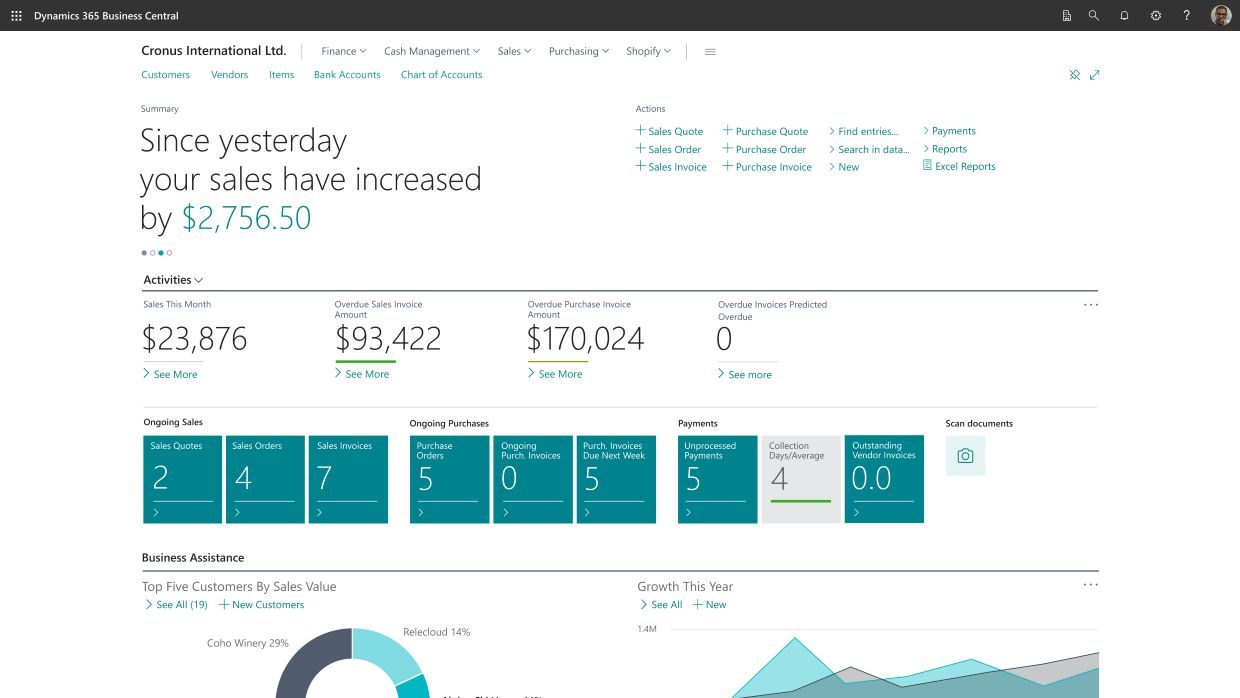
Business Central is Microsoft's cloud ERP for small and mid-market businesses. It covers finance, inventory, sales, project management, and light manufacturing in a single system, and it connects natively to Outlook, Excel, Teams, and Power BI. Companies moving off QuickBooks, Sage, or an aging Dynamics NAV or GP install tend to land here first, since what Business Central covers for Canadian SMBs lines up closely with how most SMBs already operate day to day.
Epicor Kinetic is built specifically for manufacturers. Its data model handles complex bills of materials, mixed-mode production, and shop floor control in a way few general-purpose ERPs match. If your production process involves engineer-to-order work, IoT-connected machines, or dozens of routing variations, Kinetic was built with exactly that in mind.
That difference in origin explains most of what separates Dynamics 365 Business Central vs Epicor Kinetic once you get past the marketing pages. Business Central is a broad, Microsoft-centric platform that handles light-to-moderate manufacturing well and covers finance, distribution, and services extremely well. Epicor Kinetic is a deep, manufacturing-first platform built around production complexity, with everything outside the factory floor treated as a secondary concern. Choosing between them usually comes down to which side of that trade-off carries more weight for your operations.
Company Size and Industry Fit within Dynamics 365 Business Central vs Epicor Kinetic
Company size and industry are usually the first filter in any Dynamics 365 Business Central vs Epicor Kinetic evaluation, and they narrow the field faster than pricing does.
Business Central targets companies from around 10 to 250 users, spanning distribution, professional services, retail, non-profits, and light-to-moderate manufacturing. Gestisoft's top ERP systems in Canada breakdown lists Business Central as the most frequently shortlisted platform in this segment, largely because of its Microsoft 365 integration and bilingual support. A distributor with 40 employees managing inventory across two warehouses is a textbook Business Central fit, as is a professional services firm juggling project billing and time tracking.
Epicor Kinetic targets mid-sized to large manufacturers, particularly in aerospace, automotive, metal fabrication, and industrial equipment. Its bench strength in discrete manufacturing ERP software is real. Companies with formal production processes and complex routing frequently choose it over broader platforms, and a 300-employee aerospace parts manufacturer running five production cells is the kind of company Kinetic was designed around.
A useful rule of thumb for the Dynamics 365 Business Central vs Epicor Kinetic decision: if your business runs distribution, e-commerce, professional services, or light manufacturing, and you're already on Microsoft 365, Business Central is the cleaner starting point. If your core challenge is production planning across multiple plants or product lines with intricate BOMs, Kinetic earns a closer look. Gestisoft's overview of ERP system for manufacturing options walks through this distinction in more depth, including where Business Central's manufacturing module covers enough ground on its own without adding a second, more complex system.
Dynamics 365 Business Central vs Epicor Kinetic: Cost and Total Cost of Ownership in Canada
This is where Dynamics 365 Business Central vs Epicor Kinetic gets concrete, and where most vendor conversations start to diverge from the sales pitch. Business Central starts at roughly $95 CAD per user per month for the Essentials tier, with Premium adding manufacturing and service management functionality. Implementation for a typical Canadian SMB runs in the range covered in ERP implementation cost for mid-market businesses, often landing between $40,000 and $150,000 depending on complexity, users, and data migration scope.
Epicor Kinetic doesn't publish pricing. Based on partner quotes and user reports, licensing commonly runs higher per user than Business Central, and implementation for a mid-sized manufacturer frequently reaches six figures, sometimes well past $150,000 once shop floor integrations and custom routing configurations are factored in.
Deployment cycles also tend to run longer: 6-12 months is typical for Kinetic, against several weeks to a few months for a standard Business Central rollout. Over a five-year window, that gap compounds. A Dynamics 365 Business Central vs Epicor Kinetic total cost of ownership comparison for a 50-user company frequently shows Kinetic landing two to three times higher once licensing, customization hours, and the longer deployment timeline are added together.
Two Canadian cost factors rarely show up in US-focused comparisons of these two platforms. First, GST, HST, and QST apply to cloud ERP subscriptions, so a $100 monthly licence becomes $105 to $115 depending on province, a detail covered in what Canadian SMBs pay for ERP software. Second, several ERP vendors bill in US dollars, which quietly adds 25 to 40% to the sticker price once currency conversion is factored in. Business Central pricing through a Canadian partner is typically quoted in CAD from the start, which removes that surprise.
For a full breakdown of what drives ERP pricing beyond the licence fee, Gestisoft's ERP pricing resource covers tiers, add-ons, and the hidden costs that show up mid-project.
Implementation Timeline and Complexity with Dynamics 365 Business Central vs Epicor Kinetic
Timeline is one of the clearest differences in the Dynamics 365 Business Central vs Epicor Kinetic comparison, and it's often the one that surprises finance teams most.
Business Central deployments for Canadian SMBs typically move from kickoff to go-live in weeks to a few months, following the ERP implementation phases most Gestisoft clients go through: analysis, configuration, data migration, testing, and training. Companies migrating from NAV to Business Central often move even faster, since the underlying data structure carries over.
Epicor Kinetic projects run longer because of the depth of configuration required for production workflows. A manufacturer replacing a legacy MRP system with Kinetic should plan for 6 to 12 months, with heavier internal involvement from operations and engineering throughout, and a project team that can dedicate real hours to testing routings and BOM structures before go-live.
Neither timeline is inherently a problem. A complex manufacturer needs the configuration time Kinetic demands. A distribution or services company forcing that same timeline onto a simpler set of requirements is paying for complexity it doesn't use. Reviewing common ERP implementation challenges before signing with either vendor helps set realistic expectations on both sides, and it's a useful exercise regardless of which side of the Dynamics 365 Business Central vs Epicor Kinetic decision you're leaning toward.
Flexibility and Customization with Dynamics 365 Business Central vs Epicor Kinetic
Customization philosophy is another dividing line in the Dynamics 365 Business Central vs Epicor Kinetic comparison, and it tends to carry more weight once a company is a year or two into using either system.
Business Central's extension model, built on Power Platform and AppSource, lets businesses customize Business Central for their team without touching core code, which keeps future upgrades clean. Epicor Kinetic can be customized too, but changes typically require deeper technical involvement and a consultant on standby for anything beyond configuration.
That flexibility gap came up directly in a Gestisoft implementation for Dandurand, a Canadian wine agency that evaluated several ERPs, including options with a manufacturing pedigree similar to Epicor Kinetic, before choosing Business Central.
Flexibility is crucial. There were established models in procedures and processes, but we don't fit into that mold for several reasons. Gestisoft met these expectations brilliantly.
Josiane Leclerc, Vice President, Integrated Business Planning, Dandurand
That's the pattern Gestisoft sees across most Dynamics 365 Business Central vs Epicor Kinetic evaluations. Companies with unconventional processes tend to prefer a platform they can shape themselves, rather than one that requires a partner for every change, and that preference alone has tipped more than one Dynamics 365 Business Central vs Epicor Kinetic decision toward Microsoft's platform.

The Canadian Context Nobody Else Covers Regarding Dynamics 365 Business Central vs Epicor Kinetic
Every major Dynamics 365 Business Central vs Epicor Kinetic comparison currently ranking on Google skips the factors that decide this for a Canadian buyer.
Bilingual support is a real consideration for any company operating in Quebec or serving French-speaking clients across Canada. Business Central ships with French-Canadian localization out of the box, and Gestisoft's implementation teams work in both languages throughout the project. Epicor Kinetic supports French too, but full bilingual rollout typically depends on the implementation partner rather than the platform itself.
Canadian tax and payroll compliance is another gap. GST, HST, and QST handling, along with multi-province payroll rules, need to be configured correctly from day one. Business Central's Canadian localization covers this natively; Epicor Kinetic implementations sometimes require add-ons to reach the same level of coverage.
Local partner depth also plays into long-term support. Gestisoft has served Canadian clients across manufacturing, distribution, and professional services since 1997, with offices in Montreal, Toronto, Ottawa, and Quebec City. That kind of coverage, paired with an active ERP consultant firms in Canada for manufacturing network, is harder to find for Kinetic outside a handful of larger Canadian manufacturing hubs. For a Canadian company weighing Dynamics 365 Business Central vs Epicor Kinetic, that difference in local support depth is as concrete as any feature comparison on a spec sheet.
The 10 Criteria That Predict a Successful ERP Rollout
Download Gestisoft's ERP selection framework and score Business Central, Epicor Kinetic, or any other platform against the criteria that separate a smooth rollout from a stalled one.

What Real Users are Saying About Dynamics 365 Business Central vs Epicor Kinetic
Review sentiment on G2, Capterra, and Gartner Peer Insights adds another data point to the Dynamics 365 Business Central vs Epicor Kinetic comparison, and it lines up with what Gestisoft hears directly from clients evaluating both.
Business Central users on G2 and Capterra frequently point to Office 365 and Power BI integration as a major advantage, along with faster deployment and an interface their teams pick up with minimal training. Epicor Kinetic users on G2 praise the platform's manufacturing depth and BOM handling, but Gartner Peer Insights reviews consistently flag implementation timelines and customization costs as pain points, along with a steeper learning curve for staff outside the production floor.
That pattern holds up against the 8 common ERP myths manufacturers need to stop believing, one of which is the assumption that more manufacturing depth always beats broader usability. For a company running light assembly alongside distribution and finance, that extra depth in Kinetic often goes unused while the added complexity stays, which is exactly the kind of trade-off a Dynamics 365 Business Central vs Epicor Kinetic evaluation should surface before contracts get signed rather than a year into the rollout.
Ready to compare Business Central and Epicor Kinetic for your business?
Get a side-by-side breakdown built around your industry, budget, and Canadian compliance needs, not a generic feature list.
 Book a free consultation
Dynamics 365 Business Central vs Epicor Kinetic: How to Choose
The Dynamics 365 Business Central vs Epicor Kinetic decision usually comes down to four scenarios.
- If you're a distribution, e-commerce, or professional services company already using Microsoft 365, Business Central gets you the fastest ROI and the smoothest adoption curve.
- Light-to-moderate manufacturers with straightforward BOMs and a small production footprint usually fit inside Business Central's manufacturing module just fine, without needing Kinetic's added depth.
- Complex discrete manufacturers running multi-plant operations, engineer-to-order workflows, or heavy shop floor integration are a different story. Put Epicor Kinetic on the shortlist alongside other Business Central alternatives and treat manufacturing depth as the deciding factor.
- And if you're migrating off an older Microsoft product, Business Central is almost always the more natural landing point given the shared ecosystem. Gestisoft's Dynamics GP vs Dynamics 365 Business Central comparison covers that migration path in detail.
If you're still weighing broader options beyond these two, Gestisoft's comparisons of NetSuite vs Dynamics 365 Business Central, SAP vs Dynamics 365, and Odoo vs Business Central cover how Business Central stacks up against the rest of the field, not just Epicor.
Gestisoft's breakdown of AI in ERP, from Copilot to autonomous agents in Business Central is a good next stop if you're also weighing how each platform handles automation and AI going forward. For everyone else, the case for Dynamics 365 Business Central vs Epicor Kinetic usually comes down to speed, cost, and a system your team already half-knows how to use.
If you’re ready to talk numbers, start the discussion of whether Dynamics 365 Business Central vs Epicor Kinetic is for you, contact us today for a free consultation!
-
In most Canadian Dynamics 365 Business Central vs Epicor Kinetic comparisons, yes. Business Central starts around $95 CAD per user per month with implementation typically between $40,000 and $150,000. Epicor Kinetic's licensing and implementation costs are usually higher, particularly once shop floor integrations and custom routings are added.
Explore More
- How to choose an ERP system that drives growth and efficiency
- Optimize your manufacturing processes with ERP: proven strategies for efficiency
- ERP for distributors: the complete guide to choosing and implementing the right system
- Business Central Partner: definition, benefits, services
- What makes Business Central such a good fit for small businesses?
Liked what you just read? Sharing is caring.

July 16, 2026 by Conni Guido by Conni Guido Copywriter and Brand Strategist
I started with a degree in Professional Communications and never looked back. Now, I'm a professional storyteller who believes every brand has a story to tell, and every good story should leave you wanting more. You can find me lost in a book club or a writing sprint, baking words into pies...probably both.
