

Choosing among the top ERP systems in Canada is harder than it looks. Canadian finance leaders and operations managers often end up comparing platforms that don't speak to what actually breaks an ERP project here: CRA tax handling, a bilingual interface for Québec teams, multi-currency between CAD and USD, and partner availability when your team is working late in Vancouver.
This guide takes a different lens. It walks through eight platforms on Canadian shortlists and judges each against the selection criteria that matter here.
By the end, you can draw a sensible shortlist of the top ERP systems in Canada, ask sharper vendor questions, and avoid implementation regrets that quietly cost six figures.
See How Business Central Fits Your Operations
Walk through your finance, inventory, and reporting needs with a Canadian Microsoft Partner before you shortlist any platform.
 Book a free consultation
The 8 Top ERP Systems in Canada to Compare in 2026
Eight platforms cover almost every Canadian SMB and mid-market scenario you're likely to face, from light cloud finance to discrete manufacturing. We've kept the assessment honest: each one fits some businesses better than others.
1. Microsoft Dynamics 365 Business Central
Built for small and mid-sized firms, Business Central is the platform Gestisoft implements most often and the one most frequently shortlisted among the top ERP systems in Canada.
It covers finance, inventory, sales, projects, and light manufacturing in one cloud system, with Power BI and Copilot AI included. Canadian tax codes, a bilingual interface, and CAD multi-currency come standard.
It scales for companies between 10 and 500 users and connects with Microsoft 365 out of the box. Best fit for businesses already on the Microsoft stack that want a platform built to grow with them.
2. Oracle NetSuite
NetSuite was one of the first cloud ERPs and remains popular with mid-market and high-growth Canadian companies. It's strong for finance, multi-entity consolidation, and subsidiaries across Canada and the United States.
Canadian payroll usually requires a third-party SuiteApp add-on, adding licensing costs. The platform does support French (Canada) as a UI language once multi-language is enabled, though some screens may default to English.
Implementation is heavier than smaller cloud ERPs, and customization can get expensive. Best fit for companies expecting fast international expansion. Our NetSuite vs Dynamics 365 Business Central article weighs both platforms on pricing, fit, and Canadian deployment realities.
3. SAP Business One
SAP Business One targets small businesses that want SAP credibility without S/4HANA's price tag. It's solid for distribution and light manufacturing, with respectable inventory and supply chain modules.
Canadian localization exists, and French is available as a UI language for Québec teams, though the partner ecosystem here is smaller than Business Central's or NetSuite's, which can slow support response. Implementation follows rigid SAP methodology, which limits workflow flexibility for smaller teams.
Our SAP vs Dynamics 365 breakdown explains where each one earns its license fee and where buyers later regret the choice, especially around customization costs and reporting flexibility.
4. Sage Intacct
Sage Intacct is a cloud financial management platform with a strong following among Canadian professional services firms, nonprofits, and accounting-heavy businesses. Among the top ERP systems in Canada, its multi-entity, multi-dimensional reporting is class-leading, and the CRA-friendly tax setup works cleanly for Canadian operations.
The trade-off is that Intacct is finance-first: inventory, manufacturing, and field operations are weaker than full operational ERPs.
Canadian French is now natively supported at company and user level as of the 2025 release, though custom fields stay in their original language. Best fit for finance-led organizations that don't need heavy operational modules and already run a separate tool for warehouse work.
5. Acumatica Cloud ERP
Acumatica has been growing fast among Canadian distribution and field-services businesses, partly because of its consumption-based pricing model that doesn't penalize you for adding users.
The platform covers finance, distribution, manufacturing, project accounting, and field service in one suite. Canadian taxes are configurable, and French Canadian has been included as a standard interface language since Acumatica's 2020 Canadian localization release.
Among the top ERP systems in Canada, Acumatica's partner network is smaller than the Microsoft ecosystem, so finding a partner with deep local references can take effort. Best fit for distribution-heavy businesses that expect rapid headcount growth and don't want per-user licensing to limit them.
6. Odoo
Odoo is the open-source ERP that keeps appearing in Canadian SMB conversations: low entry price, wide module library. Of the top ERP systems in Canada, it's the only major open-source option.
Community Edition is free; Enterprise is paid per user. It suits small e-commerce, light services, and businesses with internal developer talent. Canadian payroll and CRA compliance need third-party modules or partner customization. The interface is bilingual.
Best fit for businesses under 25 users with technical staff in-house. The gap between the demo and a production-ready Canadian deployment is wider than buyers expect. You may also read our comparison on Odoo vs. Business Central for more information on how both platforms fair against each other.
7. SYSPRO
SYSPRO is a manufacturing-focused ERP that's quietly held its place among Canadian discrete and process manufacturers for decades. It does inventory, MRP, shop floor, and costing exceptionally well, with detailed traceability that food, chemicals, and electronics manufacturers genuinely need.
Canadian payroll typically connects to a separate payroll system. SYSPRO ships with a standard French language pack for the user interface, though local implementation and support resources in French are more limited than what you'll find with Business Central. Cloud deployment is available, though on-premise is still common in its install base.
Best fit for mid-sized Canadian manufacturers who care more about shop-floor precision than bundled CRM or finance polish.
8. Epicor Kinetic
Epicor Kinetic targets discrete and mixed-mode manufacturers, with strong shop-floor and engineering-to-order capabilities. It's used across Canadian metals, fabrication, and industrial equipment producers.
The platform handles complex bills of material and configure-to-order scenarios well. Canadian tax support is solid, and French Canadian is available as a supported interface language for Québec teams via the standard language pack. Cloud and on-premise are both available, with cloud adoption growing.
Best fit for manufacturers with engineered or highly variable products who need deep production planning. Expect a longer go-live than with cloud-first platforms like Business Central or Acumatica.
What to Look For in the Top ERP Systems in Canada
A platform that wins on a global spec sheet can still fail in a Canadian deployment. The selection criteria below show why the top ERP systems in Canada need to be judged on local realities. Our guide on types of ERP software covers the categories if you're still mapping which one fits your operation.
Canadian Tax Compliance Across the Top ERP Systems in Canada
GST, HST, PST, and QST live at the cash register for Canadian businesses, and they have to live inside your ERP just as cleanly.
Look for built-in tax groups, the ability to handle place-of-supply rules across provinces, and reporting that exports to CRA-friendly formats. T4, T4A, ROE, and Québec's RL-1 forms add another layer if your ERP carries payroll.
Ask each vendor exactly which Canadian forms are native, which require an add-on, and whether year-end filings have been tested on real client data this fiscal year.
Bilingual Interface and Multi-Currency Reality
If your team has members in Québec or any French-speaking region, the French interface is not a nice-to-have. Test it during demos: switch users to French and walk through invoice entry, reporting, and approvals.
Some platforms localize the menus but leave error messages, help text, or custom field labels in English.
Multi-currency matters too. Most Canadian SMBs invoice in CAD but pay USD vendors, hold USD bank accounts, and report in CAD at month-end. Verify how each platform handles revaluation, gain and loss postings, and bank reconciliation across currencies.
Deployment Model: Cloud, On-Prem, or Hybrid
Cloud ERP dominates new Canadian deployments, but the choice isn't automatic. Cloud means lower upfront cost, faster updates, and easier remote access.
On-premise still has a place when data sovereignty, custom integrations, or specific regulatory constraints apply. Hybrid is rare but exists for businesses migrating gradually.
Our piece on the benefits of cloud ERP covers the trade-offs in more depth, including how cloud shifts cost from capital to operating budgets and reduces IT overhead. Either way, confirm data residency: where exactly your data lives and which laws apply.
Partner Footprint Across Canadian Time Zones
An ERP is only as strong as the partner implementing and supporting it. A vendor with one office in Toronto and no presence west of Ontario will struggle to support a Calgary or Vancouver team in real time.
Ask whether the partner has consultants in your time zone, how after-hours support is structured, and how many active Canadian clients they support on your shortlisted platform.
Our list of top ERP consultants in Canada is a useful starting point if you're still scoping who to invite to vendor demos.
Get a Shortlist Built Around Your Numbers
A Gestisoft consultant maps your finance, operations, and team realities against the platforms that have actually delivered for Canadian businesses your size.
 Book a free consultation
Which of the Top ERP Systems in Canada Fits Your Industry
The right platform shifts with your industry's economics. Below is a quick read on which of the top ERP systems in Canada tend to come out ahead for the most common Canadian SMB scenarios.
Manufacturing Picks From the Top ERP Systems in Canada
Canadian manufacturers usually narrow to Business Central, SYSPRO, or Epicor Kinetic. Business Central works well for assembly, light manufacturing, and food production, especially with batch-traceability extensions.
SYSPRO and Epicor go deeper on shop-floor control and engineering-to-order. The deciding factor is rarely the ERP itself… it's whether your partner has manufacturing implementation experience in Canada.
Wholesale Distribution and Cross-Border Logistics
Distributors moving inbound from the United States and outbound across Canada benefit from ERPs with strong inventory location tracking, landed cost handling, and EDI capability. Business Central, NetSuite, and Acumatica all handle this well.
Acumatica's consumption pricing suits warehouse teams that scale headcount with seasonal demand. NetSuite tends to fit better when multi-entity reporting across the border is the driver.
Our distribution management software article covers the operational features distributors should weigh during selection.
Professional Services and Project-Based Firms
Consultancies, agencies, and engineering firms need time tracking, billable utilization, and project profitability at the line-item level. Business Central with its project management module, Sage Intacct, and NetSuite all serve this segment well.
The choice often comes down to how integrated your CRM and ERP need to be. Firms already on Microsoft Dynamics 365 CRM gain a tighter handoff between sales and project delivery when paired with Business Central.
Watch for revenue recognition handling, especially if you bill on milestone or percentage-of-completion methods.
Get the 10 Key ERP Selection Criteria Guide
A free download covering the questions Canadian buyers wish they had asked before signing. Use it to score every vendor on your shortlist.

What Do the Top ERP Systems in Canada Actually Cost
Pricing pages rarely tell the full truth about the total cost of ownership. The real cost of the top ERP systems in Canada is split across licensing, implementation, and the years after go-live.
Licensing is the easiest piece to compare. Business Central Essentials runs around CAD 108 per user per month; NetSuite typically lands much higher once Canadian payroll and add-ons are factored in. SAP Business One and Acumatica fall in between, while Odoo Enterprise sits at the lower end.
Implementation usually represents two to five times the first year of licensing. A modest Business Central deployment for a 30-user finance and inventory team can land between CAD 50,000 and CAD 150,000 depending on customization, integration, and data migration scope. Manufacturing ERPs like SYSPRO and Epicor sit higher because shop-floor configuration is harder.
Ongoing costs include support, updates, training, and scope additions in year two. Buyers often underbudget user training, which erodes adoption faster than any technical issue. Our piece on ERP implementation challenges details the cost traps that derail otherwise sound projects.
A realistic budgeting approach assumes a three-year horizon. Add licensing, implementation, customization, training, support, and 15 percent contingency. If a quote for any of the top ERP systems in Canada lands well below that range, ask what is excluded.
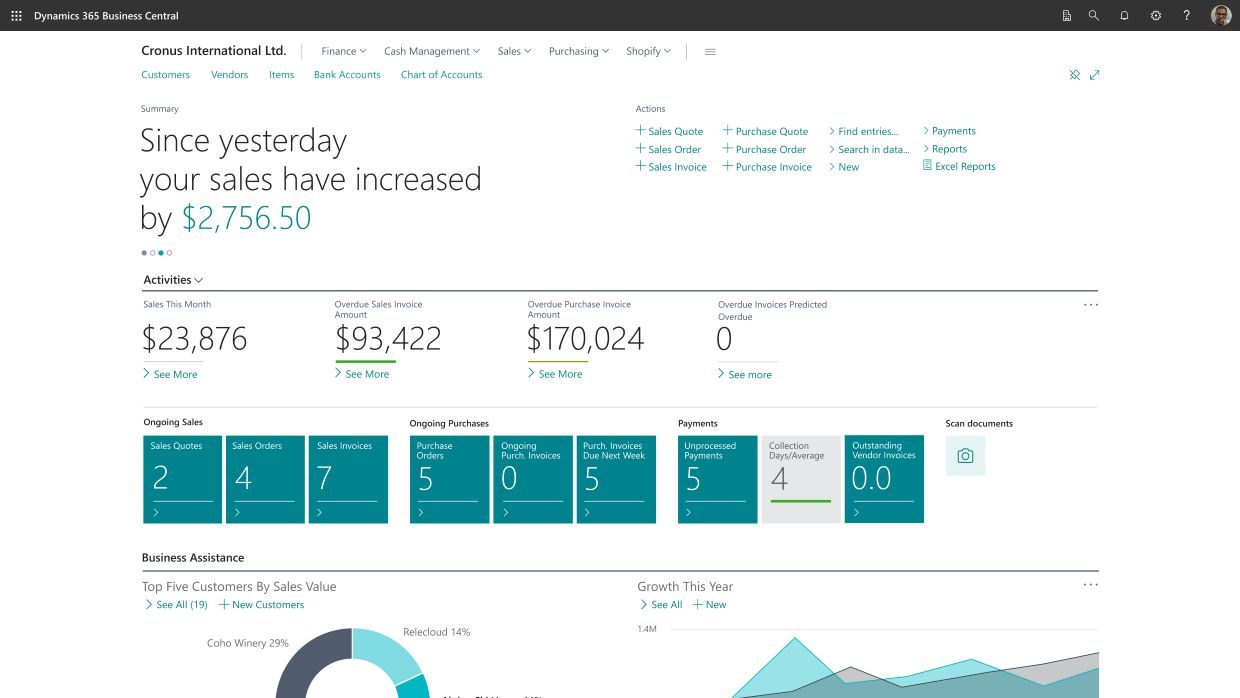
If you'd like to see what a modern Canadian ERP actually looks like in daily use, the walkthrough below shows the Business Central interface and how role-based views shape what each team member sees.
How to Choose From the Top ERP Systems in Canada Without Regret
Most ERP regrets come from rushing the selection, not from picking the wrong platform. The questions below help you stress-test the top ERP systems in Canada against your actual operating reality.
Start with what your team does today. Map your month-end close, inventory reconciliation, and billing cycle. The platform you choose should make these workflows faster, not just replace them.
When weighing the top ERP systems in Canada, vendor answers reveal more than feature lists. Ask each one:
- Can you show me one Canadian client of similar size and industry running this exact configuration today.
- Which Canadian tax and payroll forms are native versus add-on, and which were tested this fiscal year.
- What does year-three total cost look like, including support, updates, and the customizations proposed.
- How will my data move from our current system, and who absorbs the cost if migration runs over scope.
- What's your commitment if a key consultant leaves the project mid-implementation.
- Which features were customized for previous Canadian clients, and how have those held up during platform upgrades.
Our broader guide on how to choose an ERP system walks through scoring frameworks and stakeholder workshops that turn this into a defensible decision rather than a gut call.
-
There's no single best ERP for every business. Microsoft Dynamics 365 Business Central is the most common pick among Canadian SMBs between 10 and 250 users because of Microsoft 365 integration, bilingual support, and a deep Canadian partner network. Acumatica and Odoo are strong alternatives depending on user count and budget.
Why Work With Gestisoft on the Top ERP Systems in Canada
Choosing among the top ERP systems in Canada is half the work, finding a partner who'll still pick up the phone three years in is the other half.
Gestisoft has been implementing Microsoft business solutions for Canadian companies since 1997, with bilingual teams serving clients across Canada and North America.
As a certified Microsoft Solutions Partner, B Corp, and Great Place to Work certified company, our focus is on getting Business Central implementations right for finance, distribution, manufacturing, and services clients.
We work in both English and French, with consultants across Canadian time zones, so support doesn't depend on geography.
Here's how one of our clients described working with our team:
“Gestisoft was very responsive and proactive in adapting to the internal challenges we faced and ensuring that we met our objectives. We were very impressed with the work of everyone involved in the project.”
If you'd like an unbiased read on which platform from the top ERP systems in Canada fits your operation, a short conversation is usually the fastest path.
Talk to a Canadian Microsoft Partner Before You Sign
Get a sanity check on your ERP decision from a team that's implemented Business Central for hundreds of Canadian businesses.
 Book a free consultation
Liked what you just read? Sharing is caring.

July 03, 2026 by Muhammad Ali Iqbal by Muhammad Ali Iqbal SEO Content Strategist & Copywriter
Driven by a passion for search engine optimization, strategic content, and conversion-focused writing. A copywriter and content strategist who lives for content that ranks, engages, and delivers real business results.
