

ERP software price is the first question every business owner asks, and the last one most vendors answer clearly. Most pricing guides online are written for American buyers with USD figures, no mention of provincial taxes, and zero context for bilingual implementations.
This guide is for Canadian SMBs. We cover what drives ERP software price, compare licensing costs across six platforms, and give you a practical framework for evaluating any quote you receive.
Get a Clear ERP Software Price Estimate for Your Business
Walk through your actual requirements with a Business Central expert and leave with a realistic budget range tailored to your Canadian operations.
 Book a free consultation
What Affects ERP Software Price in Canada
ERP software price is not a single number on a shelf. It is shaped by how the vendor charges, how your team uses the system, and where your business operates. In Canada, that last factor matters more than most guides acknowledge.
How Licensing Models Affect ERP Software Price
Three pricing models dominate the market right now.
Per-user subscription is the most common for cloud ERP. You pay a fixed monthly or annual fee for each named user. This is how Microsoft Dynamics 365 Business Central, NetSuite, and Sage Intacct price their products. It makes budgeting predictable, and you can scale up or down as your team changes.
Consumption-based pricing charges you based on the resources you use, not the number of people logging in. Acumatica is the best-known example. This can save money if you have a large team where most people only touch the system occasionally.
Perpetual licensing means you buy the software outright and pay annual maintenance on top. SAP Business One still offers this option. The upfront cost is higher, but long-term costs can be lower if you have the IT team to manage it.
Gestisoft's ERP pricing guide breaks down each model in more detail, including how Microsoft structures Business Central subscriptions across Essentials, Premium, and Team Members tiers.
Canadian Costs Most ERP Software Price Guides Miss
Four factors change your real ERP software price in Canada, and none of them show up in the guides you find on American websites.
- First, sales tax on subscriptions. GST, HST, and QST apply to cloud ERP subscriptions in Canada. A platform priced at $100 per user per month becomes $105 in Alberta (5% GST), $113 in Ontario (13% HST), or roughly $115 in Quebec (5% GST plus 9.975% QST). Multiply that across 20 users over five years, and the tax alone adds tens of thousands of dollars most budgets miss entirely.
- Second, CAD versus USD billing. Many ERP vendors bill in US dollars. That $100 USD per user licence has cost Canadian buyers anywhere from $125 to $140 CAD depending on the exchange rate at signing. If you lock in a three-year contract during a weak Canadian dollar, you are paying that premium for the full term.
- Third, bilingual implementation. In Quebec, bilingual deployments add real consulting hours. Interface localization, bilingual training materials, French-language documentation, and dual-language reports all require time that a unilingual rollout does not. This is not optional. It is operational.
- Fourth, Canadian data residency. Some vendors charge extra for Canadian-hosted instances. Others do not offer Canadian data centres at all, which creates compliance conversations that add project scope and legal review time.
6 ERP Software Price Options Canadian SMBs Compare
Here is what Canadian SMBs actually encounter when they start requesting quotes.
1. Microsoft Dynamics 365 Business Central

Business Central uses a per-user subscription model. Essentials covers core finance, purchasing, sales, and inventory at USD $80 per user per month (approximately CAD $108.50). Premium adds manufacturing and service management at USD $110 (approximately CAD $149.20). Team Members provides limited access at USD $8 (approximately CAD $10.90).
Tight integration with Microsoft 365, Outlook, Excel, and Teams. Built-in Canadian tax configuration and a strong bilingual partner network. Gestisoft's Business Central pricing and licensing guide walks through what each tier includes.
Limitations: Manufacturing and service management require the Premium licence. CRM is a separate Dynamics 365 product, not bundled in Business Central.
2. Oracle NetSuite

NetSuite does not publish pricing. All quotes are custom, built from a base platform fee (starting around $999 USD per month) plus per-user charges ($99 to $199 per full user per month) plus module add-ons. Strong financials, multi-entity consolidation, and built-in e-commerce. Popular with service-based and subscription-model businesses.
If you are weighing these two side by side, Gestisoft's NetSuite vs. Business Central comparison covers feature differences, pricing structure, and where each platform fits best.
Limitations: No public price list makes budgeting difficult before your first sales call. Billed in USD, which adds exchange-rate risk for Canadian buyers. Implementation timelines tend to run longer than mid-market cloud alternatives.
3. Acumatica Cloud ERP

Acumatica uses consumption-based pricing, meaning you pay based on resource usage and transaction volume rather than per user. Unlimited users are included within your tier. This model is a strong fit for businesses with large teams where most people only need occasional system access.
Solid distribution and manufacturing modules with industry editions for construction, retail, and general business. Cloud-native architecture with strong API capabilities for connecting third-party tools and e-commerce platforms.
Limitations: Smaller Canadian partner network compared to Microsoft or SAP. Less out-of-the-box Canadian tax and compliance configuration. Pricing can become harder to predict as your transaction volumes grow.
4. SAP Business One

SAP Business One offers both perpetual licence and cloud subscription options. Cloud subscriptions range from roughly $91 to $150 USD per user per month depending on licence type (Professional vs. Limited). Perpetual on-premise licences run approximately $1,400 to $3,500 USD per user upfront, plus 18 to 22 percent annual maintenance.
Strong manufacturing, distribution, and financial reporting depth. Available through a network of Canadian SAP partners, with larger firms concentrated in Toronto and Montreal.
Limitations: Higher implementation complexity than cloud-native alternatives. Customization budgets tend to run larger. The Canadian partner ecosystem skews toward mid-market and enterprise, so smaller SMBs may find fewer local support options.
5. Sage Intacct

Sage Intacct uses a subscription model typically quoted as an annual package rather than a per-user rate. Annual subscriptions for small businesses start around $25,000 USD.
Strongest for finance-first use cases: multi-entity consolidation, revenue recognition, nonprofit and project accounting. Solid Canadian presence with local support teams. A good ERP software price option if your primary need is financial management depth rather than broad operational coverage.
Limitations: Limited manufacturing and inventory depth. If your evaluation includes operations and supply chain, Sage Intacct may leave gaps you will need third-party add-ons to fill. Implementation scope is narrower, but so is the platform's reach.
6. Odoo

Odoo offers a free, open-source Community edition (self-hosted) and paid cloud plans. The Standard plan includes all apps at roughly $24 to $31 USD per user per month billed annually. The Custom (Enterprise) plan adds multi-company support, Odoo Studio, and external API access at roughly $25 to $47 USD per user per month depending on region. Modular design lets you activate only the apps you need.
Limitations: The Community edition requires in-house technical skills to deploy and maintain. Pricing varies significantly by country due to regional pricelists. The Canadian partner network is smaller, and bilingual implementation support varies by region and partner.
Comparing ERP Options? Start With This Checklist
ERP software price is one factor in the decision. This guide covers the 10 criteria that separate a smart ERP investment from an expensive mistake.

What Are the Hidden Costs That Raise Your ERP Software Price?
The licence fee on your quote is the most visible number. It is rarely the biggest one. These cost categories catch Canadian SMBs after they have already committed, and they can easily double your original ERP software price estimate.
Implementation and Customization
Implementation services typically run one to three times your annual software cost for mid-market projects. The range depends on how many sites you operate, how many integrations you need, and how much of your current process needs to change.
There is an important distinction here. Configuration means adapting the system's built-in options to your workflows. Customization means building new functionality through code. Configuration is cheaper, faster, and easier to maintain. Custom development adds cost upfront and creates future upgrade complexity.
Third-party add-ons are another line item that does not appear in your base ERP software price. Shipping integrations, advanced warehouse modules, industry-specific extensions, and AI tools each carry their own recurring licence fees. Gestisoft's ERP implementation cost breakdown covers what mid-market businesses using Business Central typically spend, from basic single-site setups to complex multi-location projects.
Data Migration, Integration, and Training
Data migration is where projects quietly go over budget. If your current data lives in spreadsheets, a legacy system, or multiple disconnected tools, cleaning and mapping that data into a new ERP takes significant project hours. The messier the data, the longer it takes.
Integration costs depend on what you need to connect. E-commerce platforms, CRM systems, payroll providers, banks, and third-party logistics all require mapping, testing, and sometimes middleware. Each connection adds time and cost.
Training is often the most underbudgeted line item. Not because businesses forget about it, but because they underestimate how much is involved, especially for bilingual teams in Quebec where materials, sessions, and documentation need to work in both English and French.
Stop Guessing What ERP Will Actually Cost You
Our consultants scope your real requirements, including modules, users, integrations, and Canadian compliance needs, then give you a budget range you can plan around.
 Book a free consultation
How To Evaluate an ERP Software Price Quote
You have a quote in your inbox. Maybe two or three. Every number looks different, every scope reads differently, and it is hard to tell which ERP software price quote is realistic and which one is hiding costs you will discover six months into the project.
5 Questions To Ask About Any ERP Software Price Quote
These are the questions that separate a complete quote from one with gaps. You can send them directly to any vendor or partner you are evaluating.
Does This Quote Include Data Migration?
Data migration is scoped and billed separately more often than not. This single question has caught more budget surprises than any other in ERP projects.
What Is the Annual Price Escalation Clause?
Most cloud ERP vendors increase subscription fees by three to eight percent per year at renewal. If your quote does not mention this, ask. That increase compounds over a five-year contract.
Is Implementation Fixed-Fee or Time-and-Materials?
Fixed-fee gives you budget certainty. Time-and-materials can work but needs a clearly defined scope to prevent overruns.
Are There Minimum User Commitments or Lock-Ins?
Some vendors require minimum user counts even if your team shrinks. Some lock you into multi-year commitments with early termination penalties.
What Is Not Included That We Will Likely Need in Year One?
This is the question most vendors hope you do not ask. It surfaces the add-ons, modules, and integrations that sit outside the base ERP software price but will almost certainly become necessary once you go live.
Total Cost of Ownership vs. Sticker ERP Software Price
The sticker price tells you what you will pay for the software. Total cost of ownership tells you what the system will actually cost over five years. The gap between those two numbers is where most budget surprises live.
To estimate five-year TCO, add up your annual software subscription, implementation costs, data migration, training, ongoing support fees, and any third-party add-on subscriptions. Then add 10 to 15 percent as a buffer for scope changes and unexpected needs.
The cheapest ERP software price on paper can become the most expensive over time. If implementation runs over scope, if you need modules outside your base tier, or if support is billed hourly on top of your subscription, the total climbs fast.
Canadian buyers should also factor in exchange-rate exposure on platforms billed in USD. A five percent currency swing across a three-year contract changes your real cost meaningfully.
For a step-by-step look at the full evaluation process, Gestisoft's ERP purchasing guide walks through everything from requirements gathering to vendor shortlisting and contract finalization.
If you want a structured approach to weighing your options beyond price, Gestisoft's guide on how to choose an ERP using 10 criteria covers what to evaluate alongside cost.
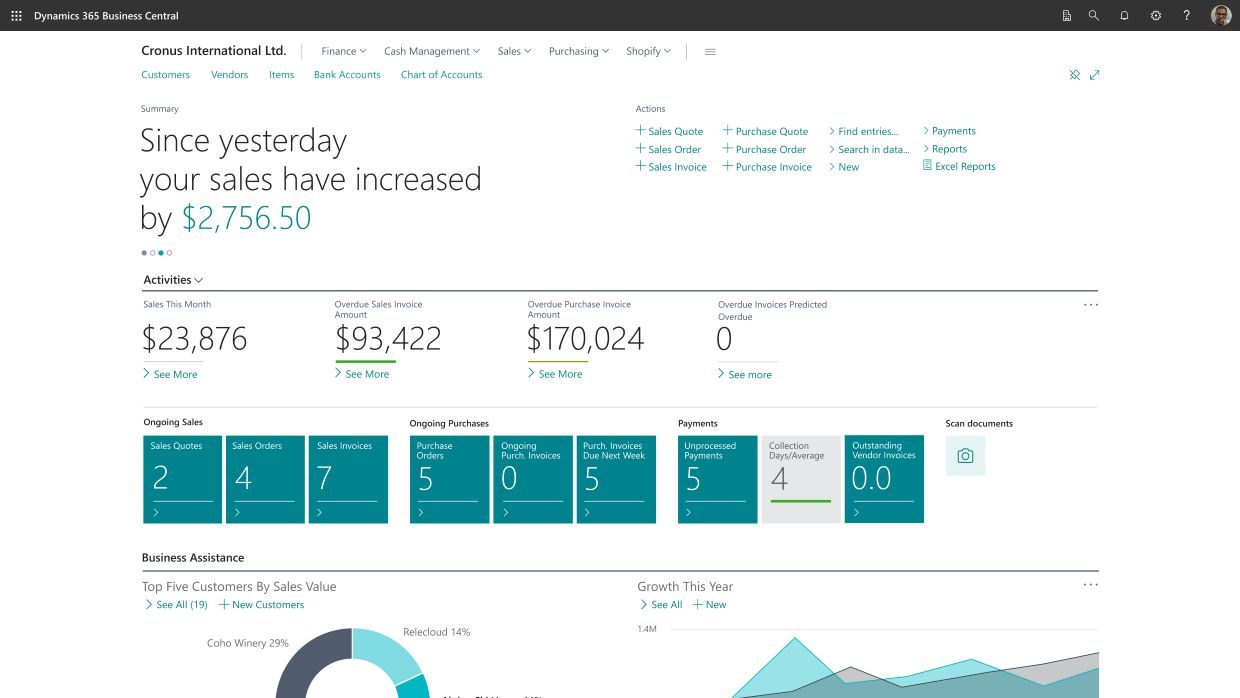
See how Business Central handles budgeting and forecasting from inside the platform:
-
Cloud ERP subscriptions for Canadian small businesses generally range from $70 to $200 per user per month, depending on the platform and licence tier. With 10 to 15 users, annual software costs land between roughly $10,000 and $36,000 CAD before tax and implementation. Total first-year investment including implementation typically falls between $40,000 and $150,000 for most small businesses.
Why Choose Gestisoft for Your ERP Software Price Evaluation
Gestisoft is a certified Canadian Microsoft Partner serving clients across Canada and North America. Bilingual implementation teams, transparent project scoping, and deep experience with Business Central across manufacturing, distribution, and professional services.
The reason ERP software price feels confusing is that most vendors do not scope your actual requirements before quoting. You get a per-user rate and a vague implementation range, and you are left to figure out the rest.
Gestisoft works differently. The process starts with your operations: how many users, which modules, what integrations you need, and what Canadian compliance requirements apply. From there, you get a budget range built around your reality, not a template.
Here is what working with Gestisoft looks like:
“As a customer since 2015, I would like to highlight the quality of support and expertise provided by Gestisoft for our Business Central application. Their competence is notable and has greatly contributed to the success of my business. I highly recommend them as a service provider for Business Central.”
That kind of long-term partnership is what turns an ERP software price into a genuine business investment. When your implementation partner understands your operations deeply enough to keep delivering value years after go-live, the return compounds.
Get an ERP Budget Built Around Your Business
Our team walks you through licensing, implementation, and total cost, scoped for your Canadian operations and your specific requirements.
 Book a free consultation
Liked what you just read? Sharing is caring.

June 10, 2026 by Muhammad Ali Iqbal by Muhammad Ali Iqbal SEO Content Strategist & Copywriter
Driven by a passion for search engine optimization, strategic content, and conversion-focused writing. A copywriter and content strategist who lives for content that ranks, engages, and delivers real business results.

