

Your CRM has the features. That part was settled when your company picked the platform and signed the licence. What probably wasn't settled is how those features connect to the way your sales team qualifies prospects or how your leadership team gets the numbers they need without a Friday afternoon spreadsheet exercise. A CRM business consultant is the person who works on that second problem. They're a business advisor who happens to work inside a CRM platform, and the engagement starts with your sales operation long before anyone opens a configuration screen. The title sounds like a technology role, but the work is closer to what a management consultant does for a sales organization.
For Canadian B2B companies, that advisory layer carries extra weight. Your CRM specialist keeps the system running. Your CRM software consultant helped you choose the technology. The CRM business consultant is the one asking whether the technology reflects how your company sells today or whether it still reflects the assumptions someone made during a rushed implementation two years ago. They start by auditing how your company sells and then compare that to what the CRM is configured to support. If there's a mismatch, their job is to rebuild the CRM so the data can be used to drive business outcomes. For Canadian B2B companies running longer sales cycles with multiple stakeholders on every deal, the mismatch between the platform and the sales process tends to be where the most revenue gets left on the table.
If your Canadian B2B company has reached the point where the CRM subscription feels like a sunk cost rather than a business tool, this is the role that changes that.
A CRM business consultant should understand how your team sells before they touch the software
Gestisoft starts every CRM engagement by mapping your business processes and building the platform around how your sales team works.
 Book a free consultation
What makes a CRM business consultant different from a technical CRM consultant
A technical CRM consultant knows the platform inside out. They can configure workflows, build automations, customize fields, and connect third-party tools. Those skills are necessary and your implementation won't get far without them. But they're the second half of a process that needs to start somewhere else.
A CRM business consultant brings the advisory layer that sits above the configuration work. Before anyone builds a pipeline stage or writes an automation rule, the consultant is in your boardroom learning why your deals stall at certain points in the cycle. They're sitting with your reps asking what information they wish they had before walking into a client meeting and reviewing how your marketing team hands leads to sales and whether the CRM reflects that handoff or whether leads land in the system and sit there until someone remembers to check. The CRM software consultant role focuses on technology evaluation and platform selection, which is a different conversation entirely from the business process work a business consultant leads.
The configuration decisions that follow those conversations look completely different from the ones a technical consultant makes working from a requirements spreadsheet. Pipeline stages get named in the language your reps use when they talk about deals internally, and the automation rules connect to specific moments your team identified as places where follow-up drops during busy weeks. The reporting layer ends up structured around the questions your CFO and VP of Sales raised during discovery rather than displaying whatever the platform shipped with as defaults.
A technical consultant builds what you tell them to build. A CRM business consultant spends enough time inside your operation to know what should be built before the conversation about configuration even starts. That upstream work is what determines whether your team ends up with a CRM they depend on or one they tolerate. Once the system is live, a CRM specialist takes ownership of the ongoing management and optimization, but the strategic foundation that makes their job possible comes from the CRM business consultant's discovery work.
When a Canadian business needs a CRM business consultant
The need usually surfaces during a growth phase. Your sales team has doubled in the last eighteen months and the CRM was configured for the smaller version of your company. The reps who joined recently were onboarded onto a system that nobody recalibrated after the team expanded. The CRM business consultant comes in to rebuild the platform around the company you've become.
Expansion across provinces creates a similar pressure point. A Canadian B2B company selling out of Ontario that starts closing deals in Quebec suddenly needs bilingual communications and data segmentation that tracks performance across both markets. A CRM business consultant maps the expanded operation so the configuration supports how your team is going to sell nationally.
“Everything has changed! We have better tracking capability that allows us to effectively manage our leads and opportunities. Our dashboard provides us with greater insight into opportunities and outcomes.”
Sometimes a mid-market Canadian company lands an enterprise client whose onboarding process includes vendor qualification questions about data residency and consent management. If the CRM can't produce clear answers from its own configuration, your team ends up scrambling to document compliance retroactively. A CRM implementation consultant handles the technical rebuild if the system needs one. A CRM business consultant determines whether rebuilding is necessary or if a targeted reconfiguration would satisfy the requirements without starting over.
Companies preparing for outside investment or acquisition face the highest-stakes version of this. Due diligence teams pull CRM data to validate pipeline claims and revenue forecasts. If the data doesn't hold up under scrutiny because reps haven't been maintaining it or because reporting was never configured for audit-ready numbers, that becomes a valuation problem. A CRM expert can clean up the data in the short term but it’s the CRM business consultant who restructures the platform so the data stays reliable after the engagement ends.
What a CRM business consultant delivers for a Canadian B2B company
The deliverables from a CRM business consultant engagement are what your team interacts with every day after the project ends. Getting them right is the entire point.
A sales process map that becomes the platform's blueprint
The sales process map is the first tangible deliverable and the one every other configuration decision traces back to. It documents pipeline stages, qualification criteria, handoff points between teams, and the reporting structure leadership needs. Most businesses don't have this documented anywhere before the consultant engagement, which is why so many CRM configurations end up reflecting the platform's defaults instead of the company's operations. Once the map exists, it becomes a reference point that outlasts the implementation project itself and serves as the foundation when the business evolves and the CRM needs to evolve with it.
A pipeline your reps recognise
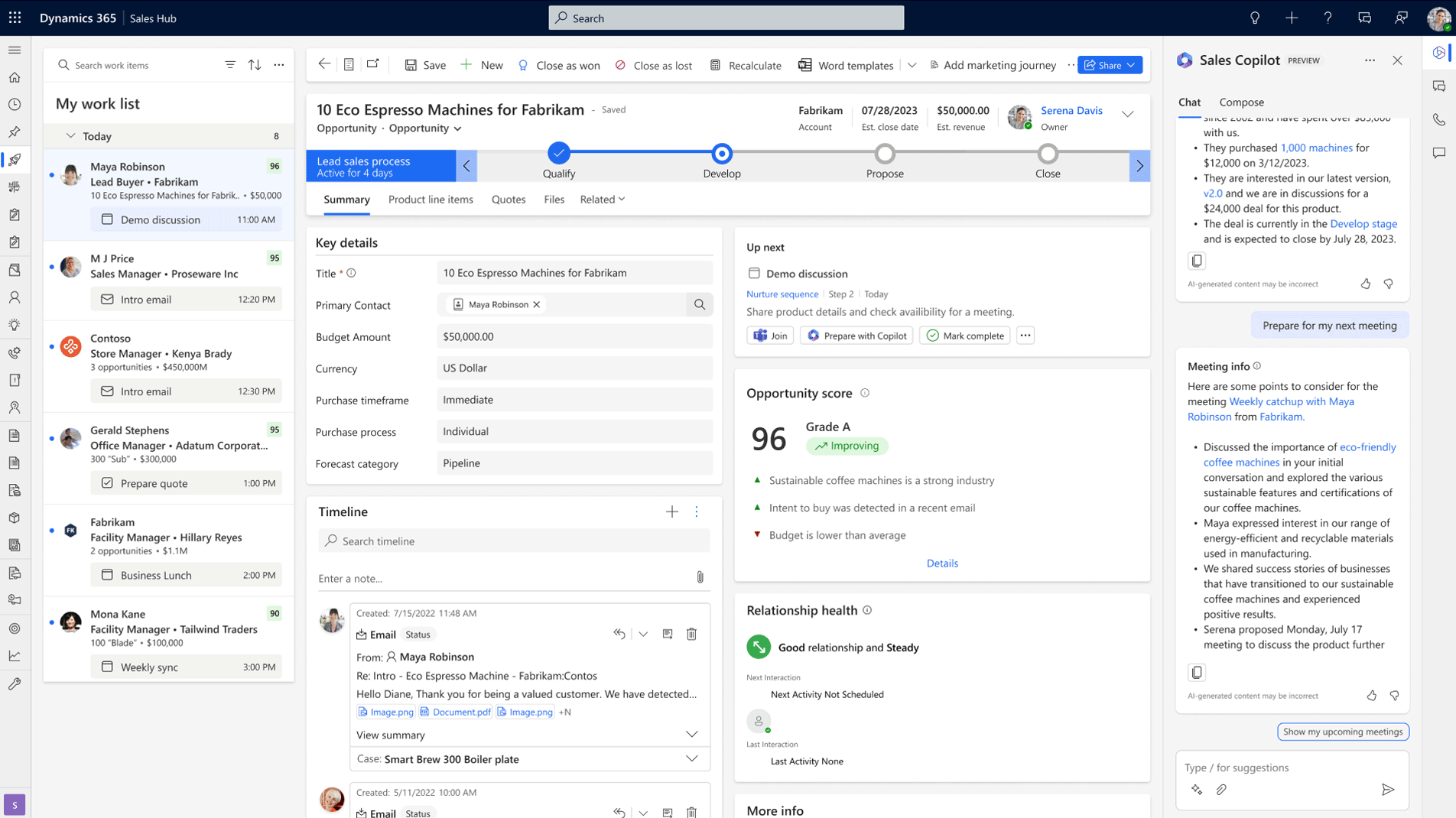
The pipeline configuration is where your team feels the CRM business consultant's work most directly. Win probabilities should be calibrated to your historical close rates, and the structure needs to support the complexity of your sales cycle whether that's four stages or twelve. Sales opportunity management for B2B deals with multiple contacts at the same account requires this level of specificity. The pipeline is also where data quality starts. If reps see their own process reflected in the system, they maintain it. If the stages feel arbitrary, the data degrades and every report built on top of it becomes unreliable.
“With a CRM like Dynamics 365, I can easily identify where each contact is in the process and prioritize the necessary actions. This allows me to manage my time optimally and ensure personalized follow-up for each potential customer.”
Automation that connects to real problems your team identified
The automation a CRM business consultant builds looks different from what comes out of a template library because every rule traces back to a conversation with your team about where things fall through the cracks. Lead assignment routes to the right rep automatically based on territory or product line, and follow-up reminders fire when deals sit at a stage longer than your average cycle length.
The automation layer also produces data that feeds back into your reporting. When every follow-up and deal progression triggers automatically, your leadership gets visibility into where the sales process is performing well and where deals are losing momentum without waiting for someone to compile that information manually. Over time, that data becomes the basis for refining the sales process itself, which means the CRM business consultant's work compounds long after the engagement ends.
Reporting that answers the questions your leadership asks
A sales dashboard showing pipeline value by stage and win rate by rep should be built and populated before the CRM goes live. Revenue forecasts for the quarter and average sales cycle length by deal size should be available without anyone building them manually. The best sales management software structures this reporting so leadership sees current numbers whenever they open the platform, and the CRM business consultant's job is to make sure the reports that get built are the ones your executive team will use in their weekly meetings.
The reporting layer is also the fastest way to build executive buy-in for the platform. When your CFO pulls a quarterly forecast and gets a complete answer in seconds, the CRM stops being a sales team tool and starts being something the entire leadership team depends on to grow the business.
“Thanks to the CRM reports, we can easily output sales projections and track our performance in real time. This helps us make strategic decisions based on concrete data.”
Integrations that connect the CRM to how your team communicates
Outlook email tracking against contact records and calendar sync for meetings should be tested and working before go-live. Power BI dashboards embedded inside the CRM give executive visibility without exports or manual data assembly. Each integration removes a step your team currently does by hand, and the fewer manual steps between your team's daily communication tools and the CRM, the higher adoption runs across every role that touches the platform.
The integration work is where a CRM business consultant's understanding of your team's daily habits pays off most directly. If most of your team's communication happens inside Outlook and Teams, the CRM gets configured to capture those interactions automatically so reps never have to log an email or a meeting manually. The integrations reflect how your company communicates, and the fewer steps between the communication and the CRM record, the more complete your data becomes over time.
A CRM business consultant pays for themselves when your team starts using the CRM instead of working around it
Gestisoft can show you what a properly configured Dynamics 365 looks like for a Canadian B2B sales team your size.
 Book a free consultation
How to evaluate a CRM business consultant for your Canadian business
The evaluation process for a CRM business consultant should feel like a preview of the engagement itself. A consultant who asks hard questions and challenges your thinking before you've signed anything is showing you how they'll operate once the project starts.
Start by asking how they begin an engagement
A CRM business consultant who opens with platform features and pricing before understanding your business is selling software configuration. The first conversation should be dominated by questions about how your team sells and where the current CRM falls short of what your leadership needs from it. If the consultant spends more time listening than presenting during that first meeting, CRM consulting is what you're getting. If they spend more time showing you the platform, you're getting technical configuration with a consulting label on the invoice.
Look for industry experience alongside platform certification
Microsoft certifications confirm the consultant knows Dynamics 365. Canadian B2B experience confirms they understand longer sales cycles and multi-contact deals. The top CRM consultants in Canada tend to specialize by industry, and asking for references from companies that sell the way you sell is the fastest way to verify depth.
Test their willingness to push back
A good CRM business consultant will tell you when what you're asking for would create problems in the data structure six months from now. If the consultant agrees with everything you suggest during evaluation, the result will reflect your assumptions instead of their expertise, and you're paying for expertise.
Confirm the Canadian context
The CRM business consultant should understand PIPEDA and how data access controls need to be configured. If your business serves clients in Quebec, bilingual email templates and French-language interfaces belong in the configuration from the start. Understanding how Canadian CRM platforms handle these requirements is a baseline expectation for anyone working in this market.
Clarify what happens after go-live
The first 90 days after launch determine adoption, and a CRM business consultant who disappears at go-live leaves your team to figure out the fine-tuning on their own. Ask for specifics on support duration and what optimization work is included versus billed separately.

What a CRM business consultant costs in Canada
The cost depends on what your business needs from the engagement. A CRM business consultant who comes in to audit and optimize an existing platform for a Canadian SMB running 10-20 CRM users typically charges $5,000 to $20,000 CAD. That scope covers evaluating the current configuration against how your team operates, identifying where the platform is underperforming, and reconfiguring the areas that need attention.
A full implementation engagement that includes business process mapping, platform configuration, data migration, and training runs $15,000 to $75,000 CAD for small businesses. Mid-market companies with larger teams and more complex requirements see $50,000 to $200,000 CAD. Dynamics 365 pricing on the licensing side sits on top of these figures, with Sales Professional at approximately $88 CAD per user per month and Sales Enterprise at approximately $128 CAD per user per month.
The number that never appears in the budget comparison is what your business spends every month on a CRM subscription that your team underuses. If your leadership is still pulling forecasts from spreadsheets because the CRM reporting wasn't configured for the questions they ask, that subscription fee is buying you a very expensive contact list. A CRM business consultant engagement typically pays for itself once the platform starts producing the pipeline visibility and reporting accuracy that justified the CRM purchase in the first place.
How Gestisoft approaches CRM business consulting for Canadian companies
Most of the CRM business consulting engagements we run are for companies whose sales team has given up on the platform. The subscription is being paid but the reps have found their own way of tracking deals that doesn't involve opening the system, and leadership stopped checking the CRM dashboard months ago.
We've sat across the table from enough Canadian B2B sales leaders to know that the conversation changes completely once the platform starts producing numbers leadership can use and reps can see the value in maintaining. That's when the CRM stops being a topic of frustration in internal meetings and becomes the tool the business runs on.
A CRM that was configured properly and continues to be refined as the business grows becomes operational infrastructure that leadership relies on for every forecast, every hiring decision, and every board presentation. That's the outcome we build toward from the first conversation.
The reason our clients stay with us past the initial engagement is that the CRM consultanting work we do produces a platform their team depends on daily. When the sales process evolves or the business expands into a new market, the configuration evolves with it because we're still in the conversation. That continuity is what turns a consulting engagement into a long-term partnership that compounds value year over year.
-
They evaluate how your business operates and configures a CRM platform to support your sales process and reporting needs. The role combines business advisory with technical CRM configuration, covering process mapping, pipeline design, automation setup, and post-go-live optimization.
Liked what you just read? Sharing is caring.

May 25, 2026 by Shelley Sunjka by Shelley Sunjka Copywriter & Marketing Strategist
Armed with a psychology degree and an irrational obsession with okapis, I've spent the last decade helping bold brands tell better stories. I believe the best writing bends grammar rules on purpose and makes people feel something. When I'm not deep in words or nerding out on buyer behaviour, I'm probably convincing my kids that impromptu kitchen dance parties are totally normal.

