
If you've started researching HubSpot competitors, you're probably at a crossroads most growing businesses reach eventually.
HubSpot is a good platform and a solid place to start. Its interface is clean, accessible, and for smaller teams trying to get sales and marketing working together, it does the job well. For this reason, a lot of businesses have built their early growth on it.
But pipelines get more complex and sales teams get bigger. Leadership starts wanting reporting that tells them something useful, and at some point the platform that felt like a perfect fit starts to feel a bit tight around the edges.
This is the moment most businesses start taking HubSpot competitors seriously.
There are a number of alternatives to consider and the right one depends entirely on where your business is headed.
Here's a breakdown of the top HubSpot competitors worth knowing about in 2026, so you can make your decision easier.
Why businesses start searching for HubSpot competitors
The problem usually appears because what a business needs from a CRM at twenty employees looks very different from what it needs at a hundred. It's rarely one dramatic moment that triggers the search for HubSpot competitors. It's usually a slow build of frustrations that eventually tips the balance. Here are some signs you might be ready to level up:
- The sales pipeline has outgrown the way it was originally set up
- Reporting has become too basic to support real revenue forecasting
- Connecting the CRM to financial systems or customer service platforms is proving harder than expected
- The sales process has evolved but the CRM structure hasn't kept up
- Costs have climbed as the team has grown and more features have been added
- Leadership is making decisions based on spreadsheets because the CRM data can't be trusted
Any one of these on its own is manageable. When several show up at the same time, that's usually when HubSpot competitors start getting googled.
Key factors to evaluate when comparing HubSpot competitors
Not all CRM platforms are built for the same kind of business, and a feature list alone won't tell you which one is the right fit. When comparing HubSpot competitors, these are the areas that actually separate the platforms worth considering from the ones that will create new problems six months down the line.
Sales pipeline depth
Some platforms are built primarily around marketing automation and treat the sales pipeline as a secondary feature. If your team is running a structured sales process with multiple stages and real forecasting needs, you need a CRM that co-ordinates this seamlessly.
Scalability
A CRM that works beautifully for a ten person team can become a nightmare at fifty. The right CRM isn’t just the platform that handles more users, but the one that can adapt to a more complex sales process without needing a full rebuild.
Integration capabilities
The CRM sits at the centre of how your business tracks revenue, which means it needs to connect reliably with your financial systems. Weak integrations create data gaps which mean the numbers leadership are relying on aren't accurate.
Automation that fits your process
Most HubSpot competitors offer workflow automation. The difference is in how deep that automation goes. Surface level automation saves a little time. Properly configured automation changes how the whole team operates.
Total cost over time
The subscription price is the starting point. Implementation, configuration, training and the cost of switching systems later all factor in. The right platform is the one that delivers the most value over time, not the one with the lowest monthly fee.
Evaluating HubSpot competitors and not sure where to start?
Understanding which CRM fits your sales process takes more than reading a feature list. A short conversation can help you decide what your business needs.
 Free discovery call
HubSpot competitors worth considering in 2026
Here's a look at the platforms that come up most often when businesses start seriously evaluating their options.
1. Microsoft Dynamics 365 as a HubSpot competitor

When businesses start seriously evaluating HubSpot competitors, Microsoft Dynamics 365 tends to come up early in the conversation, and for good reason.
Where HubSpot is primarily a marketing and sales tool with CRM functionality built around it, Microsoft Dynamics 365 works the other way around. The CRM is the foundation, and everything else, including marketing, customer service, field service and finance, connects to it.
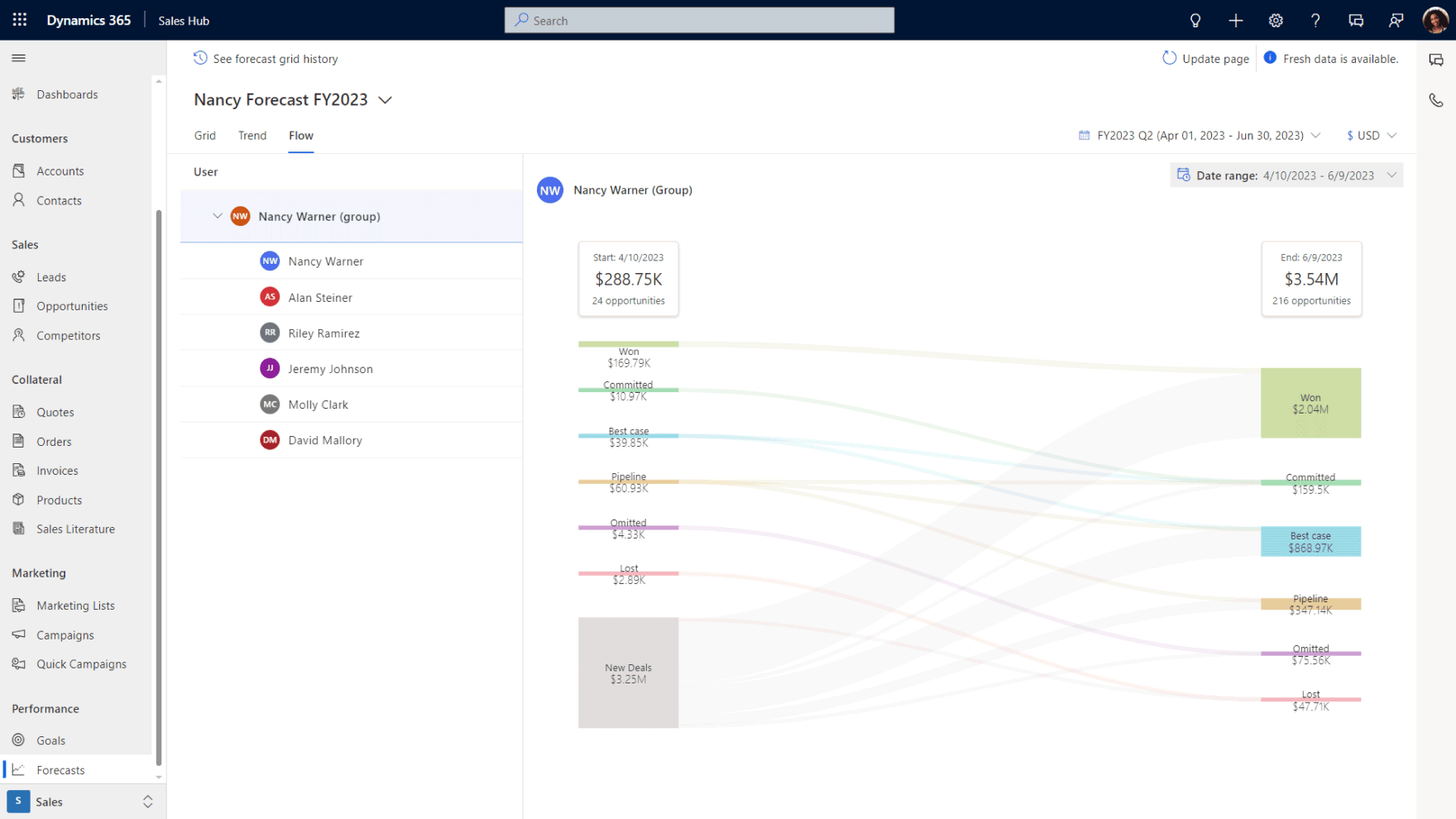
The sales pipeline functionality is considerably deeper than HubSpot's. You can build pipeline stages that reflect exactly how your business qualifies and closes deals, attach forecasting models to real opportunity data, and give leadership reporting that doesn't require someone to manually pull a spreadsheet together first.
The Microsoft ecosystem integration is also worth calling out. If your team is already working in Outlook, Teams and Excel every day, Dynamics 365 connects to all of it natively. Copilot, Microsoft's AI layer, sits across the whole platform and can surface insights from both your CRM and ERP data at the same time, which is something most HubSpot competitors simply can't do.
The downside is that Dynamics 365 is not a plug and play system. It needs to be configured properly by a CRM specialist to deliver on its potential, which is why most businesses work with a partner like Gestisoft to implement it. Done well, it becomes one of the most powerful HubSpot competitors on the market. Done poorly, it's an expensive and confusing database.
Microsoft Dynamics 365 is a different kind of HubSpot competitor.
Unlike most alternatives, it connects your CRM and ERP in one environment. Let's show you what that means in practice for your business.
 Free discovery call
Salesforce is the name most people think of when enterprise CRM comes up, and it earns that reputation. It's one of the most capable and customisable platforms available, with a vast ecosystem of integrations, a huge global partner network and decades of development behind it.
For large organisations with dedicated Salesforce administrators and complex multi-region sales operations, it's a legitimate option when evaluating HubSpot competitors. The depth of what you can configure and automate is impressive at that scale.
The harder conversation is around cost. Licensing starts at a reasonable point but climbs fast once you start adding the features most businesses need. Third party integrations through the AppExchange can add up quickly too, and implementation typically requires experienced consultants. For mid-sized Canadian businesses without an internal Salesforce team, the total investment often ends up higher than expected.
Salesforce also runs on its own ecosystem rather than connecting natively to tools like Outlook, Teams or Power BI in the way Dynamics 365 does. If your business runs on Microsoft, that gap requires workarounds.
3. Zoho CRM as a HubSpot competitor

Zoho is one of the more interesting HubSpot competitors for businesses where budget is a real constraint but functionality still matters. It covers sales pipeline management, marketing automation and basic reporting at a price point that's hard to argue with, and if you're already using other Zoho products like Zoho Books for accounting, the integration between them is straightforward.
For teams moving off of spreadsheets or outgrowing a basic CRM for the first time, Zoho can feel like a significant upgrade without being overwhelming.
Where it starts to show its ceiling is when sales operations get more complex. Forecasting hierarchies, advanced reporting and deeper pipeline configuration are available but don't feel as robust as what you'd get from Dynamics 365 or Salesforce. The interface has also historically lagged behind more modern platforms, which can affect adoption.
Zoho is worth a serious look for small to mid-sized businesses that need broad CRM functionality at an accessible price. For businesses prioritising long term scalability and deep Microsoft integration, it's likely a stepping stone rather than a final destination.


Pipedrive was built with one job in mind and that’s to help sales teams see exactly where their deals are and what needs to happen next. As HubSpot competitors go, it's one of the cleaner and more focused options on this list.
The visual pipeline is genuinely intuitive. Reps can see at a glance what's moving and where they need to put their attention. Setup is fast, onboarding is straightforward and teams tend to adopt it without much resistance.
Where Pipedrive runs out of road is when the business needs more than deal tracking. Forecasting at a leadership level, territory management, complex reporting and meaningful integration with financial systems are not where it shines. It's a sales execution tool more than a business intelligence platform.
For small teams with short sales cycles who want clarity and simplicity over depth, Pipedrive is a solid choice. For businesses that need their CRM to inform strategic decisions, it'll likely feel limited sooner than expected.
5. Freshsales as a HubSpot competitor

Freshsales sits at the middle ground among HubSpot competitors. It's more capable than entry-level tools like Pipedrive and doesn't carry the weight or the price tag of Dynamics 365 or Salesforce, which makes it an appealing option for teams that have outgrown their current setup but aren't ready for a full enterprise platform.
The interface is clean and modern, contact management is solid and the built-in AI lead scoring helps sales teams prioritise without having to manually sift through the pipeline. If your business also uses other Freshworks products for customer service or IT support, the integration between them works well.
The limitations show up when reporting and forecasting need to get more sophisticated. Multi-team pipeline structures, complex territory logic and executive-level revenue planning push Freshsales towards the edge of what it can handle comfortably. It's a strong mid-market option but businesses moving fast tend to find themselves evaluating other HubSpot competitors again within a couple of years.
Not every HubSpot competitor is built for a business that's scaling.
Some platforms shine at ten people and struggle at fifty. Getting this decision right the first time saves a very painful migration later.
 Free discovery call
Monday CRM grew out of a project management tool, and you can feel that in how it approaches sales. If your team thinks visually and wants to manage deals the same way they manage tasks and projects, it clicks pretty naturally.
The flexibility is real. You can customise boards and workflows without needing a developer, which appeals to teams that want control over how things look and move without relying on IT to make changes. For businesses where sales and project delivery are tightly connected, having both in the same environment has obvious appeal.
The trade-off is that Monday CRM is better at tracking activity than driving revenue decisions. Forecasting is relatively light, pipeline reporting doesn't go very deep and territory management requires workarounds rather than native structure. As a tool for managing deals day to day it works well. As a platform for leadership to understand pipeline health and make strategic calls, it falls short of the stronger HubSpot competitors.
7. Zendesk Sell as a HubSpot competitor

Zendesk is best known for customer service software, but Zendesk Sell is a proper sales CRM that gets evaluated as a legitimate HubSpot competitor by businesses where the line between sales and customer support is blurry.
The appeal is the connection between the two sides. If your sales team and your support team are working with the same customers, having deal history and support tickets living in the same environment removes a lot of friction. Reps can see the full picture of a customer relationship without chasing updates across different systems.
Where Zendesk Sell is less convincing is when sales operations need to get more strategic. Pipeline forecasting, territory management and executive reporting are functional but not deep. It's a solid choice for businesses where customer experience is the primary lens, but less so for organisations where revenue forecasting and pipeline visibility are the main priority.


SugarCRM doesn't get talked about as much as the bigger names, but it's one of the legitimate HubSpot competitors for mid-market businesses that need more pipeline depth than HubSpot offers without the cost and complexity of a full enterprise platform.
The configurability is a genuine strength. Workflows, reporting structures and pipeline stages can be shaped around how the business sells rather than forcing the team to adapt to a generic template. For companies that have hit HubSpot's ceiling but aren't ready to commit to Dynamics 365 or Salesforce, it solves a gap in the market.
The limitation is the ecosystem. SugarCRM doesn't integrate natively with Microsoft tools, and the partner network in Canada is considerably smaller than the major platforms. Finding experienced implementation support and long term optimisation help can be harder, which is worth factoring in before committing.
How to choose the right HubSpot competitor for your business
Features are easy to compare. Fit is harder. Before you commit to anything, here's a practical checklist of questions worth running through before deciding which of these HubSpot competitors are right for you:
Does the sales pipeline reflect how you sell?
If you can't configure the pipeline to match reality, the data coming out of it won't be reliable. Similarly, if you're spending more time working around the CRM than inside it, that's the answer right there.
Can leadership trust the reporting?
If someone is building a spreadsheet every time a revenue question gets asked, the CRM isn't doing its job.
Does it connect to the rest of the business?
The CRM sits at the centre of how revenue moves through the company. If it can't talk to your financial systems reliably, you'll end up with data gaps that undermine every decision made from that data.
Will it still work for you in three years?
Some HubSpot competitors are great at your current size and painful at the next stage. It's worth stress-testing the platform against where the business is headed, not just where it is today.
How deep does the integration with your financial systems go?
Surface level connectivity and genuine two-way data flow are very different things. If the numbers in your CRM and the numbers in your finance system don't match, trust in both erodes fast.
What does proper implementation actually cost?
The subscription is just the starting point. Configuration, training and ongoing support all affect the real investment. A platform that looks cheaper upfront can end up costing significantly more once everything is factored in.
Who supports you after go-live?
Implementation day is the easy part. What matters is whether your partner is still invested six months later when the real questions start coming up.
The right HubSpot competitor depends entirely on how your business sells.
Gestisoft works with Canadian businesses to find the right fit and configure it properly from day one.
 Free discovery call
Why Microsoft Dynamics 365 is one of the most powerful HubSpot competitors
Most HubSpot competitors solve one part of the problem. Microsoft Dynamics 365 is built to solve the whole thing.
The difference shows up when a business reaches the point where the CRM isn't just tracking sales activity but actively informing how the company makes decisions. Who to hire, where to expand, which deals to prioritise, and how revenue is likely to land at the end of the quarter. That kind of visibility requires a platform where the data is structured properly and the reporting doesn't need someone to manually assemble it.
Dynamics 365 also does something most HubSpot competitors can't. Because it spans both CRM and ERP, sales data and financial data live in the same environment. Leadership gets a complete picture of the business rather than two separate systems that need to be reconciled every time a strategic question gets asked.
Add Copilot into that environment and the AI is drawing from the full operational picture of the business, not just emails and calendar data.
The platform requires proper implementation to deliver on that potential, which is exactly where Gestisoft comes in. Getting Dynamics 365 configured around how your business operates is what turns it from an expensive piece of software into something that generates meaningful ROI based on real data.
Why Canadian businesses choose Gestisoft when evaluating HubSpot competitors
Picking the right platform is one decision. Getting it to work for your business is another one entirely.
Gestisoft are Microsoft Solutions Partners who specialise in Dynamics 365, and we're one of the very few partners in Canada who work across both CRM and ERP. That means when we configure Copilot and Dynamics 365 for your business, the AI is pulling from your complete operational picture, not just one part of it.
We don't show up with a standard deployment plan and hope it fits. The implementation starts with how your business sells, how your pipeline is structured and what you need to see in order to make decisions that move your business forward. The platform gets built around that reality rather than the other way around.
And we offer ongoing support after go-live, which makes an enormous difference to whether adoption sticks across the organisation.
If you've been evaluating HubSpot competitors and want to understand what Dynamics 365 could look like properly configured for your business, our team would love to hear from you.
Get in touch with Gestisoft and let's figure out what fits your business.
-
Many businesses evaluating HubSpot competitors look at platforms that offer stronger CRM capabilities as their sales teams grow. Microsoft Dynamics 365 and Salesforce come up most often, with Zoho a common choice for more budget conscious teams. The right choice usually depends on how complex the sales process has become and how the organisation plans to scale its CRM system over time.
Liked what you just read? Sharing is caring.

March 23, 2026 by Shelley Sunjka by Shelley Sunjka Copywriter & Marketing Strategist
Armed with a psychology degree and an irrational obsession with okapis, I've spent the last decade helping bold brands tell better stories. I believe the best writing bends grammar rules on purpose and makes people feel something. When I'm not deep in words or nerding out on buyer behaviour, I'm probably convincing my kids that impromptu kitchen dance parties are totally normal.

