The CRM went live on a Tuesday in March.
By Friday, two of the five sales reps had logged in. One of them was just looking for a phone number. The other was trying to figure out how to turn the email notifications off.
Six months later, the system is technically still "live." There are 340 contacts in it. Nobody is entirely sure how they got there, or whether any of them are current. The pipeline has four deals in it, all marked as "in progress," all untouched since April. Leadership asked for a forecast last week and the answer came back in a spreadsheet.
The software wasn't the issue. It never was.
The issue was that nobody designed the system around how the business operates. Nobody mapped the sales process before building the pipeline. Nobody thought through what data needed to move across from the old system. How the team was going to be trained and by who, or what good adoption would even look like.
That's the job of a CRM implementation consultant. It's a bigger job than most businesses expect.
What exactly is a CRM implementation consultant?
The CRM implementation consultant is the person who takes a CRM platform and builds it into a working business system. They integrate it into your team structure so that it reflects how your company sells, and what your leadership needs to see to make good decisions.
A CRM platform on its own is just potential. The fields, structures, pipeline stages, and dashboards that come out of the box mean very little until someone has deliberately shaped them around your business. Left to default settings, most CRM platforms end up as expensive contact lists with a pipeline nobody trusts.
The CRM implementation consultant closes that gap. They arrive before the system goes live, spend time understanding how your business operates, and build a structure your team can work inside. They handle the technical configuration, manage the migration of your existing data, connect the CRM to the tools your team already relies on, and ensure people are trained before they're expected to perform inside the new system.
For Canadian businesses investing in platforms like Microsoft Dynamics 365, the implementation decisions made early in the process have consequences that ripple through the whole structure for years. A CRM implementation consultant is the person who makes sure those early decisions are the right ones.
Get it right from the start and it’ll cost considerably less than unpicking it later.
A CRM implementation done properly is one your team will still trust two years from now.
Gestisoft works with growing Canadian businesses to build Microsoft Dynamics 365 around their real sales process, from discovery through to go-live and beyond.
 Free discovery call
What a CRM implementation consultant does
The reason CRM implementations fail is rarely the software. It's that nobody followed a clear process before, during, or after the build. A good CRM implementation consultant brings that process with them.
Here's what that looks like in practice.
Step 1: Understanding your business before touching the software
The first thing a CRM implementation consultant does is ask lots of questions!
- How does a lead become a qualified opportunity in your business?
- Who owns the relationship at each stage of the sale?
- What does your sales cycle look like and where does it most commonly break down?
- What does leadership need to see every Monday morning to feel confident about the pipeline?
The answers to these questions directly determine how the CRM gets built. A consultant who skips this step and goes straight to configuration is essentially building a house without measuring the plot first. It might look fine on the surface, but something is going to fail.
This discovery phase is where a CRM implementation consultant earns their fee before they've written a single line of configuration.
Step 2: Designing a structure that reflects how you sell
Once a consultant understands how the business operates, they translate that understanding into the architecture of the CRM itself.
- Pipeline stages get defined around real buyer behaviour rather than generic templates.
- Data fields are built to capture the information your team needs at each stage of the sale, not pieces of information that might theoretically be useful one day.
- Qualification criteria get baked into the process so opportunities can't advance without the right information attached to them.
This is the work that separates a well-implemented CRM from one that frustrates everyone within months. The structure has to mirror reality. If it doesn't, your team will stop using it and go back to spreadsheets.
Step 3: Moving your data across without losing what matters
Data migration is where a lot of implementations fall apart.
The old system of spreadsheets, the exported contact lists. They all come with years of inconsistency baked in like dead leads, duplicate records, missing fields and contacts assigned to sales reps who left years ago. A CRM implementation consultant manages this process with enough care that the data arriving in your new system is clean and trustworthy from day one.
This matters more than most businesses realise going in. A CRM populated with unreliable data produces unreliable reports.
Step 4: Connecting the CRM to your existing tools
A CRM that sits in isolation from the rest of your business creates more work.
Your team uses email. They may use a quoting tool, a marketing platform, or an ERP system. A CRM implementation consultant maps out those integrations and makes sure information flows between systems without your team having to manually move it.
For businesses running Microsoft tools like Outlook, Teams, or Power BI. This integration layer is where a platform like Dynamics 365 starts to show its real value when it’s been connected properly.
Step 5: Getting your team to use the system
A consultant can build a beautifully configured CRM and it will sit largely unused if the team hasn't been properly brought along. Training needs to go beyond a two-hour walkthrough on launch day. People need to understand not just how to use the system, but why it has been built the way it has, and what it means for their day-to-day work.
A CRM implementation consultant designs adoption so that using the system feels like the path of least resistance, not an added burden on top of an already full day.
A CRM implementation consultant makes the difference between software that works and software that sits there.
Gestisoft works with Canadian businesses to implement Microsoft Dynamics 365 around how they sell.
 Free discovery call
Why CRM implementations go wrong
Most businesses that end up with a broken CRM chose a perfectly capable platform, then either rushed or underestimated the implementation of it. Alternatively, they handed it to someone who treated it as a technical project rather than a business one. This is the situation a good CRM implementation consultant exists to prevent.
These are the failure points that come up most often.
- The process never got mapped. The team went straight from buying the software to building inside it. Nobody sat down to document how deals move through the business. The result is a pipeline that looks plausible but doesn't reflect reality, which means the data coming out of it can't be trusted either.
- The CRM was built for the ideal sales process, not the real one. There's often a gap between how leadership thinks the team sells and how they sell in practice. A CRM built around the ideal version will get ignored by the people who live in the real one.
- Data migration was treated as an afterthought. Old spreadsheets got imported as-is. Nobody cleaned the data first. Thus, the new system inherits all the same problems as the old one, just in a more expensive package.
- Training happened once and then stopped. A single onboarding session at launch doesn't build habits. When people get stuck, they find workarounds. Workarounds become the new normal. The CRM becomes something people file information into rather than something they use to run their day.
- Nobody owned it after go-live. The consultant left, or the internal project lead moved on to something else, and the system started drifting almost immediately. Fields got ignored, stages got skipped, and reports stopped reflecting what was happening in the pipeline.
The common thread running through all of these is the absence of a structured process led by someone who has done it before. A CRM implementation consultant builds the system, and then protects the business from the predictable mistakes that occur when they aren't in the room.
Is a CRM implementation consultant the same as a CRM administrator?
No, and confusing the two is an expensive mistake.
A CRM administrator manages an existing system. They handle user permissions, maintain data hygiene, update fields, and troubleshoot configuration issues as they arise. The role is operational and reactive by nature. Good administrators are essential, but their job assumes the system was built correctly to begin with.
A CRM implementation consultant works upstream of that. Their job is to design the system architecture before it goes live. That means defining the data model, building the business process flows, and establishing the governance rules that determine how information moves through the platform. They make structural decisions that the administrator will work inside for years.
The confusion between the two roles tends to surface when a business hands an implementation project to their internal IT team or an existing CRM admin. Both may be technically proficient on the platform. What they often lack is the combination of sales process knowledge and configuration experience needed to make consequential architectural decisions under time pressure.
On a platform like Microsoft Dynamics 365, those decisions compound quickly. How opportunity records are structured affects forecasting. How business process flows are configured affects user adoption. These are foundational choices that a CRM implementation consultant is specifically equipped to get right the first time.

How to evaluate a CRM implementation consultant before you hire one
Relevant Microsoft credentials for Dynamics 365 is the minimum any consultant worth considering should hold. What separates a competent CRM implementation consultant from a good one is harder to verify from a CV.
Start by examining their discovery process. A consultant who arrives at a first meeting with a standard project plan before they've asked meaningful questions about your sales motion is telling you something important. The quality of their questions in early conversations is a more reliable signal than their case study library.
Look at their approach to change management. Technical configuration is half the job. The other half is designing an adoption path that accounts for how people resist new systems. Consultants who treat training as a single line item in a project plan tend to leave businesses with well-built CRMs that nobody logs into.
Ask about post-implementation support. A serious CRM implementation consultant will have a clear position on what ongoing optimisation looks like and who owns it after the project closes.
Questions worth asking before you sign anything:
- How do you handle a situation where the business process doesn't fit the platform's native capabilities? The answer reveals both their technical depth and their judgment.
- What does your data migration methodology look like? Vague answers here are a red flag. Data migration requires a thorough documented approach before anything moves across.
- Can you show us an example of an implementation that didn't go to plan and how you managed it? Every honest consultant has one.
The right questions before you hire a CRM implementation consultant save considerable time and money later.
Gestisoft has been implementing Microsoft Dynamics 365 for Canadian businesses since 1997. We're happy to be the team you put those questions to.
 Free discovery call
How long does CRM implementation take?
The timeline depends almost entirely on scope, and scope is something most businesses underestimate at the start.
A straightforward implementation for a small sales team with clean existing data and a single pipeline without complex integrations, can be completed in six to eight weeks. That number grows quickly once you introduce multiple business units, legacy data that needs significant cleaning, custom business process flows, or integrations with ERP and finance systems.
The variable that blows most timelines is usually internal decision-making speed. A CRM implementation consultant can only move as fast as the business can answer questions about configurations, and then sign off on design decisions. Projects that stall tend to stall on the client side, not the consultant side.
For mid-sized businesses implementing Microsoft Dynamics 365 with moderate complexity, a realistic planning horizon sits between ten and twenty weeks from discovery to a stable go-live. Canadian organisations that operate across multiple provinces, or that need bilingual system configurations, should factor additional time into that estimate. Businesses that treat implementation as a background project and staff it accordingly should plan for the longer end of that range.
One figure worth keeping in mind is that the cost of a delayed or failed implementation consistently exceeds the cost of a properly resourced one. Time spent in discovery and design is risk mitigation not an overhead.

Does Microsoft Dynamics 365 need a CRM implementation consultant?
Microsoft Dynamics 365 is an incredibly powerful platform. It is also one that will humble a business that underestimates what proper implementation requires.
The configurability that makes Dynamics 365 attractive is the same thing that makes it unforgiving when the setup is rushed. The platform can be shaped to support almost any growing business sales process and reporting structure. But those decisions have to be made deliberately and in the right sequence. A misconfigured security model creates reporting blind spots that are difficult to trace. Business process flows designed without a clear understanding of the sales cycle produce pipeline data that looks structured but can't be trusted for forecasting.
A CRM implementation consultant who specialises in Dynamics 365 brings something beyond general CRM knowledge. They understand which configuration decisions are reversible and which ones aren't. They know where the platform's native capabilities should lead the design, and where customisation creates more problems than it solves. They've seen how Dynamics 365 behaves six months after go-live, not just on launch day.
For Canadian businesses already running Microsoft tools across their organisation, a well-implemented Dynamics 365 CRM connects into that ecosystem in ways that change how teams work. For businesses where the implementation was handled without that CRM specialist knowledge, the platform often ends up underused and quietly resented.
The difference between those two outcomes usually comes down to who led the implementation.
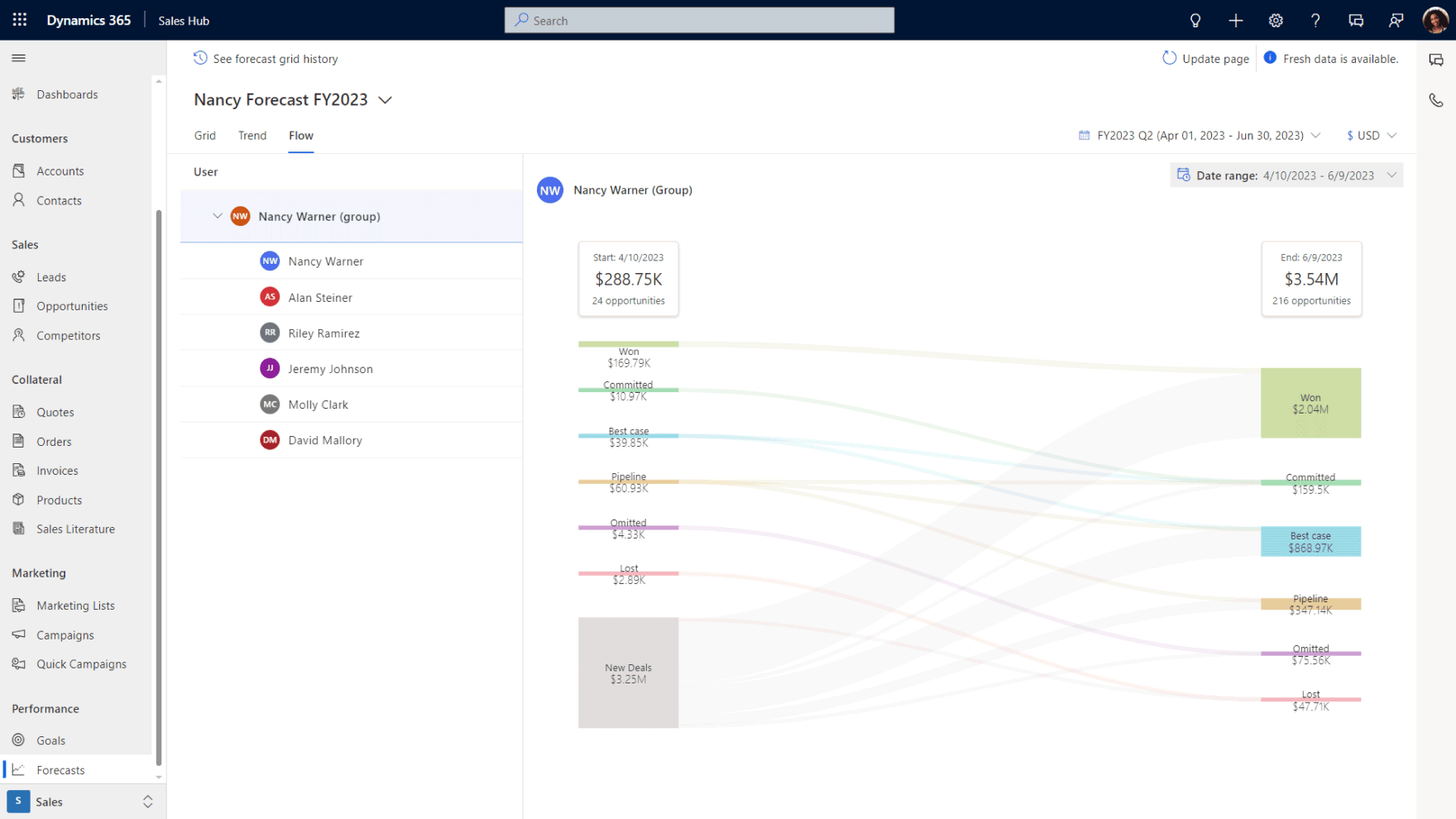
How Gestisoft approaches CRM implementation consulting for Canadian businesses
Gestisoft has been implementing Microsoft Dynamics 365 for Canadian businesses since 1997. That longevity matters less as a credential and more as a description of how many implementations the team has worked through, including the ones that came in with messy data and unclear processes that needed to be rebuilt from scratch.
The approach goes deeper than most businesses expect. Before any configuration begins, Gestisoft works with sales leadership and operations to understand how revenue moves through the business. That means understanding where deals stall and what information managers need to make confident forecasting decisions. The team's daily workflow also needs to be supported by the new system. The implementation is built around these realities, not the platform's default settings.
What sets Gestisoft apart as a CRM implementation consultant is accumulated experience with how Dynamics 365 performs in Canadian business environments specifically. The reporting requirements, the sales structures, and the integration needs that come up in manufacturing, distribution, and professional services organisations operating across Canadian provinces.
The goal in every implementation is straightforward. A CRM that leadership can trust for forecasting and that sales teams find easier to use than to avoid. This will support the business as it grows rather than needing to be rebuilt every time something changes.
If you’d like to explore how your CRM could be structured to better support your business, we’d love to hear from you.
-
A CRM implementation consultant designs and builds a CRM system around how a business operates. That includes mapping the sales process, configuring the platform, managing data migration, connecting integrations, and guiding team adoption. The goal is a system that supports real business decisions rather than one that stores information nobody trusts.
Liked what you just read? Sharing is caring.

March 31, 2026 by Shelley Sunjka by Shelley Sunjka Copywriter & Marketing Strategist
Armed with a psychology degree and an irrational obsession with okapis, I've spent the last decade helping bold brands tell better stories. I believe the best writing bends grammar rules on purpose and makes people feel something. When I'm not deep in words or nerding out on buyer behaviour, I'm probably convincing my kids that impromptu kitchen dance parties are totally normal.


