

Key Takeaways: Microsoft Dynamics 365 Business Central vs SYSPRO:
- Tax and language are native in Business Central, not bolted on. GST, PST, QST, and full French Canadian support run out of the box. SYSPRO can get there, but it typically takes more configuration work.
- Business Central fits a company that's more than a shop floor. SYSPRO's manufacturing depth is hard to beat for a pure job shop, but Business Central covers finance, distribution, and CRM on the same platform without middleware.
- Deployment and data residency favour Business Central for most Canadian buyers. It's cloud-first on Azure, with Canadian data centres in Toronto and Québec City, while SYSPRO still leans on-premise for manufacturers who want direct control.
- The cost difference shows up in implementation, not the license fee. Business Central runs roughly 110 to 157 CAD per user monthly through Canadian partners. SYSPRO's pricing depends heavily on deployment model, and either platform's setup cost will outweigh the monthly bill in year one.
Most comparisons of Microsoft Dynamics 365 Business Central vs SYSPRO are written for an American reader who has never dealt with GST, PST, QST, or a bilingual shop floor. That's a real gap if you run a manufacturer or distributor out of Mississauga, Winnipeg, or Trois-Rivières, because the two systems behave differently once Canadian tax rules, cross-border shipping, and francophone staff enter the picture.
This is the version of Microsoft Dynamics 365 Business Central vs SYSPRO built for that reader. No feature-matrix filler, no US pricing quietly presented as universal. Just the differences that change how a Canadian operations team runs its day, and what Gestisoft sees on the ground when manufacturers and distributors make this call.
Both platforms come up constantly in Microsoft Dynamics 365 Business Central vs SYSPRO shortlists, and both serve small and mid-sized manufacturers well. SYSPRO has spent almost five decades refining shop floor depth for discrete and process manufacturers. Business Central has spent that same stretch, through its NAV lineage, building a connected finance and operations platform inside the Microsoft ecosystem. Neither is the wrong answer on its own. But one of them tends to fit a Canadian growth trajectory better, and by the end of this piece you'll know which one and why.
See Microsoft Dynamics 365 Business Central vs SYSPRO Mapped to Your Tax Setup
Confirm how GST, PST, and QST will run in your system before you choose. Book a thirty-minute session with a Canadian Business Central specialist.
 Book a free consultation
What Changes When You Compare Microsoft Dynamics 365 Business Central vs SYSPRO in a Canadian Market
Two things change the calculus north of the border immediately.
1. Tax - Microsoft Dynamics 365 Business Central vs. Syspro
Every province stacks its own sales tax on top of the federal GST, and Ontario, Quebec, and BC each handle it differently. A system built primarily for the US market treats Canadian tax as a bolt-on. Business Central, covered in full in Gestisoft's what Business Central replaces for growing companies, was built inside Microsoft's Canadian infrastructure from day one, so provincial tax logic sits natively in the platform instead of getting patched in later. If you're vetting a Business Central specialist in Canada, this is one of the first things to ask about.
2. Language - Microsoft Dynamics 365 Business Central vs. Syspro
A shop floor in Trois-Rivières or Saint-Hyacinthe often runs bilingually with French as the working language for production staff and English for head office reporting. Business Central ships with full French Canadian interface and reporting support out of the box. SYSPRO's French support exists, but reaching fully bilingual documents and reporting end to end tends to take more configuration work.
That difference alone reframes Microsoft Dynamics 365 Business Central vs SYSPRO for a lot of Canadian buyers before a single feature gets compared.
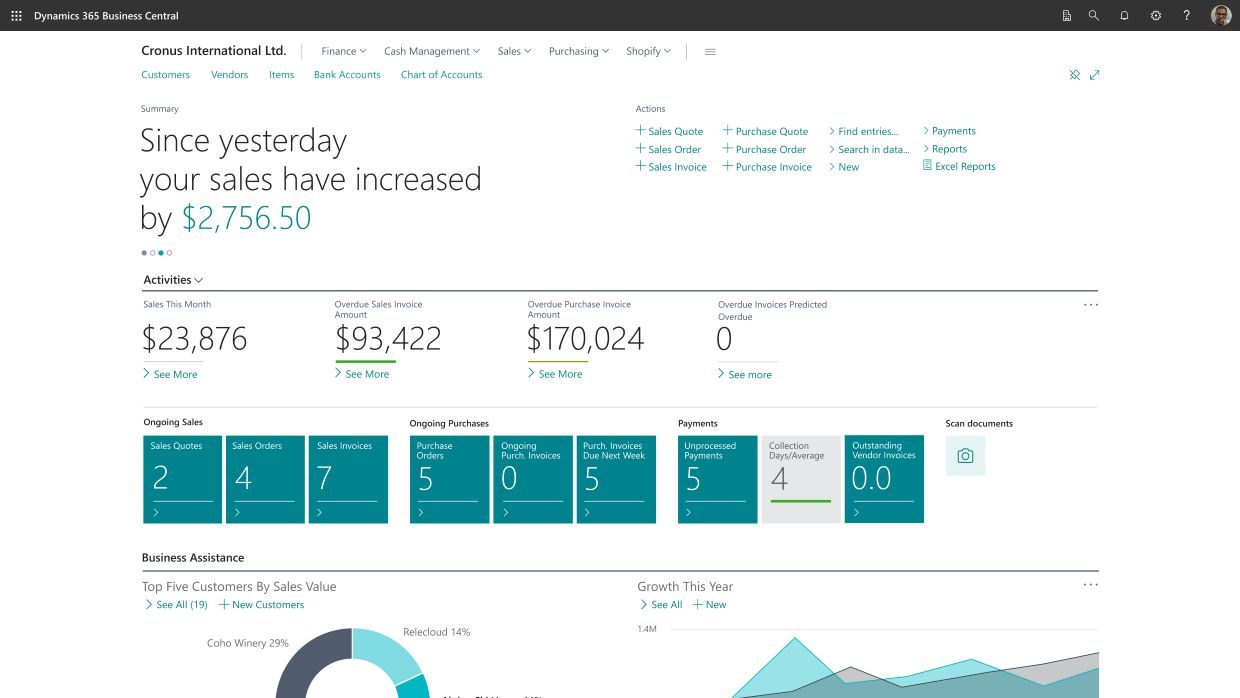
Microsoft Dynamics 365 Business Central vs SYSPRO: Manufacturing and Shop Floor Depth
Manufacturing depth is usually where this comparison starts, and for fair reason. It's the one area where the two platforms take the most different approaches to the same job. One was built around the shop floor from day one. The other treats manufacturing as one piece of a larger, connected operation.
SYSPRO built its reputation on manufacturing…
Since 1978, and it earns that reputation with a deep bill of materials handling, routing, and job costing built specifically for discrete and mixed-mode manufacturers. If your shop runs complex multi-level assemblies with heavy customization, SYSPRO's shop floor tools are mature and purpose-built.
Business Central answers with its own manufacturing module…
Part of the Premium license and covered in Gestisoft's Business Central modules list: production BOMs, routings, capacity planning, and MRP. It handles discrete manufacturing well and scales into engineer-to-order manufacturing software territory too, including the custom, project-based production covered in Gestisoft's piece on ETO manufacturing.
Where the two diverge: SYSPRO assumes manufacturing is the whole business. Business Central assumes manufacturing is one process among several, alongside finance, sales, distribution, and service, that all need to talk to each other without middleware stitched in between. For a pure job shop, that difference barely registers.
For a manufacturer that also distributes, invoices, and forecasts cash flow, it shows up fast, and it's the distinction that shapes most of the Microsoft Dynamics 365 Business Central vs SYSPRO shortlists Gestisoft sees from Canadian manufacturers.
Microsoft Dynamics 365 Business Central vs SYSPRO: Deployment, Data Residency, and Cloud Readiness
SYSPRO still lives mostly on-premise for manufacturers who want direct control over customization, though private cloud options exist for companies moving away from that model. Business Central is cloud-first, running on Microsoft Azure, and Azure operates Canadian data centres in Toronto and Québec City specifically. That means a Canadian manufacturer's financial and production data can stay inside Canadian borders under Canadian law without any special configuration, which is a real answer to a question IT directors ask constantly: where does our data sit, physically and legally.
Deployment model is often the first line item Canadian IT directors compare when they start scoring Microsoft Dynamics 365 Business Central vs SYSPRO, and Gestisoft's breakdown of Acumatica alternatives covers this same data residency question against a different competitor. The answer for Business Central stays consistent across both comparisons: data in Canada, governed by Canadian law, with no extra setup.
Microsoft Dynamics 365 Business Central vs SYSPRO: Canadian Tax, Bilingual Operations, and Compliance
Manufacturers selling into the US on top of domestic orders need multi-currency handling that doesn't require a workaround for every cross-border invoice. Business Central handles GST, PST, QST, and US sales tax natively across provinces, which changes very little if you sell only within one province, and changes quite a lot if you ship across provincial lines or across the border regularly.
For bilingual operations, Business Central supports full French and English interfaces, documents, and reporting without extra configuration, a detail Gestisoft covers in its piece on what makes Business Central such a good fit for small businesses operating across both official languages. SYSPRO offers French language support too, but running fully bilingual production documents and financial reporting end to end typically takes more implementation work to get right.
Tax handling alone convinces a fair number of Canadian finance teams which way the Microsoft Dynamics 365 Business Central vs SYSPRO decision goes, long before manufacturing depth even enters the conversation.

Let’s Talk Integration With Microsoft Dynamics 365 Business Central vs SYSPRO
If your team already lives in Outlook, Teams, and Excel, Business Central extends those habits instead of replacing them with a new interface to learn from scratch. Gestisoft's Business Central CRM integration piece covers how tightly the ERP ties into the CRM side of the Microsoft stack, and its native Power BI integration means production and finance dashboards sit inside a reporting tool most Canadian finance teams already use daily. SYSPRO integrates with Microsoft tools too, but through connectors and add-ons rather than a native relationship, since it wasn't built inside the Microsoft ecosystem to start with.
Business Central also ships increasingly deep Copilot functionality, covered in Gestisoft's AI in ERP piece. For a company weighing SYSPRO against Business Central, the two capabilities that change daily work most are predictive models and the newer Model Context Protocol (MCP) layer, which lets Copilot agents act on ERP data instead of only answering questions about it. Inside the same license a business already pays for, Copilot can draft item descriptions from images and summarize invoices by customer, plus flag stock-outs before they hit the shop floor.
The late payment prediction model is the piece manufacturers should look at closely. Manufacturing businesses carry heavy receivables tied to large production runs, and a single delayed customer payment can stall the cash needed to buy the next batch of raw materials or cover payroll before the following invoice clears. The model scores open invoices by likelihood of late payment, using each customer's payment history and terms, so an AR team can start collections outreach on the highest-risk accounts before they go overdue rather than after. For a manufacturer running tight working capital, that early warning is the difference between a planned collections call and an unplanned draw on a line of credit.
SYSPRO has its own AI and IoT roadmap, but it isn't wired into a company's existing Microsoft 365 licensing the way Copilot is. Ecosystem fit is an underrated line item in most Microsoft Dynamics 365 Business Central vs SYSPRO comparisons published outside Canada, where Microsoft 365 adoption isn't assumed the way it is here.
Reporting, Project Costing, and Cash Visibility with Microsoft Dynamics 365 Business Central vs SYSPRO
Reporting style is one of the clearest divides in the Microsoft Dynamics 365 Business Central vs SYSPRO decision. SYSPRO's standard reporting runs through Crystal Reports, and advanced report building means working inside that embedded environment specifically. Business Central's reporting lives natively in Power BI and in its own analysis mode, so finance teams can pivot data without leaving the screen they're already working in.
For manufacturers running project-based work alongside standard production, Gestisoft's piece on projects in Business Central covers budgeting, time tracking, and work-in-progress posting in detail. SYSPRO offers project costing and work breakdown structures too, though several reviewers have flagged the module as underdeveloped for complex, multi-phase projects, with one client reportedly evaluating alternatives because of it.
Cash visibility is part of this too. Business Central's cash flow forecasting tools give finance teams a forward view built from live sales orders and payables, not a static spreadsheet updated once a month. This is one place where the Microsoft Dynamics 365 Business Central vs SYSPRO gap shows up in ordinary, day-to-day finance work rather than in a sales pitch.
Pricing and Total Cost of Ownership with Microsoft Dynamics 365 Business Central vs SYSPRO
Sticker price rarely tells the real story in Microsoft Dynamics 365 Business Central vs SYSPRO, since both vendors price around licensing tiers, and both projects carry implementation costs that dwarf the software fee in year one.
Business Central runs on a per-user, per-month model. As of 2026, Canadian partners typically bill around $110 CAD per user monthly for the Essentials tier and $157 CAD for Premium, the tier that unlocks manufacturing and service management, with a lighter Team Members tier near $11 CAD for read-only staff.
SYSPRO's pricing runs less publicly, usually quoted per deployment and per module, with on-premise licenses carrying a larger upfront cost and cloud or private cloud options moving more of that cost into an ongoing subscription instead.
Implementation is where the real number lives for either platform. And it deserves actual figures rather than a link alone.
For Business Central, Gestisoft's own Canadian project data breaks into three bands.
- A streamlined rollout for 10 to 20 users with clean data and standard processes runs CAD $30,000 to $60,000.
- A mid-complexity project with custom workflows and CRM or eCommerce integrations, plus migration from a legacy system, runs CAD $80,000 to $150,000.
- Multi-site, multi-currency, or heavily customized deployments run CAD $200,000 and up.
Gestisoft's Business Central implementation cost breakdown for mid-market projects walks through what pushes a project from the low end toward the high end.
SYSPRO doesn't publish comparable numbers, and Canadian-specific figures are harder to pin down since most of its partner network sits in the US and South Africa rather than here.
- Third-party research on typical mid-market SYSPRO rollouts, 20 to 50 users on standard manufacturing modules
- $75,000 to $200,000 USD, with multi-site or heavily customized deployments climbing past $300,000.
Timelines run longer too. SYSPRO projects for mid-sized manufacturers commonly take 6 to 12 months, while a comparable Business Central project in Canada is more often measured in months rather than the better part of a year.
The top ERP consultant firms in Canada piece is a fair starting point once both ranges are in hand. Benchmarking two or more Canadian partner quotes against those figures is the fastest way to catch a proposal that's scoped too thin or padded to cover risk the partner hasn't named out loud.
One number to share here: Canadian manufacturers coming off a spreadsheet-and-QuickBooks setup typically consolidate four to six disconnected point tools onto a single Business Central instance during implementation. That consolidation, not the monthly license fee, is where most of the labour-hour savings shows up months after the software itself is already running.
Microsoft Dynamics 365 Business Central vs SYSPRO: A Decision Framework for Canadian Manufacturers
Score your own operation against these before a generic feature list makes the call for you:
- If more than half your revenue touches finance, sales, or distribution work outside the shop floor, Business Central's broader platform likely saves you from stitching systems together later.
- If your production is deeply customized, multi-level, and the shop floor is essentially the whole business, SYSPRO's manufacturing depth may outweigh Business Central's broader reach.
- If your team already uses Microsoft 365, Teams, and Power BI daily, Business Central adds to habits your staff already have instead of asking them to learn a second ecosystem from scratch.
- If your operation runs bilingual, or ships across provinces and the border regularly, Business Central's native Canadian tax and language handling removes manual work your finance team would otherwise carry.
- If your existing on-premise infrastructure and customization investment in SYSPRO is recent and deep, walking away from it needs a stronger reason than a feature checklist alone.
Every Microsoft Dynamics 365 Business Central vs SYSPRO shortlist eventually runs through a version of this scoring exercise, and Gestisoft's team has run it with Canadian manufacturers enough times to know it rarely produces a split decision once the tax and ecosystem questions get honest answers, which is part of why manufacturers choose Gestisoft as their Business Central partner for the evaluation itself, not just the implementation after.
Settle the Microsoft Dynamics 365 Business Central vs SYSPRO Question for Your Shop
Get a straight, Canadian-specific comparison mapped to your production, tax, and reporting needs.
 Book a free consultation
The Microsoft Dynamics 365 Business Central vs SYSPRO Decision, Summed Up
There's no universal winner in Microsoft Dynamics 365 Business Central vs SYSPRO, and any comparison that hands you one without asking about your tax jurisdiction, your bilingual requirements, or your existing Microsoft footprint is skipping the parts of the decision that cost real money later. For a Canadian manufacturer running mixed operations across finance, distribution, and production, Business Central's breadth and native handling of Canadian tax and language usually make it the stronger long-term platform bet. For a pure, complex job shop where production is the entire business, SYSPRO's manufacturing depth still earns its place on the shortlist.
It was important for us to be in control of our system. Today, we're able to make every change ourselves.
Sonia Préville, Corporate Finance Director, AmNor Industries
If you take one thing from this Microsoft Dynamics 365 Business Central vs SYSPRO comparison, take the tax and language sections seriously before the feature checklist. That's the part every US-written version of this article skips, and it's the part that costs a Canadian finance team real hours if it gets missed during selection instead of caught after go-live.
If you’re ready to talk Microsoft Dynamics 365 Business Central vs SYSPRO, Gestisoft representatives are ready now in a free consultation. Book a call today and get the conversation started!
-
For pure discrete manufacturing with complex multi-level BOMs, SYSPRO's shop floor tools are deep and mature. For manufacturers that also need finance, distribution, and CRM connected on one platform, Business Central usually covers more ground without add-ons.
Explore More:
- NetSuite vs. Dynamics 365 Business Central, a look at how Business Central stacks up against another major ERP competitor.
- Why Migrating from NAV to Business Central? A Complete Guide, for manufacturers still running legacy NAV.
- 15 Best Business Central Alternatives for 2025 (Ranked & Compared), a wider view beyond SYSPRO alone.
- Top 10 Business Central Partners to Consider in 2026, what to look for when shortlisting an implementation partner.
Liked what you just read? Sharing is caring.

July 16, 2026 by Conni Guido by Conni Guido Copywriter and Brand Strategist
I started with a degree in Professional Communications and never looked back. Now, I'm a professional storyteller who believes every brand has a story to tell, and every good story should leave you wanting more. You can find me lost in a book club or a writing sprint, baking words into pies...probably both.
