

Key Takeaways: Sage Intacct vs Microsoft Dynamics 365 Business Central:
- Scope is the real fork in the road. Sage Intacct is a financial management platform built for accounting depth. Business Central is a full ERP where finance sits alongside inventory and sales, plus the rest of day-to-day operations, in the same license.
- Pricing transparency favors Business Central. Sage Intacct uses quote-based, modular pricing that climbs as you add consolidation or ISV integrations. Business Central publishes per-user pricing with core ERP functionality included standard.
- Canadian compliance leans toward Business Central. Its Microsoft Dynamics NAV heritage gives it a longer track record with GST/HST and QST configurations, plus native bilingual support for businesses operating across provinces.
- Fit depends on where your complexity lives. Finance-led organizations like nonprofits and professional services firms tend to do well on Sage Intacct. Operationally complex businesses like distributors and manufacturers tend to do better on Business Central.
Most articles comparing Sage Intacct vs Microsoft Dynamics 365 Business Central land on the same non-answer: it depends on your needs. True, but not especially useful when you're the one signing the contract.
Here's the short version. Sage Intacct vs Microsoft Dynamics 365 Business Central comes down to one distinction before any other. Sage Intacct was built by accountants, for accountants, to manage the general ledger with precision. Business Central was built as a full ERP, with finance sitting alongside inventory and sales, plus the rest of day-to-day operations, rather than standing alone. Once your finance team knows which of those two jobs the software needs to do, the rest of the Sage Intacct vs Microsoft Dynamics 365 Business Central comparison gets a lot easier to read.
This article walks through pricing, implementation timelines and Canadian tax handling, plus long-term fit for both platforms, so you can make the call with your finance team instead of guessing from a vendor comparison page.
Sage Intacct vs Microsoft Dynamics 365 Business Central: What Is Sage Intacct?
Sage Intacct is a cloud-based financial management platform built specifically for accounting teams. It handles the general ledger, accounts payable and receivable, plus multi-entity consolidation, with a level of detail that appeals to finance-led organizations. Nonprofits managing grants and professional services firms billing by project tend to gravitate toward it. So do SaaS companies tracking complex subscription revenue.
What Sage Intacct doesn't do natively is run your operations. Inventory and warehouse management sit outside its core product, and manufacturing support is limited at best. If your business needs those functions, you're layering on third-party add-ons, which adds cost and another vendor relationship to manage on top of the accounting system itself. That gap is usually the first thing that surfaces once a business starts pricing out a Sage Intacct vs Microsoft Dynamics 365 Business Central evaluation in detail.
Sage Intacct vs Microsoft Dynamics 365 Business Central: What Is Microsoft Dynamics 365 Business Central?
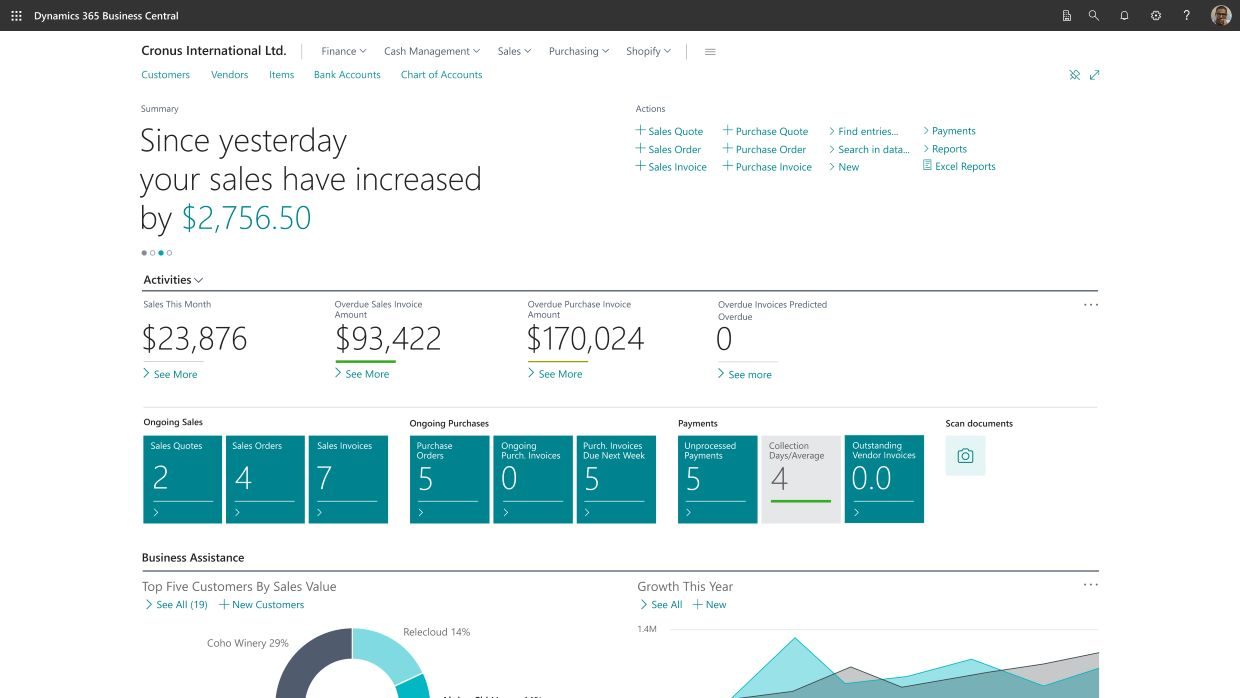
Microsoft Dynamics 365 Business Central is a cloud ERP that covers finance, inventory and sales, plus purchasing, inside one system, with project management and, on the Premium tier, manufacturing included. It grew out of Microsoft Dynamics NAV, so the accounting core is mature rather than bolted on as an afterthought.
Because it's a Microsoft product, Business Central connects natively to Excel and Outlook, along with Teams and Power BI. For a Canadian finance team already living inside Microsoft 365, that means fewer logins and fewer manual exports between systems every month. That native connection is one of the more underrated points in any Sage Intacct vs Microsoft Dynamics 365 Business Central discussion, since it changes how much daily friction your team deals with long after go-live.
Is an ERP Transition on Your To-Do List?
Whichever platform you choose, a clean implementation plan saves months of rework later.
 Book a free consultation
Sage Intacct vs Microsoft Dynamics 365 Business Central: Core Differences at a Glance
Set side by side, the Sage Intacct vs Microsoft Dynamics 365 Business Central comparison breaks down along a few clear lines:
Scope
Sage Intacct focuses on accounting and financial reporting. Business Central covers finance plus inventory and purchasing in the same license, with sales built in too.
Depth of Financial Reporting
Sage Intacct offers granular multi-entity consolidation built specifically for complex finance structures. Business Central's reporting is strong but leans on Power BI for the deepest analysis.
Add-On Dependency
Sage Intacct requires ISV add-ons for inventory or manufacturing needs. Business Central includes those functions out of the box.
Ecosystem Fit
Business Central integrates natively with Microsoft 365. Sage Intacct integrates with a smaller marketplace and often needs middleware for a comparable Microsoft connection.
Deployment
Sage Intacct is cloud-only. Business Central offers cloud deployment, along with on-premises and hybrid options for businesses with data residency requirements.
None of this makes one platform universally better than the other. It means the Sage Intacct vs Microsoft Dynamics 365 Business Central decision should start with what your operations look like beyond the finance department, not only with what your controller wants from a general ledger.
Curious how this compares to other options on your shortlist? We've also broken down Business Central vs QuickBooks, Xero and FreshBooks and Odoo vs Business Central for a wider view of the ERP landscape.
Pricing: Sage Intacct vs Microsoft Dynamics 365 Business Central
Sage Intacct doesn't publish pricing. You'll go through a sales call, and quotes typically start in the tens of thousands per year, scaling with the number of entities and users, plus whichever modules you add on top. That modularity gives smaller finance teams a way to start lean, but costs climb fast once multi-entity consolidation or project accounting get added as separate paid modules.
Business Central publishes its licensing openly. Essentials and Premium tiers are priced per user, per month, with Premium adding manufacturing and service management. Because core ERP functionality comes standard, you're not paying extra per module just to get inventory or purchasing working. For Canadian businesses budgeting in CAD, that price transparency alone speeds up early-stage evaluation.
If pricing is the deciding factor in your Sage Intacct vs Microsoft Dynamics 365 Business Central evaluation, look at the full cost picture rather than the license fee alone. Our breakdowns on ERP pricing and ERP implementation cost cover what typically gets left out of a vendor's opening quote, including data migration and training.
Implementation Timelines and What to Expect for Sage Intacct vs Microsoft Dynamics 365 Business Central
Sage Intacct implementations for straightforward finance-only setups tend to move quickly, sometimes within a few weeks, since the scope stays narrow. Add multi-entity consolidation or several ISV integrations, and the timeline stretches closer to a full ERP project.
Business Central implementations vary by scope too, but because the system covers more ground, planning tends to focus on getting the accounting core live first, then layering on inventory and purchasing in phases. That phased approach is exactly what one Gestisoft client leaned on when their old accounting setup could no longer keep pace with their growth:
We didn't want to suffer in our inefficiency any longer.
Sonia Préville, Corporate Finance Director, AmNor Industries
AmNor's team rebuilt their accounting core in three months by prioritizing the essentials first: invoicing and vendor management, plus the general ledger, with document management folded in early. Modules got added once that foundation was solid. That's a pattern to keep in mind regardless of which platform you land on in your Sage Intacct vs Microsoft Dynamics 365 Business Central decision. Fix the core first, then expand.
If you're migrating off an older system entirely, our guides on QuickBooks to Business Central migration and the true cost of accounting software implementation walk through what a realistic project timeline and budget look like.
Sage Intacct vs Microsoft Dynamics 365 Business Central for Canadian Businesses
This is where the Sage Intacct vs Microsoft Dynamics 365 Business Central comparison gets specific to Canada. Neither platform handles Canadian tax and payroll requirements identically out of the box, and the gap shows up fastest for businesses operating across provinces.
Business Central, through its Microsoft Dynamics NAV heritage, has long-standing support for multi-currency and multi-jurisdiction tax handling, including GST/HST and QST configurations for Québec-based operations. Combined with a Canadian implementation partner, that means less custom configuration to get province-specific tax rules working correctly from day one.
Sage Intacct handles Canadian tax reasonably well too, but businesses operating bilingually, or needing Québec-specific compliance out of the box, often find themselves configuring more manually or leaning on a partner to bridge the gap. If your business already runs on Microsoft 365 and needs native French-English support across finance and operations, that's a meaningful data point in the Sage Intacct vs Microsoft Dynamics 365 Business Central decision.
For businesses further along the evaluation, our resource on how to choose an ERP software using 10 criteria is a practical way to score both platforms against your specific compliance and operational needs.
Security, Compliance, and Long-Term Support with Sage Intacct vs Microsoft Dynamics 365 Business Central
Security is rarely the deciding factor in a Sage Intacct vs Microsoft Dynamics 365 Business Central evaluation, but it shapes how confident your finance team can be day to day. Both platforms offer role-based access controls and encryption in transit, and both meet common compliance standards that Canadian auditors expect to see.
Where the two diverge is in how updates and long-term support get delivered. Business Central runs on Microsoft Azure and inherits Microsoft's security investment and update cadence, with a large partner network available for ongoing support. Sage Intacct runs on AWS and handles updates automatically as well, though the partner ecosystem behind it is smaller in Canada specifically.
An ERP software consultant can help you evaluate both platforms against your specific compliance obligations before you commit to either one.
Total Cost of Ownership: Sage Intacct vs Microsoft Dynamics 365 Business Central
License fees are only the opening number in a Sage Intacct vs Microsoft Dynamics 365 Business Central budget. Implementation hours and data migration sit on top of that starting quote, along with staff training and any add-ons your finance team ends up needing. Those extras tend to grow with the complexity of your operations rather than shrink.
Sage Intacct's total cost usually climbs through ISV add-ons. Once you need inventory tracking, project accounting, or advanced consolidation beyond the base package, each of those additions carries its own licensing and configuration cost. Business Central's total cost tends to grow instead through implementation depth. Because the platform covers more functional ground out of the gate, a thorough rollout across finance and inventory, plus sales, takes more upfront planning, even though the core license itself stays predictable.
Neither pattern in the Sage Intacct vs Microsoft Dynamics 365 Business Central comparison is automatically cheaper over a three-to-five-year horizon. What tends to separate the two in practice is how much of that cost your finance team can see coming. Business Central's published pricing makes budgeting more straightforward from day one, while Sage Intacct's quote-based model can hide the full number until you're deep into procurement. Our financial management system resource is a useful next read if spreadsheets are the real starting point for your comparison, rather than another accounting platform.
Get Started With the Right ERP for Your Business
Whether Sage Intacct or Business Central looks like the better fit, our team can help you confirm it before you commit.
 Book a free consultation
Which Platform Fits Your Business: Sage Intacct vs Microsoft Dynamics 365 Business Central
The Sage Intacct vs Microsoft Dynamics 365 Business Central question usually resolves once you map it against your industry and structure.
Sage Intacct tends to fit finance-led organizations well. Nonprofits managing grants and fund accounting lean toward it, and so do professional services firms billing by project or SaaS companies with subscription revenue recognition to track closely. If your day-to-day complexity lives in the general ledger rather than the warehouse, Sage Intacct's depth on the finance side can be the stronger case.
Business Central tends to fit operationally complex businesses instead. Distributors managing inventory across locations rely on it, along with manufacturers running production orders and retailers who need finance and operations talking to each other in real time. Our piece on what makes Business Central such a good fit for small businesses digs into this in more detail.
Nonprofits specifically weighing fund accounting needs against a broader ERP should also look at our guide to fund accounting software, since that use case comes up often in the Sage Intacct vs Microsoft Dynamics 365 Business Central conversation.
It helps to think a step ahead too. AI-driven forecasting and automated approvals in your finance workflows deserve a spot on your roadmap now, not later, and our overview of AI in ERP covers where both platforms are headed on that front, and where Business Central's Microsoft backing gives it a faster path to new features.

Deciding to Make the Switch: Sage Intacct vs Microsoft Dynamics 365 Business Central
Once the Sage Intacct vs Microsoft Dynamics 365 Business Central question is settled on paper, the real work is picking a partner who can execute the migration without disrupting month-end close in the process.
That's true whether you're moving off spreadsheets, an aging on-premises system, or a different cloud accounting tool entirely. A Business Central consultant can scope the project realistically and flag which of your current processes will need to change before you sign anything.
If your business has already outgrown basic accounting software and inventory spreadsheets, our piece on accounting software vs ERP is a good sanity check before you commit to either platform. And if other options are still on your radar alongside Sage Intacct, our full roundup of Business Central alternatives and Sage 50 alternatives covers the wider field.
Working with an established Business Central partner also means you're not navigating Canadian tax configuration and bilingual rollout on your own for the first time. However the Sage Intacct vs Microsoft Dynamics 365 Business Central decision lands for your business, the implementation partner you choose will shape how smoothly that first year runs.
There's no single winner in the Sage Intacct vs Microsoft Dynamics 365 Business Central comparison, only a better fit for what your business looks like today and where it's headed next. Gestisoft has been helping Canadian industries get their products and solutions for nearly three decades and will continue to be a reliable source. Representatives are standing by to help get a Canada-specific opinion. Book a Free Consultation and start the conversation.
-
Sage Intacct is a financial management platform built for accounting depth, while Business Central is a full ERP covering finance and inventory, plus broader operations, in one system. The Sage Intacct vs Microsoft Dynamics 365 Business Central choice usually comes down to whether you need deep financial reporting alone or a connected system for your whole business.
Liked what you just read? Sharing is caring.

July 16, 2026 by Conni Guido by Conni Guido Copywriter and Brand Strategist
I started with a degree in Professional Communications and never looked back. Now, I'm a professional storyteller who believes every brand has a story to tell, and every good story should leave you wanting more. You can find me lost in a book club or a writing sprint, baking words into pies...probably both.
