

“A system thinking mindset addresses not only the bad decision that was just made, but also solves for all future bad decisions that used that framework."...
— Tobias Lütke, Canadian Entrepreneur & CEO of Shopify
Picture this: you’re a business leader in an important client meeting with a vendor. You want to strike a new deal that would significantly improve your purchasing margins and reduce supply chain friction.
You’re already carrying a financed $1.2M CAD expansion, and last quarter included a $200,000 CAD winter campaign designed to drive revenue during your peak season. If you increase purchase commitments now, will your operating line utilisation spike above its threshold? Will there be high inventory turnover required to justify the added debt servicing?
You need clarity before end of day.
Instead, you’re waiting on a report.
If this feels familiar, it’s often a signal that your current financial management system is no longer supporting the speed and complexity required for your business.
In this article, we’ll provide concrete, real-life examples to illustrate what a financial management system is, why they become critical as complexity increases, and how a modern financial management system, particularly an Enterprise Resourse Planning (‘ERP’)-integrated one, fundamentally enables faster and more confident executive decision-making.
Looking for a financial management system?
Contact our team to learn more about Microsoft Dynamics 365 Business Central and how it can transform your financial processes.
 Free discovery call
What Is a Financial Management System?
A financial management system is a platform that records, tracks, automates, and analyses a company’s financial data in real time.
A modern financial management system typically includes:
- General ledger (GL)
- Accounts payable (AP)
- Accounts receivable (AR)
- Cash flow management
- Budgeting and forecasting
- Financial reporting
- Revenue and expense tracking
- Compliance and audit trails
Unlike legacy accounting tools, a modern financial management system is often embedded within ERP platforms. These ERP-connected tools unify all business operations, such as finance, inventory, procurement, payroll, and sales data into one coherent system.
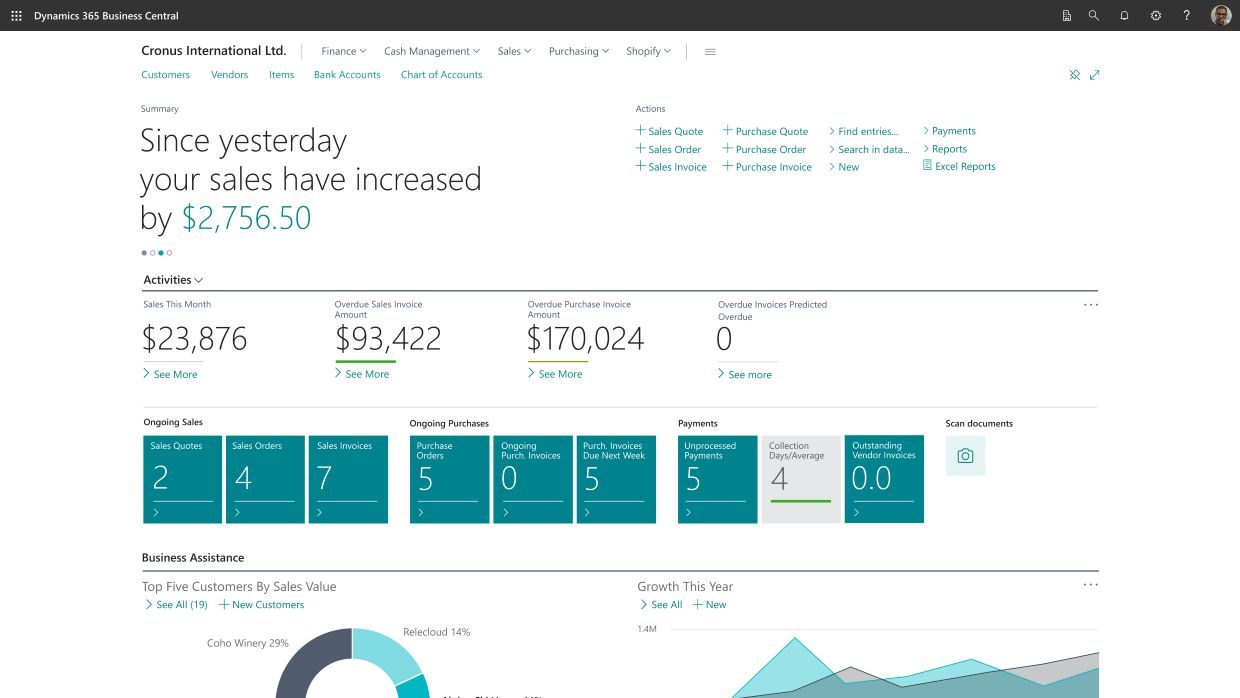
For example, Microsoft Dynamics 365 Business Central is a popular ERP platform that can integrate a financial management system directly with a business’ supply chain and operational workflows, generally reducing manual reconciliation lag between business departments and financial reporting friction.
When Do You Need a Financial Management System?
As revenue increases, the complexity of a business starts to compound. Although growth is often the sought-after goal, it often introduces a new set of challenges for executive and finance teams, including:
- Higher transaction volume
- Multi-department cost allocation
- Debt structuring
- Seasonal cash fluctuations
- Vendor contract negotiations
- Regulatory compliance
At a small scale, traditional accountancy tools and spreadsheets may suffice. However, further expansion to medium size and beyond without the underlying financial foundations could induce greater financial risks and increased delays in reporting for a company.
Consider a hospitality franchise preparing to open a new store in a local city. The question “Can we afford it?” only scratches the surface of the underlying details of the potential operational implications. Business executives may ask the following:
- “What does our 90-day cash conversion cycle look like post-expansion”?
- “How will increased raw material purchasing impact payables”?
- “Will construction draws strain liquidity during off-season months”?
- “Are we at risk of breaching lender covenants”?
A financial management system reduces this uncertainty by providing executives with instantaneous data to align a business’ operations and finances. Legacy tools, such as disconnected spreadsheets or entry-level accounting software, typically only record numbers, whilst a modern financial management system can connect these numbers to real-life operational consequences.
How much can you really save with Business Central?
Download your free Excel ROI calculator and discover the savings you can make when you implement Business Central as your financial management system today.

What Are The Benefits Of a Financial Management System?
Transitioning from legacy accounting tools or spreadsheets to an integrated financial management system can significantly expand the possibilities of how business professionals can use their financial data to operate on a larger scale.
1. Reduced Manual Reconciliation
If you find your finance team is consolidating multiple spreadsheets before leadership meetings, your current financial system may be more reactive, rather than operational.
The pattern may look something like this: Finance pulls data from separate department systems as fast as they can, yet the reports still arrive days later. Consequently, business opportunities tend to stall.
However, after implementing an integrated financial management system, reports can be generated in real time with menial manual interventions, so vendor negotiations can move faster, and leadership decisions can be data-backed within hours.
2. Department-Level Tracking Synergized Within Operational Context
If marketing spend, inventory procurement, and revenue performance sit in separate systems, legacy accounting tools struggle to provide high level strategic visibility.
Let’s take the following scenario as an example:
If you spend $200,000 on a marketing campaign projected to drive a 30% sales increase…
The operational questions then become:
- “Do we have sufficient inventory to support the surge”?
- “If we increase purchase orders, how will this affect our 60-day cash position”?
- “Will gross margin offset the increase in inventory carrying costs”?
Disconnected tools may struggle to synthesize these interactions dynamically, whereas a modern financial management system is designed precisely for these calculations.
3. Long-term Forecasting Potential
If forecasting focuses primarily on surviving the next quarter rather than planning the next two years and beyond, your current financial management system may be limiting strategic foresight potential.
An advanced financial management system can allow for more precise scenario modelling. For instance:
- What happens across departments in the next 5 years if revenue grows 15% year-on-year?
- What if supplier costs increase 8% in the next 2-3 years?
- What may happen in the short and long term if we accelerate expansion by six months?
Strategic forecasting requires an integrated financial management system that can connect operational data with forward-looking modelling. Instead of reactive planning, more prepared executives can calculate their moves years in advance.

4. Reduced Delays Impacting Strategic Decisions
Let’s say you’re reviewing a new supplier contract that promises improved margins…
You need to know immediately:
- How will revised pricing affect the cost of goods sold?
- Will adjusted purchase volumes impact warehouse capacity?
- What happens to our operating line utilisation over the next quarter?
A modern financial management system can generate consolidated insights quickly, whereas legacy tools may delay this clarity.
5. Multi-Entity or Multi-Currency Operation Capability
Without a robust financial management system, currency conversions, tax compliance, and consolidation can become arduous and risky for your finance team if you decide to expand or currently operate in a foreign market.
A modern financial management system can automate exchange rate adjustments, maintain audit trails and produce consolidated reports without spreadsheet layering and manual cross-referencing. For businesses scaling internationally, a modern financial system can become almost essential.
How Could a Financial Management System Impact My Business?
The primary impact of a financial management system is the increased speed and quality of executive decision making. Day-to-day requests of your finance team can become less burdensome, which can free up energy to plan future moves, rather than react to present challenges.
What could this look like in practice? Vendor negotiations concluding the same day, cash flow projections accurately anticipating seasonal dips, and capital allocation becoming strategic rather than cautious.
Fundamentally, a financial management system can reduce hesitation and replace it with more structured, data-driven confidence.
“Gestisoft had a knack for finding creative solutions. It wasn't easy, but the team never gave up and always managed to come up with solutions while trying to reduce costs as much as possible and bearing in mind the solution ecosystem's durability.”
What can AI do in a Financial Management System?
AI can be embedded within a financial management system to automate financial analysis and reduce manual input.
In ERP platforms such as Microsoft Dynamics 365 Business Central, AI tools can enhance a business’ financial management system by providing:
- Predictive Payment Risk Analysis
AI can analyse transaction history, payment patterns, credit memos, and open invoices to provide a late payment risk metric.
In practise, rather than discovering overdue invoices after impact, a financial management system can alert leadership early to reach out to clients and avoid potential cash flow disruption.
- Automated Invoice Capture
An AI-powered financial management system can scan email inboxes for vendor invoices and generate draft entries into their systems automatically.
This reduces the need for manual entry and thus can provide finance teams the space needed to focus on strategic analysis rather than repetitive data entry.
- Cash Flow Prediction
An AI-enhanced financial management system can model projected inflows and outflows based on upcoming projects, supplier agreements and seasonal trends.
As discussed above, this forecasting can improve financial accuracy and reduce reactive decision making.

How do you Implement a Financial Management System?
Selecting the right financial management system for your business is only half the decision. Implementation is equally important because of the potential risk of upgrading. This could manifest as:
- Existing data migration errors,
- Misalignment when restructuring chart of accounts,
- Incomplete system integration
In contrast, an experienced partner can ensure:
- Clean data migration,
- Proper account structuring, and;
- Team training to prevent adoption failure
Organisations such as Gestisoft have multiple decades of experience working to implement a financial management system and wider ERP resource like Microsoft Business Central into various businesses spanning across myriad Canadian industries.
In addition to installment, experienced implementation partners aim to strengthen long-term business financial governance and accelerate operational clarity to meet the demands of fast-growing and dynamic markets.
Book your free consultation with our experts today
Contact us for more details about Microsoft Dynamics 365 Business Central and how it can help you with your financial management and processes.
 Free discovery call
-
Accounting software fundamentally records transactions, whereas a financial management system can fully integrate a business’ finances with its operations, procurement, inventory, and reporting data. This integration can intrinsically enable strategic forecasting capabilities and more accurate reporting across business departments.
Liked what you just read? Sharing is caring.
June 16, 2026 by Nizar Madihi by Nizar Madihi Marketing Specialist
Curious by nature and passionate about digital, I am always looking to learn, explore new ideas and understand the world around me. I place a lot of importance on creativity, knowledge sharing and continuous improvement, both personally and professionally.
