
Imagine you’re the CEO of a growing Canadian office supplies distribution company, Northern Office Supply Co., based in Ontario.
A few years ago, the business was still relatively small. You had a modest warehouse, a handful of employees, and a steady stream of local retail clients ordering paper, printers, and office furniture. Orders were manageable, inventory moved at a predictable pace, and the finance team relied on accounting software to track invoices, payroll, and expenses. Everything worked well because the business was simple, and thus there was no need to know the difference between accounting software vs ERP (‘Enterprise Resource Planning’).
Then the company began to grow. The business expanded, and so new challenges cropped up…
Your company began supplying retailers across multiple provinces and new product lines were introduced, including desks, chairs, and bulk office equipment. As such, the warehouse expanded to handle the increased demand. The sales teams grew, purchasing became more complex, and inventory started moving through the business at a much faster pace.
Those same systems that were suited for smaller operations suddenly started to show cracks under the pressure of expansion. Whilst the inventory tracking happened in one system, the purchasing data lived in another, and financial reports were generated separately by the accounting software. With growing business demands, the capacity to make efficient business decisions started to shrink. Your sales team had to repeatedly call inventory to ensure the stock was available, and business executives needed constant confirmation from finance to ensure new supplier deals were financial viable.
Your operations and finance teams struggle to meet deadlines quickly with spreadsheets and manually reconciling numbers.
Eventually, someone in leadership raises the important question:
“Is there a better way to manage all of this?”.
This is the moment many growing companies begin exploring the difference between accounting software vs ERP systems, and whether their existing tools are still fit for growth.
Throughout this article, we’ll return to you and Northern Office Supply Co. to illustrate how different systems support businesses at different stages of growth.
If your business is starting to experience the operational challenges described in this article, it may be time to explore an ERP system.
Speak with our Microsoft Dynamics 365 Business Central specialists to see whether an ERP implementation makes sense for your organisation.
 Free discovery call
Accounting Software vs ERP: A Quick Overview of the Key Differences
If you’re on this article looking for a straightforward distinction between accounting software vs erp, the difference is actually quite simple.
- Accounting softwares focus primarily on managing financial transactions and records. Finances are the sole focus.
- ERP systems (Enterprise Resource Planning systems) manage the broader operations of a business; including finance, but also areas such as inventory, purchasing, sales, and operational planning. They integrate the entirety of a business into one central hub.
To illustrate the difference, let’s return to Northern Office Supply Co.
In the early stages of the business, accounting software excels. For Northern Office Supply, it records supplier payments for inventory, tracks payroll for warehouse employees, and produces financial statements for the company’s accountant and tax filings.
In short, the system provides clear financial visibility, showing how much revenue is coming in, what expenses look like each month, and whether the company is operating profitably.
But as the company grows, operational complexity begins to increase.
Say you want to expand by opening new warehouses across Canada. Naturally, inventory moves between locations, and purchasing managers need to negotiate supplier orders while your sales teams handle larger retail contracts
At this point, leadership needs more than just financial transactions. They need to understand how decisions across inventory, sales, logistics, and purchasing affect the entire organisation. That’s where ERP systems begin to offer a different level of visibility.
The key bridge of an ERP is that instead of seeing just the financial result of a decision, you can see how that decision affects the entire business operation.
What Accounting Software Does Well

To understand where ERP systems become useful in the accounting software vs ERP discussion, it first helps to understand where accounting software excels. Accounting software focuses primarily on managing financial transactions and records.
Most accounting software platforms include tools such as:
- General ledger management
- Accounts payable and accounts receivable
- Payroll processing
- Financial reporting and statements
- Tax tracking and compliance
So for Northern Office Supply Co in its early stages, the company might have processed around 120–150 retailer orders per month, with an average order value of $1,200 CAD. A typical order might have looked something like this:
- 40 reams of printer paper at $8 each
- 10 office chairs at $140 each
- 6 desktop printers at $220 each
The total order value would have come to roughly $3,200, which the accounting software would have recorded as revenue once invoiced.
Inventory turnover was also predictable. The warehouse might have held approximately 4,000 units of printer paper and 300 office chairs, with stock replenished from suppliers every four to six weeks based on historical sales patterns.
It’s at this stage where accounting software worked well in the accounting software vs erp discussion because the finance team only needed to track supplier invoices, retailer payments, payroll, and monthly expenses. It excelled at keeping financial records organised, reduced manual data inputting errors, and made it easy to generate reports for tax preparation and financial planning. For a business at this scale, implementing a full ERP platform would have been unnecessary, overly complex and costly.
So, accounting software works best when the organisation itself remains relatively straightforward with fewer departments, simpler operations, and manageable volumes of financial transactions.
In summary, accounting software handles the following tasks most efficiently:
- Keeping financial records organised,
- Reducing the risk of manual errors, and;
- Making tax preparation far easier than managing everything in spreadsheets.
Where Accounting Software Starts to Struggle Compared to ERP Systems
Where executives may encounter challenges is when their company expands beyond the small business stage. As revenue increases and operations become more complex, accounting software often becomes just one piece of a much larger technology puzzle. This is often the turning point for many businesses in the accounting software vs erp conversation.
What would this look like for Northern Office Supply Co in practice as it begins to expand?
With the aforementioned expansion, the business now supplies retailers across several provinces, and product lines now include desks, chairs, and workplace equipment. With more products and customers, operations naturally become significantly more complicated.
The warehouse team manages inventory levels using one system, whilst the sales team processes retailer orders using another. Meanwhile, the finance department still relies on accounting software to reconcile revenue and expenses. Up until this point, these separate tools seem manageable.
But eventually a situation arises that exposes the limitations of separate systems…

One afternoon, your sales team confirms a large order for 450 office desks from a national retailer worth roughly $180,000 CAD. The sales system suggests enough stock is available, but when the warehouse team double-checks inventory, only 310 desks are actually in stock.
The reason for the discrepancy? The remaining units were already allocated to other retailer shipments in a separate inventory system that wasn’t synced with the sales platform. The result is that purchasing now has to urgently contact suppliers, which could then impact shipping timelines. The retailer then begins asking uncomfortable questions about delivery commitments...
Situations like this under pressure may raise critical operational questions for leadership, such as:
- Do we currently have enough inventory to fulfil this order?
- If not, how quickly can suppliers replenish stock?
- Will fulfilling this order impact other pending shipments?
- What effect will this have on cash flow over the next quarter?
This is when the cracks in the disconnected company’s systems start to show, as answering all these questions under time pressure from this retailer requires pulling data from multiple sources: inventory must be checked separately from purchasing records, and financial implications must be calculated manually.
What should be a quick operational decision for the executives has now become a time-consuming investigation. Consequently, as businesses scale, these inefficiencies start to slow down decision-making. It’s at this point when leadership begins considering an ERP system in the accounting software vs erp debate.
In summary, in several disconnected systems, this fragmentation can create a number of common operational frustrations amongst business executives:
- Departments rely on different software tools to manage their work without synchronization between them.
- Employees manually enter the same data into multiple systems, leading to increased inefficiency and duplicate entries that may need rectifying later.
- Inventory levels must be reconciled with financial records after purchases due to a lack of real-time data.
- Reports may take days or weeks to compile because information is scattered, leading to slowed executive decision making and potentially missed opportunities.
- Leadership and C-suite lacks real-time visibility into the state of the business, increasing the disconnect between employees in different departments.
If your business is starting to experience the operational challenges described in this article, it may be time to explore an ERP system.
Speak with our Microsoft Dynamics 365 Business Central specialists to see whether an ERP implementation makes sense for your organisation.
 Free discovery call
What ERP Systems Actually Change

How much can you save?
Download our Microsoft Business Central ROI Calculator to estimate the potential return from implementing an integrated ERP system in your organisation.

This is where ERP systems enter the picture in the accounting software vs ERP conversation.
Instead of operating as a single-purpose financial tool, ERP systems connect the major functions of a business into one unified platform. Or in other words, the ERP acts as a central nervous system for the organisation.
So, rather than each department running its own isolated system, ERP brings them together. Finance, purchasing, inventory management, sales, and operations can all interact through the same core system in real-time.
Let’s return once more to Northern Office Supply Co…
Suppose the retail market has been successful and your fellow leadership team decide to expand further into the commercial furniture market by adding a new line of office desks and workstations. This decision affects several parts of the business simultaneously:
- Inventory planning must now account for larger items that require more warehouse space,
- Purchasing teams need to coordinate with new suppliers,
- Sales teams must forecast demand from retailers, and;
- Finance must track the investment required to stock these products.
With an ERP platform in place, all of this information seamlessly flows through a single integrated system. What does this look like in our commercial expansion scenario?
- Warehouse teams can see real-time inventory levels,
- Purchasing managers can track supplier deliveries,
- Finance automatically receives updated financial data as transactions occur, and;
- Leadership gains a clear picture of how operational decisions affect revenue, costs, and supply chain capacity.
An ERP solution such as Microsoft Dynamics 365 Business Central is designed to support this level of integration, helping growing businesses connect financial management with operational data across departments.
The high-level result is not just better record-keeping, but better business decision-making. Executives gain the ability to view the organisation from a true “bird’s-eye perspective” while still accessing detailed information from each department.
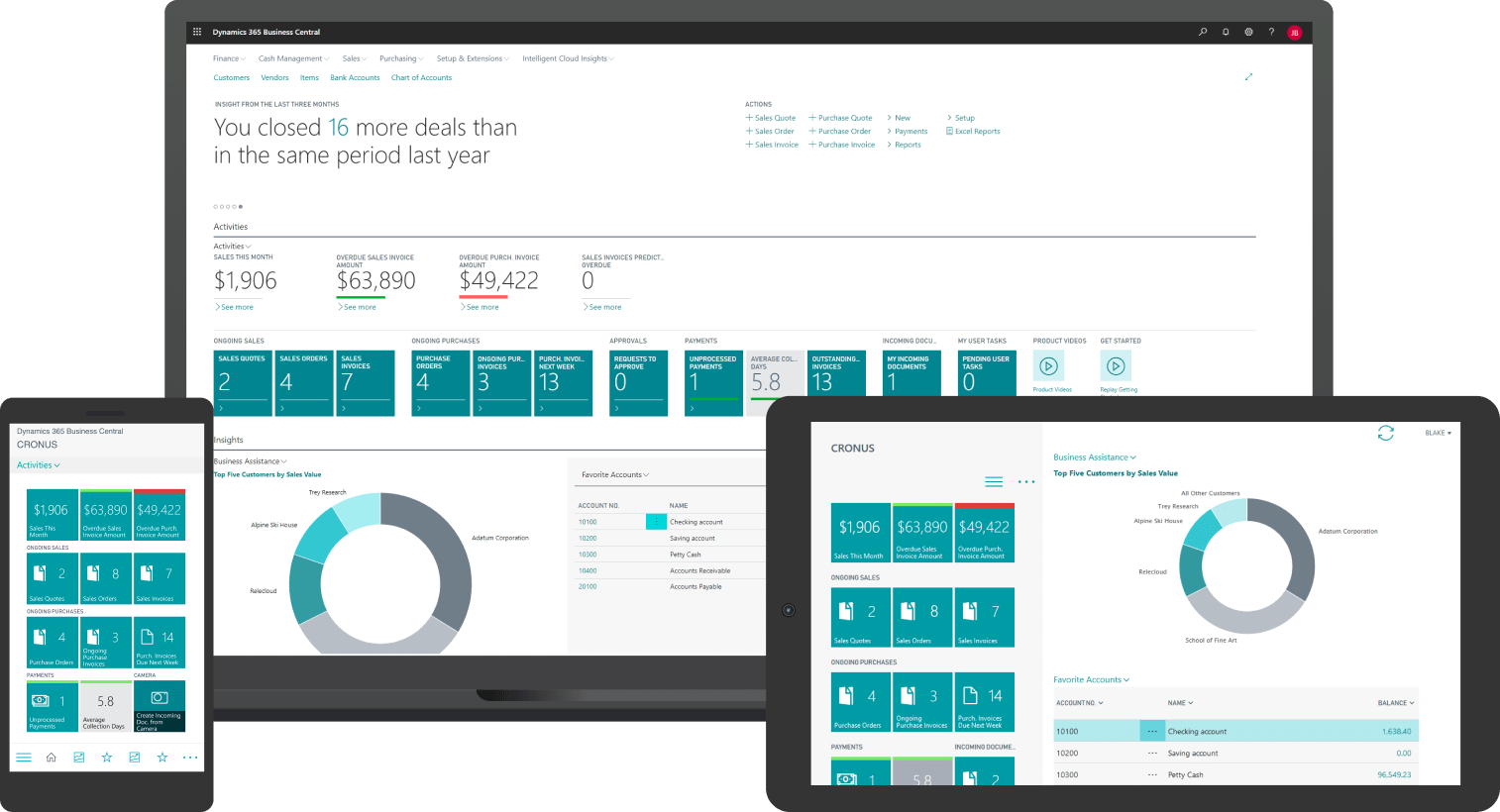
Looking to implement Microsoft Dynamics 365 Business Central in your organisation?
Our team helps growing businesses plan, deploy, and optimise ERP systems that connect finance, operations, and inventory in one unified platform.
 Free discovery call
Accounting Software vs ERP: Key Differences
While both systems include financial management capabilities, their overall scope is very different.
Scope: Accounting software is primarily focused on financial management, meaning it is designed to handle core accounting functions such as bookkeeping, invoicing, accounts payable and receivable, and financial reporting. Its role is largely confined to tracking and managing money-related activities within a business. In contrast, an ERP (Enterprise Resource Planning) system has a much broader scope. It not only includes financial management but also supports other key business operations such as procurement, inventory, human resources, supply chain, and customer management. This makes ERP a central system that unifies multiple business processes under one platform.
Data: Accounting software deals mainly with financial data, including transactions, ledgers, and financial statements. The data is typically structured around income, expenses, assets, and liabilities, providing a clear financial picture of the organization. On the other hand, ERP systems manage both financial and operational data. This includes everything from sales orders and inventory levels to employee records and production schedules. Because all this data is interconnected, ERP systems enable better data consistency, real-time updates, and more informed decision-making across departments.
Integration: Accounting software often operates as a standalone system or has limited integrations with other tools, such as payroll or basic CRM systems. While some modern solutions offer integrations, they may still require additional setup or third-party connectors. ERP systems, however, are designed with integration at their core. They connect multiple business functions within a single unified system, allowing different departments to share information seamlessly. This reduces data silos, minimizes duplication, and improves overall efficiency and collaboration.
Scalability: Accounting software is generally best suited for small to medium-sized businesses or organizations with relatively simple financial processes. As a business grows and its operations become more complex, accounting software may struggle to keep up with increasing demands. ERP systems are built with scalability in mind. They can handle large volumes of data, support multiple departments, and adapt to the evolving needs of growing and complex organizations. Many ERP solutions also allow businesses to add modules as needed, making them flexible for expansion.
Visibility: Accounting software provides visibility primarily into financial performance, such as profit and loss, cash flow, and balance sheets. While this is essential, it offers a limited view of the overall business. ERP systems, in contrast, provide organization-wide visibility. Because they integrate data from various departments, they offer real-time insights into operations, supply chains, workforce performance, and more. This comprehensive visibility helps management make strategic decisions based on a complete and accurate understanding of the business.
In essence, accounting software answers the question: “What happened financially in the business?”
ERP systems help answer a broader one: “What is happening across the entire business; AND, what can we do next?”
So, is Your Business Ready to Move from Accounting Software to ERP?
Now comes the important question: when is the right time to transition from one software to the other? Although there is no single metric that determines when a company could benefit from an ERP system, several operational signs often indicate it might be time to transition:
- The company is growing quickly and managing multiple departments,
- Teams across said departments rely on disconnected systems that do not easily share information in real-time,
- Reporting takes too long to compile, slowing decision-making,
- Leadership lacks real-time visibility into operational performance,
- Inventory or supply chain management is becoming increasingly complex.
For Northern Office Supply Co, the aforementioned signs manifested as operational challenges. Their sales data lives in one system, inventory information in another, and financial reports were generated separately through accounting software.
Thus, preparing a complete picture of their business’s performance required hours of manual reconciliation between teams. If the company wants to introduce new warehouses, additional product lines, or larger retail contracts, the complexity only increases.
It’s at this stage, where a single integrated system is almost essential to maintain efficiency and competitiveness in the market.
Accounting Software vs ERP: At the End of the Day, It’s Not a Competition...
A final important statement before the end of this article…
Accounting software and ERP platforms are not competing technologies.
The reality is actually quite the opposite: they typically complement each other depending on the different stages in a company’s operational maturity. Many businesses follow the natural progression of:
Spreadsheets → Accounting Software → ERP System
And it makes sense why: early-stage companies begin with simple tools to manage finances which are cost effective yet highly effective. However, as operations expand and departments multiply, it’s almost imperative to adopt a more complex system, such as an ERP, to connect their processes and improve organisational visibility. It’s these systems that maintain dynamism and keep the business running efficiently in a competitive market.
Overall, both technologies play valuable roles depending on the size and complexity of the organisation.
Still unsure about choosing between accounting software vs ERP? Here are some Frequently Asked Questions that may help clarify things…
Is ERP the same as accounting software?
No. Accounting software focuses specifically on financial transactions and reporting. ERP systems, however, include accounting functionality (known as a financial management system) but also integrate additional business processes such as inventory management, purchasing, sales, and operations.
Is QuickBooks an ERP system?
QuickBooks is widely recognised as accounting software designed for small businesses. While it integrates with other tools, it does not provide the full operational integration typically associated with ERP platforms.
Are ERP systems outdated?
ERP systems remain one of the most widely used technology platforms for growing businesses. Modern cloud-based ERP solutions, including platforms like Microsoft Dynamics 365 Business Central, continue to evolve with advanced automation, reporting, and integration capabilities.
Can small businesses use ERP?
Yes. Many ERP systems now offer scalable cloud-based versions designed specifically for small and mid-sized organisations that are preparing for growth.
If your business is starting to experience the operational challenges described in this article, it may be time to explore an ERP system.
Speak with our Microsoft Dynamics 365 Business Central specialists to see whether an ERP implementation makes sense for your organisation.
 Free discovery call
Liked what you just read? Sharing is caring.

March 18, 2026 by Kooldeep Sahye by Kooldeep Sahye Marketing Specialist
Fuelled by a passion for everything that has to do with search engine optimization, keywords and optimization of content. And an avid copywriter who thrives on storytelling and impactful content.