

Key Takeaways:
- Dynamics GP support ends in 2029, and the earlier you start planning your GP to Business Central migration, the more control you keep over timeline and budget.
- There are two migration paths: a direct data migration or a reimplementation, and picking the wrong one is the most expensive mistake businesses make.
- Cost and timeline vary widely based on data volume, customizations, and how many companies you're migrating, so a rough estimate isn't a plan.
- Canadian businesses face extra considerations, from bilingual requirements to payroll and provincial tax setup, that generic migration guides skip entirely.
If you're running Dynamics GP right now, you already know the clock is ticking. Microsoft's mainstream support winds down by 2029, and every year you wait, the GP talent pool gets a little thinner and the workarounds get a little more creative. A GP to Business Central migration isn't a nice-to-have anymore. For most Canadian businesses still on GP, moving to Business Central is the next project on the list, whether it feels ready or not.
This article walks through what a GP to Business Central migration looks like in practice: the two paths you can take, what it costs, how long it runs, and the mistakes that turn a routine ERP project into a year of finance-team headaches. No fluff, no vague "modernize your business" language. Just what you need to plan this properly.
Why the GP to Business Central Migration Conversation is Happening Now
Dynamics GP has done its job for decades. It's stable, finance teams know it, and for a long time there was no urgent reason to touch it. That's changed. Microsoft has confirmed mainstream support ends in 2029, with only critical security patches after that, and it has made clear that Business Central, not GP, is where new investment goes. Copilot, Power BI embedding, Power Platform connectivity: all of it lands in Business Central first. We've laid out the full timeline in GP end of life, if you want the details beyond what's here.
That leaves GP customers with a real decision, not a hypothetical one. Waiting doesn't remove the need for a GP to Business Central migration, it just shrinks your runway. Fewer partners will support GP-specific customizations as the user base shrinks. Add-on vendors will deprioritize GP compatibility. And if you wait until 2028 to start planning, you'll be doing a rushed migration under a hard deadline instead of a deliberate one on your own timeline. This ties into a bigger pattern: the role of ERP in digital transformation generally, where the businesses that plan ahead get more say in how the change happens.
The businesses that get the smoothest GP to Business Central migration are the ones that start planning eighteen to twenty-four months out, not the ones scrambling in the final year.
Ready to Modernize Instead of Just Relocate?
A reimplementation can fix years of GP workarounds in one project. Let's talk through what that would look like for you.
 Free discovery call
What a GP to Business Central Migration Looks Like
Here's where a lot of confusion comes from: people assume a GP to Business Central migration means flipping a switch and everything from GP shows up in Business Central, formatted and ready.
It doesn't work that way, and it shouldn't.
GP and Business Central are structured differently under the hood, so a migration is really a translation project, not a copy-paste job.
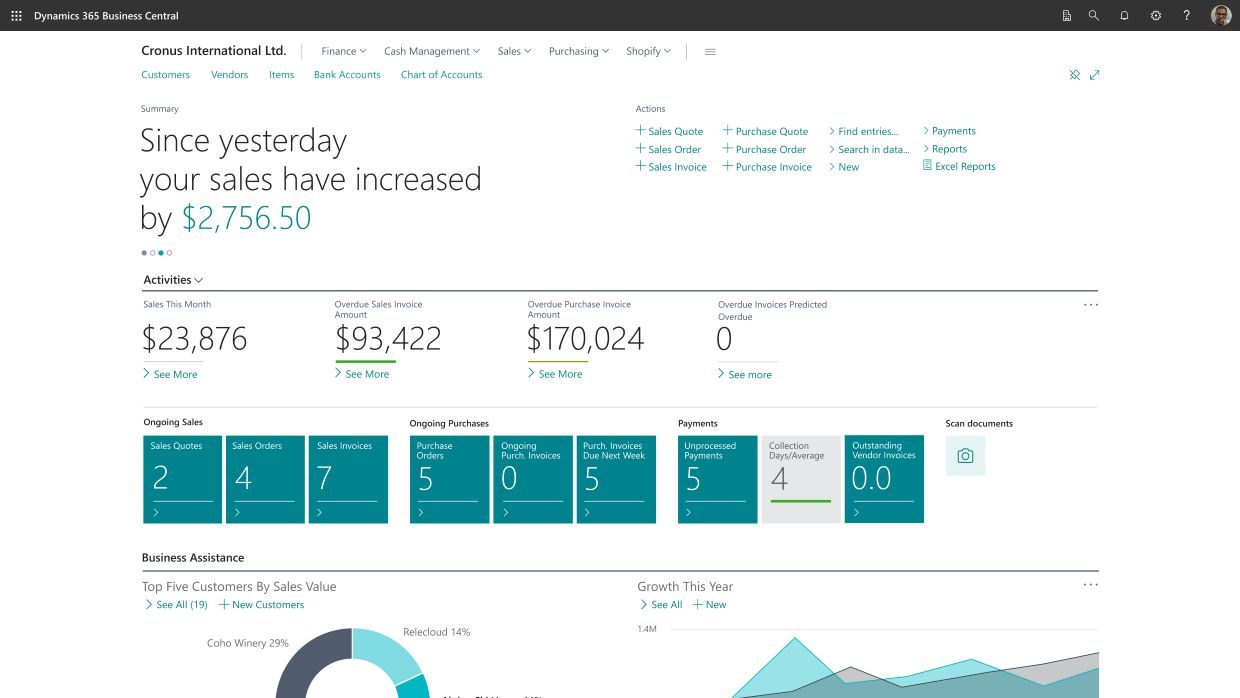
Microsoft provides a built-in migration tool that handles the mechanics: general ledger accounts and balances, customer records and receivables, vendor data and payables, and inventory quantities. That tool has improved a lot over the past few Business Central releases, and for straightforward environments it does the heavy lifting.
However, straightforward is doing a lot of work in that sentence. If you're running GP 2015 or later, on SQL Server 2016 SP1 or newer, with a database under 80GB, the built-in path is viable. Outside those parameters, or if your GP environment carries years of customizations and third-party add-ons, the built-in tool becomes a starting point rather than the whole solution.
This is the part where most GP to Business Central migration projects either go smoothly or go sideways: the decision between migrating everything as-is or rebuilding cleaner. Take a look at steps in purchasing an ERP if you haven't already scoped the buying and licensing side of this decision.

Two Paths for Your GP to Business Central Migration
#1. Direct Migration
A direct migration moves your existing GP data, structure, and history into Business Central with minimal redesign. It's faster, cheaper upfront, and keeps the system your team already understands mostly intact, just on a new platform. This path fits businesses with a relatively clean GP environment, limited customizations, and no strong appetite for process change right now. It's the more standard option, closer to what we cover in personalized ERP vs standard ERP.
#2. Reimplementation
A reimplementation rebuilds your ERP in Business Central based on how your business runs today, not how it ran when GP was first configured years or decades ago. Only essential data, like master records, opening balances, and open transactions, comes across. Everything else gets left behind on purpose. This path fits businesses with heavy customizations, messy or duplicated data, or processes that have outgrown what GP was ever built to handle. If that sounds like your environment, our breakdown of custom ERP costs and roadmap is a good read before you commit.
Neither path is automatically "better." The mistake is picking based on cost alone. A direct migration that drags two decades of GP technical debt into Business Central often costs more in the long run than a reimplementation would have, because you end up paying to clean up the mess anyway, just later and under more pressure. Running through how to choose an ERP software using 10 criteria before you commit to either path is time well spent.
The GP to Business Central Migration Process in Five Steps
A GP to Business Central migration moves through five stages. Skipping or rushing any of them is where projects lose months.
1. GP to Business Central Migration Assessment
Before anything moves, you need a clear picture of your current GP environment: version, database size, customizations, integrations, and which modules are in daily use versus dormant. This is also where you decide between a direct migration and a reimplementation. Gestisoft's analysis phase is built around exactly this kind of environment review.
2. GP to Business Central Migration Data Cleanup
Dead vendor records, duplicate customers, and years of unused GL accounts don't get more useful by moving to a new system. Clean before you migrate, not after. This single step prevents most of the post-go-live frustration teams report, and it's one of the most common ERP implementation challenges we see teams underestimate.
3. Configuration and Mapping
Chart of accounts, dimensions, workflows, and approval hierarchies get built out in Business Central, and GP data fields get mapped to their Business Central equivalents. Any customizations or third-party add-ons get evaluated: rebuild, replace with native Business Central functionality, or retire. This is the core of what an implementation engagement delivers.
4. GP to Business Central Migration Testing and Validation
Run the migration in a sandbox first. Reconcile balances against GP. Have finance work in the test environment before go-live, because catching a mapping error in testing costs an afternoon; catching it three weeks after go-live costs a lot more.
5. Go-live and Stabilization
Cut over, monitor closely for the first few close cycles, and keep a support plan in place for the inevitable "how do I do this in Business Central" questions that come up once the team is working on it daily. Pairing that with proper Business Central training up front cuts down on how many of those questions come up in the first place.
Organizations moving off GP typically consolidate several disconnected add-ons and workarounds into native Business Central functionality during this process, which is often the biggest efficiency win of the whole project, separate from the platform switch itself. Features like Analysis Mode in Business Central and native Business Central Project Management tend to replace tools GP users were paying for separately.
What a GP to Business Central Migration Costs and How Long it Takes
There's no single number here, and any article that gives you one flat figure is guessing. Cost and timeline for a GP to Business Central migration depend on data volume, company count, customization load, and whether you're going direct or reimplementing.
These five things help move the needle predictably:
#1. Data Volume and History
Migrating five years of detailed transactional history costs more than migrating current-year data with summarized history, and most businesses don't need that much historical detail live in their new ERP anyway.
#2. Number of Companies
A single-entity GP to Business Central migration is a very different project from consolidating six subsidiaries with different charts of accounts.
#3. Customizations and Integrations
Every GP add-on or custom report needs a decision: rebuild in Business Central, replace with native functionality, or retire. Each rebuild adds cost; each retirement saves it.
#4. Migration Path
A direct migration is almost always cheaper upfront than a reimplementation, since a reimplementation involves rebuilding workflows and approval structures instead of just carrying them over.
#5. Timeline
Timeline follows a similar logic. A straightforward, single-company direct migration can run a few months from assessment to go-live. A multi-entity reimplementation with heavy customization can take considerably longer. The honest answer to "how long does a GP to Business Central migration take" is: long enough to do the assessment properly first, because that's what determines the real timeline.
Business Central ROI Calculator
See what switching from Dynamics GP to Business Central could save your business in licensing, infrastructure, and manual work.

The Canadian Considerations of GP to Business Central Migration Most Skip
A lot of GP to Business Central migration content is written for a generic North American audience, and that leaves out details that matter to Canadian businesses specifically. This shows up differently depending on your sector: manufacturing businesses and distribution companies each carry their own compliance and reporting quirks on top of the general list below.
Bilingual requirements. If your organization operates in Québec or serves bilingual customers, Business Central needs to be configured for French and English from the start, not patched in after go-live.
Canadian payroll and tax. GL structures, sales tax handling (GST/HST/QST depending on province), and payroll integrations need Canadian-specific configuration, and this is exactly where a partner without Canadian implementation experience tends to miss details.
Data residency. Some Canadian organizations, particularly in regulated industries or public sector-adjacent work, need to confirm where their Business Central data is hosted and how that aligns with internal policy.
Local support availability. When something goes wrong at 8 a.m. on a Monday close, a support team in your own time zone that understands Canadian business practices responds faster than one working from a different market entirely.
None of this is exotic. It's just easy to overlook if the team running your GP to Business Central migration hasn't done one for a Canadian business before.
Common Mistakes That Turn a GP to Business Central Migration into a Mess
Treating the migration tool as the whole plan. The tool moves data. It doesn't design your chart of accounts, decide what history you need, or configure approval workflows. Teams that treat "run the tool" as the strategy end up with a technically complete migration and an operationally confusing first year.
Migrating everything "just in case." More data isn't more value. Every unnecessary historical record or unused customization you bring along is something your team now has to work around indefinitely. This is one of the more common ERP automation opportunities teams miss, since they're too busy replicating old processes to automate the new ones.
Skipping stakeholder involvement. Finance, operations, and any frontline system users should shape how workflows get rebuilt in Business Central. A migration designed entirely by IT, without input from the people using the system daily, tends to recreate the same GP frustrations in a new interface.
Underinvesting in training. A GP to Business Central migration changes the interface your team works in every day. Without real training, people default to the workarounds they already know, and adoption stalls.
Is GP to Business Central Migration on Your To-Do List?
Get a clear assessment of your GP environment and a realistic roadmap forward, no obligation.
 Book a free consultation
Choosing a Partner for Your GP to Business Central Migration
The technical side of a GP to Business Central migration counts for a lot, but so does who's running the project. Look for a partner who has migrated GP customers before, not just implemented Business Central for net-new clients; those are different skill sets. Our notes on how to choose an ERP consultant cover the questions to ask before you sign anything, and it helps to understand the role of an ERP consultant going in, since it extends well past the go-live date.
For Canadian businesses, there's a real advantage to working with an ERP consultant in Canada who already understands provincial tax rules, bilingual configuration, and payroll requirements, instead of translating that context after the fact. It's the difference between a migration that works technically and one that fits how your business operates day to day. We've written more on what a Business Central partner does day to day, and our success stories page has examples of what that partnership looks like once a migration is behind you. If you're comparing options, our roundup of Top 10 ERP consultants in Canada is a fair place to start, even though we're obviously one of the names on it.
That kind of persistence is what a migration project needs when it hits a snag, and it's what Bédard HR found while moving their accounting operations off a legacy Dynamics platform onto Business Central:
Gestisoft had a knack for finding creative solutions. It wasn't easy, but the team never gave up and always managed to come up with solutions while trying to reduce costs as much as possible and bearing in mind the solution ecosystem's durability.
Julie Lachance, IT and Innovation Manager, Bédard HR
Final Thoughts on GP to Business Central Migration
A GP to Business Central migration is a bigger decision than a routine software upgrade, but it doesn't have to be chaotic. Start with an honest assessment of your GP environment, pick the migration path that fits your business instead of the cheapest one on paper, and bring in a partner who has done this for Canadian businesses before. Organizations that treat this as a planned transition, not a last-minute scramble before 2029, come out the other side with a system that works better than the one they left.
When it comes to GP to Business Central migration, you should have the right team, as well as the right tools in your corner. Talk to a Gestisoft representative today by booking a free consultation to find out how we can help you move the needle.
-
It's the process of moving your data, configuration, and finance operations from Microsoft Dynamics GP to Microsoft Dynamics 365 Business Central, either through direct data migration or a reimplementation that rebuilds the system around your current business needs.
Explore More:
- Dynamics GP vs Dynamics 365 Business Central for Canadian businesses: A side-by-side comparison to confirm Business Central is the right move before you migrate.
- Dynamics GP to Business Central: Benefits, Risks & Cost Savings: The business case, for stakeholders who still need convincing.
- What are the steps for building an ERP data migration strategy?: A deeper look at the data cleanup and mapping work behind any ERP move.
- What is ERP consulting? Process, benefits, cost: What working with an implementation partner involves.
- Microsoft Dynamics 365 Business Central in Canada: Meet the team that can run your migration.
Liked what you just read? Sharing is caring.

July 28, 2026 by Conni Guido by Conni Guido Copywriter and Brand Strategist
I started with a degree in Professional Communications and never looked back. Now, I'm a professional storyteller who believes every brand has a story to tell, and every good story should leave you wanting more. You can find me lost in a book club or a writing sprint, baking words into pies...probably both.

