

Running a Shopify store is exciting — until you realize that Shopify's built-in reporting only scratches the surface of what your finances actually need. Shopify handles checkout and basic sales summaries, but it does not reconcile your bank account, produce proper financial statements, or track cost of goods sold (COGS) with the depth a growing ecommerce business demands.
That is where dedicated accounting software comes in. The right tool connects directly to your Shopify store, automates reconciliation, handles Canada's complex multi-province tax rules, and gives you a real picture of profitability — not just revenue.
In this guide, we compare the most popular accounting software options for Shopify merchants in Canada, from lightweight bookkeeping tools to full-scale ERP solutions like Microsoft Dynamics 365 Business Central. Whether you are processing your first hundred orders or managing a multi-warehouse, multi-channel operation, you will find the right fit below.
Ready to Connect Shopify to a Powerful ERP?
If your Shopify store is outgrowing basic accounting tools, Gestisoft's team can help you evaluate and implement the right solution — including Business Central with its native Shopify connector.
 Book a free consultation
Why Shopify Merchants Need Dedicated Accounting Software
Shopify is an outstanding ecommerce platform, but it was never designed to be an accounting system. Here is why a separate accounting tool is essential.
Payout reconciliation is tricky. Shopify batches your payouts and deducts fees, shipping costs, and refunds before depositing funds into your bank account. Without software that maps each payout to the underlying transactions, your bank balance and your Shopify dashboard will never match cleanly.
COGS tracking requires real-time inventory data. Profit margins mean nothing if your cost of goods sold calculations are wrong. Your accounting software needs to pull inventory valuations in real time — especially if you carry stock across multiple warehouses or suppliers.
Canadian sales tax is uniquely complex. Unlike the United States, where sales tax rates vary by state, Canada layers federal GST (5%) with province-specific PST, HST, or QST depending on the buyer's location. Ontario charges 13% HST as a single line. British Columbia splits it into 5% GST plus 7% PST. Québec requires a separate QST registration and charges 9.975% on top of GST. Getting this wrong on invoices — or in your accounting records — creates compliance headaches that compound at filing time. Your accounting software needs to handle Canadian tax structures natively to keep you compliant.
Multi-channel selling adds complexity. Many Shopify sellers also sell on Amazon, Etsy, wholesale channels, or through in-person retail. Consolidating financials across all these platforms manually is a recipe for errors and missed revenue.
How to Choose the Right Accounting Software for Your Shopify Store
Before diving into specific tools, think about where your business sits today and where it is heading. Consider these factors:
- Order volume and complexity. A store doing 50 orders per month has very different needs from one processing 5,000. Lightweight tools work at low volumes, but they struggle as transaction counts and SKU complexity increase.
- Multi-channel presence. If Shopify is your only sales channel, a simple connector may suffice. If you also sell on Amazon, through EDI, or via B2B channels, you need software that consolidates everything.
- Inventory management. Basic accounting tools track revenue and expenses. A full ERP tracks inventory across locations, manages purchase orders, and calculates landed costs — giving you accurate COGS and margins.
- Canadian compliance. Your software must handle GST/HST/PST/QST calculations, produce compliant invoices with the correct tax lines, and support CRA filing requirements. This is a non-negotiable for any business selling to Canadian customers.
- Growth trajectory. Switching accounting software mid-growth is painful. If you are scaling quickly, choosing a platform you can grow into — rather than one you will outgrow — saves significant time and money.
When evaluating tools, remember that the cheapest option today may be the most expensive one in eighteen months if you have to migrate, re-train your team, and re-map all your integrations. Canadian SMBs that plan for growth typically consolidate four to six disconnected tools into a single ERP platform within their first two years of scaling.

The Best Accounting Software for Shopify in 2026
Below is a comparison of six popular options, organized from lightweight bookkeeping tools to full enterprise resource planning (ERP) solutions.
1. QuickBooks Online
QuickBooks Online (QBO) by Intuit is the most widely used small business accounting platform in North America. Nearly every accountant and bookkeeper knows how to use it, which makes hiring professional help straightforward.
Shopify integration: QBO offers a native Shopify connector for basic order syncing. For more accurate reconciliation of fees, refunds, and payouts, most merchants pair it with a middleware tool like A2X or Link My Books.
Strengths: Massive ecosystem of third-party apps, strong bank reconciliation, widespread accountant adoption in Canada, solid invoicing and expense tracking.
Limitations: QuickBooks is a bookkeeping tool — not an operations platform. It does not manage inventory across warehouses, handle purchase orders natively, or offer demand forecasting. As order volume grows, the Shopify-to-QBO data pipeline can become a bottleneck without middleware. That's when migration from QuickBooks to something more powerful like Business Central becomes important.
Best for: Early-stage Shopify merchants (under 500 orders per month) who want a familiar, affordable accounting tool and work with a Canadian accountant already using QBO.
Pricing: Plans start around $25 CAD per month and scale to roughly $80 CAD per month for advanced features like multicurrency and project tracking.
2. Xero
Xero is a cloud-based accounting platform popular with small businesses globally, particularly in Canada, the UK, and Australia. Its interface is clean and approachable, and its AI assistant (JAX) can handle tasks like generating invoices.
Shopify integration: Xero connects to Shopify via a free app for merchants in the US and Canada. Like QBO, pairing it with A2X or Link My Books improves reconciliation accuracy for Shopify payouts.
Strengths: Excellent multicurrency support, unlimited users on all plans, strong bank feeds, and a growing ecosystem of integrations. Xero works well for businesses that operate internationally or sell in multiple currencies.
Limitations: Similar to QuickBooks — Xero is an accounting tool, not an ERP. It does not handle warehouse management, manufacturing, or complex supply chain processes. Inventory tracking is basic compared to dedicated solutions.
Best for: Small to mid-size Shopify merchants who sell internationally and need strong multicurrency handling, or businesses whose accountant prefers Xero.
Pricing: Plans range from approximately $20 to $80 CAD per month depending on features.
3. FreshBooks
FreshBooks is built for freelancers and very small businesses. It excels at invoicing, time tracking, and expense management with an extremely user-friendly interface.
Shopify integration: FreshBooks connects to Shopify through third-party integrations (like Zapier or Make), but the integration is not as deep or native as what QuickBooks or Xero offer.
Strengths: Beautiful interface, excellent invoicing, easy to learn, strong mobile app.
Limitations: FreshBooks is designed for service-based businesses and freelancers — not product-based ecommerce. It lacks robust inventory management, COGS tracking, and multi-channel reconciliation. Canadian tax handling is basic compared to QBO or Xero.
Best for: Solo Shopify merchants with a small product catalog who primarily need invoicing and expense tracking, not full ecommerce accounting.
Pricing: Plans start at approximately $11 CAD per month.

4. Sage
Sage has a long history in accounting software, particularly in the UK and Canada. Sage 50 (desktop) and Sage Business Cloud Accounting (online) serve different segments.
Shopify integration: Sage connects to Shopify through third-party connectors and middleware. The integration is functional but typically requires more configuration than QuickBooks or Xero.
Strengths: Strong in Canadian compliance and payroll, well-established in Canada with local support, good for businesses that need both accounting and basic inventory management.
Limitations: The user interface feels dated compared to cloud-native competitors. The Shopify integration is not as seamless as QBO or Xero, and Sage's ecosystem of ecommerce-specific apps is smaller.
Best for: Established Canadian businesses already using Sage who are adding a Shopify channel.
5. A2X (Middleware — Works With QBO, Xero, or Sage)
A2X is not an accounting platform itself — it is a Shopify-to-accounting middleware that automates the reconciliation of Shopify payouts. It breaks down each Shopify payout into its components (sales, refunds, fees, taxes, shipping) and posts accurate journal entries to your accounting software.
Shopify integration: This is A2X's entire purpose. It connects Shopify (and Amazon, Etsy, eBay, Walmart, and BigCommerce) to QuickBooks, Xero, or Sage.
Strengths: Extremely accurate payout reconciliation, purpose-built for ecommerce, handles multi-channel consolidation. If you use QBO or Xero for Shopify, adding A2X significantly improves data quality.
Limitations: A2X adds a monthly cost on top of your accounting software. It also does not replace the need for a proper accounting platform — it just makes the data flowing into it cleaner.
Best for: Any Shopify merchant using QuickBooks, Xero, or Sage who wants clean, accurate financial data without manual reconciliation.
Pricing: Starts at approximately $25 USD per month depending on order volume.
6. Microsoft Dynamics 365 Business Central (Full ERP)
This is where the conversation shifts from bookkeeping tools to a complete business management platform. Microsoft Dynamics 365 Business Central is a cloud ERP designed for small and mid-size businesses that need accounting, inventory, supply chain, purchasing, and operations in a single system.
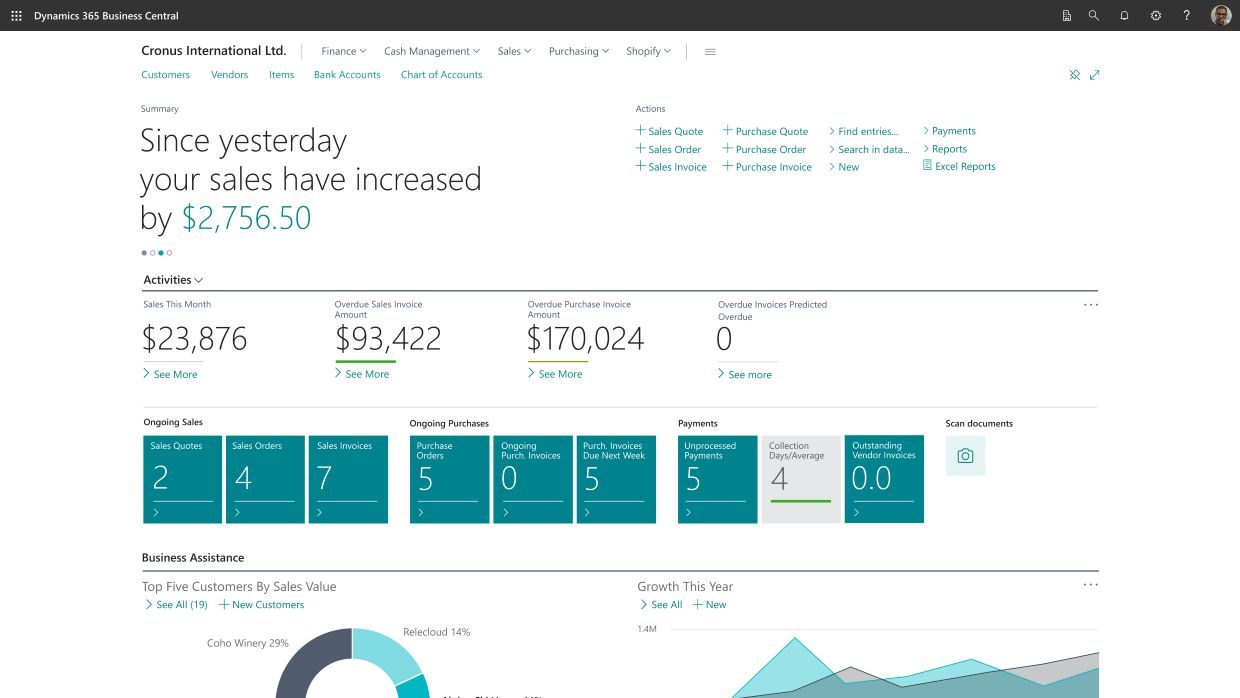
Shopify integration: Microsoft offers a native Shopify connector built directly into Business Central. This connector synchronizes products, inventory levels, customers, orders, fulfillment, and financial transactions between your Shopify store and your ERP in real time — no middleware required. Orders placed in Shopify automatically create sales documents in Business Central. Inventory updates in Business Central push directly to your Shopify storefront. Financial postings happen automatically, so your general ledger always reflects your ecommerce activity.
Strengths:
- Unified accounting and operations. Business Central is not just accounting software — it is a complete ERP. Your chart of accounts, accounts payable, accounts receivable, general ledger, bank reconciliation, budgeting, and cash flow forecasting all live in one system alongside your inventory, purchasing, and sales processes.
- Canadian tax compliance built in. Business Central handles GST, HST, PST, and QST natively, including multi-line tax invoices for split-tax provinces like BC and Québec. Setting up Canadian sales tax in Business Central is straightforward, and the system produces CRA-compliant reporting.
- Multi-channel and multi-warehouse. Beyond Shopify, Business Central manages B2B orders, EDI, wholesale, and in-store POS. It tracks inventory across multiple locations with bin management, transfer orders, and demand forecasting.
- AI-powered with Microsoft Copilot. Copilot in Business Central helps with bank reconciliation, late payment prediction, cash flow forecasting, and even creating sales orders with a single prompt. This accelerates month-end close and reduces the manual effort that comes with high-volume ecommerce accounting.
- Scales with your business. Unlike standalone accounting tools that you will outgrow, Business Central grows with you from startup to mid-market — adding manufacturing, warehousing, project management, and advanced analytics (via Power BI integration) as you need them.
Limitations: Business Central is more complex and more expensive than standalone bookkeeping tools. It is best suited for businesses that have outgrown QuickBooks or Xero and need operations management alongside their accounting. Implementation benefits from working with a certified Microsoft Partner like Gestisoft to ensure it is configured for your specific workflows.
Best for: Growing Shopify merchants (typically 500+ orders per month or $1M+ in annual revenue) who need a single platform for accounting, inventory, purchasing, and fulfillment — especially those selling across multiple channels or managing complex Canadian tax obligations.
Watch how accounts payable processing works inside Business Central to see the kind of financial automation a full ERP provides:
This tutorial walks through the complete AP workflow — from posting vendor invoices to issuing payments — showing how Business Central automates steps that Shopify merchants typically handle manually in spreadsheets or basic bookkeeping tools.
Thinking About Upgrading Your Shopify Accounting?
Whether you are considering Business Central, QuickBooks, or any other solution, Gestisoft's ERP consultants can help you evaluate what fits your business today and scales for tomorrow.
 Book a free consultation
Choosing by Growth Stage: A Decision Framework
To simplify your decision, here is how to match your accounting software to your current stage:
Stage 1 — Just getting started (under 100 orders/month). FreshBooks or QuickBooks Online with basic Shopify syncing is sufficient. Keep it simple and affordable. Focus on getting your tax registrations right and building good bookkeeping habits early.
Stage 2 — Growing steadily (100–500 orders/month). QuickBooks Online or Xero paired with A2X for clean Shopify reconciliation. At this stage, invest in middleware to ensure your financial data is accurate. Start thinking about whether your accounting tool will scale with you.
Stage 3 — Scaling seriously (500+ orders/month, multi-channel, multi-warehouse). This is where standalone accounting tools start breaking down. You are likely managing inventory in one system, accounting in another, and Shopify in a third — with spreadsheets holding everything together. Microsoft Dynamics 365 Business Central replaces this patchwork with a single platform. The native Shopify connector eliminates middleware, and the ERP handles accounting, inventory, purchasing, and fulfillment in one place. For Canadian businesses at this stage, working with a Business Central specialist ensures the system is configured for your specific tax, compliance, and operational needs.
Stage 4 — Enterprise scale (thousands of orders/day, manufacturing, B2B + DTC). Business Central with advanced warehouse management, manufacturing modules, and Power BI analytics. At this stage, your ERP becomes the central nervous system of the business — and Shopify is one of several channels feeding into it.
The Canadian Tax Factor: Why It Matters for Software Selection
Many "best Shopify accounting software" guides are written from a US perspective and gloss over Canada's tax complexity. This is a mistake.
Canada's sales tax structure is one of the most complex in the developed world for ecommerce sellers. Depending on where your customer is located, you may need to charge GST only (Alberta, territories), HST as a single combined tax (Ontario, Maritimes), GST plus a separate PST (British Columbia, Saskatchewan, Manitoba), or GST plus QST with a separate provincial registration (Québec).
Your accounting software must produce invoices with the correct number of tax lines — one line in HST provinces, two separate lines in GST+PST provinces — and your books must reconcile to the correct tax accounts for each jurisdiction. Errors here do not just affect your bookkeeping; they create compliance exposure with the CRA and provincial tax authorities.
This is where a full ERP like Business Central offers a significant advantage over lightweight bookkeeping tools. Business Central's tax engine is designed for multi-jurisdiction compliance, and a Canadian Microsoft Partner like Gestisoft configures it specifically for the GST/HST/PST/QST landscape — including the nuances of inter-provincial selling that trip up many Shopify merchants.
-
For most small Shopify stores in Canada, QuickBooks Online or Xero paired with A2X provides accurate bookkeeping and clean Shopify reconciliation. For growing businesses that need inventory management, multi-channel consolidation, and full Canadian tax compliance in one platform, Microsoft Dynamics 365 Business Central with its native Shopify connector is the strongest option.
Let Gestisoft Help You Find the Right Fit
Choosing accounting software for your Shopify store is a strategic decision that affects your operations, compliance, and growth. Gestisoft's team of ERP and ecommerce specialists can guide you through the evaluation — from lightweight bookkeeping tools to a full Business Central implementation.
 Book a free consultation
Explore More
- Inventory management software for Shopify – why Microsoft Dynamics 365 is your best choice — A deep dive into how Business Central's native Shopify connector handles inventory across channels and warehouses.
- Top 10 free accounting software in Canada for small businesses — If you are just starting out and budget is tight, this guide covers free options to get your books in order.
- How to choose an ERP software using 10 criteria — A structured framework for evaluating ERP systems when you are ready to upgrade from basic accounting tools.
- Financial automation software: the complete guide — Learn how automation reduces manual accounting work and improves accuracy for ecommerce businesses.
- Analysis mode in Business Central: unlock instant data insights — See how Business Central's built-in analysis tools let you pivot and explore financial data without leaving your workflow.
Liked what you just read? Sharing is caring.

June 09, 2026 by Kooldeep Sahye by Kooldeep Sahye Marketing Specialist
Fuelled by a passion for everything that has to do with search engine optimization, keywords and optimization of content. And an avid copywriter who thrives on storytelling and impactful content.