

Picking the right warehouse management system for small business is one of those decisions that feels small until it isn't. You start with a spreadsheet, add a free app, bolt on a shipping tool, and suddenly you have four systems that don't talk to each other, your team is double-entering data, and a missed order just cost you a customer.
This guide is built for Canadian small business owners and operations leaders tired of patching things together. We will cover seven tools small businesses actually use in 2026, what to look for before you buy, the mistakes that cost real money, and the signs you have outgrown your setup.
Get a Warehouse Setup That Actually Scales With You
Walk away from this call with a clear picture of how Business Central can replace three or four disconnected tools and give you one warehouse system that grows as your orders grow.
 Free discovery call
7 Warehouse Management System for Small Business Options to Consider in 2026
Most "best WMS" lists treat small businesses like one group. They aren't. A solo Shopify seller and a 25-person Canadian distributor are both technically small businesses, but their needs from a warehouse management system for small business are completely different.
Here are seven options ranked by real-world fit, what they handle well, and where they start to break.
1. Microsoft Dynamics 365 Business Central: The Warehouse Management System for Small Business Built to Scale

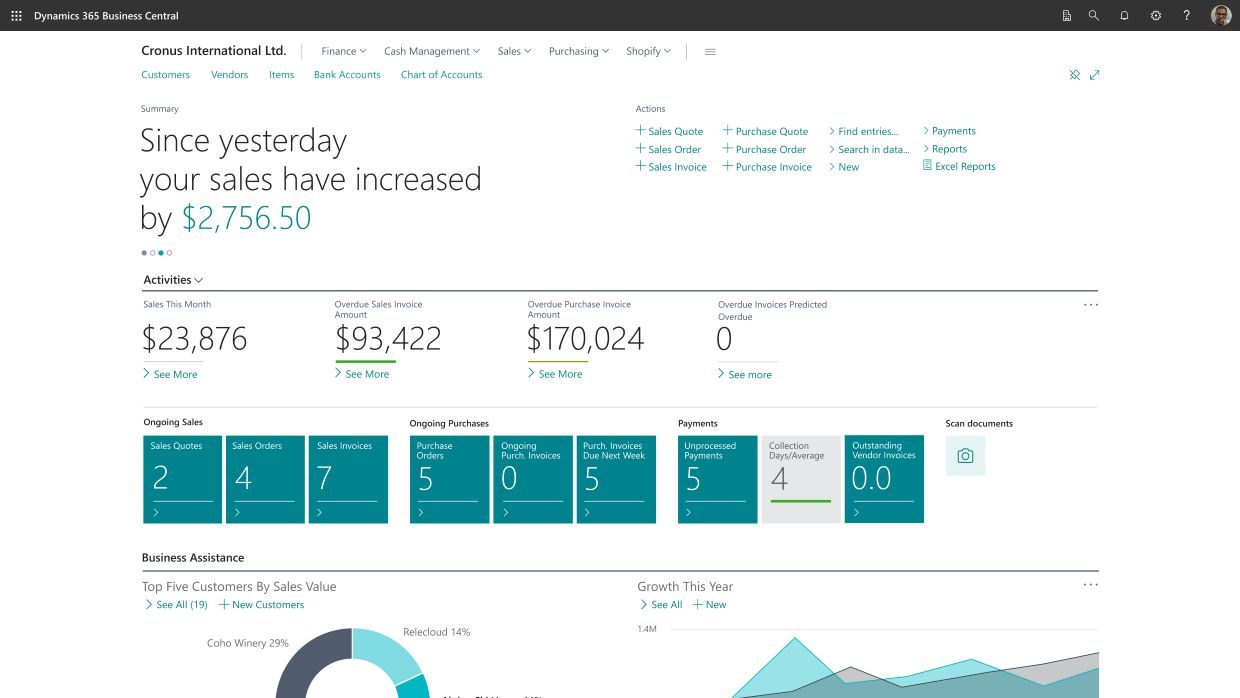
Business Central is Microsoft's cloud ERP for small and mid-sized businesses, and its warehouse module is built in, not bolted on. You get receiving, put-away, bin management, pick and ship, cycle counts, and inventory accuracy in one system that also handles finance and sales.
Best for: Canadian small businesses planning real growth or tired of stitching tools together.
The catch: Needs a proper implementation partner. Not a weekend setup.
Upgrade trigger: Already here. This is the system most small businesses graduate to when they outgrow standalone WMS tools.
2. Zoho Inventory: The Light Starter for Tiny Operations

Zoho Inventory is a cloud inventory and order tool with light WMS features. Easy to set up, clean interface, and the free tier covers small order volumes.
Best for: Solo sellers and very small teams running under 50 orders a month with one or two warehouse locations.
The catch: The free plan caps you fast, and warehouse execution is shallow. No directed put-away, no advanced picking logic.
Upgrade trigger: The moment you cross 50 orders a month or add a third location, the gaps in this warehouse management system for small business show up fast.
3. Sortly: Visual Inventory With Mobile Scanning

Sortly is a mobile-first inventory app that tracks stock with photos, QR codes, and barcodes. One of the easiest tools to roll out, especially for non-technical teams.
Best for: Small businesses tracking physical assets, tools, or stock where visual ID matters more than deep workflows.
The catch: It is an inventory tracker, not a true warehouse management system for small business. No real pick-pack-ship flow.
Upgrade trigger: When you need to run a warehouse floor with directed workflows, not just track what is on the shelf.
4. Fishbowl: The QuickBooks Companion for Small Manufacturers

Fishbowl is a desktop and cloud WMS built around tight QuickBooks integration. It handles inventory, manufacturing, and warehouse workflows for Canadian small businesses that already live inside QuickBooks every day.
Best for: Small manufacturers and distributors on QuickBooks needing real WMS features without leaving their accounting platform.
The catch: Setup costs run higher than the cloud-only tools here, and the interface feels dated next to newer options.
Upgrade trigger: When QuickBooks itself starts holding you back on financial reporting, multi-entity handling, or Canadian tax complexity.
5. Odoo Inventory: The Flexible Open Module

Odoo Inventory is part of the broader Odoo suite. The free Community edition gives you double-entry inventory, basic putaway and replenishment, and multi-location tracking. Advanced features like barcode integration and quality management sit in the paid Enterprise version.
Best for: Tech-comfortable small businesses that want a modular platform and are willing to self-host or work with an Odoo partner.
The catch: Self-hosting means you own updates, security, and support. The "free" label hides real internal cost.
Upgrade trigger: When your IT team spends more time maintaining Odoo than running the business itself.
6. Cin7: Multi-Channel Inventory for E-Commerce Sellers

Cin7 is a cloud platform built for businesses selling across multiple sales channels. It connects to Shopify, Amazon, and major marketplaces with real-time stock sync.
Best for: Small Canadian e-commerce brands needing a warehouse management system for small business that connects multiple sales channels and one or two warehouses.
The catch: Pricing climbs quickly with more channels, users, or order volume. Accounting integration works but is not seamless.
Upgrade trigger: When finance complains about reconciliation gaps or you need true Canadian tax handling built in.
7. ShipBob: Outsourced Warehouse With WMS Visibility

ShipBob is technically a 3PL, but small businesses use it as their warehouse management system for small business when they would rather outsource the whole warehouse.
Best for: Small e-commerce businesses that don't want to run a warehouse and are happy paying for fulfillment as a service.
The catch: You are renting visibility, not owning your operation. Customization is limited and you live inside ShipBob's pricing.
Upgrade trigger: When fulfillment fees eat your margin or you need packaging and returns control the 3PL won't customize
What to Look for in a Warehouse Management System for Small Business
Before you commit to any warehouse management system for small business above, run it through a quick three-part check. This is the same logic most ERP consulting companies use when guiding Canadian small businesses through ERP WMS evaluations.
Order Volume Today, and 18 Months From Now
A good warehouse management system for small business should not just handle today's volume. It should handle where you will be in a year and a half.
Look at your monthly order count, your peak season spike, and your three-year growth plan. If your tool caps out at 100 orders a month and you are already at 80, you are shopping for the next one.
Integration Capabilities of a Warehouse Management System for Small Business
This is where most small businesses get burned. A warehouse management system for small business that doesn't connect cleanly to accounting, sales channels, and shipping carriers creates more manual work than the spreadsheet you are trying to escape.
You need clean two-way sync with your accounting platform, real-time stock updates to your e-commerce stores, and direct carrier integration. For Canadian small businesses, that usually means Canada Post, Purolator, and UPS Canada.
The hidden cost of poor integration shows up in your team's hours. If your warehouse manager spends six hours a week reconciling stock between systems, you are paying for a tool that is not doing its job.
Canadian Tax, Compliance, and Bilingual Needs
Most warehouse management systems are built for the US market. They handle US sales tax but stumble on Canadian GST, HST, and provincial tax variations. If you operate in Quebec, you also need French-language workflows or solid integration with a tool that does.
Tools like Business Central handle Canadian tax compliance natively and support bilingual operations out of the box. Many cloud-only options require workarounds or third-party add-ons.
Cut Your Warehouse Costs With the Right System Setup
Talk to a Canadian Microsoft Partner about how to wire up your warehouse, finance, and sales into one ERP and stop paying for tools that don't talk to each other.
 Book a free consultation
Common Mistakes With a Warehouse Management System for Small Business
After 27 years of helping businesses across North America move from spreadsheets to real ERP-connected warehouses, we see the same warehouse management system for small business mistakes over and over.
Picking the Cheapest Option Without Checking the Ceiling
The lowest sticker price is almost never the lowest total cost. A free or near-free warehouse management system for small business often has hard caps on users, locations, or orders. You hit the wall, you migrate, you pay for the migration. Many businesses redo their setup within 18 to 24 months because they chased the lowest price up front.
Ignoring How the Warehouse Connects to Finance
Plenty of small businesses run their WMS and accounting as separate worlds. Stock comes in, sales go out, and finance reconciles by hand at month-end. This is where margin disappears. A connected setup, like the one you get with ERP-integrated inventory management, eliminates that work entirely.
Treating the WMS as an IT Project
Warehouse software is an operations project that happens to involve IT. If your warehouse team is not in the room from day one, telling you how they actually receive, put away, and pick, the tool will not match how you actually work.
Skipping the Data Cleanup
Garbage in, garbage out. If you bring messy customer records, duplicate SKUs, and inconsistent units of measure into a new warehouse management system for small business, you are just digitizing the chaos. The single biggest predictor of success is how clean your master data is on day one.
Underestimating Training Time
Even the most intuitive system needs hands-on time with the people using it daily. Small businesses that skip training see adoption stall and end up back on spreadsheets within months.
The 10 ERP Selection Criteria Every Small Business Should Use
Skip the guesswork. This guide walks you through the exact 10 criteria to score any ERP before you sign a contract.

Signs You've Outgrown Your Warehouse Management System for Small Business
Every small business eventually hits the moment where their warehouse management system for small business stops keeping up. The trick is spotting it early, not after a bad quarter.
Your Team Spends More Time on Workarounds Than Warehouse Work
If your warehouse manager is exporting CSVs every week to get reports your tool should provide natively, the tool is the problem.
You Are Paying for Three or Four Tools That Should Be One
A standalone WMS, a separate accounting platform, a third-party shipping tool, and a Shopify connector. Each one has its own subscription and integration cost. Understanding the core components of a real WMS helps you see why a connected setup often works out cheaper at scale.
You Can't See Real-Time Stock Across Locations
The moment you open a second warehouse or retail backroom, most lightweight WMS tools start lagging. Real-time multi-location visibility is one of the hardest things to retrofit later.
Your Finance Team Is Reconciling Stock Manually at Month-End
This is the loudest signal. If accounting is still chasing inventory numbers in a spreadsheet, your warehouse and your books are not connected, and that is costing you real money.
You Are Hitting the User, Order, or Location Cap on Your Current Plan
Most freemium WMS tools have hard ceilings. When you start paying to expand, run the math against the real benefits of a modern WMS. You may be closer than you think.
If you see two or more of these signs, you are not failing. You are growing. Time to look at a warehouse management system for small business that grows with you.
Want to see how the pick-and-ship flow actually works inside a proper ERP-connected warehouse? This short walkthrough shows it step by step.
-
For Canadian small businesses planning to scale, Microsoft Dynamics 365 Business Central is the most complete option. It handles warehouse, finance, and sales in one platform with native Canadian tax support. For very small operations, Zoho Inventory or Sortly can work as a starting point.
Why Gestisoft Is the Right Warehouse Management System for Small Business Partner in Canada
Gestisoft has been helping small and mid-sized businesses across North America run smarter warehouses for over 27 years. As a certified Microsoft Solutions Partner headquartered in Canada, we specialize in implementing Microsoft Dynamics 365 Business Central as a complete ERP solution that includes proper warehouse management out of the box.
We work bilingually in English and French, we know Canadian tax and compliance inside out, and we have moved dozens of small businesses from spreadsheets to a single connected warehouse management system for small business growth.
We are a B Corp certified company and a Microsoft Solutions Partner with deep expertise in Business Applications. We don't just sell software. We design implementations that fit how your business actually runs.
Here is what one of our clients had to say after we implemented Business Central:
“Gestisoft's consultants come from the industry, so when we worked together, we spoke the same language and shared the same vision of what was important and necessary. They guided us in implementing industry best practices. Throughout the project, their industry expertise eliminated any potential irritants that might have risen from inexperience in the distribution environment.”
That kind of real-time visibility is what separates a real warehouse management system for small business from a glorified spreadsheet. And that is what we build with every client.
Ready to map out what this could look like for your operation? Let's talk.
Move From Warehouse Chaos to a Connected ERP
Sit down with a Gestisoft expert and map out exactly how to turn your manual warehouse work into a real-time, ERP-connected operation built for Canadian small businesses.
 Free discovery call
Liked what you just read? Sharing is caring.

May 20, 2026 by Muhammad Ali Iqbal by Muhammad Ali Iqbal SEO Content Strategist & Copywriter
Driven by a passion for search engine optimization, strategic content, and conversion-focused writing. A copywriter and content strategist who lives for content that ranks, engages, and delivers real business results.
