
If you’re an eCommerce business in your early growth stages, you’ll know that Shopify and accounting software integration is a strong starting point for managing business finances.
Shopify handles the front-facing operations such as your storefront, orders, and payments, whilst accounting software such as Xero, Sage or QuickBooks helps track the behind-the-scenes revenue, expenses, and taxes.
Together, they form a highly functional system that typically enables small to medium sized businesses to operate efficiently in their early stages.
Yet, as a business grows, this once simple system may start to feel fragmented. Naturally, growth is accompanied by more orders, products and regions. The result is increased operational complexity beyond just the financials.
Of course, Shopify and accounting software don’t necessarily break at this point; rather, it’s the division of these two systems that can lead to friction, which can unknowingly become a quiet bottleneck in your business operations.
We’ll outline in this article when it makes sense for a business to continue using their Shopify and accounting software duo, and when it may make sense to transition to an Enterprise Resource Planning (“ERP”) solution to continue their upwards growth trajectory.
Interested in scaling beyond your current Shopify and accounting software?
As your operations scale, it’s common for these two disconnected systems to slow you down.
 Free discovery call
Why Businesses Start With Shopify and Accounting Software: 4 Key Benefits
If you’re not already using a Shopify and accounting software integration, here are several benefits of using the two tools together:
1. Simplicity
Shopify and the most popular accounting softwares such as QuickBooks, Xero and Sage already offer plug and play in-built integrations that make it easy for someone to connect the two.
In other words, there's a short learning curve, and the initial set-up is straightforward to get started.
2. Cost-effectiveness
For eCommerce businesses with limited funding or spend, it’s more reasonable to start with Shopify and accounting software integration before a fully comprehensive system.
Having these two lower cost monthly subscriptions models is considerably more cost effective in the early growth stage.
3. Automation
As an eCommerce business, you’ll likely have a constant high volume of orders to fulfil, making financial record keeping crucial.
Hence, having automated income and expense reconciliation alongside other services like tax reports and filing, makes the cost of having this integration entirely worth it over manual alternatives like spreadsheets.
4. Accessibility
For businesses operating across regions, Cloud-based systems rather than manual spreadsheets such as Excel allow for easier access regardless of region.
This, in combination with automatic multi-currency features integrated in most popular accounting software, allows for manageable orders and financial reporting with simpler reconciliation.
Together, Shopify and accounting software integration offers a powerful tool for eCommerce businesses needing simple yet effective financial record keeping in their early to mid stage growth phases.
4 Signs To Keep Your Shopify and Accounting Software
Shopify and accounting software works particularly well in your business if it meets the following criteria:
1. Order volume is manageable
If your order volume is manageable, this setup is likely the right fit for your business at this stage.
Anything else at this point may be unnecessarily costly and not yet worth the investment to learn an entirely new system.
2. Operations are simple
If you have, for instance, one major supplier with a core customer base, it’s probably right to continue using your existing setup.
There’s no need to overcomplicate your operations and fix what’s not broken.
3. Single region operations
Linked to operational simplicity above; if you operate in one main country, jurisdiction or region, Shopify and accounting software are often to support your operations at this stage.
Even if you do decide to expand to another region, perhaps operating in 2 or 3 currencies, accounting software multi currency platforms such as QuickBooks, Xero and Sage all have in-built automated currency conversions to aid your income and expenditure record keeping.
4. Financial reporting needs are basic
Say the executive team, owner or manager only requires basic financial reporting such as quarterly or annual updates; this integration is the ideal combination that balances automation and cost to achieve this.
So, for early-stage eCommerce businesses with simple operations, Shopify and accounting software excels at tracking financial records and aiding tax returns— it typically isn’t time to change systems.
Where Shopify and Accounting Software Starts to Create Friction
As your business scales, you’ve probably noticed operations becoming harder to manage.
These are the most common signs of the duo showing cracks:
1. Financial Data Doesn’t Line Up Cleanly
Although Shopify and accounting software excels at the small-medium sized level, reconciliation of records using these two systems may become increasingly more complex as your business grows.
As Shopify batches payouts, deducts fees, and processes refunds all completely separately, finance teams often need to review and reconcile how these transactions appear in their accounting system to make sense of them.
To illustrate what this might look like in practice, we’ll use a fictitious outdoor clothing brand called MapleStride as an example. Last month, MapleStride processed 1,200 orders, generating approximately $180,000 CAD in revenue.
Despite their Shopify and QuickBooks integration, payments often arrive in lump sums, the payment processor fees vary per transaction and refunds are processed separately, which may appear as completely separate transactions in the future.
The result? Finance spends 6–8 hours per week reconciling discrepancies between Shopify and QuickBooks; despite the integration.
But it’s not just efficiency that’s impacted; it affects confidence in the numbers by constantly checking whether the data is correct in the first place.
For example, let’s say there’s a $2,000 discrepancy between a Shopify payout and recorded revenue. An entire investigation may need to be conducted to deduce the mismatch. This could include combing through individual transactions, payment processor reports and refund timelines.
Thus, what could be a quick reconciliation then becomes an investigation requiring the entire team’s input.
In short— Shopify and accounting software introduces automation of records, but it doesn’t remove the financial complexity and reconciliation that often accompanies growth.
2. Inventory and Financials Drift Apart
Shopify and accounting software excels at financial record keeping, but it often doesn’t connect to inventory systems such as Zoho.
So again, human and manual reconciliation is often required at the end of the month to piece together fragmented data into a single, accurate view of business performance.
For MapleStride, it could look like this: Shopify shows high sales volume and QuickBooks shows revenue growth, but without integrated inventory costing:
They can’t automatically accurately track margins and;
They may grossly overestimate profitability.
3. Multi-Currency Adds Operational Complexity
Yes, accounting software multi currency such as QuickBooks can convert sales figures into multiple currencies automatically if you’re operating in multiple regions.
However, it still needs to account for varying exchange rates and tax implications. Shopify and accounting software can handle this, up to a point.
Let’s say MapleStride expands into the US and the UK. Their situation now looks like:
- 40% of their revenue is now in USD and GBP
- Currency fluctuations create reporting inconsistencies and;
- Monthly financial reports require manual adjustments
This complexity starts to slow down the integration duo as an increasing amount of currencies are introduced into operations.
So, whilst Shopify and accounting software is often ideal for simple operations, as complexity increases, it often starts to create friction and slow down once efficient workflows.
Can you relate? Real-World Scenarios
To see if your business may need a change in financial systems, we’ll highlight some fictitious MapleStride examples where this setup may start to slow down operations:
1: Month-End Close
When wrapping up accounts at month-end, MapleStride’s finance team takes 5–6 days to close monthly accounts.
How is this the case?
The finance team needs to do the following:
- Export data from Shopify.
- Make adjustments in spreadsheets: In order to produce accurate reports.
- Final reports validated manually: The finance team then fine-tooth combs the report to ensure it’s correct before showing the executive team.
A unified system such as an ERP, however, could reduce this process to 1–2 days.
2: Cash Flow Visibility
Although Shopify and accounting software integration can record financial transactions, they don’t show a clear picture of cash flow.
For instance, although MapleStride recorded $250,000 CAD in revenue last month, it may take considerable time to identify:
- Which are their most profitable hiking products and;
- What their real cash position is: what’s now tied up inventory, assets and other costs versus what they can use as profit.
The knock-on impact is heightened hesitation at the leadership level.
Take this as an example: if MapleStride’s leadership team is unsure whether their available cash is $80,000 or closer to $50,000 after inventory and liabilities, they may delay important decisions that could aid expansion, such as hiring decisions, marketing spend and supplier negotiations.
So overall, the issue is more than just visibility; it’s decision speed.
Therefore, to accomplish faster in-depth insights, a fully-integrated system is often needed.
3: Scaling Operations
MapleStride wants to expand into wholesale in addition to their retail operations.
Shopify is primed to handle primarily retail transactions, whilst the accounting software handles financial record tracking.
But inventory is tracked completely independently in Zoho. Although possible, MapleStride may struggle to continuously reconcile these three systems as they continue growing.
This is when a unified system is almost crucial to scaling beyond simple operations.
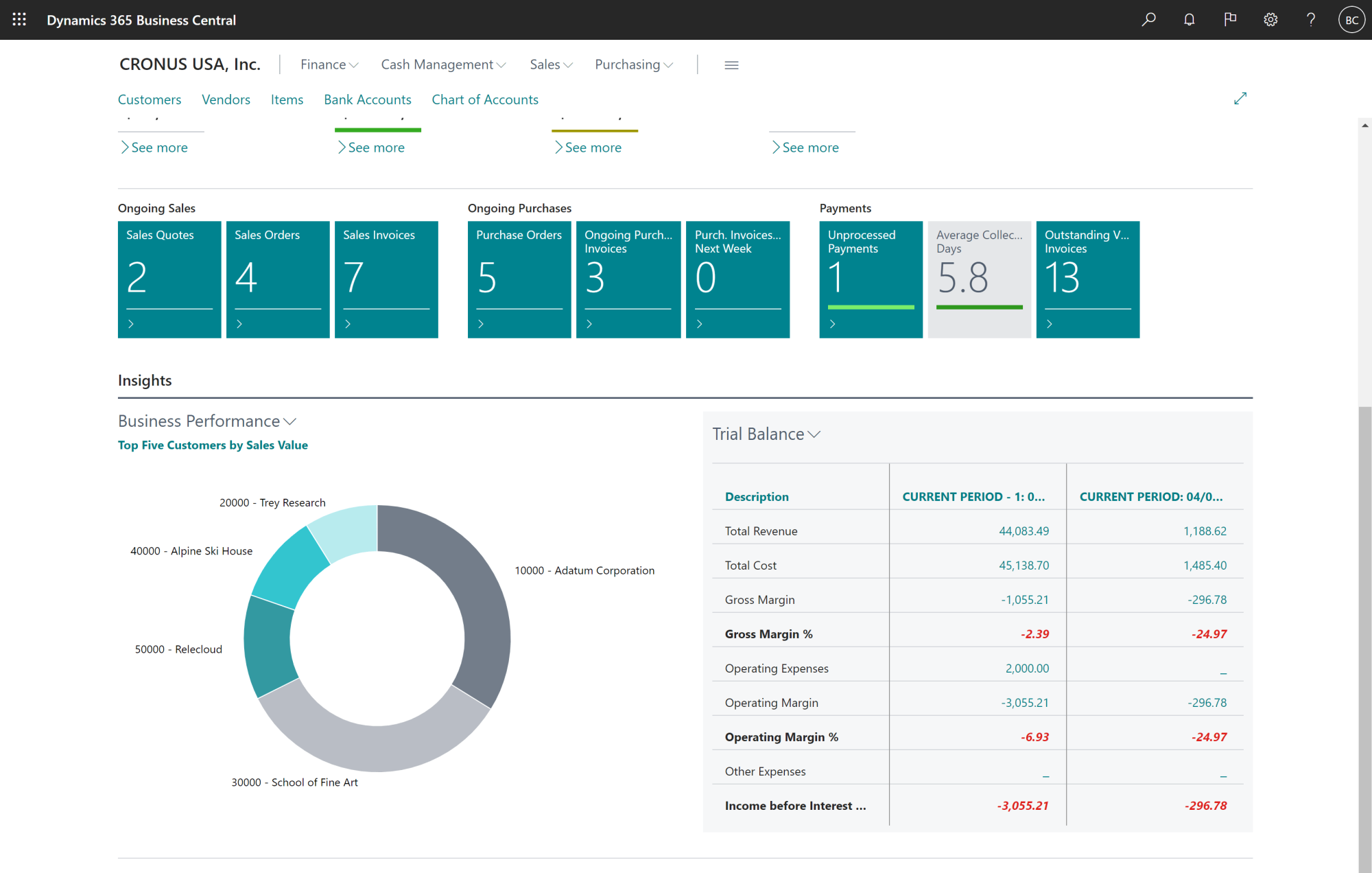
The Natural Next Step: Moving Beyond Shopify and Accounting Software
At a certain point, businesses need dependable systems that can support their wider business endeavours.
This is where ERP (Enterprise Resource Planning) solutions come into the picture. Instead of just tool integration, as is the case with your Shopify and accounting platform system, ERP systems unify all departments of a business, including finance, inventory, sales and daily operations.
Key decision makers then have a bird’s eye view of all business operations and how each department impacts one another.
When Does It Actually Make Sense To Upgrade?
To clarify; not every business using Shopify and accounting software needs to move to an ERP system.
The defining moment for many businesses is when the cost of managing their current system starts to outweigh the cost of replacing it.
For many businesses, some quintessential moments look like the following:
- Finance teams spending multiple days, perhaps even a week, per month, reconciling data
- increasing reliance on spreadsheets and other disconnected tools to fill gaps
- Delayed reporting affecting decision-making. This may be especially pertinent when leadership wants to make major moves that could considerably boost business growth.
So rather than a team problem, it’s the system itself that’s ultimately reducing efficiency and resulting in blockages to growth.
How ERP Changes the Picture
With an ERP system such as Microsoft Dynamics 365 Business Central:
1. Financial data updates in real time
There’s no longer any lag between Shopify, accounting software, and reporting. All data is updated in real time with no constant reconciling.
For MapleStride, this shift can significantly change how decisions are made. For instance, instead of waiting until month-end, leadership can:
- Track product profitability in real time and respond dynamically to market trends.
- Adjust pricing based on margin data and consumer demands.
- identify underperforming SKUs immediately so they can reduce or eliminate production and unnecessary costs.
The outcome of better reporting isn’t for the financials to just look good on paper— it translates into faster and more confident decision making.
2. Connected inventory and sales
With an ERP like Business Central, inventory and sales are automatically updated when records are changed in either one, which can then be instantly reflected in financial accounts.
3. Centralised reporting
With Shopify and accounting software, only financial reporting is reconciled at the end of the month.
With an ERP, reporting accounts for the entirety of your operations, including inventory, sales and CRM. Everything is accounted for.
4. Reduced Manual Intervention
An ERP significantly reduces the time needed for manual financial reconciliation, which frees up time for finance teams to engage in strategic work that can more directly contribute to a business’s success.
Other smaller tasks, such as copywriting, can be assisted with Copilot and AI.
For instance, eCommerce brands can use Copilot for Finance to aid marketing text creation for product descriptions. You can view how this works in our video below:
Curious about how switching from Shopify and accounting software to an ERP system could help?
Download our free eBook to discover the benefits of adopting a cloud ERP like Business Central

The Role of an Implementation Partner
If you’re considering transforming your Shopify and accounting software integration into an ERP, it’s likely you’ll need both technical and strategic support.
An expert implementation partner such as Gestisoft can help with the following:
- Map your current systems
- To gather, organise and clean all your current Shopify and accounting software data before transition.
- Design a scalable structure
- An implementation partner can personalise the transition to an ERP specifically to your business for whenever you want to scale and grow.
- Ensure smooth transition
- An implementation partner can provide an accurate timeline of the transition to minimise any disruptions to your current workflow.
- They also already have all learning resources in place to help your team use this new system.
Ready to move beyond Shopify and accounting software?
Speak with a specialist to explore how a unified system can support your next stage of growth.
 Free discovery call
Conclusion: From Shopify and accounting software to ERP solution
Overall, as a business grows, operations increase beyond financial transactions.
To make strategic decisions to move the business forward, leadership often needs real-time insights that can be executed quickly.
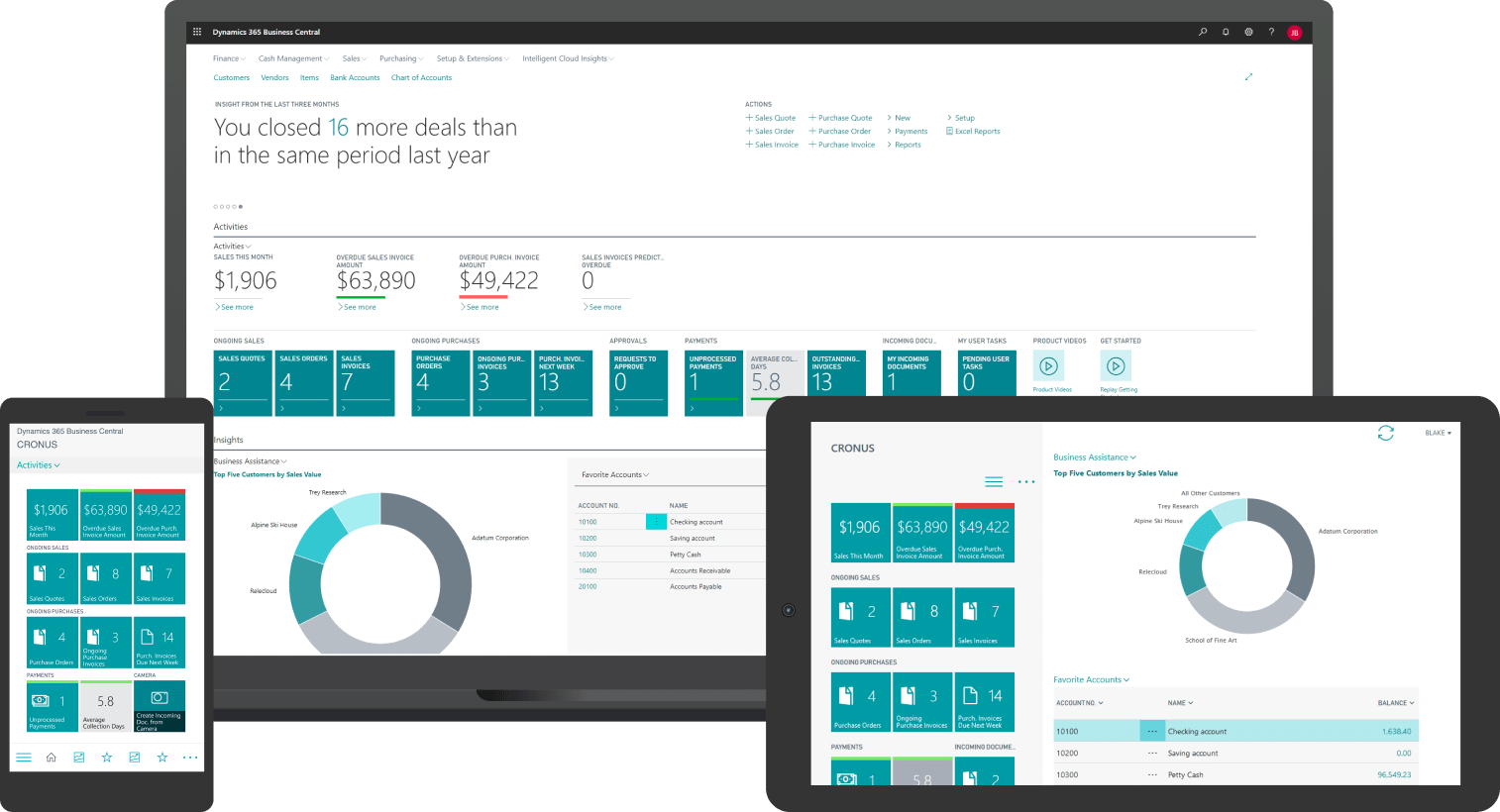
Disconnected systems, even integrated ones like Shopify and accounting software, can slow this process down, and it’s at this point where an eCommerce brand needs a fully-integrated system such as Microsoft Dynamics 365 Business Central ERP solution to provide a full view of business operations.
-
Yes, Shopify handles sales but not full financial management. Accounting software is needed for reporting, tax, and compliance.
Looking to design a system you can scale with confidence?
Book a discovery call to see how you can move beyond Shopify and accounting software.
 Free discovery call
Liked what you just read? Sharing is caring.

April 20, 2026 by Kooldeep Sahye by Kooldeep Sahye Inbound Marketing Manager
Specializing in SEO-driven pipeline growth, I combine keyword strategy, content optimization, and inbound tactics to turn organic search into a reliable source of qualified leads. I work at the intersection of traditional SEO and AI search — optimizing for LLMs and AI Overviews alongside Google — pairing data-informed strategy with sharp, story-led copywriting.