

You've seen what an AI agent can do. It answers the same HR policy questions your team fields on repeat and scores inbound leads against your criteria before a rep opens them. It can sort support tickets to the right queue by reading what each one says. The payback is measurable, and you want one in your business but that means hiring an AI agents development company that builds custom agents from scratch and charges six figures for the work that takes the better part of a year to deliver.
For a Canadian business already paying for Microsoft and Dynamics 365, much of that custom work may be unnecessary. Copilot Studio puts agents on top of the data you already license and has them running in a matter of weeks. The custom route keeps its value for a specific set of jobs, and a good part of this decision comes down to recognising which jobs need it.
A Microsoft consultant who has scoped both kinds of build is the person who can tell those jobs apart for your situation. The work that needs custom engineering looks different from the work a platform handles, and the difference isn't always obvious from inside the business.
Two things settle most of it. One is how complicated the agent's job gets once you map out every step. The other is where the data it needs is kept, and whether reaching that data keeps you inside the Microsoft platform or carries you past its edge. Get that read right and you have agents running inside ninety days, costed against the Copilot ROI before a dollar is spent.
The decision between an AI agents development company and Copilot Studio depends on where your business data exists and what the agents need to access
Gestisoft helps Canadian businesses scope their agent requirements against Microsoft platform capabilities before committing to a build approach.
 Book a free consultation
What an AI agents development company builds and what makes it different from platform-based agents
A custom AI agents development company works at the architecture level, assembling an agent from its component parts rather than configuring something pre-built. That work covers a defined set of decisions, each one made from scratch for the client.
What a custom AI agents development company builds
- The model underneath it, chosen from GPT, Claude, Gemini, or an open-source option depending on the task
- The orchestration layer, which is the logic that chains one task to the next so the agent can carry a job through several steps
- The data connectors that let the agent reach into CRM records, document stores, and email
- The guardrails that decide what the agent settles on its own and what it hands to a person
- The hosting, deployed onto cloud infrastructure the business then runs and pays for
The payoff from all that engineering is an agent shaped to your workflow.
- A law firm gets a document-review agent trained on its own precedent library.
- A manufacturer gets a quality-control agent that reads sensor output against tolerance specs on the line.
- A financial firm gets a compliance agent tuned to the regulatory patterns of its specific jurisdiction.
- A logistics company gets a routing agent that reweighs delivery schedules against live traffic conditions and driver hours as conditions change through the day.
- A healthcare provider gets an intake agent that reads referral letters against clinical criteria and flags the cases needing a specialist's review first.
These are precision workflows a general tool can't pick up off the shelf, but in turn the specificity carries a real price. A single custom agent from an AI agents development company runs four to eight months to build and lands somewhere between $75,000 and $300,000, with the figure climbing alongside complexity and the number of systems it has to plug into. The bill doesn't stop at launch either, since the business owns the code from then on, retrains the model as its data moves, and keeps the hosting running.
None of that is wasted money when the job demands it. Custom development is the right call when an agent needs a model trained on proprietary data, draws its primary information from systems outside Microsoft, or has to do something a platform tool can't, like processing a live sensor feed or running an industry-specific machine-learning model.
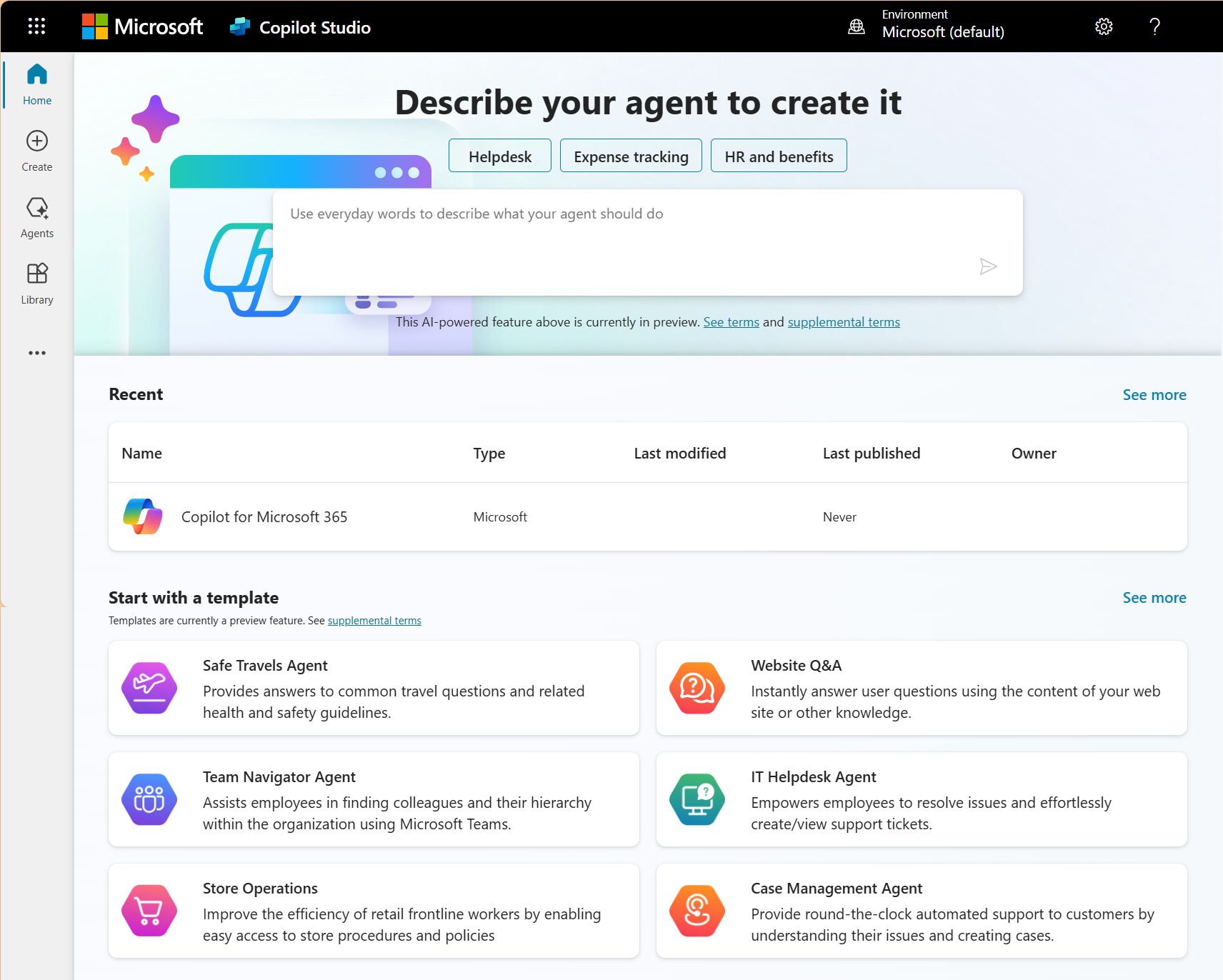
What Copilot Studio builds as an AI agents development company alternative for Microsoft-based businesses
Copilot Studio is Microsoft's own platform for building agents. It produces autonomous agents that reach across Dynamics 365, SharePoint, Microsoft 365, and outside systems through Power Platform connectors, then puts them to work on two kinds of tasks. One kind is conversational, where the agent answers a question or walks someone through a process. The other is functional, where it triggers a workflow or routes a request to the right place. None of it requires a line of custom code.
How Copilot Studio agents are built
Every agent in Copilot Studio comes together from four configured parts.
- A knowledge base, which is the set of data sources the agent is allowed to read
- Topics, the conversation flows and task chains that define what the agent actually handles
- Guardrails, the rules setting what it acts on alone and what it passes up to a person
- Integration points, the systems it reads from and writes back to
The assembly happens in a visual builder instead of a code editor. A business analyst or an IT administrator can get the agent up and working, which takes the whole job out of the hands of a dedicated development team and puts it with the people who already understand the workflow.
What data Copilot Studio agents can access
This is where a Microsoft-based business gets its biggest head start. Copilot Studio agents read Dynamics 365 records natively, the contacts and accounts and opportunities and cases and work orders already in the system. They pull SharePoint content through Microsoft Graph and they fire Power Automate flows when a job needs to move across several systems at once. For a Canadian business whose operational data already sits inside the Microsoft ecosystem, the agent reaches that data directly, whereas an AI agents development company would have to build custom connectors to touch that same data. The connection work that eats weeks of a custom budget is already done.
How Copilot Studio guardrails work
An agent is only safe to run loose if its boundaries are clear, and Copilot Studio sets them per agent.
- AI agents in HR answer policy questions on their own and pass a harassment complaint straight to a person
- A sales qualification agent scores inbound leads, then routes anything above a deal-size threshold to a rep rather than handling it
- A support agent clears routine tickets and opens a case for anything it recognises as complex
Those boundaries aren't fixed at launch. Once an agent has been running, the escalation data shows where it's handing off too often or not often enough, and each topic's guardrails get adjusted against what the agent is doing in practice. Setting the boundaries well the first time, and tuning them afterward, is the part a Microsoft Copilot consultant earns their fee on, and it's configured in the same Copilot Studio environment as everything else.
How to scope an AI agent project before choosing between an AI agents development company and Copilot Studio
Picking the build approach before you've defined the agent is how projects go sideways. Four questions about the agent itself tell you which way to go, and answering them honestly upfront saves an expensive custom build with an AI agents development company when it’s not necessary.
1. Where does the agent's data live?
Start with the data, because it decides more than anything else. An agent whose information comes from Dynamics 365 records, SharePoint documents, Outlook email, and Teams threads is already sitting inside Copilot Studio's native reach, with no connector-building required. The picture changes when the primary source is Salesforce or a proprietary industry database. At that point the question becomes whether a Power Platform connector already bridges to it or whether someone has to engineer that link by hand.
2. What does the agent need to do with that data?
Copilot Studio agents retrieve information, summarise it, route it, and set workflows running. That covers the conversational and the functional side of most business jobs. Some requirements run past it. An agent that has to run a proprietary model against incoming data, produce output that depends on a fine-tuned model, or read data types the underlying models struggle with, like audio sentiment or image recognition for quality inspection, needs the machine-learning engineering an AI agents development company supplies. The test is whether the task is reading and acting on data or running specialised inference on it.
3. How many systems does the agent have to coordinate?
Copilot Studio orchestrates across the Microsoft ecosystem and anything Power Automate connects to, which carries most business workflows comfortably. The strain shows when an agent has to coordinate actions across half a dozen non-Microsoft systems at once, with branching conditional logic threading through all of them. That volume of cross-system choreography can run past what the platform handles cleanly. The best move here is to map the orchestration before assuming the platform can't do it, since plenty of workflows that feel complex sit well inside its range. A Microsoft 365 consulting assessment is where that mapping usually happens.
4. What interaction volume does the agent need to handle?
Copilot Studio runs on Microsoft's infrastructure, which scales to enterprise load. For the volumes a Canadian B2B operation sees, hundreds or low thousands of interactions a day, the platform absorbs it without strain. The exception is the high-frequency case, an agent processing millions of transactions a day under sub-second latency demands, where dedicated custom infrastructure starts to make sense. Most businesses are nowhere near that line, especially where the agent works inside everyday tools like the CRM in Outlook their team already runs.
Scoping the agent project correctly determines whether you need an AI agents development company or a Microsoft Partner with Copilot Studio expertise
Gestisoft runs the scoping assessment for Canadian businesses so the build approach matches the agent requirements.
 Book a free consultation
Where Copilot Studio hits its ceiling and an AI agents development company becomes the right choice
There are four Microsoft Copilot limitations, and each one points clearly toward custom development with an AI agents development company.
1. Proprietary model training
Some agents have to run on a model trained solely on the business's own data. A pharmaceutical company analysing compound behaviour, or a financial firm scoring risk against twenty years of its own transactions, needs a model built around information no general system has seen. Copilot Studio's underlying models don't open up to custom training at that depth. Building and deploying a proprietary model is the core of what an AI agents development company does, and it's the clearest case for going custom.
2. Non-text data processing
Copilot Studio is strong on anything text-based, from conversations to document analysis to email. The wall appears with other data types. An agent inspecting product images for defects, reading audio for customer sentiment, or interpreting a live sensor feed on the factory floor is working in formats the platform doesn't process today. Those modalities call for the custom engineering a development company brings, since the requirement falls outside what the platform was built to read.
3. Multi-agent orchestration at scale
A single Copilot Studio agent does its job well. The harder pattern is a team of specialised agents working together without a human in the loop, where one spots a problem, hands the context to a second that diagnoses it, which sets a third off to fix it. That kind of autonomous handoff between agents can need orchestration frameworks Copilot Studio doesn't yet offer natively. A build like that is one of the bigger challenges with Microsoft Copilot a business runs into when it pushes past single-agent work.
4. Offline and edge processing
Copilot Studio agents run in the cloud, which is fine until the agent has to work somewhere the cloud doesn't reach. A remote site with patchy connectivity or a manufacturing floor that can't depend on a live connection rules out a cloud-only setup. Deploying to edge infrastructure is custom territory, and the experienced Copilot consultants worth hiring will tell you so plainly rather than sell you a platform fit that isn't there.
The cost and timeline comparison between an AI agents development company and Copilot Studio for Canadian businesses
The numbers make the decision concrete, and the spread is wide enough to settle most business cases on its own.
Custom agent from an AI agents development company
- $75,000 to $300,000+ per agent, climbing with complexity
- Four to eight months from start to deployment
- $2,000 to $10,000+ a month afterward for hosting and code upkeep
- You own the intellectual property, and the maintenance that comes with it, indefinitely
Copilot Studio agent through a Microsoft Partner
- $10,000 to $50,000 per agent, depending on data-connection and guardrail complexity
- Two to six weeks from scoping to go-live
- Ongoing cost folds into your existing Microsoft 365 Copilot and Copilot Studio licensing
- Microsoft handles model updates and infrastructure, so there's no custom code on your books
The proper comparison runs over two years of total ownership.
- A custom agent built at $150,000 with $5,000 a month in upkeep reaches $270,000 by the end of year two.
- A Copilot Studio agent at $30,000 of configuration, sitting on licensing you already pay for, costs a fraction of that.
The gap only closes when an agent needs something the platform can't provide, which is where a Canadian CRM build with custom requirements might tip back toward bespoke work.
For a Microsoft-based business, the platform route is faster and cheaper to get operational and lighter to maintain. Custom development earns its cost only when scoping turns up a requirement the platform can't meet. A standard need like a CRM dashboard stays well inside the platform. A proprietary-model requirement is what pushes a build toward custom.
Canadian businesses evaluating an AI agents development company should compare the two-year total cost of ownership against Copilot Studio configuration
Gestisoft provides the cost comparison using your specific agent requirements so the business case is built on real numbers.
 Book a free consultation
How Gestisoft builds AI agents for Canadian businesses through Copilot Studio and the Microsoft ecosystem
Gestisoft builds AI agents on the Microsoft platform a Canadian business already pays for. Working in Microsoft Copilot and Copilot Studio, Gestisoft connects each agent straight into the Dynamics 365 records and SharePoint content your team already works in, which is why these builds ship in weeks where a from-scratch agent takes months. The platform you license becomes the platform your agents run on, with no custom infrastructure to build and no separate system to maintain.
Ready-to-deploy AI agents from Gestisoft for common business workflows
Gestisoft offers a set of turnkey AI agents already built for the workflows most businesses run. For a common job handled the same way across thousands of companies, a pre-built agent skips the custom configuration entirely and goes live faster.
Our agents cover the requests that pile up on internal teams.
- An HR FAQ agent fields the recurring questions about vacation, insurance, and policy.
- An onboarding agent walks new hires through their first steps and answers what they ask along the way.
- An IT support agent takes routine requests and points them to the right resource.
- An internal procedures agent guides staff through the correct steps for administrative tasks.
- A safety and compliance agent answers policy questions and keeps cybersecurity practices front of mind.
Each one still runs on the same Microsoft foundation as a configured or custom build, reading your data inside the ecosystem you already license. The difference is that the workflow is already mapped, so the agent is ready to drop into your environment. For a Canadian business that recognises one of these jobs as its own, the turnkey route is the fastest and cheapest of the three.
Gestisoft's ecosystem depth drives every agent build
Gestisoft works across the whole Microsoft ecosystem, so an agent built by a team that also runs your CRM and your Power Platform workflows is an agent that fits how your business already operates. A Copilot for Sales qualification agent knows your pipeline because the people who built it set up that pipeline. The knowledge sources, the escalation rules, the workflows it triggers, all of it gets configured against your systems and documented so you know exactly what your agent does.
For a Canadian business, where the data is kept is part of the build. Copilot Studio agents process through Azure's Canadian datacentres, so the records and documents an agent reads stay inside the country and meet PIPEDA's residency expectations. Gestisoft configures each agent's access against that, defining which SharePoint libraries and Dynamics 365 records it can reach and keeping it clear of anything carrying personal data it has no business surfacing. Bilingual operations get agents tested in both languages before launch, so an agent citing Quebec employment standards has them right in French.
The relationship with us extends past go-live. Gestisoft's Customer Success Manager reviews how each agent performs at 30 and 90 days and tunes it on the evidence, widening what an over-cautious agent can answer and tightening the reins on one reaching beyond its brief. Your agents get sharper the longer they run, backed by the same team behind the Microsoft Copilot features Canadian businesses lean on every day.
-
An AI agents development company designs and builds autonomous AI systems that run business workflows on their own, handling jobs like answering staff questions, qualifying inbound leads, and routing support tickets through multi-step processes. Some build every agent from scratch with custom models and frameworks. Others, working as an AI agents development company on the Microsoft side, build agents on Copilot Studio so they connect straight into the platform a business already runs.
Liked what you just read? Sharing is caring.

June 18, 2026 by Shelley Sunjka by Shelley Sunjka Copywriter & Marketing Strategist
Armed with a psychology degree and an irrational obsession with okapis, I've spent the last decade helping bold brands tell better stories. I believe the best writing bends grammar rules on purpose and makes people feel something. When I'm not deep in words or nerding out on buyer behaviour, I'm probably convincing my kids that impromptu kitchen dance parties are totally normal.

