
Sales Professional Dynamics 365 sits at an interesting point in the CRM market. It's the entry-level tier of Microsoft's sales platform, priced below Enterprise and stripped of the advanced features most small to mid-sized teams won't use in their first two years. For B2B companies that need pipeline visibility and a system their reps will adopt without a six-month training programme, it covers that ground well and does it inside the Microsoft ecosystem your team already works in.
The trade-off is real though. There are fewer customisation options, no AI-driven insights through Copilot, and caps on custom entities and integrations. The honest question every business needs to answer before choosing Sales Professional Dynamics 365 is whether those limits will feel comfortable for the next two years or whether you'll be pushing against them within six months and wishing you'd started with Enterprise.
Getting this decision right saves money in both directions. Overspending on Enterprise when Professional would have covered the job wastes your budget on capabilities nobody touches, but underspending on Professional when the business needs Enterprise creates a second implementation project twelve months later that costs more than the licence savings.
Sales Professional Dynamics 365 works best when it's configured around your sales process
Gestisoft helps Canadian B2B teams get Sales Professional set up properly so your team uses it from day one.
 Free discovery call
What Sales Professional Dynamics 365 includes out of the box
The features inside Sales Professional Dynamics 365 are deliberately scoped. Microsoft designed this tier to cover the fundamentals a growing B2B sales team needs without burying them in capabilities they won't use for years. Understanding what's included helps clarify whether the platform matches where your business is right now.
Pipeline and opportunity management in Sales Professional Dynamics 365
Sales Professional Dynamics 365 gives your team a structured place to manage deals from first conversation through to closed invoice. Every opportunity has its own record with a defined stage, so the sales manager can see where the pipeline stands without calling a meeting or opening a shared drive to find the latest version of someone's tracking file. The quote-to-cash process is built in, which means a deal that closes flows into an order and an invoice within the same system. For teams coming from spreadsheets or no CRM at all, the shift in visibility alone changes how the sales operation runs day to day.
How Sales Professional Dynamics 365 connects to Microsoft 365
This is the adoption accelerator most competitors can't match at this price point. Your reps already open Outlook and Teams every morning, and Sales Professional Dynamics 365 integrates with both natively so email activity and calendar data flow into deal records without anyone manually logging them. For B2B teams where CRM adoption is the biggest risk in the project, that native integration removes the friction that kills most rollouts before they gain momentum. The CRM earns its place in the daily workflow because it lives inside the tools the team is already using.
Dashboards and reporting in Sales Professional Dynamics 365
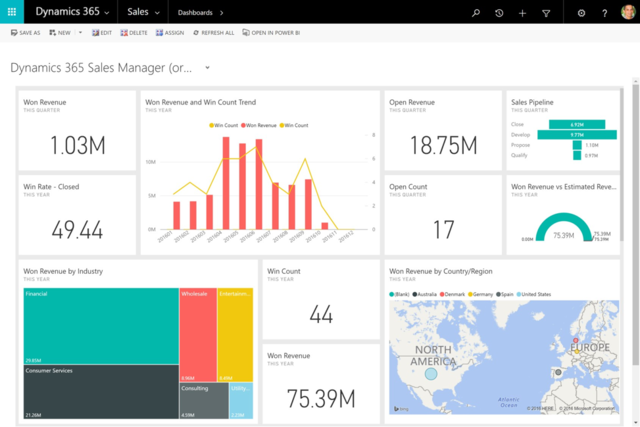
Sales Professional Dynamics 365 includes basic CRM dashboards and pipeline views with the ability to export to Excel and connect to Power BI for deeper analysis. A sales manager can see pipeline health and team activity without building anything manually, which covers the weekly reporting needs of most small to mid-sized teams comfortably. The reporting is functional at this tier, though it lacks the depth and customisation Enterprise offers. That gap becomes noticeable once leadership starts asking questions the standard views can't answer, which is one of the signals that an upgrade conversation is approaching.
Where Sales Professional Dynamics 365 has limits worth knowing about
Every CRM tier involves trade-offs, and Sales Professional Dynamics 365 has clear boundaries worth understanding before you commit. Discovering a limitation mid-project costs more to resolve than choosing the right tier from the start.
Customization caps in Sales Professional Dynamics 365
Sales Professional Dynamics 365 caps custom entities at fifteen, business process flows at five, and third-party app integrations at ten. For teams running a standard sales process without complex approval chains, those numbers won't feel restrictive.
The pinch comes when a business starts customising heavily to accommodate workflows the platform wasn't scoped for. A company that needs twelve third-party integrations or wants to build custom entities for project tracking alongside sales will hit the ceiling faster than expected, and at that point the conversation shifts to Enterprise whether the budget was ready for it or not.
No advanced forecasting or AI in Sales Professional Dynamics 365
Sales Professional doesn't include weighted forecasting tools, territory management, or Copilot AI capabilities. If your sales manager needs to forecast by rep or territory with probability weightings tied to historical conversion data, that functionality lives in Enterprise. The same applies to AI-driven deal risk insights and predictive lead scoring. For teams where the sales manager's forecasting needs are covered by looking at the pipeline view and making a judgement call, Sales Professional Dynamics 365 handles it fine. For teams where leadership needs a number they can build a hiring plan around, the absence of structured forecasting becomes a real gap.
Sales Professional Dynamics 365 and Business Central compatibility
This is where Sales Professional holds an advantage most competing entry-level CRMs can't touch. If your business already runs on Business Central, Sales Professional is available at a reduced licence price and the integration gives your team CRM-ERP connectivity from day one. Your reps see financial context alongside pipeline data inside the same environment. No other lightweight CRM on the market offers native access to your operational and financial data at this price point, which makes Sales Professional Dynamics 365 a fundamentally different Canadian CRM proposition for businesses already invested in the Microsoft ecosystem.
Sales Professional Dynamics 365 configured properly outperforms a more expensive CRM set up badly
Gestisoft implements Sales Professional around how your team sells so you get full value from day one.
 Free discovery call
Who Sales Professional Dynamics 365 is built for
Sales Professional Dynamics 365 works well for a specific type of business, and the profiles below make it easy to test whether yours is one of them.
B2B teams with a straightforward sales process
If your deals move through a predictable set of stages and your team is under 25 reps, Sales Professional covers the pipeline management and activity tracking you need without paying for capabilities that sit unused. You're investing in structure and Microsoft ecosystem integration, which for teams that have been running on spreadsheets is where the biggest performance shift comes from.
Companies already in the Microsoft ecosystem
If your team already uses Outlook and Teams, Sales Professional Dynamics 365 is the CRM that doesn't ask anyone to change how they work. The integration is native, so adoption tends to be faster than with platforms that connect to Microsoft through middleware. For teams where getting reps to use the CRM is the biggest concern in the project, that frictionless integration outweighs most feature comparisons.
Businesses that want a clear upgrade path with Sales Professional Dynamics 365
One of the underrated advantages of starting with Sales Professional is that it runs on the same platform as Enterprise and Premium. When you outgrow it, you upgrade your licence and your configuration carries forward. There's no data migration and no retraining. The Dynamics 365 Sales Professional vs Enterprise comparison is worth understanding before you choose a starting point, but knowing that the upgrade path is a licence change and a configuration expansion takes significant risk out of the initial decision.
When to start with Sales Professional Dynamics 365 and when to skip to Enterprise
The decision between Sales Professional and Enterprise comes down to timing more than features. Every business that starts on Professional will eventually consider Enterprise, which is why understanding how the best sales management software tiers compare before you commit saves time and money down the road. The question is whether that conversation will happen in two years because the business grew into it naturally, or in six months because someone underestimated what the team needed from day one.
The best way to pressure-test that timing is to involve your sales manager in the evaluation alongside whoever is making the budget decision. The per-seat price difference is what the budget holder focuses on, but the person managing the pipeline daily brings a perspective that changes the conversation entirely because they can tell you whether the team's current sales process has already outgrown what Professional was scoped for. That operational read on the decision is what prevents a tier regret six months in.
The cost gap is roughly $40 CAD per user per month. For a ten-person team, that's $400 monthly. That number feels small when you're choosing the wrong tier and large when you're paying for capabilities the team won't use for two years. Having both perspectives in the room when the decision gets made is what keeps it honest.
The right setup for Sales Professional Dynamics 365 makes the licence tier matter less
Gestisoft configures Sales Professional around your sales process so your team gets enterprise-quality outcomes from a streamlined platform.
 Free discovery call
How Gestisoft implements Sales Professional Dynamics 365 for Canadian B2B teams
Most CRM partners treat Sales Professional Dynamics 365 implementations as a quick deployment where you just install the platform and run a training session. The engagement is light because the licence is light, and the assumption is that entry-level software deserves entry-level attention.
Gestisoft treats it differently because we've seen what happens two years down the road. The businesses that get a thoughtful Professional implementation grow into Enterprise smoothly when the time comes, while the ones that got a rushed deployment hit the upgrade point with a CRM full of workarounds and bad data that has to be cleaned up before Enterprise can deliver any value. The upgrade becomes a remediation project instead of an expansion, and the cost of fixing the original implementation often exceeds what a proper setup would have cost in the first place.
That long-term view also changes what happens with Business Central. Most CRM implementation consultants working at the Professional tier don't think to connect the CRM to the ERP because they're scoping a small project. Gestisoft connects them from day one because our team operates as a CRM specialist across both Dynamics 365 CRM and Business Central, and we know that CRM-ERP visibility at the Professional level is one of the most underrated ways to improve sales performance because it gives a small sales team capabilities that competitors charging twice the licence fee can't match.
The upgrade conversation itself is something Gestisoft manages proactively. Our team monitors how your usage evolves and flags the inflection point before the limits start creating friction. When the move to Enterprise happens, it's a planned expansion built on a clean foundation, not an emergency migration triggered by a system that stopped working for the team.
-
Sales Professional is the entry-level sales CRM tier from Microsoft. It covers pipeline management, lead and opportunity tracking, and the full quote-to-cash process, with native integration into Microsoft 365 apps like Outlook and Teams. The platform is designed for small to mid-sized B2B teams with straightforward sales processes who want CRM structure without enterprise-level complexity.
Liked what you just read? Sharing is caring.

April 22, 2026 by Shelley Sunjka by Shelley Sunjka Copywriter & Marketing Strategist
Armed with a psychology degree and an irrational obsession with okapis, I've spent the last decade helping bold brands tell better stories. I believe the best writing bends grammar rules on purpose and makes people feel something. When I'm not deep in words or nerding out on buyer behaviour, I'm probably convincing my kids that impromptu kitchen dance parties are totally normal.


