
The Dynamics 365 Sales Professional vs Enterprise decision is one of those choices that looks simple until you start digging into it.
The two licenses run on the same platform and manage the same core functions, like leads, contacts, opportunities, quotes, and orders. They both connect to Outlook, Teams, and Excel, so when someone asks which one their business needs, the answer isn't about a features checklist. It depends on how your sales operation is built today and where it's heading in the next two years.
Get the license wrong in either direction and the consequences go beyond the invoice. A team on Professional that should be on Enterprise will outgrow the system before they've recouped the implementation cost. A team on Enterprise that only needed Professional is paying for capabilities nobody uses.
The pricing, the feature differences, the customisation limits, and the signals that point toward one tier over the other all factor into the Dynamics 365 Sales Professional vs Enterprise decision. So does the question of whether starting with Professional and upgrading later is as straightforward as it appears on paper.
The right Dynamics 365 license starts with the right conversation
The choice between Dynamics 365 Sales Professional vs Enterprise is easier when someone who knows the platform can walk through your sales process with you. Gestisoft helps Canadian businesses land on the right license before implementation begins.
 Free discovery call
Dynamics 365 Sales Professional vs Enterprise: what the Professional tier covers
Dynamics 365 Sales Professional is the entry-level license in Microsoft's sales platform. Entry-level doesn't mean inadequate. For a lot of Canadian businesses, it's the right place to start.
The license covers the core of what a sales team needs to manage pipeline and customer relationships day to day:
- Lead, contact, account, and opportunity management
- Product catalogue, price lists, quotes, orders, and invoices
- Basic dashboards, views, and reports
- Mobile access for phones and tablets
- Integration with Outlook, Teams, Excel, and Word
At approximately $88 CAD per user per month, Sales Professional gives smaller teams a structured CRM environment without the overhead of configuring features they won't use for years. If your sales process follows a consistent path and your team doesn't need complex automation, Professional does the job well.
If your business already runs Dynamics 365 Business Central, Sales Professional is available at a reduced attach price, which makes the entry point even more accessible.
The platform underneath is the same one that powers Enterprise. The data model and Microsoft ecosystem connections are identical. You're buying a more focused product. For businesses evaluating Dynamics 365 Sales Professional vs Enterprise, understanding where that focus stops being sufficient is the whole decision.
Where Dynamics 365 Sales Professional hits its ceiling
Dynamics 365 Sales Professional works well within its boundaries. The issue is that those boundaries are fixed, and they show up at a predictable point in a company's growth.
The license caps customisation at 15 custom entities, 5 business process flows, and 10 third-party integrations. For a business running a single consistent sales motion, those numbers are irrelevant. For a business managing multiple product lines with approval workflows that need to be built into the CRM, they become a hard stop fairly quickly.
Beyond the caps, there are capabilities that Professional doesn't include:
- Territory and quota management
- Sales forecasting module
- Competitor tracking
- Sales goals and playbooks
- Microsoft Copilot in Dynamics 365 Sales
- Embedded intelligence and assistant cards
- Sales Accelerator for structured follow-up sequences
None of these feel urgent when the team is small and pipelines are manageable. They start to count when leadership needs reliable forecasting data, or when sales managers are manually chasing updates that a properly configured system should surface automatically. That's usually when someone goes looking for what the platform can do and realises Professional was the wrong starting point.
Microsoft built that ceiling intentionally. Sales Professional is designed for teams at a specific stage. The challenge for Canadian businesses facing the Dynamics 365 Sales Professional vs Enterprise decision is recognising when they've moved past that stage before the limitations start affecting performance. A CRM specialist who knows the platform can usually spot those signals before they become problems.

Dynamics 365 Sales Professional vs Enterprise: what the Enterprise tier adds
Dynamics 365 Sales Enterprise includes everything in Professional and opens up the parts of the platform that support more complex, higher-volume sales operations.
The most significant additions are:
- Unlimited custom entities, business process flows, and third-party integrations
- Territory and quota management
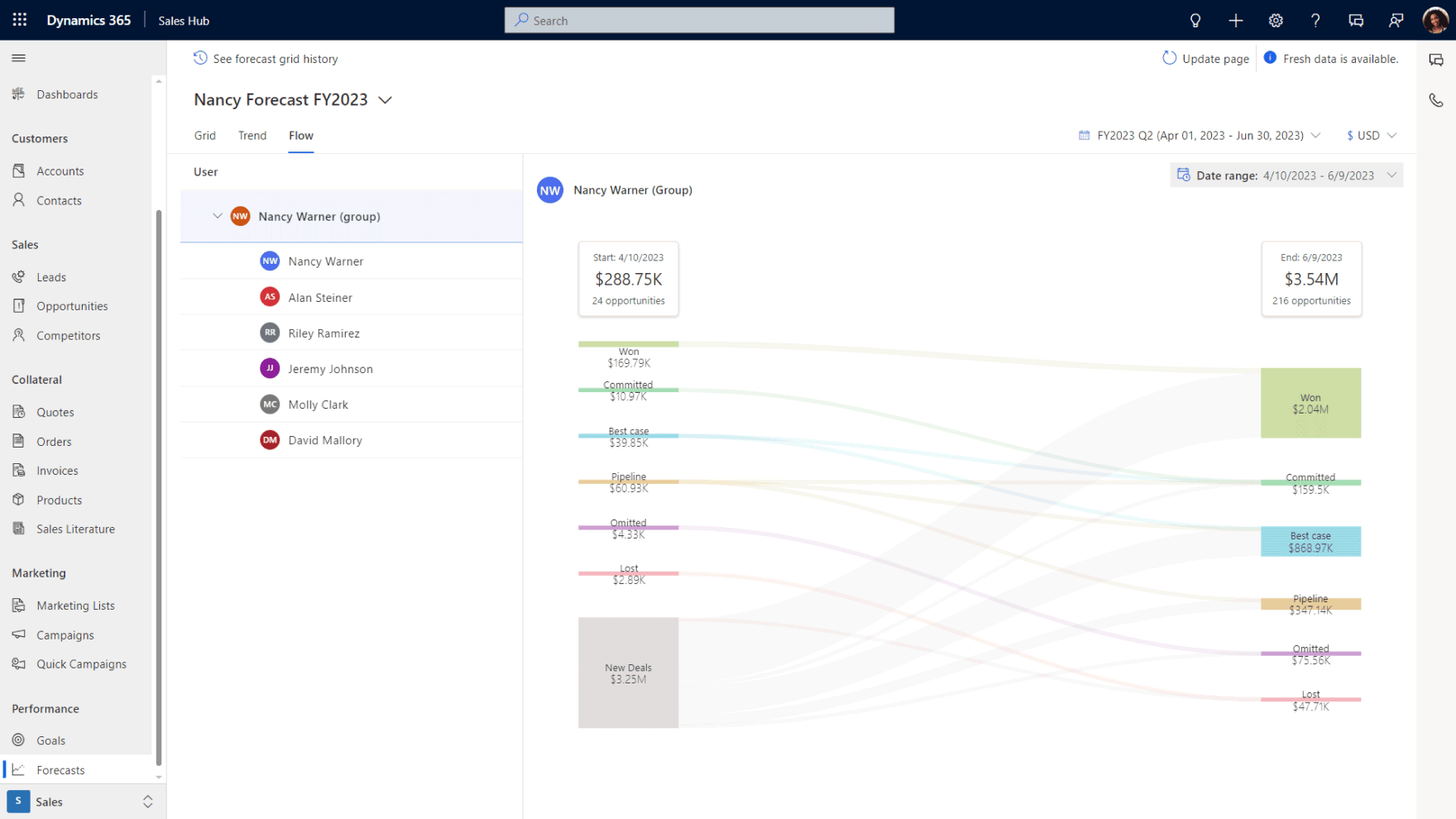
- Sales forecasting with structured forecast hierarchies
- Competitor tracking and relationship intelligence
- Sales goals and playbooks
- Microsoft Copilot in Dynamics 365 Sales, Outlook, and Teams
- Sales Accelerator with up to 1,500 sequence-connected records per month
- Assistant cards for guided selling
- Additional Dataverse storage per user (250MB database, 2GB file capacity)
The customisation ceiling disappears entirely. For businesses with complex approval workflows or industry-specific sales processes that need to be built into the CRM, that flexibility is what makes Enterprise worth the price difference.
Forecasting is the addition leadership notices first. Professional gives you pipeline visibility. Enterprise gives you structured forecasting hierarchies tied to real opportunity data, so revenue projections come from what's in the pipeline rather than from gut feel and manual spreadsheet work.
Copilot is the other significant shift. At the Enterprise tier, it's embedded directly into Dynamics 365 Sales, Outlook, and Teams. Before a customer call, it can pull account history and summarise the opportunity. After a meeting, it drafts the follow-up email from a CRM context. It's built into the platform rather than bolted on as an extra.
In the Dynamics 365 Sales Professional vs Enterprise comparison, this is where the platform starts working at full capacity for Canadian businesses with growing sales teams or leadership that needs to trust its forecast numbers.
What Dynamics 365 Sales Professional vs Enterprise costs in Canada
The pricing gap between Dynamics 365 Sales Professional vs Enterprise is roughly $54 CAD per user per month. Professional sits at approximately $88 CAD and Enterprise at approximately $142.50 CAD, both billed per user.
On paper, that gap is easy to fixate on. Across a sales team of ten, you're looking at an additional $6,500 CAD per year. That's not a trivial number for a mid-sized Canadian business.
The more useful question is what that gap costs you on the other side. A sales team of ten without structured forecasting or territory management is missing more than features. Leadership is manually assembling revenue projections that should already be in the system while sales managers run pipeline reviews without reliable conversion data. The hours that disappear into that kind of manual work have a real cost. It just doesn't show up on the licensing invoice.
For businesses where forecast accuracy feeds directly into hiring decisions or board reporting, Enterprise tends to pay for itself well before the year is out. For smaller teams with stable processes that follow a consistent path, Professional may hold up longer than expected and the $54 difference is worth keeping until the business needs what Enterprise offers.
Both are defensible choices. The deciding factor is an honest read of where your sales operation sits right now.
Choosing the wrong license tier costs more than the price difference.
Gestisoft works with Canadian businesses at exactly this decision point, helping teams choose the right license tier before the wrong one creates problems down the road.
 Free discovery call
The Dynamics 365 Sales Professional vs Enterprise decision comes down to these four signals
Dynamics 365 Sales Professional vs Enterprise pricing comparisons and feature lists only get you so far. The clearer guide is an honest read of where your business sits right now and where it's headed in the next 12 months.
Your sales team is growing and territories need structure
If you're adding reps or expanding into new regions, territory and quota management stops being optional. Without it, territory logic lives in spreadsheets and quota targets get tracked outside the CRM entirely. Managers lose visibility the moment the team grows beyond a handful of people. Dynamics 365 Sales Enterprise handles this natively. Territories get assigned with quotas tied to real capacity, and performance tracked inside the same system your reps use every day. This is one of the clearest signals in the Dynamics 365 Sales Professional vs Enterprise decision.
Leadership can't trust the forecast numbers
This one tends to creep up on businesses. The pipeline looks healthy, deals are being logged, then someone asks for a revenue projection and the answer requires a manual export and an hour of spreadsheet reconciliation. Dynamics 365 Sales Professional gives you pipeline visibility. It doesn't give you structured forecasting hierarchies tied to opportunity data. If your planning process or board reporting depends on reliable forecast numbers, that capability lives in Enterprise.
Your sales process is more complex than a single straight line
Some businesses have one product and one clear path from lead to close. Dynamics 365 Sales Professional is built for that reality. But if your team manages different product lines with different approval requirements, or needs workflows that reflect how your business specifically sells, Professional's caps on custom entities and business process flows will start generating workarounds. Workarounds become habits. Habits become the reason your CRM data stops reflecting reality.
You want Copilot working inside your sales process
Microsoft Copilot is included at the Dynamics 365 Sales Enterprise tier. For sales teams this means account history pulled before a customer call, follow-up emails drafted from CRM context, and next steps flagged without anyone having to dig for them. For most Canadian businesses competing for the same accounts, AI-assisted selling is increasingly part of the picture and Dynamics 365 Sales Professional doesn't include it. For businesses where AI-assisted selling is part of the growth plan, this alone can settle the Dynamics 365 Sales Professional vs Enterprise decision.
Dynamics 365 Sales Professional vs Enterprise: can you start small and upgrade later?
Microsoft built the upgrade path from Dynamics 365 Sales Professional to Enterprise to be technically simple. Both licenses run on the same platform, so your data carries across. The configuration work is a different story.
Upgrading mid-cycle isn't a license swap. Territory logic needs to be designed from scratch. Forecasting hierarchies have to be built and aligned with how your team actually reports. If the original Professional implementation wasn't designed with an eventual upgrade in mind, that reconfiguration work can be significant and it lands at the worst possible time.
Businesses rarely upgrade during a quiet period. The trigger is almost always growth. New reps coming on, a board asking for better forecast visibility, a sales operation that's expanded past what Professional can support. That's precisely when the sales team has the least capacity to absorb a system change.
Starting with Professional is a reasonable choice for businesses that are early stage with no near-term growth plans. For anyone expecting meaningful expansion in the next 12 to 18 months, starting with Dynamics 365 Sales Enterprise from day one tends to be the cleaner path. The Dynamics 365 Sales Professional vs Enterprise decision is easier to get right at the beginning than to correct halfway through a growth phase.
Get the right Dynamics 365 Sales license from the start
Gestisoft helps Canadian businesses choose between Dynamics 365 Sales Professional and Enterprise based on how their sales operation works today and where it's headed.
 Free discovery call
A quick note on Dynamics 365 Sales Premium
The Dynamics 365 Sales Professional vs Enterprise comparison is where most Canadian businesses land when evaluating their licensing options. Premium is worth knowing about, but it's a different conversation.
Dynamics 365 Sales Premium sits at approximately $203.50 CAD per user per month. It adds a full layer of advanced AI on top of everything Enterprise includes. That means predictive opportunity scoring, relationship analytics, and conversation intelligence running at full capacity with AI-based forecasting that analyses patterns across your entire sales history.
It's built for organisations that have already gotten strong value from Enterprise and want to push further into predictive analytics. If you're still deciding between Professional and Enterprise, Premium isn't the decision in front of you right now.
The right sequence for most growing Canadian businesses is to get Enterprise configured properly and learn to use it well before revisiting Premium. The Dynamics 365 Sales Professional vs Enterprise decision is the one to get right first. Premium can wait until your organisation is set up to act on what it offers.

Why the Dynamics 365 Sales Professional vs Enterprise decision is only half the story
The choice between Dynamics 365 Sales Professional vs Enterprise determines what the platform is capable of. How it's configured determines whether that capability translates into anything useful.
This is where a lot of implementations underperform. A business selects Enterprise, activates the license, and ends up with a system where forecasting exists but doesn't reflect actual reporting lines and territory logic was set up generically at go-live and never revisited. Sales Accelerator sequences weren't designed around the real sales motion so adoption drops off within weeks and nobody's quite sure why. This is exactly the kind of problem a Microsoft consultant prevents by getting configuration decisions right before they have downstream consequences.
The Dataverse schema decisions made during initial configuration have downstream consequences that aren't always obvious upfront. How custom entity relationships are structured, and how business process flows are designed, directly affects how reliably the system feeds data to the reporting layer. A poorly structured opportunity record means forecasting pulls from fields that reps interpret differently. No amount of AI capability corrects for that upstream.
The same principle applies to Copilot. At the Enterprise tier, Copilot draws on the data already in the system. If that data is incomplete or inconsistently maintained, Copilot's output reflects those gaps. The feature works. The results are disappointing.
The license determines the ceiling. The implementation determines whether the business ever gets close to it.
Getting the Dynamics 365 Sales Professional vs Enterprise decision right with Gestisoft
The Dynamics 365 Sales Professional vs Enterprise decision doesn't happen in isolation. The licensing question connects directly to how the system will be configured and how it will be structured around the way your business sells. Getting those answers wrong is expensive regardless of which tier you choose.
Gestisoft approaches the licensing conversation by looking at your sales operation first. How your team runs pipeline reviews, how forecasting feeds into board reporting, where the current process breaks down, and what the growth plan looks like over the next 12 to 18 months. The license recommendation comes out of that conversation rather than defaulting to a price point or upselling to Enterprise because the margin is better.
That same understanding carries into implementation. The team configuring your system has already seen how your business sells, so the CRM gets built around your actual sales motion instead of a generic template that needs reworking six months later. Territory logic reflects how your reps are organised and forecasting hierarchies match how your leadership reports. It's the same approach Gestisoft brings to every CRM implementation, and it's why the Dynamics 365 Sales Professional vs Enterprise decision and the implementation partner decision are really the same conversation.
For Canadian businesses, Gestisoft brings familiarity with PIPEDA compliance and bilingual configuration that international partners tend to treat as an afterthought. Getting those elements right from day one is significantly cheaper than retrofitting them after the system is already in production.
-
Yes, but with an important limitation. Both licenses can exist at the tenant level, but each environment can only be connected to one license type. Users on Enterprise can access a Professional environment, but Professional users cannot access Enterprise features.
Liked what you just read? Sharing is caring.

April 10, 2026 by Shelley Sunjka by Shelley Sunjka Copywriter & Marketing Strategist
Armed with a psychology degree and an irrational obsession with okapis, I've spent the last decade helping bold brands tell better stories. I believe the best writing bends grammar rules on purpose and makes people feel something. When I'm not deep in words or nerding out on buyer behaviour, I'm probably convincing my kids that impromptu kitchen dance parties are totally normal.
