

If your business runs on Microsoft Dynamics NAV software, you're in good company. Thousands of Canadian companies built their operations on it, and for a long time, that was a smart call. NAV was reliable, flexible, and purpose-built for small and mid-sized businesses that needed more than accounting software but weren't ready for an enterprise-grade ERP.
But the landscape has changed. The platform has officially exited mainstream support, and extended support for the last version, NAV 2018, is approaching its final phase. For many Canadian organizations, 2026 is the year the conversation about what comes next can no longer be postponed.
This article breaks down what Microsoft Dynamics NAV software is, why it became so popular in Canada, what it can and can't do today, and what a realistic path forward looks like for businesses that are ready to make a move.
What Is Microsoft Dynamics NAV Software?
Microsoft Dynamics NAV software is an ERP (Enterprise Resource Planning) system designed for small and mid-sized businesses. It connects finance, operations, inventory, purchasing, sales, manufacturing, and reporting into a single platform, replacing the patchwork of spreadsheets and disconnected tools that most growing companies eventually outgrow.
The software has a long history. It started in Denmark in the late 1980s as Navision, a simple accounting package for smaller businesses. Microsoft gained it in 2002, rebranded it as Microsoft Dynamics NAV in 2004, and spent the next fifteen years turning it into one of the most widely adopted mid-market ERP systems in the world. By 2018, it served over 120,000 businesses globally.
Canada became one of its strongest markets. According to market data from Enlyft, Canada accounts for roughly 5% of NAV's global customer base, with most of those users being businesses with 50-200 employees. Manufacturing, retail, food and beverage, and distribution are the sectors where Microsoft Dynamics NAV software took the deepest root.
The reason for that adoption is straightforward: NAV was deeply customizable. Unlike rigid out-of-the-box systems, it could be shaped around industry-specific workflows. A parts manufacturer in Ontario could configure it for complex bills of materials. A distributor in Alberta could build their entire warehouse operation around it. That flexibility made it the backbone of a lot of Canadian businesses.
Ready to Switch from Microsoft Dynamics to NAV Software?
Whether you're still evaluating options or you've already moved, talking to an expert early makes the process far smoother.
 Book a free consultation
What Microsoft Dynamics NAV Software Does (And Where It Falls Short)
At its core, Microsoft Dynamics NAV software is built around a set of interconnected modules. Finance and accounting is where it has always been strongest, giving businesses a real-time view of cash flow, general ledger, fixed assets, and multi-currency operations in one place instead of exporting data from four different systems.
Beyond finance, NAV's inventory and warehouse modules handle stock tracking in a way that most accounting-focused tools simply cannot. Businesses can track stock across multiple locations, manage purchasing workflows, and connect procurement directly to sales orders without switching systems.
For manufacturers, NAV added production planning, bills of materials, and capacity management. For distributors, it offered supply chain visibility that helped move goods faster and with fewer errors. The ERP functionality that Dynamics NAV delivered was a strong fit for the Canadian SMB market, which is why so many businesses are still running it today.
The system also integrated well with Microsoft Office products like Excel and Outlook, which lowered the learning curve for teams already familiar with the Microsoft ecosystem. That practical accessibility was a big part of why NAV stuck.
Why Canadian Businesses Still Run Microsoft Dynamics NAV Software
Here’s the thing, many business are still on NAV because…it works. You need a program that can handle the day-to-day, something your team is familiar with, and when push comes to shove, the cost of change felt so much higher than the cost of just keeping it.
This calculation made sense for a long time. But in 2026, things have changed. The things that mattered before don’t necessarily now, and we should explore them.
To start off, Microsoft has stopped releasing new features for NAV. Mainstream support ended years ago, and extended support for NAV 2018 winds down in 2028. That means no new capabilities, no architectural improvements, and eventually no security patches. Businesses running on Microsoft Dynamics NAV software after extended support ends are carrying real risk, particularly on the security and compliance front.
Not only that, the integration problem has gotten harder. The system was built for an on-premises, pre-cloud world. Connecting it to modern tools like Power BI, Microsoft 365, Teams, or third-party platforms requires workarounds that are increasingly expensive to maintain. Every new tool your team wants to use becomes a custom integration project.
And, the talent pool is shrinking. There are fewer finance consultants who specialize specifically in NAV configurations and its customizations. Support becomes harder to get and more expensive to find the deeper you dig. For businesses that are trying to make modifications or troubleshoot complex issues, this becomes a tremendous problem down the line.
Not that this is alarming. No need to reach for the red panic button. This is just a warning to tuck into the back of your mind. But it does factor into the decision about whether to stay on Microsoft Dynamics NAV or move forward is a conversation that needs to be had in 2026.
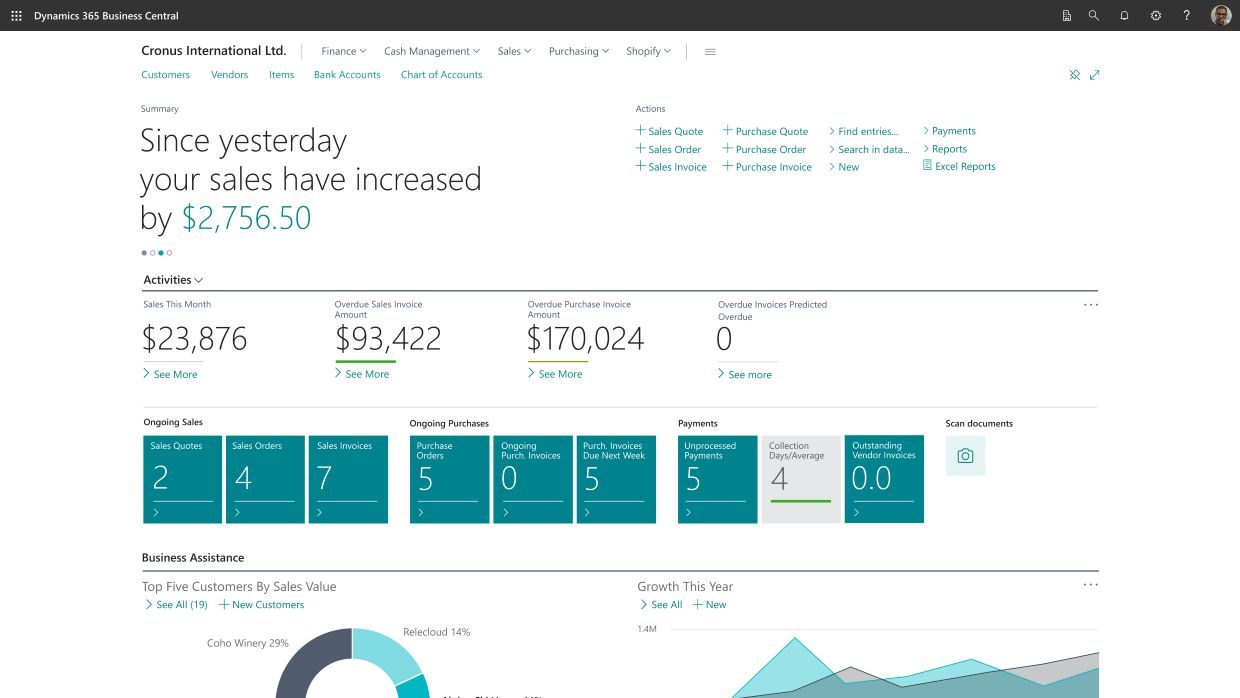
Microsoft Dynamics NAV Software vs. Dynamics 365 Business Central
The natural successor to Microsoft Dynamics NAV software is Dynamics 365 Business Central. Microsoft built Business Central directly on NAV's code base, which means it is not a replacement in the disruptive sense. It's an evolution, carrying forward the logic and functionality of NAV while rebuilding the architecture for a cloud-first world.
Here's what changes when you move from Microsoft Dynamics NAV software to Business Central:
Deployment Model
NAV is on-premises. Business Central runs in the cloud via Microsoft Azure, which means no server maintenance, automatic updates twice per year, and access from any device or location. For Canadian businesses with remote teams or multiple sites, that accessibility is significant.
Integration
Business Central connects natively to Microsoft 365, Teams, Outlook, Power BI, and the Power Platform. The integrations that required custom development on NAV come standard in Business Central.
AI capabilities
This is the part that competitors are not talking about. Business Central includes Microsoft Copilot AI features that automate tasks like invoice matching, cash flow forecasting, and inventory replenishment suggestions. These are not add-ons. They are built into the platform and updated regularly. Businesses still on Microsoft Dynamics NAV software have no path to these capabilities without migrating.
Licensing
NAV licenses were perpetual and often complex. Business Central uses a subscription model, which lowers upfront costs and makes budgeting more predictable.
Scalability
NAV scales reasonably well up to mid-market. Business Central scales further and handles multi-company, multi-currency, and multi-country setups more gracefully.
The critical point for Canadian organizations is this: Canadian SMBs that migrate from Microsoft Dynamics NAV software to Business Central typically consolidate four to six disconnected legacy tools into one platform, which reduces month-end close cycles by 30 to 50%. That's not a marketing number. It reflects what happens when finance, ops, and reporting stop living in separate systems.
What a Migration from Microsoft Dynamics NAV Software to Business Central Looks Like
This is where a lot of businesses get stuck. The idea of migrating feels enormous, so the decision gets deferred. But the process is far more structured than most people expect when they work with an experienced Microsoft Partner.
A migration from NAV to Business Central generally follows four phases.
- Phase 1: A discovery and assessment phase where your current NAV configuration, customizations, and data are mapped.
- Phase 2: Data preparation, which involves cleaning and structuring your existing data for migration.
- Phase 3: Configuration and testing in Business Central, validating that workflows function correctly and that users can navigate the new system.
- Phase 4: Go-live and post-launch support.
The complexity of a migration depends heavily on how customized your Microsoft Dynamics NAV software environment is.
Businesses with heavy customizations built on older versions of NAV require a more involved approach, often a two-step upgrade path through an intermediate Business Central version before reaching the current cloud release.
Businesses running more standard configurations can move more directly.
For a deeper look at the specific steps, our article on migrating from NAV to Business Central covers the common challenges and how to plan around them. And if you want to understand what the ERP implementation process looks like more broadly, that's a useful companion read.
Let’s Talk Migration from Microsoft Dynamics NAV!
Our team at Gestisoft works with Canadian businesses at every stage of this decision, from early evaluation to full migration.
 Book a free consultation
Microsoft Dynamics NAV Software in the Canadian Context
Canadian businesses face specific considerations that generic NAV content tends to ignore.
On the compliance side, Canadian SMBs need to manage provincial sales tax (PST, HST, QST), multi-currency operations for businesses trading in USD, and in Québec specifically, bilingual documentation and reporting requirements. NAV handled many of these, but required manual configuration and ongoing maintenance to stay current with tax changes. Business Central's Canadian localization handles these natively and updates automatically.
The bilingual requirement deserves direct attention. For businesses operating in Québec, having an ERP system that supports French-language interfaces, French-language reporting, and Québec-specific compliance is not optional. Business Central's localization covers this, and as a Québec-based Microsoft Partner, Gestisoft implements it for Canadian clients daily.
From a market concentration standpoint, Canadian NAV users are concentrated in manufacturing, distribution, and retail, with a strong presence in Ontario, Alberta, and Québec. These are also the industries where Business Central's AI-assisted inventory replenishment, production planning, and supply chain tools deliver the most immediate value.
“Gestisoft was able to adjust its approach to help us navigate a complex transition phase. Their ability to understand our priorities and react quickly made all the difference.”
How Gestisoft Approaches Microsoft Dynamics NAV Software Migrations
Gestisoft has been implementing Microsoft ERP and CRM solutions in Canada for over 20 years. We work with organizations in Québec and across the country, in both English and French, which makes us one of the few partners that can handle bilingual implementations without subcontracting the French-language work.
Our approach to Microsoft Dynamics NAV software migrations starts with understanding your current environment before we recommend anything. Some businesses are good candidates for a full Business Central implementation with a clean slate. Others are better served by a phased migration that keeps operations stable while moving data and workflows incrementally. The right path depends on your NAV version, your level of customization, your industry, and your timeline.
We also bring Business Central partner expertise to every engagement, which means you're not just getting a technically competent migration. You're getting a partner who knows how Canadian manufacturing and distribution companies use these systems in practice, and who can configure Business Central to fit your real workflows rather than forcing your business into a generic template.
If you're currently on NAV and wondering what a realistic migration timeline and cost looks like, the ERP implementation cost article breaks this down in detail. And our Business Central consultant page explains exactly what working with our team looks like from first call to go-live.
If you’re ready to see what Business Central can do for your business, let's talk through your current NAV setup and map out a realistic path forward together. Book a Free Consultation
Explore More
- Why Migrating from NAV to Business Central? A Complete Guide — Everything you need to know about the case for moving from legacy NAV to a modern cloud ERP.
- Migrate Navision to Dynamics 365: Challenges and Best Practices — A practical look at the migration process, common obstacles, and how to navigate them with a Canadian Microsoft Partner.
- What Makes Business Central Such a Good Fit for Small Businesses? — Why SMBs across Canada are choosing Business Central as their next ERP platform.
- ERP Implementation Cost for Mid-Market Businesses — A transparent breakdown of what a Business Central implementation costs in the Canadian market.
- Copilot for Finance: Relieving the Repetitive Financial Frustrations — How Microsoft Copilot AI inside Business Central handles the manual work that NAV couldn't automate.
Liked what you just read? Sharing is caring.

May 22, 2026 by Conni Guido by Conni Guido Copywriter and Brand Strategist
I started with a degree in Professional Communications and never looked back. Now, I'm a professional storyteller who believes every brand has a story to tell, and every good story should leave you wanting more. You can find me lost in a book club or a writing sprint, baking words into pies...probably both.
