


The AMS tools market has a translation problem. Platforms built for American chambers of commerce get sold into Canadian professional orders all the time, and the mismatch doesn't become obvious until months into the engagement. By then the organization has spent six figures on customizations to make French correspondence work properly, and the compliance report the provincial ministry asks for every quarter still requires someone on staff to export data from three places and reconcile it manually over a weekend.
This is the gap between what gets marketed as Canadian AMS tools and what holds up in Canadian operations. Most of the platforms dominating the category were built for a US association buyer whose regulatory environment is different and whose members don't expect to interact with their organization in French. The vendors adapt the product for the Canadian market by adding a pricing page in CAD and a French language toggle somewhere in the settings menu, and they call the job done.
The AMS tools worth evaluating for a Canadian association are the ones built with this country in mind from the start. Bilingual member portals need to hold up for Quebec members without a translation layer patched on top, and PIPEDA compliance has to be built into the data architecture. Renewal and compliance workflows built around how Canadian regulatory bodies and professional associations operate are what separate the platforms worth a serious evaluation from the ones that look good in the demo.
The right AMS tools replace four platforms with one
Gestisoft gives Canadian associations a single Microsoft-based platform for membership, events, renewals, and compliance.
 Free discovery call
AMS tools and the operational problem they solve
AMS stands for association management software, and the category exists because associations have spent decades running operations across platforms that were never designed to share data. Every system in the stack was chosen at a different moment to solve a different problem, and none of them were chosen with any of the others in mind.
AMS tools consolidate all of that into one platform, so member data, renewal cycles, event registration, dues collection, communications, and reporting share the same system and the same underlying data. This removes the reconciliation work that absorbs hours of staff time every week.
The operational cost of running without AMS tools compounds into a drag that makes every other decision harder, from budget forecasting to board reporting. Professional associations, trade associations, chambers of commerce, regulatory bodies, nonprofits, and professional orders all rely on AMS tools for the same underlying reason. The work of running a member organization involves too many moving parts to manage across disconnected systems without someone paying a permanent tax in wasted hours and missed information. A properly implemented AMS is the platform that makes that tax disappear.
What separates a good AMS from a weak one is what the bundle includes and how well those components work together. Every vendor claims to offer a complete platform. The question worth asking is whether their version of "complete" covers the categories your association depends on or whether you'll be back in the market for supplementary tools within eighteen months.
The 6 AMS tools every association needs in its platform
The gap between a good AMS and a weak one lives inside six categories of tools. These are the functional components your platform has to cover for the operation to run properly, and the quality of any vendor's offering comes down to how well each of these is built and how seamlessly they connect to the others. An AMS that handles membership brilliantly but falls apart at event registration is still going to leave you managing events in a separate tool, which is the problem you bought the AMS to solve in the first place.
Member database tools
The member database is the foundation everything else sits on. Every profile, every role, every interaction history, and every segmentation rule lives here, and if the data isn't clean the rest of the platform underperforms by default. Good membership management software treats the member record as the single source of truth across every other system, which means a profile update made during a renewal call shows up correctly in the event portal the next time that member logs in.
Renewal and dues tools
Renewal management is one of the membership management software challenges where most associations lose money without noticing. Automated reminders, payment capture, lapsed member recovery workflows, and proration logic for mid-cycle joins all belong inside the AMS rather than in a billing spreadsheet somebody rebuilds every year. The automation side of this is what separates platforms that recover late renewals from ones where lapsed members just disappear. Associations with recurring revenue built around annual cycles depend on this layer working properly, because every missed renewal is revenue the organization has to spend three times as much to replace through new member acquisition.
Event management tools
Most AMS tools handle event registration and ticketing at a basic level. One of the membership management software features that separates the platforms worth their price from the rest is how the events module connects back to the member record. Attendance tracks to the profile and post-event communications go out through segmented lists based on who showed up and who didn't. Waitlist management and on-site check-in run through the same system your membership coordinator uses every day.
Communication tools
Segmented email, member newsletters, portal notifications, and automated messaging tied to member status are the baseline every AMS platform needs to cover. For regulatory bodies and professional associations, the communication layer does heavier lifting because compliance deadlines and continuing education reminders have to go out on specific timelines to specific members without anyone assembling the list manually. The CRM regulatory bodies use in this space should handle that automation natively rather than asking staff to build distribution lists every time a deadline approaches.
Payment and finance tools
Dues collection, receipts, refund handling, and tax receipt generation all belong inside the AMS. Canadian associations specifically need CRA-compliant tax receipt capability for the charitable portion of their dues structures, and the reporting needs to flow cleanly into whatever accounting system the finance team uses. Platforms that handle payment in isolation from the rest of the operation create a reconciliation problem every month when someone has to match payments received against member records across two systems.
Reporting and analytics tools
Retention rates, engagement scores, renewal forecasts, and CRM dashboards close the loop on everything else the AMS is capturing. The reporting layer is what turns member data into the information leadership needs to make decisions. Weak reporting in an AMS means the operations team spends a day every month pulling numbers together manually for the board meeting, which is the tell that the platform is storing data rather than surfacing it properly.
AMS tools vs CRM tools
The confusion between AMS tools and CRM software exists because generic CRM vendors have been marketing into the association space for years. The pitch usually sounds reasonable. An association manages relationships with members, a CRM manages relationships with customers, and the underlying database structure is similar enough that the vendor can point to other associations running on their platform and call the category fit proven.
The pitch falls apart once the operational workflows start being built. Traditional CRMs are designed around sales pipelines and lead conversion, with every default template, report, and automation shaped by how a B2B sales team moves a prospect from first contact to closed deal. AMS tools are designed around the member lifecycle, which runs on a completely different logic. Annual renewal cycles, dues collection, committee participation tracking, continuing education credits, and compliance workflows aren't features you configure on top of a sales CRM. They're fundamentally different workflows that require a platform architected for them from the start.
This is the gap Canadian associations should pay particular attention to during evaluation. A Canadian association needs a platform built for the work from the first line of code.
Top 5 AMS tools for Canadian associations
Every platform on this list was either built in Canada or is hosted here, handles bilingual member experiences properly, has proven adoption inside Canadian associations or regulatory bodies, and covers the tool categories outlined above without requiring supplementary software to fill obvious gaps.
1. Legio (by Gestisoft)

Best for regulatory bodies and Canadian associations with complex compliance workflows.
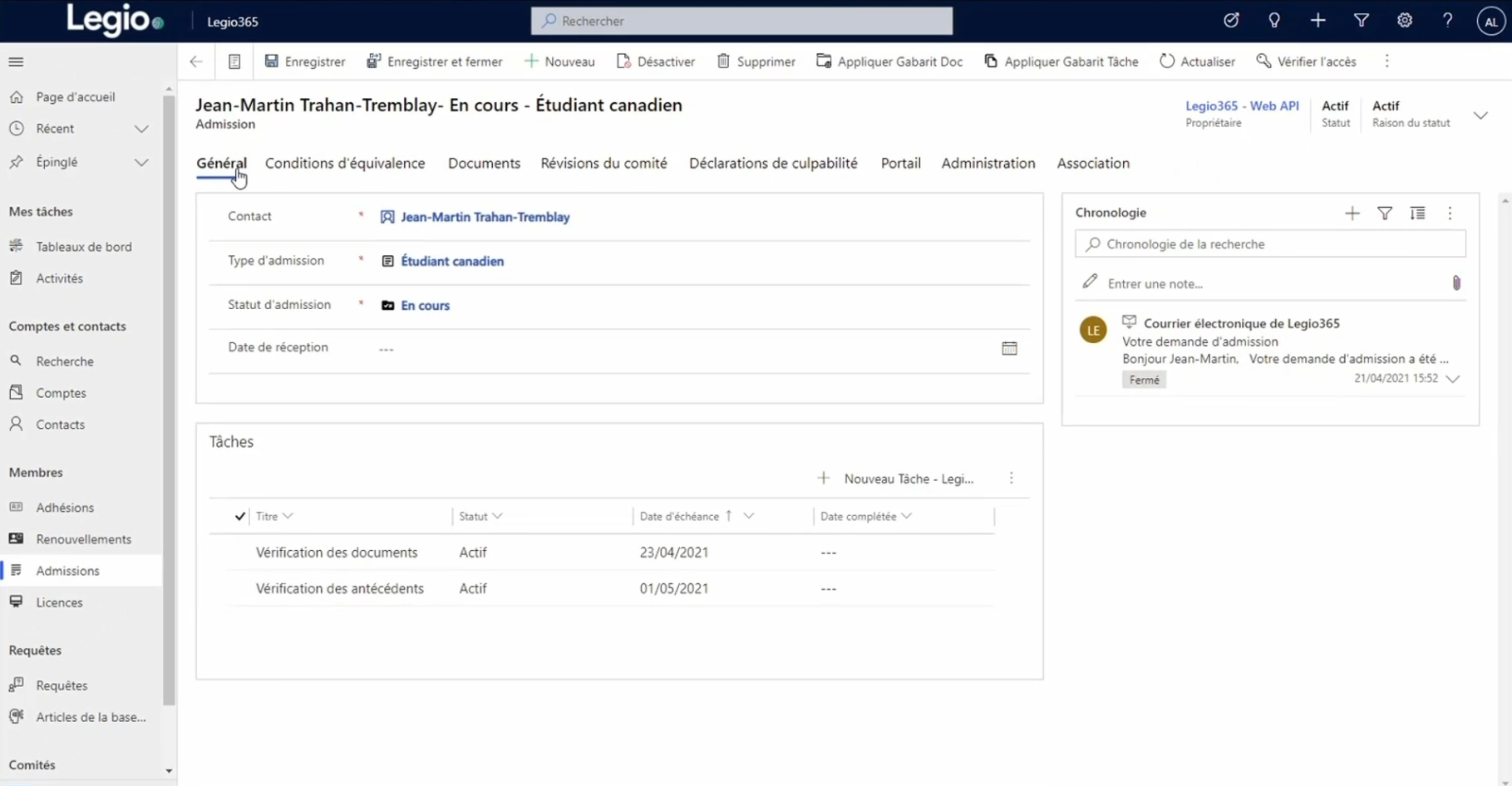
Legio is an AMS built specifically for the way Canadian regulatory bodies and professional associations operate. The platform runs on Microsoft Dynamics 365 and Power Platform, which gives it enterprise-grade security and data infrastructure alongside workflows designed from the start for the compliance and member lifecycle work generic platforms struggle with.
Bilingual member portals hold up for Quebec members without a translation layer patched on top. Disciplinary case management, continuing education tracking, renewal automation, and compliance monitoring all run natively on the platform rather than being approximated through custom fields and workflow rules. PIPEDA compliance is built into the data architecture. Canadian hosting through Microsoft data centres means the residency question is settled on day one rather than after a six-month configuration conversation.
The other thing worth knowing is that Legio ships with Gestisoft implementation. A Microsoft consultant with two decades of regulatory body experience configures the platform around the organization's specific bylaws and legislative environment, and the engagement includes post-go-live support rather than ending at launch. For associations that want the platform and the implementation expertise from the same team, that combination is difficult to match elsewhere in the Canadian market.
2. Association Server (by Oasis Computing)

Best for established Canadian associations already running on Microsoft infrastructure.
Association Server is Canadian built and Microsoft Azure hosted, with an open-source CMS architecture that gives mid-sized associations flexibility on the website side alongside the AMS. Version 5.0 introduced agentic AI features, and the flat-cost pricing model appeals to professional associations that want predictable budgeting without per-member pricing escalation. Strong fit for organizations where the executive director already has a clear view of what they need from an AMS.
3. Members Village

Best for smaller Canadian associations and nonprofits prioritizing ease of use and Canadian data residency.
Members Village is a Canadian-hosted AMS with CRA-compliant tax receipts built in, along with automated renewal cycles and a member self-service portal that handles event registration. The platform is designed around smaller organizations that want Canadian data protection without enterprise complexity. Setup is faster than enterprise-tier platforms, and the learning curve is manageable for teams without dedicated admin resources.
4. Exware

Best for North American associations wanting a long-established Canadian vendor.
Exware is Vancouver-based with over 20 years in the market, offering a modular AMS covering membership, events, LMS, and content management. The modular approach lets associations start with what they need and add components over time. Good fit for organizations that prefer a single vendor relationship across their website and AMS rather than stitching together separate platforms.
5. Association DNA

Best for bilingual Canadian associations prioritizing EN/FR member experiences.
Association DNA is built with bilingual features as part of the core rather than a translation layer added after launch. The platform covers website integration, member management, and communication tools in one system, and Quebec adoption is strong enough that the vendor understands the operational realities of running an association across both official languages.
The AMS tools Canadian associations choose shape the next decade of operations
Gestisoft helps you pick a platform your team won't be migrating away from in two years.
 Book a free consultation
Why Gestisoft built Legio as an AMS tool for Canadian regulatory bodies and professional associations
Most Canadian regulatory bodies running on Dynamics 365 today got there through a customization project. A consultant configured the platform around admissions workflows, added custom entities for compliance tracking, built renewal automation from scratch, and retrofitted a member portal after the organization realized Quebec members needed the interface in French. The project finished and the platform worked, so the consultant moved on to the next client to rebuild most of the same workarounds from scratch.
Legio exists because Gestisoft got tired of watching that pattern repeat itself. Every regulatory body engagement looked structurally identical under the surface. The bylaws changed, the legislative environment shifted slightly from one province to another, but the workflows the consultant was being asked to build were the same ones Gestisoft had configured for the last six clients. Legio took those workflows and turned them into a product, and the customizations stopped being custom. They became the platform.
What that means for a Canadian association evaluating Legio is that the compliance tracking, disciplinary case management, renewal automation, and bilingual member portals are core platform functionality rather than configuration work. The implementation focuses on matching the platform to your specific bylaws and legislative requirements instead of building the underlying functionality from scratch. That shifts the timeline, the budget, and the operational risk of the project significantly.
The Microsoft ecosystem is another reason Legio fits the way these organizations already operate. Legio runs on Dynamics 365 and Power Platform, which means associations already working in Outlook, Teams, and Power BI get an AMS tool that connects to what their staff already uses every day. Email and internal collaboration flow through Outlook and Teams rather than a separate platform, and compliance reporting runs in the Power BI environment the organization may already have for other operational reporting. The familiarity accelerates adoption because staff aren't learning a new system from scratch.
The Canadian context gets handled the same way. Legio is PIPEDA-ready out of the box, with bilingual member experiences native to the platform rather than translated after launch. Canadian hosting through Microsoft data centres resolves the data residency question on day one, which removes an obstacle most global AMS platforms surface halfway through implementation.
If your organization manages licensed professionals with annual compliance obligations or carries the kind of regulatory oversight that makes compliance reporting a permanent fixture in operations, Legio is the AMS tool built for that work.
-
AMS tools are software platforms built to manage every side of running a membership organization from one place. Member records, renewals, dues, events, and communications all live in a shared system rather than across disconnected tools.
Liked what you just read? Sharing is caring.

April 23, 2026 by Shelley Sunjka by Shelley Sunjka Copywriter & Marketing Strategist
Armed with a psychology degree and an irrational obsession with okapis, I've spent the last decade helping bold brands tell better stories. I believe the best writing bends grammar rules on purpose and makes people feel something. When I'm not deep in words or nerding out on buyer behaviour, I'm probably convincing my kids that impromptu kitchen dance parties are totally normal.
