

Most AMS software on the market was designed for American trade associations and chambers of commerce. The US association market is larger and the vendors have been building for it longer, so the platforms reflect those priorities. Pricing is in USD and compliance features assume US regulatory frameworks. The "bilingual" option, when it exists, is Spanish.
Canadian associations evaluating AMS software in 2026 inherit that bias by default. For a professional association or regulatory body operating under PIPEDA and provincial privacy legislation, the evaluation starts with filtering out the platforms that weren't built for this country's operating environment.
The Canadian market has matured, though. Platforms now exist that were purpose-built for associations operating under Canadian governance structures with bilingual obligations baked in. The gap between domestic options and what US vendors offer has narrowed enough that Canadian associations no longer have to compromise on compliance capability or language support to get a modern platform.
Knowing which questions to ask before you book demos is what protects your association from signing a contract with a vendor who treats Canadian requirements as edge cases. Most associations that end up on the wrong platform evaluated against the wrong criteria because the vendor's marketing made US-centric assumptions feel universal.
Your association deserves AMS software built for how Canadian organizations operate.
Gestisoft helps regulatory bodies and professional associations across Canada find the right platform without importing American assumptions.
 Book a free consultation
What is AMS software and how does it help a Canadian association
Some organizations call AMS software membership management software and others call it an association management system. All three terms describe the same category of platform.
Association management software, is a platform that consolidates the operational work of running a membership organization into one system. Member records, renewals, dues collection, event registration, compliance tracking, and reporting all run from the same place instead of being scattered across disconnected tools that were never designed to work together.
Most Canadian associations didn't build their current tech stack on purpose. A spreadsheet got created for renewals five years ago and someone signed up for a separate event registration tool because the old one broke. Each tool was adopted at a different time to solve a different problem, and none of them were selected with the others in mind. AMS software replaces that accumulation with a single connected platform where your membership data feeds into your event management and board reporting without manual reconciliation between systems.
For Canadian associations specifically, the value of AMS software goes beyond consolidation. When your member data and compliance records are connected in one system, your staff spends less time on administrative reconciliation and more time on the work your members pay dues to receive.
Why AMS software for Canadian associations is a different conversation than the US market
Canadian associations operate under a different regulatory environment than their American counterparts, and the AMS software they use needs to reflect that. Most US-built platforms were designed around American compliance frameworks and voluntary association structures that don't map cleanly onto how Canadian professional bodies operate.
PIPEDA and provincial privacy legislation create obligations around how member data is collected and stored that US platforms don't always accommodate. Data residency is a real concern for associations handling sensitive professional licensing or disciplinary records. When a provincial regulator asks where your member data physically resides, "somewhere in the cloud" is not an acceptable answer.
Associations serving members in Quebec or across both official languages need software with bilingual member portals and governance reporting built in natively. A French language toggle that translates interface labels but leaves member-facing communications untouched doesn't meet that standard. Your Quebec members will find the gaps within the first week of using the portal.
CRA-compliant tax receipts and Canadian payment gateways with provincial tax handling are daily requirements for your finance team that US-built AMS software treats as edge cases. Canada's large number of professional regulatory bodies and orders operating under provincial legislation need compliance tracking and disciplinary case management that most US platforms don't offer natively. The membership management software features required by a regulatory body managing licensed practitioners with CE requirements bear almost no resemblance to what a US chamber of commerce needs. Organizations evaluating Canadian CRM and AMS options built for this market are responding to that reality.
The cumulative effect is that Canadian associations can't just pick the highest-rated software on a US review site and expect it to work. The compliance requirements, the language obligations, the payment infrastructure, and the regulatory body workflows all demand a platform that was built with Canada in mind.
The signs your association has outgrown spreadsheets and needs AMS software
The signs that an association has outgrown its current tools tend to accumulate slowly. Everybody tolerates the workarounds until someone asks why the board report took two weeks to compile.
The renewal process is often the first area where the gaps become obvious. When it depends on one person's memory and a spreadsheet that nobody else on the team can maintain or interpret, your association is carrying operational risk that becomes visible the moment that person takes a vacation.
Event registration often runs through a third-party tool that doesn't connect to your member database, so attendance data has to be reconciled manually after every event. That's hours of staff time absorbed by administrative work that AMS software handles automatically.
Board reports take longer when data is spread across four or five disconnected systems and someone has to pull it together by hand before every meeting. The reports arrive late and the figures from different sources rarely match. For regulatory bodies, compliance tracking done through custom fields that store data but don't enforce rules or trigger notifications means your team is responsible for catching every exception manually, and that stops being feasible well before your membership hits 1,000.
If your staff spends more time reconciling systems than serving members, your association has outgrown its current setup. These membership management software challenges compound the longer an organization waits to address them, and the data cleanup required during a delayed migration adds months to an implementation that could have been smoother a year earlier.
What to look for in AMS software if you're a Canadian association
The membership management software selection process works best when you build it around your association's operations rather than a vendor's feature list. These are the evaluation criteria that matter most for Canadian associations.
Compliance capability matched to your tier of complexity
A trade association with 500 voluntary members has fundamentally different AMS software needs than a professional order managing 12,000 licensed practitioners with CE requirements and government reporting obligations. The first question to settle before you demo anything is whether the platform was built for your level of regulatory obligation. Generic software designed for voluntary associations will store compliance data, but it won't enforce rules or cascade status changes the way a compliance-native platform does. The membership management software features required by regulatory bodies go well beyond what most general-purpose platforms offer.
Bilingual capability tested with real scenarios
Request your demo in French then walk through a full member journey from application through renewal and CE tracking, and ask the vendor to show you portal access and communication preferences. If they can't deliver that demo fluently, the bilingual capability won't hold up once your Quebec membership starts using the system daily.
Integration with your existing technology stack
Your association's AMS software needs to connect to the tools your staff already uses. Teams running on Microsoft Outlook, Teams, and Power BI will adopt software that connects natively to that ecosystem far faster than a platform that pulls them into an unfamiliar environment. Ask the vendor which integrations are native and which require custom development.
Implementation partner and post-go-live support
The vendor configuring your AMS software needs to understand Canadian association operations. A partner with experience implementing a CRM for regulatory bodies under provincial legislation will anticipate requirements that a generalist integrator would miss entirely. Evaluate the post-go-live support model with equal scrutiny. The first six months after launch are when your team discovers what the platform can do beyond the initial configuration, and that period determines whether the implementation will succeed long-term.
Evaluating AMS software is faster with the right framework
Gestisoft can help you map your association's requirements before you start booking vendor demos.
 Book a free consultation
How AMS software compares to using a generic CRM for association management
A CRM like Salesforce or HubSpot tracks customer relationships and sales pipelines. AMS software tracks the member lifecycle, covering renewals, credentials, compliance, and events. The underlying data structures look similar, which is why CRM vendors market into the association space. The workflows are fundamentally different, though, and associations that adopt a generic CRM end up paying for extensive customization to approximate what purpose-built software delivers natively.
For Canadian associations with regulatory obligations, compliance tracking and disciplinary case management aren't features you configure on top of a sales pipeline. They need to be core to the platform architecture. Associations weighing both options will find the AMS CRM question goes deeper than a feature comparison, especially for regulatory bodies where the platform architecture determines whether compliance workflows function natively or require months of custom development.

6 AMS software options Canadian associations should know about
The right AMS software depends on your organization's size and regulatory obligations. These are the platforms Canadian associations are most likely to encounter during an evaluation of AMS tools.
1. Legio by Gestisoft
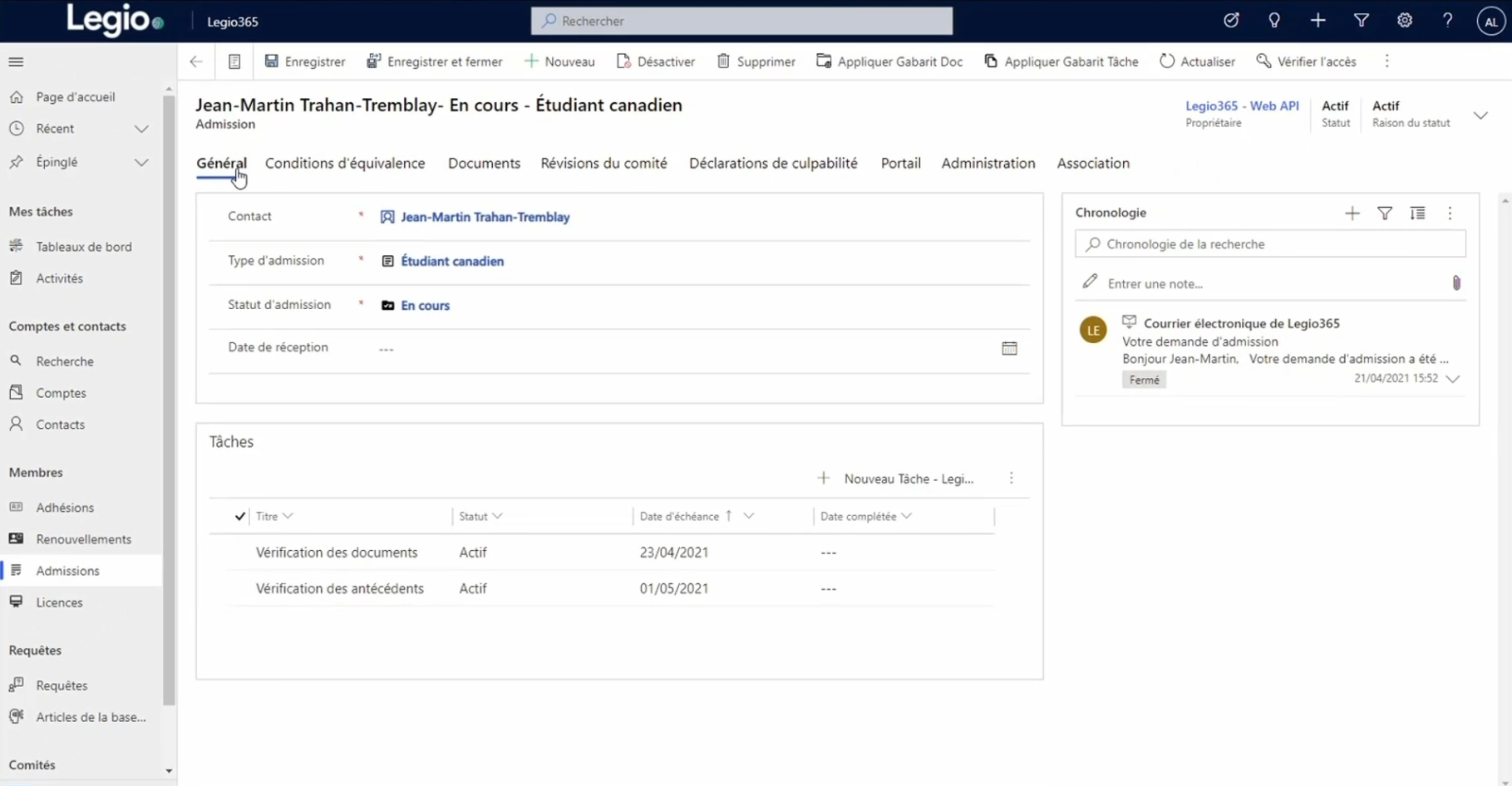
Legio is purpose-built for Canadian regulatory bodies and professional associations on Microsoft Dynamics 365 and Power Platform. Compliance tracking, disciplinary case management, CE credit workflows, and bilingual member portals are core platform functions rather than add-ons configured after purchase. Canadian data residency is provided through Microsoft Azure's datacenters in Toronto and Quebec City, and the platform was designed specifically for organizations operating under provincial legislation with government reporting obligations. For associations that started on free membership management software and have since outgrown them, Legio is often where they land when compliance obligations require a platform built for that level of regulatory complexity.
“Legio has allowed us to take a crucial step in our digital transformation. We have automated several processes, improved our data management, and increased efficiency. There is still great potential to unlock, and we look forward to seeing how the solution will continue to evolve with us.”
2. WildApricot
WildApricot is one of the most widely used AMS software platforms for small associations, nonprofits, and clubs. It serves over 15,000 organizations globally and offers affordable pricing that starts around $60/month, scaling based on contact count. The platform handles member databases, event registration, payment processing, email communications, and includes a drag-and-drop website builder. Onboarding is fast and the interface is accessible for non-technical staff, which makes it a popular first AMS for organizations under 500 members. The limitations show up as associations grow. Reporting is basic, with no built-in post-event engagement tracking or behavioural analytics and bilingual capabilities are not native. Compliance capability for regulatory bodies is minimal and data residency for Canadian organizations is not clearly documented on their website. Associations that need to enforce CE requirements or produce governance-level reporting will hit the platform's ceiling relatively early.
3. Fonteva
Fonteva is built natively on Salesforce, which gives it a strong CRM foundation and access to the broader Salesforce ecosystem including AppExchange integrations. The platform handles membership lifecycle management, event registration, e-commerce, payment processing, and offers community portal features. It works well for larger associations with complex data needs and the budget to support Salesforce licensing on top of the AMS layer. Fonteva is US-headquartered and owned by Togetherwork, so customization for Canadian regulatory workflows typically requires significant development, and the Salesforce licensing model adds considerable cost to total ownership. Bilingual capability for Canadian associations is not a standard feature. Associations considering Fonteva should factor in implementation complexity, as the platform requires dedicated time to learn and configure properly.
4. Protech
Protech is built on Microsoft Dynamics 365, which gives it native integration with the Microsoft ecosystem including Power BI for analytics and reporting. The platform has been serving associations for over 35 years and offers strong membership management and payment processing capabilities. It is US-headquartered, so Canadian-specific compliance and bilingual capabilities require configuration rather than being available out of the box. For Canadian associations already running Microsoft tools, Protech offers a familiar technology foundation.
5. Members Village
Members Village is Canadian-built and headquartered in Ottawa. The platform emphasizes self-serve member portals with Canadian data residency and PIPEDA compliance built in. It offers membership management, event tools, email communications, and financial tracking with a focus on reducing administrative workload through member self-service. The membership management software benefits are most visible for associations that want members handling their own renewals and event registrations online rather than going through staff. Members Village serves a broader association market and is a solid option for Canadian associations that prioritize self-service portal functionality.
6. Association DNA
Association DNA is Canadian-built AMS software focused on smaller associations and membership organizations. The platform offers an affordable entry point with Canadian data residency included and covers core functions like member management, event registration, and communications. Scalability is more limited for larger regulatory bodies with complex compliance requirements, disciplinary case management needs, or multi-tiered membership structures. For smaller Canadian associations with straightforward operational needs and modest budgets, Association DNA provides a domestic alternative to US-built entry-level platforms.
The AMS software your association chooses will shape the next decade of operations
Gestisoft helps Canadian associations find a platform their team won't need to migrate away from in two years.
 Book a free consultation
How Gestisoft helps Canadian associations get the most out of their AMS software
Gestisoft's team understands how provincial bylaws affect membership workflows and how PIPEDA obligations shape data architecture decisions. That depth of experience in the Canadian regulatory environment is what separates Gestisoft from generalist integrators who learn your operating environment on the job.
Gestisoft built Legio because the same regulatory body configurations for admissions, renewals, compliance tracking, CE credit management, and bilingual portals kept being custom-built every time on Dynamics 365. Legio productized those recurring patterns into membership management software that Canadian regulatory bodies can implement without rebuilding from scratch.
For associations that have been through a failed AMS software implementation, Gestisoft treats that experience as an asset. An association that already knows what went wrong has the clearest picture of what needs to happen next, and Gestisoft's familiarity with Canadian regulatory frameworks means the second implementation becomes the last one.
The implementation itself accounts for the realities of running an association during a platform transition. Gestisoft schedules around renewal cycles and board reporting deadlines so your membership doesn't experience a gap in service while the new system is being configured.
-
AMS software (association management software) is a platform that centralizes membership management, renewals, events, communications, compliance tracking, and reporting for associations and member-based organizations. It replaces the patchwork of spreadsheets and disconnected tools most associations rely on.
Explore more
Liked what you just read? Sharing is caring.

May 21, 2026 by Shelley Sunjka by Shelley Sunjka Copywriter & Marketing Strategist
Armed with a psychology degree and an irrational obsession with okapis, I've spent the last decade helping bold brands tell better stories. I believe the best writing bends grammar rules on purpose and makes people feel something. When I'm not deep in words or nerding out on buyer behaviour, I'm probably convincing my kids that impromptu kitchen dance parties are totally normal.
