

Somewhere between your last board meeting and the vendor demo you have booked next month, the term AMS CRM probably came up. It's one of those phrases Canadian associations hear constantly but understand differently depending on who's explaining it.
The confusion comes from two categories of software that overlap more than their names suggest. Association management software handles the operational side of running a membership organization, covering everything from dues collection and renewal workflows to event registration and member directories. A CRM sits on the other side of that line, tracking engagement history and behavioral data to help you understand how members interact with your organization over time.
Both terms describe real categories of software, and both categories do things your association needs. The problem is that vendors on each side have spent years claiming their platform covers both, and most of the time that claim falls apart the moment your team tries to run a renewal cycle and pull an engagement report from the same system.
An AMS CRM refers to the concept of combining those two capabilities into a single platform so your staff stops toggling between systems with no connection between them. For Canadian associations governed by provincial legislation and handling PIPEDA obligations, getting this combination wrong has consequences that go beyond inconvenience. It affects your compliance posture and the quality of service your members experience every time they interact with your organization.
Your association's technology should support how your team works
Gestisoft helps Canadian associations and regulatory bodies evaluate their current systems and build a plan that connects member management with the data intelligence a CRM provides.
 Free discovery call
What AMS CRM confusion costs Canadian associations (and how the terms got tangled)
When a Canadian association can't clearly distinguish between AMS and CRM capabilities during a vendor evaluation, the consequences show up in the contract they sign. They end up paying for a platform that handles renewals but can't tell them which members are disengaging. Or they buy a CRM with strong analytics and then spend six months trying to add on dues processing and event registration workflows that the system was never designed for.
This happens because vendors on both sides of the AMS CRM line have spent years stretching their product descriptions. AMS providers added a "CRM" tab to their platform and called it relationship management, even when the tab is just a contact list with no behavioral tracking behind it. CRM vendors started marketing to associations by calling their sales pipeline tools "membership management," which is a bit like calling a hammer a screwdriver because both come from the hardware store. The underlying technology serves a different purpose, and the workflows your staff depends on daily don't transfer between the two without significant customization.
The cost compounds over time. Your operations team builds workarounds in spreadsheets to fill the gaps the platform can't cover, and your membership coordinator ends up tracking renewal risk in their head because the system only tells them who renewed, not who's likely to leave. Board reports take longer because the data lives in two places and someone has to reconcile it manually before every meeting.
For Canadian associations with compliance obligations under provincial legislation or federal oversight, the stakes go further than lost productivity. When your membership management software can't maintain accurate member status records or connect compliance data to engagement history, you're carrying regulatory risk alongside the operational inefficiency. An AMS CRM will handle member data differently because the relationship layer is built into the architecture from the start.
The functional gap between an AMS and a CRM for associations
The easiest way to understand why the AMS CRM conversation keeps coming up is to look at how the two categories handle the same work differently. Your association doesn't operate in one mode. Membership touches operations, events, communications, and governance reporting, and each of those areas exposes the gap between what an AMS does on its own and what a CRM adds to the picture.
Member lifecycle management
An AMS tracks the mechanical side of membership. Applications come in, renewals go out, dues get collected, statuses update, grace periods run, and reinstatements process when a lapsed member returns. It's the system of record for who belongs to your organization and what they owe.
A CRM tracks what that member did between those transactions. It records which events they attended, which emails they opened, which resources they downloaded, and how their engagement pattern changed over the twelve months leading up to their renewal date. An AMS tells you a member renewed in March. A CRM tells you they attended two events and downloaded your annual report in the weeks before that renewal, which means their decision wasn't random. That behavioral context is what turns a membership database into an AMS CRM your team can use to predict retention instead of reacting to lapses after they happen.
Event management
Most AMS platforms handle the logistics of running an event well enough. Registration, payment processing, capacity tracking, and attendee lists are all tracked inside the system. What they don't capture is what happened after the event ended.
A CRM connects attendee behavior back to the member record, tracking which sessions each person attended and whether their participation correlated with a renewal or a tier upgrade down the line. Without that connection, your events generate revenue but produce no usable intelligence about what your members valued and what fell flat. For associations running annual conferences that consume months of staff time, that's a significant blind spot an AMS CRM can fill.
Communications
An AMS sends renewal notices and bulk emails. It handles the operational messages your association needs to deliver on schedule, and it does that job reliably. The limitation is that every member gets the same message at the same time regardless of where they are in their relationship with your organization.
CRM-driven communications work differently. They let your team segment members by behavior and send outreach that reflects what each person has done, not just what category they fall into. The gap between a mass renewal reminder and a message that acknowledges a member's recent event attendance before asking them to renew is the difference between being efficient and being effective. AI is already changing how regulatory bodies approach this kind of operational intelligence, and associations that treat communications as a one-size-fits-all function are falling behind organizations that use their data to personalize the experience.
Reporting and governance
An AMS gives your board the numbers they expect, from member counts and dues collected through to event attendance and renewal rates. These are the operational metrics that keep an association running, and they're necessary.
A CRM gives your board the context behind those numbers. It surfaces engagement depth across membership tiers and flags members likely to lapse before they do. This makes a connection between your investment in events or CE programming to measurable changes in member behavior.
For Canadian associations reporting to provincial regulators or government oversight bodies, the ability to produce board-ready analytics from a single data source instead of compiling reports from disconnected systems is becoming a baseline expectation.
The pattern across all four areas is consistent. An AMS runs the operation. A CRM makes sense of the data the operation produces. An AMS CRM platform does both from the same system, which means your staff works from one member record instead of reconciling two.
Why most AMS CRM platforms fall short for growing Canadian associations
Most AMS platforms on the market were built for small community organizations running memberships under 500 people. They handle the basics at that scale, but the functional gaps start compounding once an association grows past that threshold. The operational workarounds that felt manageable with a few hundred members become full-time jobs when your membership hits four figures. And for Canadian associations, the problems don't stop at scale. They extend into territory that most vendors headquartered outside this country haven't accounted for.
Compliance and data governance in a Canadian regulatory environment
Canadian professional associations and regulatory bodies operate under PIPEDA and provincial privacy legislation that dictates how member data is collected and stored. For associations handling sensitive professional licensing or disciplinary records, data security isn't a preference. It's a legal obligation with real enforcement behind it.
Most AMS vendors are headquartered in the United States and store data on US servers. Ask them where your Canadian member records physically reside and you'll often get a vague answer about "cloud infrastructure" without specifics. Ask whether their platform can document data residency for a provincial audit and the conversation stops. Microsoft Azure's Canadian datacenters in Toronto and Quebec City provide data residency by default for platforms built on the Microsoft stack, which is one reason Canadian associations with compliance obligations are increasingly looking at AMS CRM platforms built on that foundation.
Bilingual operations that go beyond a language toggle
Associations operating across English and French Canada need more than a translated settings menu. They need bilingual member portals where a Quebec-based practitioner can complete their entire renewal, access CE records, and communicate with your office in French without hitting a page that reverts to English halfway through.
Most AMS platforms offer English as the primary language and treat French as an add-on. Some provide a language toggle that translates interface labels but leaves member-facing communications, governance reporting, and portal content untouched. Any AMS CRM platform serving Canadian associations has to support French and English natively across every function your staff and your members use daily.
The scaling ceiling Canadian associations hit too late
When an association chooses an AMS CRM platform at 300 members and now they have 1,200, the ceiling cap becomes clear quickly. The platform still processes renewals and tracks dues, but everything around it has started to buckle. Manual renewal reminders consume hours each cycle and event follow-ups stop happening because nobody has time. Meanwhile, board reports require a week of spreadsheet work because the system can't produce the analytics leadership needs.
By the time these membership management software challenges become visible to the board, the association has already spent years absorbing the cost in staff hours and missed opportunities. The platform migration conversation that should have happened at 800 members gets delayed until the operational pain forces it, and by then the data cleanup and workflow rebuilding add months to the implementation timeline.
See how your current member management system measures up
Gestisoft's team can assess your association's technology setup and identify where operational gaps are costing your staff time and your member’s patience.
 Book a free consultation
What a CRM-based AMS delivers that standalone tools can't
A CRM-based AMS puts your association's operational workflows and relationship intelligence into the same platform. That single record is where the value starts. Every interaction a member has with your association, from their initial application through their most recent event attendance and CE credits earned is in one place. Your membership coordinator and your executive director see the same analytical data without reconciling exports from different platforms.
The CRM layer underneath makes that record intelligent. Instead of storing static membership data, the platform tracks behavioral patterns over time. You can see which members are actively engaged and which have gone quiet in the months before their renewal date. That early visibility gives your team room to intervene with targeted outreach before a lapse happens. The membership management software benefits show up fastest in retention, because you're acting on data.
Automation in a CRM-based AMS follows association logic. Renewal sequences trigger based on membership type, compliance status, and engagement history. Continuing education works as a growth accelerator for regulatory bodies when CE tracking connects directly to the renewal cycle, so members with outstanding requirements get flagged before their deadline passes. These are workflows that a generic CRM would require months of custom development to approximate, but a CRM-based AMS built for associations handles natively. The membership management software features that regulatory bodies need from a combined platform are what separate a productive evaluation from a frustrating one.
For associations already running Microsoft tools, a CRM-based AMS built on Dynamics 365 and Power Platform connects directly to Outlook, Teams, and SharePoint, which means your staff works inside the environment they already know.

How to evaluate an AMS CRM platform for a Canadian association
Vendor demos are designed to make every AMS CRM platform look good. The evaluation work that protects your association happens before and during those demos, when you show up with specific questions your team has already agreed on.
Start with your workflows
Map how your team handles licence registration, renewals, admissions, event registration, compliance tracking, and reporting before you open a single vendor's website. The goal is to walk into a demo with a list of the workflows your staff runs daily and ask the vendor to show you how their platform handles each one natively. If the answer involves "custom development" or "we can configure that," you're looking at months of implementation work on top of the licensing fee. A structured membership management software selection process built around your operations will save your association from buying a platform that looks impressive in a demo and frustrates your team within six months.
Ask where your member data is stored
For Canadian associations, data residency is a compliance requirement. Ask the vendor directly whether Canadian member records are stored on Canadian servers. If the answer references "global cloud infrastructure" without naming specific locations, press harder. Microsoft Azure's Canadian datacenters in Toronto and Quebec City provide data residency by default for platforms built on the Microsoft stack, which gives associations a clear answer to give provincial regulators or auditors when the question comes up.
Test the bilingual capability with real scenarios
If your association serves members in both official languages, request your demo in French. Walk through a full member journey from application through renewal and CE tracking and ask them to show you portal access and communication preferences. If the vendor can't deliver that demo fluently, the bilingual capability won't survive contact with your Quebec membership.
Pressure-test the CRM and integration claims
When a vendor says their AMS CRM platform includes relationship management, ask to see the member engagement analytics, the segmentation tools, and the automated outreach capabilities. If those features are listed as "coming soon" or require a paid add-on, the CRM layer is a marketing claim. Apply the same scrutiny to integrations. Your association likely runs a learning management system and an accounting package alongside your member management platform. Ask which of those connect natively and which require custom development. The AMS software you choose will sit at the centre of your technology stack, so the connections need to work on day one.
Your association's next platform should handle membership and relationships in one place
Talk to Gestisoft about how Legio combines the operational workflows of an AMS with the data intelligence of a CRM, built for Canadian associations.
 Book a free consultation
How Gestisoft helps Canadian associations stop losing time to the AMS CRM split
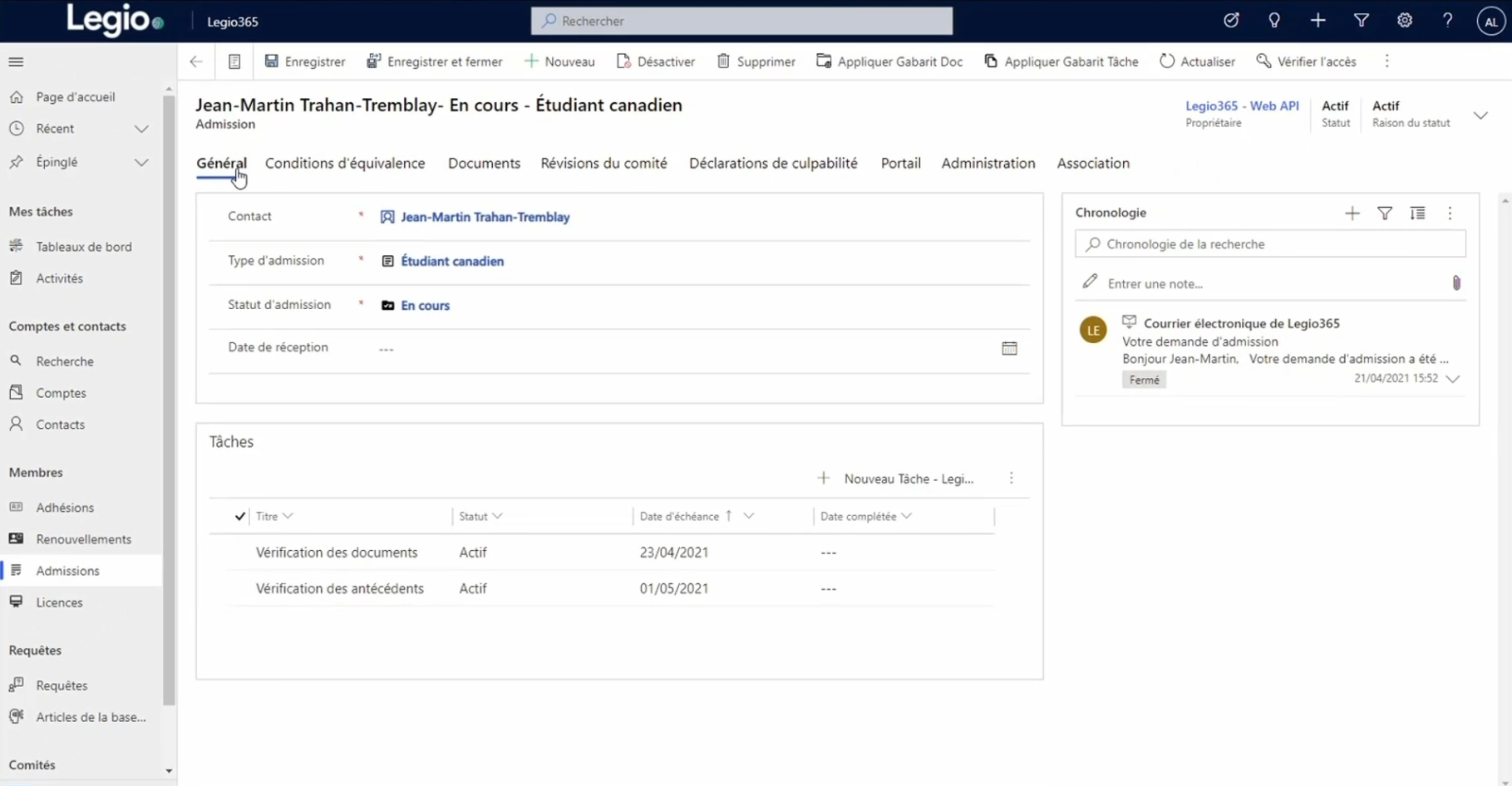
Gestisoft built Legio after years of configuring Dynamics 365 for Canadian regulatory bodies one engagement at a time. Every project looked structurally identical under the surface, with the same admissions workflows, renewal automation, compliance tracking, and bilingual member portals appearing across engagements. Legio took those recurring configurations and turned them into a product purpose-built for Canadian associations.
“Legio has allowed us to take a crucial step in our digital transformation. We have automated several processes, improved our data management, and increased efficiency. There is still great potential to unlock, and we look forward to seeing how the solution will continue to evolve with us.”
Read the full Case study here.
Because Legio runs on Dynamics 365 and Power Platform, the AMS CRM question disappears inside the system since renewal status, dues payments, engagement history, and event attendance all exist on the same member record. Your staff works from one data source and your board gets reports from one reporting layer. Associations already using Outlook, Teams, and Power BI get an AMS CRM platform that plugs into their existing environment.
Gestisoft's implementation process for associations and professional orders coming from a two-system setup starts with mapping how member data currently moves between platforms. The team has done enough AMS CRM migrations for Canadian regulatory bodies that the process has its own playbook, covering data consolidation, workflow rebuilding, and staff training in a sequence designed to minimize disruption to your members during the transition.
PIPEDA compliance is handled through Microsoft Azure's Canadian datacenters in Toronto and Quebec City, so your association has a clear answer when a provincial regulator or auditor asks where member data is stored. Bilingual member portals are native to the platform, built in French and English from the ground up rather than translated after launch.
-
A standalone CRM can store member records and track engagement, but it lacks the association-specific workflows most organizations depend on, for example, dues processing, renewal automation, event registration, CE tracking, and committee management. Canadian associations get more value from a CRM-based AMS that combines relationship intelligence with operational tools purpose-built for membership organizations.
Liked what you just read? Sharing is caring.

May 21, 2026 by Shelley Sunjka by Shelley Sunjka Copywriter & Marketing Strategist
Armed with a psychology degree and an irrational obsession with okapis, I've spent the last decade helping bold brands tell better stories. I believe the best writing bends grammar rules on purpose and makes people feel something. When I'm not deep in words or nerding out on buyer behaviour, I'm probably convincing my kids that impromptu kitchen dance parties are totally normal.

