

Key Takeaways:
- The 8 best CRMs for large companies in 2026 are Microsoft Dynamics 365 Sales, Salesforce Sales Cloud, Oracle Fusion Sales, SAP Sales Cloud, HubSpot Sales Hub Enterprise, Zoho CRM Enterprise, Creatio, and SugarCRM Enterprise.
- True enterprise CRM cost: licenses account for just 20–30% of a three-year total cost of ownership; implementation, integrations, and change management drive the remaining 70–80%.
- Canadian buying filter: bilingual English and French support, Quebec Law 25 compliance, and Canadian data residency reshape most enterprise CRM shortlists in Canada.
- Three-year budget anchor: a 500-user enterprise CRM deployment in Canada typically runs between CAD $3M and CAD $8M all-in across licenses, implementation, integrations, and change management.
Picking the best CRM for large companies used to be simple: buy Salesforce or Dynamics 365 and move on. In 2026, it's messier.
Vendors have blurred the line between "mid-market" and "enterprise." AI gets marketed harder than the sales workflow itself. Half the "top enterprise CRM" lists on Google still mix in tools built for 50-person startups.
Canadian buyers hunting for the best CRM for large companies face requirements most global rankings never mention. Bilingual sales teams. Quebec's Law 25. Data residency in Canadian regions…
Below are 8 enterprise-tier options with honest trade-offs, Canadian pricing where public, and a clear "who this is not for" for each.
Get a Real Read on Your Shortlist
Book time with a Canadian Microsoft Solutions Partner who has spent nearly three decades on enterprise CRM rollouts. Bring your questions.
 Book a free consultation
8 Best CRM for Large Companies in 2026: Honest Picks and Trade-offs
Each entry below covers what the platform does well, real pricing, and who should skip it. Enough to build a working shortlist for the best CRM for large companies in an afternoon.
(CAD figures use the July 2026 mid-market rate and will shift over time.)
1. Microsoft Dynamics 365 Sales — Best for Companies Already on the Microsoft Stack
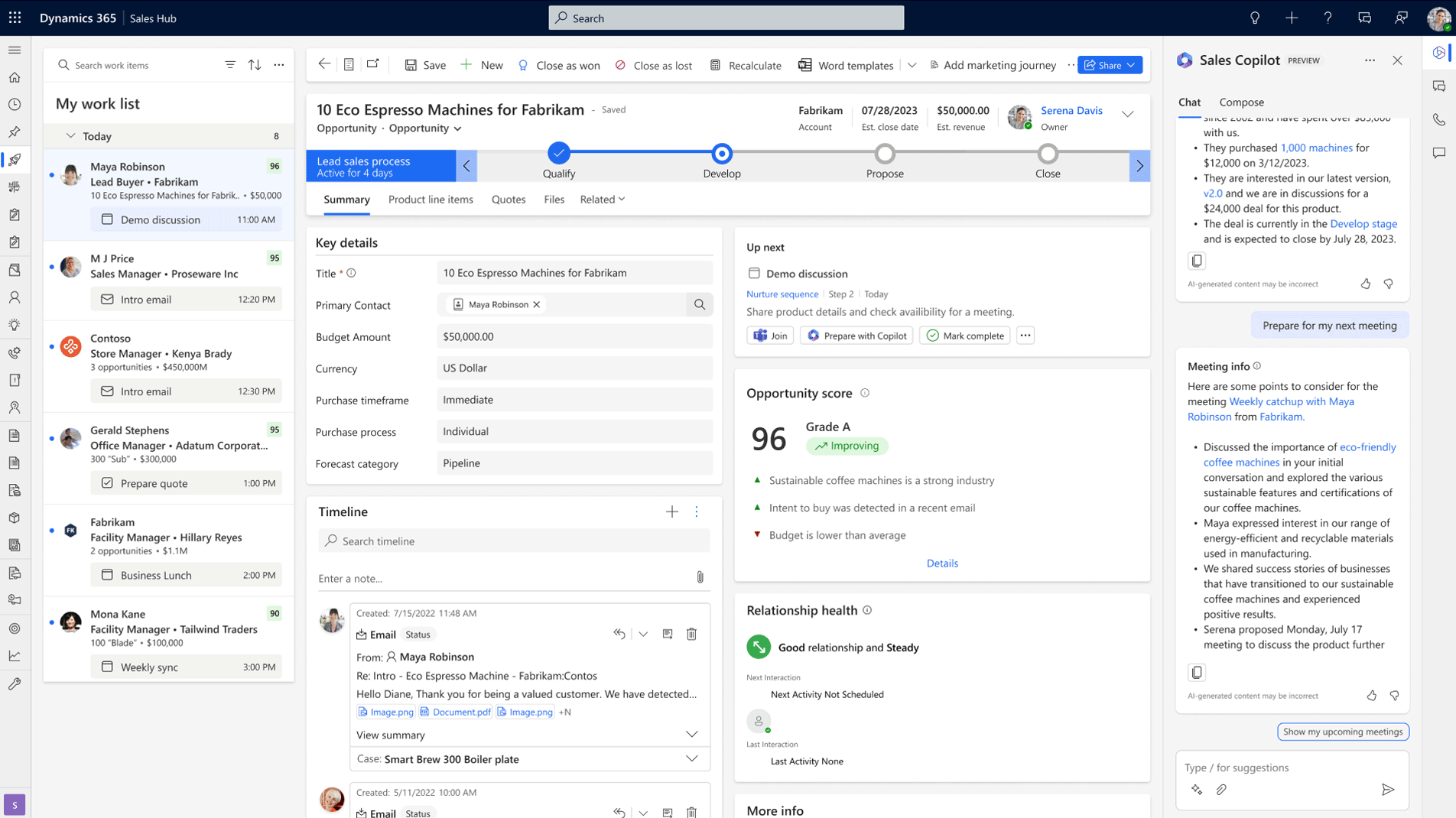
Microsoft Dynamics 365 Sales sits inside the tools your reps already use: Outlook, Teams, Excel, Power BI. That alone shortens time-to-value.
Copilot for Sales summarises meetings, drafts follow-up emails, and flags at-risk deals directly inside Outlook and Teams. Native Power BI dashboards give sales leaders live forecast visibility across territories and currencies without a separate BI stack.
The Enterprise tier adds custom entities, unlimited workflows, and native ties to Business Central or Finance & Operations, which is what makes it fit multi-BU rollouts. Our Sales Professional vs Enterprise breakdown covers the tier trade-offs.
Pricing: CAD $142.50/user/month (Enterprise), ~CAD $203.50/user/month (Premium). CAD $27 attach with Business Central Premium.
Best fit for: Organizations already on Microsoft 365, Teams, Azure, and Power BI.
Not the right pick if: You run on AWS end-to-end, avoid Microsoft by policy, or need heavy native e-commerce.
If Dynamics doesn't fit, the Dynamics 365 competitors list has alternatives.
2. Salesforce Sales Cloud — Best for Deep Customization and AppExchange Depth
Salesforce Sales Cloud is the default answer for many enterprise CRM shortlists. Sales Cloud Enterprise lists at USD $175/user/month (~CAD $249), with Einstein and Agentforce AI as paid add-ons that push the per-seat total higher.
The AppExchange is the largest CRM ecosystem, which helps with niche industry needs. The trade-off is admin overhead. Large companies often spend more on Salesforce admins and consultants than on the licenses. Multi-year rollouts of 12 to 18 months are common globally.
Pricing: USD $175/user/month (~CAD $249) for Sales Cloud Enterprise. AI add-ons priced separately.
Best fit for: Deep customization needs, mature RevOps teams, industries with strong AppExchange coverage.
Not the right pick if: You have a small internal admin team, want native Microsoft 365 integration, or need predictable per-user pricing.
See our Salesforce competitors list if the price ceiling is a concern.
3. Oracle Fusion Sales — Best for Data-Heavy Global Enterprises
Oracle Fusion Sales sits inside the wider Oracle CX suite. It's built for organizations already on Oracle Cloud or Oracle ERP. NetSuite customers typically use NetSuite CRM instead, since it comes bundled with the NetSuite stack.
Its edge is the real-time analytics engine that joins sales data to finance, supply chain, and marketing across the business. Oracle's predictive forecasting on very large datasets holds up in 2026. Implementations at enterprise scale run 8 to 14 months depending on module scope and existing Oracle footprint.
Pricing: Quote-based, enterprise-tier.
Best fit for: Existing Oracle Cloud ERP customers, data-heavy global operations, regulated multinationals.
Not the right pick if: You're not on Oracle's stack, want short time-to-value, or need frequent product updates outside change-control boards.
Our Oracle competitors overview covers alternatives that don't need Oracle's data engine.
4. SAP Sales Cloud — Best for SAP-Centric Manufacturing and Distribution
SAP Sales Cloud is built for large companies already running SAP S/4HANA or SAP ERP. It's a strong fit in manufacturing, distribution, and consumer goods where CRM has to talk fluently to a heavy back office.
Sales automation, quote-to-cash, and CPQ hold up under complex product configurations with real BOM logic. SAP's generative AI for account planning is improving but still trails Microsoft and Salesforce in day-to-day adoption.
Pricing: Base license typically USD $60–$80/user/month (~CAD $85–$114). Quote-based enterprise contracts cover CPQ, integrations, and premium tiers.
Best fit for: SAP-anchored manufacturing, distribution, and consumer goods.
Not the right pick if: You're not on SAP's ERP, want a modern UX new users pick up in a week, or need a lightweight CRM for a distributed team.
Note: SAP CX specialist rates in Canada remain among the highest in the market.
5. HubSpot Sales Hub Enterprise — Best for Marketing-Led Sales Organizations
HubSpot Sales Hub Enterprise fits large companies where marketing and sales operate as one revenue team. UX is the strongest on this list, and adoption at enterprise scale is faster than Salesforce or SAP.
HubSpot has grown its enterprise permissions, audit logging, custom object depth, and API limits, so 500-plus user deployments across regions are no longer the exception at the top end.
Pricing: From USD $150/seat/month (~CAD $213) for Sales Hub Enterprise (annual). HubSpot removed mandatory seat minimums in 2024, so you can start with one paid seat.
Best fit for: Marketing-led revenue teams and mid-to-large B2B companies with content-driven pipelines.
Not the right pick if: You need very deep custom object modeling (HubSpot caps custom objects at 10), multi-BU territory logic, or native ERP integration outside NetSuite.
See our HubSpot competitors roundup for feature and price comparisons.
6. Zoho CRM Enterprise — Best for Cost-Conscious Larger Teams
Zoho CRM Enterprise is the price-performance option on this list. For a 500-seat deployment, the gap versus Salesforce or Dynamics 365 adds up quickly.
Zoho covers workflow rules, custom modules, sandboxes, and Zia AI features that meet most enterprise needs. The Zoho One bundle can also replace several adjacent tools, which pulls overall stack cost down further.
Pricing: USD $40/user/month (~CAD $57) for Enterprise (annual billing), USD $52/user/month (~CAD $74) for Ultimate (annual billing).
Best fit for: Cost-conscious deployments where budget outweighs partner ecosystem depth.
Not the right pick if: You need enterprise-grade change management support in French and English across Canada, or the partner network of Salesforce or Microsoft.
Support quality at the enterprise tier is still the most common complaint we hear from Canadian buyers evaluating the best CRM for large companies.
7. Creatio — Best for Process-Heavy Enterprises That Want No-Code
Creatio treats workflow automation as the main event. It combines sales, marketing, and service CRM with a no-code process designer that lets business analysts change workflows without waiting on developers.
For insurance, financial services, and regulated industries, that model breaks the "developer for every change" bottleneck. Creatio expanded its AI story in 2026 with agents that automate handoffs across sales and service teams.
Pricing: USD $40/user/month (~CAD $57) for Growth and USD $75/user/month (~CAD $107) for Enterprise, with an Unlimited tier for custom enterprise deals.
Best fit for: Process-heavy enterprises, regulated industries, ops teams with mature governance.
Not the right pick if: You want the deepest out-of-the-box AI, or lack the governance to keep no-code from turning into shadow IT.
Creatio is not on every Canadian shortlist, but it deserves a look when workflow flexibility outweighs the size of the partner network.
8. SugarCRM Enterprise — Best for Data Ownership and Deep Customization Control
Sugar Enterprise fits when data ownership, hosting flexibility, and customization control matter more than the latest AI features. Sugar Enterprise (on-prem) and Sugar Sell Advanced (cloud) both list at ~USD $85/user/month (~CAD $121) , letting you choose deployment model at the same seat cost.
The platform is less "opinionated" than Salesforce, so heavy customization doesn't fight the tool. Private-cloud tenancy or on-prem is a real advantage in regulated Canadian industries where data residency and control still trump ecosystem breadth.
Pricing: USD $85/user/month (~CAD $121) for Sugar Enterprise or Sugar Sell Advanced.
Best fit for: Regulated industries needing on-prem or private cloud, teams that value long-term control over ecosystem breadth.
Not the right pick if: You want the largest partner network, strongest agentic AI, or a rich third-party marketplace.
Watch how Microsoft Copilot AI transforms your Dynamics 365 Sales workflow…
What Makes a CRM the Best CRM for Large Companies (Not Just "Enterprise-Labelled")
Every vendor markets an "enterprise" tier. Most are just mid-market products with volume pricing. Here's how to spot the best CRM for large companies from the ones just wearing the label.
How to Tell If a CRM Is Really the Best CRM for Large Companies
The best CRM for large companies clears a specific bar. Look for these signals:
- Handles thousands of concurrent users without slowing down.
- Supports multiple business units with separate territories, currencies, and sales processes in one tenant.
- Row-level security, audit logging, and role-based access control an auditor will sign off on.
- Native integration with an enterprise data warehouse and an ERP of record.
- Identity provider support for Entra ID or Okta out of the box.
- Published API rate limits fit for enterprise workloads.
A useful gut check: ask the vendor how many of their reference customers exceed 1,000 CRM users. Then ask to talk to one of them in Canada.
Red Flags That a "Best CRM" Is Actually Mid-Market in Disguise
If the vendor's pricing page tops out at 25 users, that's a red flag. Other tells:
- Partner directory is short, or all references are under 200 employees.
- No formal sandbox environment.
- No way to segment data by business unit.
- Storage limits capped in gigabytes rather than terabytes.
- "Possible via API" answers for basics like ERP integration or SSO.
- No published SLAs for uptime or support response.
If you're recognizing your own team more clearly in a small-business shortlist, take a look at our guide to the best CRM for small business in Canada, which covers the 8 things a small-business CRM has to do well.
Get a Second Opinion on Your Shortlist
Walk through your team, your data, and your integrations with a certified Microsoft Solutions Partner.
 Book a free consultation
How to Choose the Best CRM for Large Companies in Canada
Picking the best CRM for large companies isn't about the highest Gartner score. It's about the fit with your sales motion, your integrations, and your budget over three years, not one.
Score Vendors Against Your Actual Requirements
Start by mapping the top 10 things your CRM has to do based on how your team already sells. Named-account, high-velocity, or channel-led motions each demand different pipeline, forecasting, and role structures.
Weight each requirement. Score every finalist against it. Anything a vendor demos outside that list is a bonus, not a decision. The best CRM for large companies is the one that scores highest on your requirements...
If customer service sits inside the same team, factor that in early. Our Dynamics 365 for customer service buyer's guide covers what it does at each tier, when it fits, and the trade-offs vendors don't mention in the demo.
What Does a Best CRM for Large Companies Actually Cost?
License cost is usually the smallest line item. For a 500-seat rollout in Canada, expect this rough three-year split:
- Licenses: 20–30%
- Implementation and integrations: 35–45%
- Change management and training: 15–25%
- Ongoing support and optimization: 10–15%
A CRM that looks 20% cheaper per seat can be 40% more expensive in total once integrations and internal admin time are counted.
Our Dynamics CRM cost breakdown walks through licensing, implementation, and total ownership so you can build a real three-year budget.
Model the three-year total, not the monthly per-seat rate.
What to Test Before You Sign the Best CRM for Large Companies
Never sign a contract based on a scripted demo. Run a proof-of-concept with your own data, your users, and your worst-case reports. Focus the POC on three tests.
Test the Bilingual Experience End-to-End
If you have French-speaking users, test every touchpoint in French: UI, notifications, custom fields, workflow messages, and reports.
Vendors often ship a partially French UI while custom automation stays in English. Also test Quebec Law 25 workflows, including consent capture, opt-in logs, and data-subject requests, inside the CRM itself.
Test the Integrations With Real Records
Connect the CRM to your ERP using real accounts, real invoices, and real product SKUs. Skip the sandbox data.
Watch for record-matching failures, currency mismatches, tax-code errors, and sync latency. These are the issues that break real go-lives.
Test the Mobile Experience Your Reps Actually Use
Field reps live in mobile. Load the CRM on the real phones and tablets they carry, not on a fresh iPad the vendor supplied.
Test what happens when a Copilot or Einstein prompt fails: does the CRM still work, or is the AI blocking the workflow? Ask the vendor for a signed rollback clause. If they hesitate, that tells you what you need to know.
The CRM Maturity Guide
See where your team sits on the CRM maturity curve and the exact steps to move up a level.

Common Mistakes When Picking the Best CRM for Large Companies
Most enterprise CRM projects that quietly fail share the same handful of mistakes upstream in the buying process for the best CRM for large companies.
Buying for Features Your Team Will Never Use
Buying for a slick agentic AI demo is the biggest mistake when shortlisting the best CRM for large companies. If adoption of your current CRM is under 60%, more features won't fix it.
Rank your top 10 real requirements, weight them, and score every finalist. Anything outside that list is a bonus, not a decision.
Our guide to the most common CRM implementation challenges covers the 12 patterns we see repeatedly, and how to avoid each.
Rolling It Out Without a Real Change Plan
Treating a rollout of the best CRM for large companies as an IT project is the second-biggest mistake. It's a sales ops, enablement, and executive sponsorship project that happens to involve software.
Companies that skip formal change management often see adoption crater within 90 days. Reps drift back to spreadsheets, and the CRM becomes a reporting shell nobody trusts.
Budget change management has been a real line item from day one. If your CIO is the sole sponsor, the commercial leader needs to co-own the outcome.
-
Typically 250-plus employees, 100-plus CRM users, multiple business units, and integration with at least one ERP or data warehouse of record.
Why Gestisoft Helps You Pick the Best CRM for Large Companies
Gestisoft has spent nearly three decades as a Microsoft Partner helping Canadian organizations choose the best CRM for large companies and roll it out well. That includes Dynamics 365 Sales for enterprises with distributed teams, complex product catalogues, and bilingual sales floors.
We aren't the right partner for every CRM on this list. We're Microsoft Solutions Partner certified, and we're deep in the Dynamics 365 stack. The Microsoft competitive advantage at enterprise scale usually comes down to ecosystem density, and we can help you weigh whether that fits your business.
If Dynamics turns out to be the right fit after honest evaluation, we lead the full engagement from selection through post-launch optimization. If it's not, we'll say so.
Our team is B Corp certified and Great Place to Work certified. We serve clients across Canada and North America in English and French. Our CRM consultants in Canada work with commercial, IT, and finance leaders through vendor evaluation, business case, RFP scoring, and roadmap design.
Here’s what one of our clients said after working with us:
“The support we received from Gestisoft gave us the confidence we needed to integrate and use CRM on a daily basis. It has transformed the way we work.”
If you're already narrowing your shortlist for the best CRM for large companies, the next step is a straight-talk conversation...
Start Your CRM Evaluation With Real Experts
Bring your requirements to a team that has picked, implemented, and supported enterprise CRMs across Canada.
 Book a free consultation
Liked what you just read? Sharing is caring.

July 16, 2026 by Muhammad Ali Iqbal by Muhammad Ali Iqbal SEO Content Strategist & Copywriter
Driven by a passion for search engine optimization, strategic content, and conversion-focused writing. A copywriter and content strategist who lives for content that ranks, engages, and delivers real business results.

