
A warehouse management system isn’t valuable because it’s “more software.” It’s valuable because it changes what your warehouse can reliably do every day: receive accurately, locate inventory instantly, pick faster, ship with fewer mistakes, and keep the rest of the business aligned with what’s happening on the floor.
These are the real WMS benefits: operational control, measurable execution, and scalability—especially when your ERP warehouse has to keep up with high order volume, multiple channels, and tight shipping timelines.
In this article, you’ll learn the most important WMS benefits, what actually drives them (process + system components), and how to think about ROI without guesswork.
What are “WMS benefits” exactly?
When businesses talk about WMS benefits, they usually mean improvements across four themes:
- Accuracy (inventory, picking, shipping)
- Speed (throughput and cycle time)
- Visibility (real-time operational truth + KPIs)
- Scalability (more orders/SKUs/warehouses without chaos)
Ready to adopt a new WMS software?
Contact us to learn more about Business Central today.
 Free discovery call
The 12 most important WMS benefits
1) Higher inventory accuracy (and fewer “where did it go?” moments)
A WMS improves accuracy by controlling locations/bins, capturing movements, and confirming execution steps (receiving, put-away, picks, counts). That reduces the gap between what your system says and what’s physically on the shelf.
If you’re scaling across multiple sites or sales channels, real-time inventory control becomes a non-negotiable benefit because everyone depends on the same stock truth.
2) Faster receiving and put-away
Receiving is the first place errors appear—and also the easiest place to stabilize execution. With a WMS, receiving is structured (often against purchase orders), and put-away is guided so inventory lands in known locations and becomes available faster.
This reduces delays between inbound arrival and “ready to pick,” which directly improves fulfillment speed.
3) Better picking productivity (with less walking and less rework)
Picking is usually the highest warehouse labor cost. A WMS improves pick speed by:
- Guiding pick paths and priorities
- Reducing searching time through bin/location control
- Using batch/zone/wave strategies when needed
Even without advanced automation, structured picking is one of the clearest WMS benefits because it increases throughput without adding headcount, depending on the types of warehouse management system.

4) Fewer picking and packing errors
A strong WMS reduces mis-picks and wrong shipments through confirmation points (and, often, barcode verification).
This matters because a single error creates multiple costs at once: reshipment, return handling, customer dissatisfaction, and admin time to reconcile.
5) Barcode scanning and mobility that reduces manual work
Mobile execution and barcode scanning are among the most immediate, practical WMS benefits—because they reduce manual entry and make confirmations fast enough for real warehouse pace.
Barcode-enabled workflows are especially impactful for:
- Receiving confirmation
- Pick confirmation
- Cycle counts
They also create traceability (who scanned what, when), which improves accountability and training.
6) More reliable shipping and fewer delays
In many operations, shipping becomes a bottleneck because teams juggle separate tools for orders, labels, carrier rates, tracking, and confirmations.
A modern WMS approach improves shipping by:
- Standardizing pick/pack/ship steps
- Capturing shipment confirmations
- Supporting carrier integration and shipment visibility where your stack allows it
When shipping is integrated with your business system, you reduce rekeying and improve tracking communication.
7) Stronger customer service (because order status is trustworthy)
When warehouse execution is structured and confirmations happen in real time, customer-facing teams can trust order status:
- What’s picked
- What’s packed
- What shipped
- What’s delayed (and why)
That reduces internal back-and-forth and gives customers clearer answers.
8) Better returns handling and reverse logistics control
Returns aren’t just a service problem—they’re warehouse workload and inventory integrity.
A WMS supports more consistent returns processing by controlling:
- Receiving of returned goods
- Disposition (restock vs scrap vs refurbish)
- Inventory updates and traceability
This is especially important when you handle serialized items or have strict inventory accuracy goals.
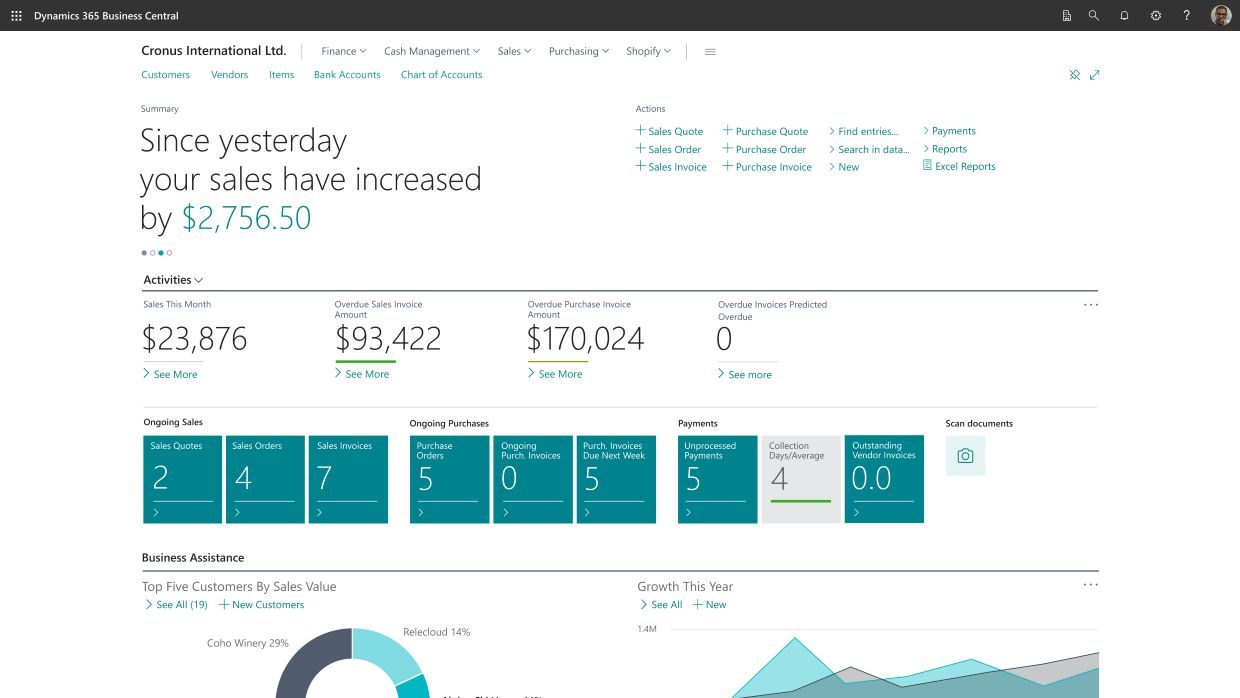
9) Real-time operational visibility and better decisions
One of the most strategic WMS benefits is that it creates reliable warehouse data you can actually manage against.
With the right reporting and dashboards, teams can monitor:
- Inventory levels and stockouts risk
- Shipping timelines
- Inventory turnover
- Warehouse capacity/utilization indicators
This kind of insight is also strengthened when your ERP ecosystem connects analytics and collaboration tools.
10) Better planning and replenishment outcomes
WMS isn’t “just operations.” When warehouse execution data is accurate, planning improves:
- Reorder point signals are more reliable
- Stock availability is more truthful
- Demand and fulfillment decisions become less reactive
Microsoft’s Business Central positioning for supply chain management includes inventory management, order processing, and demand forecasting—capabilities that depend on accurate operational data.
11) Scalability without losing control
A warehouse can often grow for a while on heroics. Then growth turns into chaos.
A WMS provides repeatable structure so you can scale:
- SKU count
- Order volume
- New staff and onboarding
- Additional warehouses and locations
That scalability benefit is often why businesses adopt WMS at the exact moment they feel operational pressure increasing.
12) Lower total “cost of exceptions”
This is an underrated benefit: fewer exceptions means fewer hidden costs.
A WMS reduces exceptions like:
- Inventory mismatches
- Short picks
- Rework due to wrong shipments
- Manual reconciliations between tools
- Time spent searching for items
What drives WMS benefits (and why some projects disappoint)?
WMS benefits don’t come from installing software alone. They come from three drivers working together:
- The right WMS components for your maturity level: If you implement too many components at once, adoption suffers. If you implement too few, you don’t see meaningful change.
- Data discipline (items, locations, barcodes, units of measure): Bad data turns a WMS into a fast way to make mistakes faster.
- Integration with ERP and your selling channels: When orders and inventory flow through multiple channels (B2B, e-commerce, marketplaces), integration prevents double entry and mismatched stock.
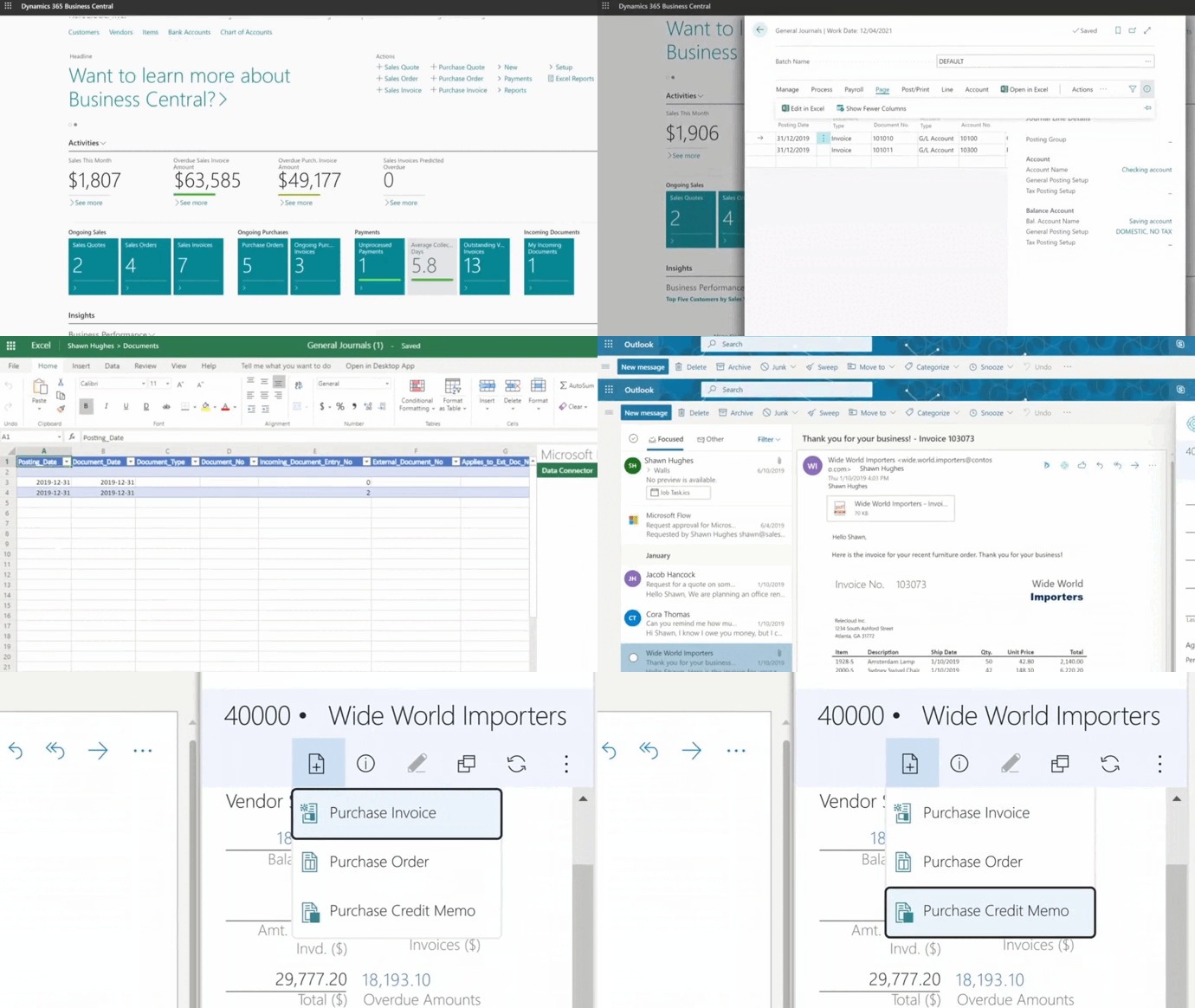
For example, Microsoft’s documentation for the Shopify connector in Business Central describes synchronizing items, inventory, customers, sales orders, transactions, and payouts between Shopify and Business Central.
How to estimate ROI from WMS benefits (without inventing numbers)
If you want a practical ROI lens, anchor it in things you can measure in your operation today:
- Pick errors per week (and cost per error)
- Orders shipped per day per picker
- Time from order release to shipment
- Inventory adjustment frequency and variance
- Returns caused by wrong item/quantity
- Time spent producing labels/tracking and reconciling shipments
You don’t need perfect math to make a good decision. You need directional clarity on where your operation leaks time, money, and customer trust.
Contact us for a free consultation today
Learn more about Business Central and its capabilities to handle your distribution and logistics needs.
 Free discovery call
Where Gestisoft fits in a WMS journey?
Gestisoft helps organizations design warehouse execution as part of a connected ERP and supply chain strategy—so the WMS benefits you’re aiming for (accuracy, speed, visibility, scalability) are supported by the right components, integrations, and rollout sequencing.
If you want your warehouse to move from “manual firefighting” to “controlled execution,” start with the ERP-connected foundation and build maturity in phases.
Related articles
- ERP WMS: a practical guide to warehouse management with ERP
- Components of warehouse management system
- Types of warehousing system: how to choose the right model for your operations
- Examples of warehouse management system: real workflows you can model in your warehouse
- Warehouse supply chain management: how to connect warehouse execution to the full supply chain
- WMS Software Cost: what it really includes (and how to budget accurately)
- Top 10 WMS systems to consider in 2026
- Disadvantages of warehouse management system: 10 risks to plan for (and how to avoid them)
- Inventory management company near me: how to choose the right partner for your warehouse and ERP
-
Typically: higher inventory accuracy, faster picking and shipping, fewer errors, and better visibility across inventory and fulfillment performance.
Liked what you just read? Sharing is caring.

January 16, 2026 by Kooldeep Sahye by Kooldeep Sahye Inbound Marketing Manager
Specializing in SEO-driven pipeline growth, I combine keyword strategy, content optimization, and inbound tactics to turn organic search into a reliable source of qualified leads. I work at the intersection of traditional SEO and AI search — optimizing for LLMs and AI Overviews alongside Google — pairing data-informed strategy with sharp, story-led copywriting.
