

Warehouse supply chain management is what happens when your warehouse stops operating like an isolated “storage function” and becomes a controlled part of the end-to-end flow: inbound → storage → fulfillment → shipping → returns. In practical terms, it means your warehouse decisions and actions stay aligned with purchasing, inventory planning, order processing, and customer delivery expectations.
A good way to think about it: the warehouse is where supply chain plans become physical reality—receiving, movement, storage, picking, and packing are core functions of warehousing operations.
This article explains what warehouse supply chain management is, the workflows and KPIs that matter most, and how to build an ERP-connected approach that scales.
What is warehouse supply chain management?
Warehouse supply chain management is the discipline of managing warehouse operations as a core link in the supply chain, not just as “inventory storage.” It includes:
- Inbound logistics and receiving control
- Storage and location/bin discipline
- Fulfillment execution (pick/pack/ship)
- Inventory accuracy and cycle counting
- Returns and reverse logistics
- Integration to the business system (orders, inventory availability/value, reporting)
Warehousing operations typically involve receiving, movement, storage, picking, packing, and packaging—functions that directly shape service levels and cost-to-serve.
If you’re building your model around an ERP + WMS ecosystem, start here: Components of warehouse management system.
Book your free consultation today
Our experts will be happy to introduce you to Microsoft Dynamics 365 Business Central, a software that can help with warehouse supply chain management.
 Free discovery call
Why warehouse supply chain management matters in 2026 and beyond?
When businesses struggle with supply chain performance, the warehouse is often where symptoms show up first:
- Inventory “looks available” in the system but isn’t physically there
- Picking is slow because inventory isn’t located consistently
- Shipping is delayed because packing and carrier steps aren’t synchronized
- E-commerce oversells because inventory updates lag between systems
Warehouse supply chain management solves this by creating one operational truth and pushing it through the entire flow. Read more about WMS benefits here.
The 7 core processes of warehouse supply chain management
Now, let’s break down the 7 core processes of warehouse supply chain management that every business needs to know.
1) Inbound receiving and verification
Receiving sets the accuracy baseline. Warehouse supply chain management requires:
- Controlled receiving (what arrived vs what was expected)
- Immediate discrepancy capture (short/over/damaged)
- Fast visibility so inventory becomes usable quickly
2) Put-away, movement, and storage discipline
A supply chain warehouse isn’t just “where items sit.” It’s where items must be findable. That means:
- Defined locations/bins (or logical zones)
- Put-away confirmations
- Traceable internal movements
This reduces “search time” and unlocks faster picking later. Read more about workflows in our examples of warehouse management system here.
3) Inventory accuracy and counting strategy
Supply chain decisions are only as good as inventory truth. Strong warehouse supply chain management uses:
- Cycle counting (continuous accuracy)
- Root-cause thinking (why variances happen)
- Audit trail discipline
4) Picking and fulfillment execution
Picking is where labor cost and order speed collide. Warehouse supply chain management typically improves fulfillment by:
- Directed picking tasks
- Picking methods matched to volume (single, batch, zone, wave)
- Exception handling captured immediately
If you’re unsure which maturity level fits you, use this guide: types of warehousing system.
5) Packing and shipping synchronization
This is where many warehouses break: the order is picked, but shipping becomes a separate world. Warehouse supply chain management requires:
- Packing verification (accuracy checkpoint)
- Shipment confirmation (so order status is trustworthy)
- Carrier steps integrated where possible (labels, tracking)
6) Returns and reverse logistics
Returns are part of supply chain reality. A controlled returns workflow protects:
- Inventory accuracy (restock vs scrap)
- Customer satisfaction
- Financial alignment (credits and inventory value)
7) Reporting and continuous improvement
If you can’t measure it, you can’t improve it. Warehouse supply chain management needs:
- KPIs that reflect service + cost
- Regular review cadence (weekly ops + monthly improvement)

The systems layer: how ERP and WMS support warehouse supply chain management
Warehouse supply chain management is not “a WMS project.” It’s a connected systems project.
ERP’s role (the system of record)
ERP typically owns:
- Item and inventory policies
- Order processing
- Planning signals (replenishment/demand)
- Financial inventory and reporting
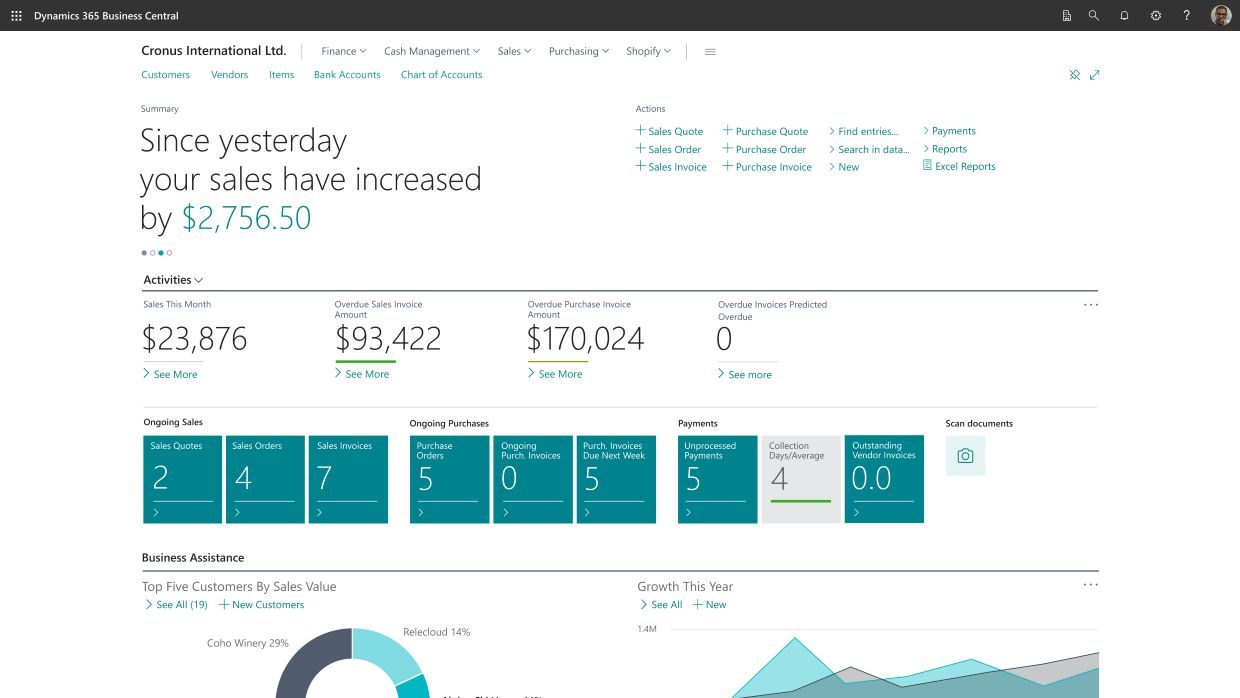
Microsoft’s Business Central release plan positioning for supply chain management highlights capabilities spanning inventory and warehouse management, as well as sales and purchase processes (among other areas).
WMS’s role (execution control)
WMS typically owns:
- Warehouse tasks (receive, put-away, pick, pack, ship, count)
- Location/bin accuracy
- Confirmation of physical work at the moment it happens
When ERP and WMS are aligned, warehouse execution becomes reliable enough to drive better planning and customer service.
Multi-channel reality: e-commerce in warehouse supply chain management
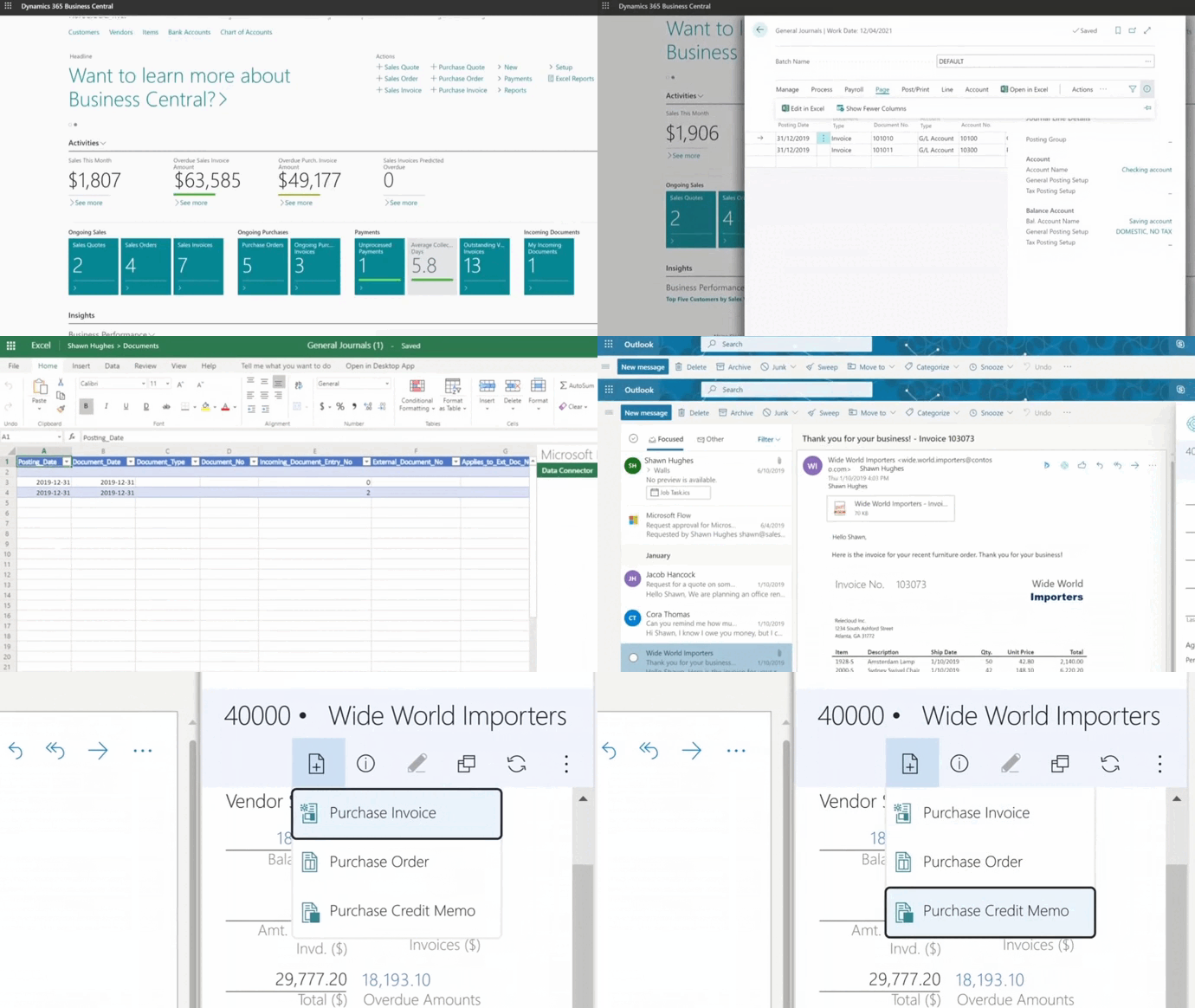
If you sell online, warehouse supply chain management must include synchronization across systems. For example, Microsoft’s Shopify connector guidance for Business Central describes synchronizing items, inventory, customers, sales orders, transactions, and payouts between Shopify and Business Central.
Why it matters:
- Prevents overselling due to stale inventory
- Reduces manual re-entry of orders
- Keeps order status and shipment progress consistent
The KPIs that actually matter in warehouse supply chain management
To manage warehouses as part of the supply chain, track a balanced set of KPIs:
Accuracy
- Inventory accuracy / variance rate
- Pick accuracy (mis-picks per 1,000 lines)
Speed
- Order cycle time (release → ship)
- Units/lines picked per hour
Reliability
- On-time shipping rate (against cutoffs)
- Backorders caused by inventory mismatch
Cost-to-serve
- Cost per order shipped (labor + packaging + rework)
- Returns due to warehouse error
These KPIs connect warehouse reality to supply chain outcomes (service, cash flow, and margin). Read more about WMS software cost here.
A practical roadmap to improve warehouse supply chain management
Here’s a sequencing that works for most growing distributors:
- Stabilize master data (items, units, locations, barcodes)
- Standardize receiving + put-away confirmations
- Deploy barcode execution for picking and counts
- Add packing verification + shipping confirmation discipline
- Integrate carriers and order channels where needed
- Operationalize KPIs and continuous improvement cadence
This is also the safest way to avoid “big bang” complexity that slows adoption. Read more about the disadvantages of warehouse management system here.
Book your free consultation today
Contact our team for more details about Business Central.
 Free discovery call
How Gestisoft helps?
Gestisoft helps organizations design warehouse supply chain management as an operating model—combining workflow discipline, ERP alignment, and warehouse execution capabilities so inventory and fulfillment stay reliable as the business scales. Contact us for more details now.
-
It’s managing warehouse operations (receiving, storage, picking, packing, shipping, returns) as an integrated part of the supply chain so the business runs on accurate, real-time execution.
Liked what you just read? Sharing is caring.

January 16, 2026 by Kooldeep Sahye by Kooldeep Sahye Inbound Marketing Manager
Specializing in SEO-driven pipeline growth, I combine keyword strategy, content optimization, and inbound tactics to turn organic search into a reliable source of qualified leads. I work at the intersection of traditional SEO and AI search — optimizing for LLMs and AI Overviews alongside Google — pairing data-informed strategy with sharp, story-led copywriting.