

Key Takeaways:
- What is cloud ERP: business software (finance, ops, inventory, sales) hosted by the vendor, accessed via browser, with automatic updates and no server closet. Microsoft's Business Central documentation frames the category.
- Canadian businesses get data residency in Azure Canada Central/East, Law 25 and PIPEDA alignment, and bilingual operations out of the box.
- Gestisoft has been implementing specialized Microsoft business applications since 1997, from four Canadian offices in Montreal, Toronto, Ottawa, and Quebec City.
- The 6-Signal Readiness Framework in this guide tells you whether cloud ERP is urgent, worth scoping, or a nice-to-have.
What is cloud ERP? Cloud ERP is business management software (finance, inventory, sales, operations) that runs on a vendor's servers instead of yours, and you access it through a browser.
It replaces the on-premise systems, spreadsheets, and disconnected tools that stop scaling once your business grows past a certain point.
Most articles on cloud ERP read like a brochure. This one does not. We cover what cloud ERP actually is, how it works, where it saves you money, where vendors oversell cloud ERP, what it costs Canadian businesses in 2026, and how you know you are ready to switch.
Gestisoft is a Microsoft Partner headquartered in Montreal that has been deploying and optimizing cloud ERP and CRM environments since 1997, with strong operational roots in mid-market manufacturing, distribution, and regulated industries across Canada.
“As a customer since 2015, I would like to highlight the quality of support and expertise provided by Gestisoft for our Business Central application. Their competence is notable and has greatly contributed to the success of my business. I highly recommend them as a service provider for Business Central.”
Kim's feedback captures the kind of long-term partnership a cloud ERP project actually needs. If you would rather get a direct answer for your own business than keep reading.
One System for Finance, Ops, Inventory, and Sales
See what cloud ERP would look like in your business with a certified Business Central expert from a Microsoft Solutions Partner.
 Free discovery call
What Is Cloud ERP? A Straight Definition Without the Jargon
Cloud ERP (Enterprise Resource Planning) is one system that runs your business: accounting, inventory, sales, purchasing, projects, and reporting.
The vendor hosts it. You access it through a browser. You pay a monthly or annual subscription. You do not buy servers, patch them, or back them up.
What is cloud ERP replacing when a business switches? Usually three things:
- An aging on-premise ERP (Dynamics GP, older SAP, older Sage).
- A stack of disconnected tools (QuickBooks plus spreadsheets plus a warehouse app).
- Manual processes that only the veteran controller understands.
At its core, cloud ERP does three jobs. First, it stores your business data in one place. Second, cloud ERP automates the workflow across departments so a sales order triggers the invoice, the picking slip, and the inventory update. Third, it reports on all of it in real time, so decisions do not wait for month-end.
Microsoft's Business Central technical documentation walks through the underlying architecture for anyone who wants the deeper layer.
What Is Cloud ERP Doing That Old Systems Cannot?
Two things:
- First, updates happen automatically. Your cloud ERP stays current on tax tables, security patches, and new features without your IT team lifting a finger.
- Second, your data lives in a Microsoft-managed data center. For Canadian customers, that is Azure Canada Central (Toronto) or Canada East (Quebec City), which matters for Quebec's Law 25 and PIPEDA compliance.
What Is Cloud ERP vs. On-Premise ERP? The Honest Comparison
The difference is not just where the software lives. It is who is responsible for what.
On-Premise ERP
You own the servers. You (or an IT contractor) install updates, back up data, secure the network, and rebuild the hardware every 5 to 7 years.
Upfront cost is high, monthly cost is low. When something breaks at 11pm on a Sunday, that is your team's problem.
Cloud ERP
The vendor (Microsoft, in the Business Central case) owns the servers. They handle uptime, updates, backups, and security. You pay per user per month.
When something breaks, their engineers get paged, not yours.
For where these terms overlap, see our breakdown of SaaS ERP vs. Cloud ERP.
What Is Cloud ERP Doing to Total Cost of Ownership?
The most common trap Canadian buyers fall into: assuming on-premise is cheaper than cloud ERP because the license is one-time.
Once you add server hardware, backup infrastructure, IT labour, and the fact that most on-premise ERPs need a major re-implementation every 7 to 10 years, cloud ERP wins on total cost of ownership for the vast majority of Canadian SMBs.
What Is Cloud ERP Used For? Real Business Problems It Solves
This is where what is cloud ERP starts to matter beyond the definition. It earns its price tag not through features on a spec sheet, but by removing specific friction from specific teams.
Finance and Accounting
Month-end close typically drops from 8 to 10 business days to 3 to 5 in Business Central implementations Gestisoft has delivered.
Bank reconciliation runs on rules, not on the controller manually matching lines. Financial reports refresh live. When you connect Power BI to Business Central, the CFO stops waiting on IT to build a dashboard. They build it themselves.
Inventory and Supply Chain
One accurate stock count instead of three (warehouse, accounting, and sales all showing different numbers).
Real-time visibility into what is in the warehouse, what is on order, and what is already committed to a customer. This is where ERP in inventory management and what is ERP in supply chain management matter operationally, not just as buzzwords.
Manufacturing
Production visibility that manufacturers actually trust. For a shop floor running MRP, cloud ERP consolidates material requirements, work orders, and cost tracking into one system. The what is MRP and ERP distinction becomes practical rather than academic.
When someone asks us what the best manufacturing ERP is for a Canadian mid-market operation, Business Central is almost always on the shortlist.
Distribution
A distributor with three warehouses, 8,000 SKUs, and a Shopify storefront does not want three separate systems.
A cloud ERP with proper cloud based distribution software capability handles multi-location inventory, replenishment, EDI, and picking in one place. That is the difference between a distribution ops team that ships and one that firefights.
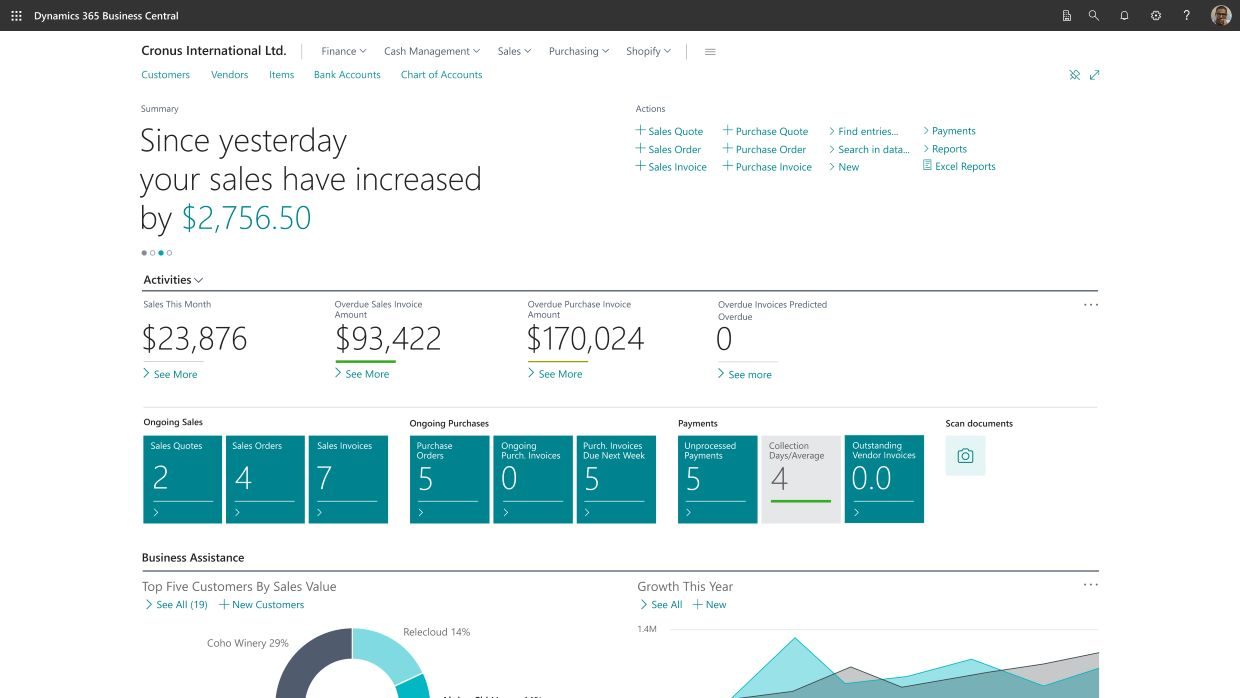
Want to see what a cloud ERP actually looks like once you log in? This short Gestisoft tutorial walks through the Business Central interface and how role-based views organize each user's day.
What Is Cloud ERP Worth? Benefits Canadian SMBs Actually Get
Here is what mid-market businesses experience that truly matters once they understand what cloud ERP delivers after 12 months in production:
- Predictable IT spend. A per-user monthly fee is easier to budget than a $200K CAD hardware refresh every 5 years.
- No "let me get back to my desk" data. Finance, sales, and ops open the same dashboard from any device.
- Canadian data residency. Azure Canada Central and Canada East keep your customer data inside the country.
- Faster month-end. A consistent pattern across the Business Central projects Gestisoft delivers, not a marketing claim.
- Bilingual by design. Business Central runs in English or French per user, which matters in Quebec and federally regulated industries.
- A foundation for AI. Copilot features come built into Business Central, and Microsoft 365 Copilot for business adds a productivity layer that connects Business Central data to Word, Excel, and Outlook.
For the deeper benefits breakdown, see the companion piece on the benefits of ERP software on the cloud.
5 Reasons to Adopt a Cloud ERP
Understand the concrete benefits of switching to a cloud ERP like Business Central.

What Is Cloud ERP NOT? Misconceptions Vendors Won't Correct
Understanding what is cloud ERP requires understanding what it is not.
It Is Not a Magic Fix
If your processes are broken, cloud ERP digitizes broken processes faster. Fixing the process comes before any cloud ERP rollout.
It Is Not Just Accounting Software
Cloud ERP is broader than QuickBooks or Xero. It is the operating layer of the business, not just the ledger.
It Is Not a CRM
Sales pipeline, marketing automation, and customer service live in Dynamics 365 CRM, not Business Central. The two integrate. They are not the same product.
It Is Not Automatically Cheaper on Day One
Subscription costs stack over years. Where cloud ERP wins is total ownership: no hardware, no re-implementations, no emergency IT calls.
It Is Not "One and Done"
A cloud ERP implementation is a project, not a purchase. Underestimating change management is the single biggest reason implementations struggle.
What Is Cloud ERP Readiness? The 6-Signal Framework
Before scoping vendors, the honest first question is what is cloud ERP readiness for your specific business. Score each signal from 0 to 3 based on how strongly it applies.
- Version lock. Your current ERP has not had a major upgrade in 3 or more years.
- Server anxiety. You are facing a hardware refresh or worrying about data center costs.
- Data blindness. Month-end takes more than 5 business days.
- Tool sprawl. Finance, ops, and inventory live in 4 or more disconnected systems.
- Remote friction. Staff struggle to work securely without VPN gymnastics.
- AI envy. Your team uses ChatGPT for tasks your ERP should already handle.
How to Read Your Score
- 0 to 5: Cloud ERP is a nice-to-have, not urgent. Revisit in 12 months.
- 6 to 11: Start scoping. The pain is real. A discovery call is worth your time.
- 12 to 18: Legacy systems are costing you money. A properly scoped cloud ERP project usually pays back within 12 to 18 months in Canadian SMBs.
Gestisoft's 10 ERP selection criteria guide picks up once your score puts you in the "start scoping" zone.
Get a Realistic Cloud ERP Scope for Your Business
Walk away with an honest read on budget, timeline, and risk from a Microsoft Solutions Partner with 20+ years of ERP experience.
 Free discovery call
What Is Cloud ERP Going to Cost You in 2026?
So what is cloud ERP going to cost in real numbers? For a Canadian SMB implementing Microsoft Dynamics 365 Business Central, the budget usually breaks into three buckets. All figures in Canadian dollars.
1- Subscription
Business Central Essentials sits at CAD $108.50 per user per month, and Premium at CAD $149.20 per user per month (billed yearly, per Microsoft's current Canadian pricing).
Team Members (light/view users) come at a lower price point. Microsoft updates these periodically, so check before you sign.
2- Implementation
For a 20-user Canadian SMB, a properly scoped implementation typically runs CAD $60K to $180K+ depending on complexity, integrations, and data migration.
Partner quality shows up here more than anywhere else.
3- Ongoing Partner Support
Budget for a support retainer post go-live. Based on Gestisoft's implementation experience, 5 to 10 hours a month for the first year is a realistic starting point.
It's essential to internalize this before signing anything: cloud ERP projects that overlook proper change management frequently go over budget and beyond deadlines. Underestimating the human side of the project is a bigger risk than the software itself.
What Is Cloud ERP With AI Like Today? Copilot in Business Central
This is where what is cloud ERP in 2026 stops looking like what is cloud ERP in 2020.
Microsoft has embedded Copilot directly inside Business Central. Practical, working features today include:
- Bank reconciliation assistance.
- Sales line suggestions.
- Marketing text generation.
- Product data suggestions.
- Late payment prediction.
- Autonomous agents that handle whole workflows, such as accounts payable coding.
Combine that with the ability to build a Power App that extends Business Central, or set up a Power Automate approval flow for expense reports, and you are not just running an ERP. You are running an AI-augmented business system.
Gestisoft's deeper reads on AI in ERP and the intelligent ERP shift walk through the Copilot and agent layer in more depth.
Realistically, AI inside a cloud ERP is genuinely useful for repetitive structured tasks (reconciliations, coding, drafting). It is still weak on high-judgment decisions. Treat cloud ERP AI as a very fast junior accountant, not a CFO.

What Is Cloud ERP Partner Selection Done Right in Canada?
When you have decided what is cloud ERP going to solve for your business, the partner you pick matters more than the software itself.
A great partner on a mediocre platform beats a mediocre partner on the best platform every time.
Five Criteria That Separate a Real Partner From a Reseller
- Microsoft Solutions Partner designation for Business Applications, not just any Microsoft Partner badge.
- Canadian presence with people who understand PST, GST, HST, QST, and provincial payroll.
- Bilingual capability if you serve or hire in Quebec.
- Verifiable clients in your industry with reference calls available.
- A published methodology (analysis, implementation, training, optimization) instead of a "we'll figure it out" pitch.
Whether you are in Vancouver, Calgary, or the Greater Toronto Area, the local expertise question is the same. Gestisoft's regional resources cover what to look for in a Dynamics 365 Business Central partner, a Business Central partner in Ottawa, or a Business Central partner in Toronto.
-
Cloud ERP is business management software you rent instead of buy. The vendor runs it on their servers, you use it through a web browser, and it handles your finance, inventory, sales, and operations in one system.
What Is Cloud ERP Done Right? Why Gestisoft Fits Canadian SMBs
Gestisoft has been implementing specialized Microsoft business applications since 1997, delivering 220+ projects a year across four Canadian offices in Montreal, Toronto, Ottawa, and Quebec City. In 2024, the client renewal rate hit 95%, which is the honest measure of whether an ERP partner actually earns its second year of trust.
The credentials sit alongside that track record: B Corp certified, Microsoft Solutions Partner for Business Applications, a Microsoft Canada Impact Award, Great Place to Work Canada, Prix Performance Quebec, and the Quebec Technology Association's Most Involved Company of the Year (2020).
Bilingual project teams run analysis, implementation, migration, support, optimization, and training as distinct services, not a bundled promise.
Here is how one client describes working with the team:
“The Gestisoft team offered a high level of both business and technical experience to the project and actively listened to and grasped all needs. Their recommendations enabled our client to make the best choice and have access to Business Central's greatest features. Along with this knowledge, Gestisoft consistently maintained strong communication.”
That is the kind of feedback that matters when you are choosing who will implement the operating system of your business.
Get an Honest Cloud ERP Fit Assessment
Talk to a Business Central specialist at a Microsoft Solutions Partner that has been implementing cloud ERP in Canada since 1997.
 Book a free consultation
Liked what you just read? Sharing is caring.

September 17, 2026 by Muhammad Ali Iqbal by Muhammad Ali Iqbal SEO Content Strategist & Copywriter
Driven by a passion for search engine optimization, strategic content, and conversion-focused writing. A copywriter and content strategist who lives for content that ranks, engages, and delivers real business results.

