

Key Takeaways:
- The best manufacturing ERP for your shop is the one that matches your manufacturing mode (discrete, process, or mixed) and your revenue tier, not the vendor with the loudest ad budget.
- For Canadian mid-market manufacturers between $10M and $500M in revenue, Microsoft Dynamics 365 Business Central handles shop floor, MRP, costing, and finance in one system.
- Manufacturing ERP implementations in Canada typically run $75,000 to $500,000 depending on user count, integrations, and customization.
- Gestisoft is a certified Microsoft Solutions Partner in Business Applications and implements Business Central Manufacturing for producers across Quebec, Ontario, and Western Canada.
The best manufacturing ERP is the one that fits how you actually produce. For Canadian mid-market producers, that usually means Business Central. For enterprise, it is SAP S/4HANA or Oracle Cloud ERP. For small shops under $10M, tools like Katana or Odoo do the job. Match the system to your mode and size, not the marketing.
Picking the best manufacturing ERP feels harder in 2026 than it did five years ago. There are more vendors, more "cloud-first" pitches, more AI copilots, and more Canadian manufacturers trying to on-shore production without blowing up their margins.
This guide cuts through that. You will get the criteria that actually matter, a mode-by-mode breakdown, real cost ranges for Canadian implementations, and a five-question framework to shortlist your top two options.
But before diving into features and vendor lists, the honest test for any manufacturing ERP is whether it gives you real, live visibility into what your shop floor is doing. Everything else, the modules, the dashboards, the extensions, is downstream of that.
That is exactly what one Gestisoft manufacturing client reported after implementation:
“The solution delivered to us has significantly improved our production visibility. We are now able to track our production in real time, and have more accurate data on the costs of each production run.”
If a system cannot do that for you in the first 90-120 days after go-live, it is not the best manufacturing ERP for your business no matter what its brochure says. So how do you figure out which one will? It starts with knowing what to demand from any vendor on your shortlist.
Find Your Best Manufacturing ERP
Get a straight assessment from a certified Microsoft Solutions Partner and walk away knowing which manufacturing ERP actually fits your production.
 Book a free consultation
What Actually Makes An ERP The Best Manufacturing ERP?
Every vendor claims to be the best manufacturing ERP for someone. What separates real fits from marketing fits is a short list of non-negotiables and a match to how you produce.
What Features Are Non-Negotiable In A Manufacturing ERP?
Any serious contender for the best manufacturing ERP has to cover six things without duct tape or third-party bolt-ons.
- Bill of materials (BOM) with multi-level structures and version control.
- MRP that generates net requirements, planned orders, and exception messages from your live demand.
- Shop floor control with real-time production posting, whether by tablet, barcode, or PLC integration.
- Quality management tied to inspection points, non-conformance tracking, and CAPAs.
- Standard and actual costing so you can see margin per job, per SKU, and per customer.
- Lot and serial traceability, both forward and backward, without a spreadsheet.
If a vendor demo skips any of these or answers with "we integrate with a partner for that," treat it as a gap and price it into your total cost of ownership.
Why Does Your Manufacturing Mode Decide The Best Manufacturing ERP For You?
Your manufacturing mode is the single biggest signal for which ERP will fit. A make-to-stock beverage plant and an engineer-to-order equipment builder need almost opposite things from the same category of software.
Picture a Quebec metal fabricator running a mix of make-to-order structural jobs and short make-to-stock runs of standard brackets. They start on a lightweight MRP tool that works fine at 12 users.
By the time they hit 40 shop-floor users and start routing multi-level assemblies with subcontract operations, that tool breaks down. Quoting drifts back into spreadsheets, scrap goes uncaptured, and job costing quietly loses accuracy.
The lesson is not that the first tool was bad. It was the wrong tool for their mode and scale.
The pattern to watch for is a common one. Mid-market manufacturers often lean toward an enterprise-tier system for a shop that never grows into those features, then pay to migrate off it a few years later. The best manufacturing ERP is usually the smallest system that covers your non-negotiables, not the most feature-heavy one you can afford.
In the mid-market, most ERP systems get replaced within roughly a decade of go-live, and the leading driver is a poor fit for how the business actually operates. That is a decade of paying for horsepower you never used, then paying again to migrate off it.
This is where a certified partner earns their fee. Gestisoft's scoping conversations with manufacturers start from what your shop actually does today and where it is realistically headed in three years, not from a feature matrix.

Which Is The Best Manufacturing ERP By Company Size And Type?
There is no universal "best manufacturing ERP" ranking. There are strong fits by revenue tier and production type. Here is how the market actually shakes out in 2026.
What Is The Best Manufacturing ERP For Canadian Mid-Market Producers?
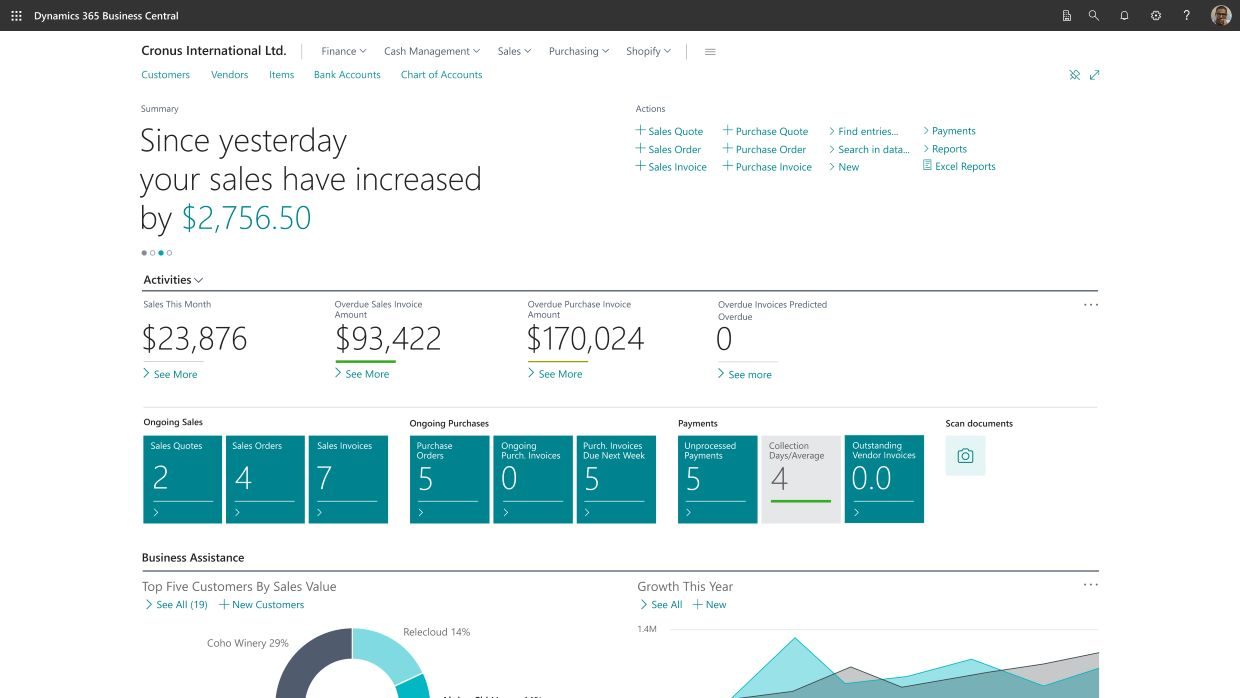
For manufacturers between $10M and $500M in revenue, Microsoft Dynamics 365 Business Central is the strongest fit. It covers production orders, BOM, MRP, capacity planning, subcontracting, warehouse management, and finance in a single system, hosted in Microsoft's Canadian cloud regions.
Business Central also integrates natively with Microsoft 365, Teams, Power BI, and Copilot, which matters if your team already lives in those tools. It sits on the Microsoft platform, which means the AI features arriving in 2026 (not just chat, but actual production-planning copilots) show up without a separate contract.
The features and ROI expectations for any ERP for manufacturer buyers at this tier are what push most Canadian shops toward Business Central over the alternatives.
Business Central holds a 4.0 out of 5 average across 900+ verified G2 reviews, with the strongest scores in ease of setup and quality of support for mid-market buyers.
What Is The Best Manufacturing ERP For Enterprise Manufacturers?
If you are over $500M in revenue with global operations, multi-plant, and complex regulatory needs, SAP S/4HANA and Oracle Cloud ERP remain the default picks.
Both are proven at scale, both cost significantly more, and both need a dedicated internal team to operate. Infor CloudSuite Industrial is a credible alternative for industrial manufacturers in verticals like machinery, metal fabrication, electronics, and medical devices, particularly at the upper end of mid-market.
What Is The Best Manufacturing ERP For Small Shops Under $10M?
For shops with fewer than 20 users and simple production, look at Katana Manufacturing ERP, Odoo Manufacturing, or Fishbowl.
These are affordable, quick to implement, and cover the essentials. The trade-off is limited financial depth, so most growing shops outgrow them within two to four years. If you are leaning toward an inventory-first tool at this size, our comparison of manufacturing inventory control software covers the eight platforms Canadian small manufacturers usually shortlist.
What Is The Best Manufacturing ERP For Process And Food Producers?
Process manufacturers (chemicals, food, beverage, pharma) need batch management, formula-based BOMs, and strict lot traceability. SAP S/4HANA, Aptean Process Manufacturing, and BatchMaster are the deepest fits.
Business Central can handle light process needs but is not the strongest choice for regulated batch producers.
If Business Central keeps showing up on your shortlist, this short walkthrough from Gestisoft shows what the platform actually looks like in a real manufacturing setup before you sit through a full sales demo.
Cloud Or On-Prem: Which Deployment Delivers The Best Manufacturing ERP For You?
The cloud vs on-prem question for the top manufacturing ERP is close to settled for most Canadian manufacturers.
Cloud wins on cost of ownership, upgrade cadence, and AI features. On-prem still wins if you have specific compliance rules, poor connectivity at your plant, or heavy customizations you cannot rebuild. Understanding what is cloud ERP in a manufacturing context matters here because the tradeoffs are different than for a services business.
Microsoft hosts Business Central in Canada Central (Toronto) and Canada East (Quebec City) regions, which keeps your production and customer data inside Canadian borders. That handles most data-residency concerns for regulated Canadian manufacturers.
Consider an Ontario food processor who stayed on legacy on-prem software for years because someone in leadership assumed cloud meant "data in the US." When they finally scoped a Business Central migration, they learned their data would sit in Microsoft's Toronto region, under Canadian jurisdiction. That single clarification unblocked a two-year decision in one meeting.
The lesson is worth repeating: ask specifically about Canadian data regions before you rule out cloud on compliance grounds. It is often not the blocker people assume.
5 Reasons To Adopt A Cloud ERP
A short eBook on why Canadian manufacturers are moving to cloud ERP like Business Central, and what changes when they do.

How Much Does The Best Manufacturing ERP Cost In Canada?
Real Canadian budgets for the manufacturing ERP options in 2026 land in these ranges based on our own scoping work with Canadian manufacturers.
- Small shop (5 to 20 users): $40,000 to $120,000 all-in for year one, covering licenses, implementation, training, and data migration.
- Mid-market (20 to 150 users): $150,000 to $500,000 all-in for year one.
- Enterprise (150+ users, multi-site): $500,000 to $5M+ depending on scope.
Ongoing costs (licenses, support, minor customization) usually run 18 to 25 percent of the year-one implementation cost per year after go-live. That number is worth pressuring every vendor on your shortlist about, because it is where most buyers get surprised.
The category itself is broad, and ERP solutions for manufacturing span everything from lightweight cloud tools to fully custom-built systems, each with its own cost profile.
One thing to weigh when comparing quotes: whoever implements your system needs to actually understand Canadian labour rates, French translation work, and Canadian tax and compliance setup.
Gestisoft delivers Business Central projects for Canadian manufacturers from its Montreal, Toronto, Ottawa, and Québec City offices, which is why our cost ranges reflect what actually gets billed in Canada, not what a US price sheet would suggest.
Get A Real Cost Estimate
Talk to Gestisoft, a B Corp certified Microsoft Solutions Partner, and get an honest cost range built from Canadian implementations.
 Free discovery call
How Do You Choose The Best Manufacturing ERP? A 5-Question Decision Framework
Skip the 40-page evaluation matrix. Answer these five questions honestly and the best manufacturing ERP for your shop usually narrows to two vendors.
1- What Is Your Primary Manufacturing Mode?
Discrete, process, mixed, or project-based? Your answer eliminates roughly half the market immediately. A process food producer should not be looking at engineer-to-order specialists, and vice versa.
2- How Many Concurrent Shop Floor Users Do You Need?
Fewer than 20, 20 to 150, or 150 plus? This narrows your tier. Mid-market tools like Business Central are designed for the middle band. Enterprise tools like SAP S/4HANA get overpriced fast for smaller shops.
3- Do You Need Bilingual (EN/FR) User Experience?
If your shop floor runs partly in French, this is a hard requirement, not a nice-to-have. Business Central has native French UX. Many US-first tools do not. This alone eliminates a lot of vendors for Quebec-based producers.
4- Cloud, On-Prem, Or Hybrid?
Cloud is the default in 2026. On-prem still fits some regulated or connectivity-limited environments. Hybrid is real but adds cost. Have a clear answer before demos start.
5- Which Ecosystem Do Your Customers And Suppliers Already Run In?
If your top customers push EDI, your suppliers use Microsoft or Google, and your accounting team already lives in Excel, that ecosystem tips the scale. Fighting against your value chain's tools is expensive.
For reporting and analytics, being able to connect Power BI to Business Central natively is one of the reasons mid-market buyers keep landing on the Microsoft stack.
One quiet factor a lot of buyers under-weight is the support team culture on the partner side, because that team will be inside your production for years. Gestisoft is Great Place to Work Canada Certified, which is worth checking on any partner you consider, not just us.
-
For shops under $10M with fewer than 20 users, Katana, Odoo Manufacturing, and Fishbowl are the strongest starting points. Business Central Essentials also fits growing small manufacturers who want room to scale without switching platforms in three years.
Why Canadian Manufacturers Pick Gestisoft To Deliver The Best Manufacturing ERP Fit
Choosing the best manufacturing ERP is only half the decision. The partner who implements it decides whether you actually get the ROI on the brochure.
If you have shortlisted Business Central as the best manufacturing ERP for your shop, the implementation partner shapes the outcome as much as the product. Gestisoft has focused on the Microsoft business applications stack for years and holds the credentials to back it up:
- Certified Microsoft Solutions Partner in Business Applications.
- B Corp Certified.
- Great Place to Work Canada Certified.
- Named Canada's Most Admired Corporate Culture in 2023.
- Prix Performance Québec winner.
- Offices in Montreal, Toronto, Ottawa, and Québec City.
For manufacturers, that combination matters. You are not just buying software. You are picking a team that will scope, build, train, and support your production system for the next decade.
Here is what that looks like from a client's side:
“Always attentive to our needs, the dedicated team never hesitated to take the time to review points generating concern in order to ensure a project that would meet our expectations from A to Z.”
That kind of partner relationship does not show up on a spec sheet, but it is the difference between a system that goes live on time and one that limps along for two years. The fastest way to know if it fits your shop is a conversation.
Know If Business Central Actually Fits Your Shop
Walk through your setup with a certified Microsoft Solutions Partner and leave with a straight answer on scope, cost, and timeline.
 Book a free consultation
Liked what you just read? Sharing is caring.

September 16, 2026 by Muhammad Ali Iqbal by Muhammad Ali Iqbal SEO Content Strategist & Copywriter
Driven by a passion for search engine optimization, strategic content, and conversion-focused writing. A copywriter and content strategist who lives for content that ranks, engages, and delivers real business results.
