

If you're looking into Microsoft GP Dynamics accounting, there's a good chance you're already running it, or you're evaluating whether your organization should. Either way, you've come to the right place.
This article covers what the software does, who still uses it in Canada, what's changing with Microsoft's end-of-support announcement, and what your next step should look like.
What Is Microsoft GP Dynamics Accounting Software?
Microsoft GP Dynamics accounting software, also known as Microsoft Dynamics Great Plains or simply Dynamics GP, is an ERP (enterprise resource planning) solution built for small and mid-sized businesses. Microsoft acquired the original Great Plains platform in 2001, and over the following two decades it became one of the most widely deployed accounting platforms in North America.
The core of Microsoft GP Dynamics accounting is financial management. General ledger, accounts receivable, accounts payable, bank reconciliation, fixed assets: the full accounting cycle that mid-market finance teams depend on. But GP was always more than just an accounting tool. Over the years it expanded into a broader ERP covering inventory, purchasing, order processing, payroll, and project tracking.
In Canada specifically, GP includes Canadian Payroll as a built-in module, with support for provincial tax calculations, ROE processing, and year-end T4 filings. That localization was a genuine differentiator when the platform was in its prime.
Canada ranks as the second-largest market for Dynamics GP globally, with roughly 890 Canadian companies still actively running the platform. That's a meaningful installed base, and it's a big part of why the upcoming end-of-support announcement has created urgency for finance teams from coast to coast.
Thinking About Your GP Accounting System?
Our Business Central specialists help Canadian SMBs assess their current setup and plan their next move, on your timeline, not ours.
 Book a free consultation
What Microsoft GP Dynamics Accounting Software Covers
Before diving into what's changing, it's useful to take stock of what Microsoft GP Dynamics accounting software does. Because it's a more complete system than many people realize when they're evaluating migration options.
Financial Management
The financial backbone of GP is solid. General ledger with multi-currency support, bank reconciliation, budgeting, cash flow management, fixed asset tracking, and intercompany consolidations. For mid-sized Canadian businesses running multiple entities, that consolidation capability has been a genuine strength. If you're unsure whether your business has outgrown a basic accounting tool and needs a full financial management system, GP sits firmly in ERP territory.
Accounts Payable and Receivable
GP handles the full payables and receivables cycle: vendor invoice processing, payment runs, customer billing, collections tracking, and aging reports. Finance teams that have lived in GP for a decade or more know these workflows well. They're the workflows that need to map cleanly into whatever platform comes next.
Canadian Payroll
This module often gets overlooked when comparing Microsoft GP Dynamics accounting to alternatives. GP includes Canadian Payroll with support for provincial tax calculations, Records of Employment, T4s, and direct deposit. For many Canadian businesses, this was a deciding factor when they originally chose the platform.
Inventory and Distribution
GP extends into supply chain territory with inventory control, purchase order processing, sales order processing, and returns management. Distribution companies in particular built their operations around these modules, often adding third-party extensions to fill gaps in functionality.
Project Accounting
For professional services firms, GP includes a Project Accounting module covering project budgets, time and expense tracking, billing by project phase, and revenue recognition. It's one of the more underappreciated parts of the platform, and one that requires careful attention during any migration.
Reporting and Business Intelligence
GP integrates with Management Reporter for financial statements and supports connections to Power BI for broader analytics. The reporting layer has long been one of the reasons finance teams remained loyal to the platform. Familiar layouts, flexible row definitions, and Excel integration that worked reliably without a lot of configuration overhead.
Who Still Uses Microsoft GP Dynamics Accounting in Canada?
The typical GP user in Canada tends to look similar across industries: a company that has been running Microsoft GP Dynamics accounting for anywhere from 8 to 20 years, has customized it over time, and has built real institutional knowledge around it.
You'll find GP in professional services firms, distributors, manufacturers, nonprofits, and even some municipalities. The industries that relied most heavily on the platform (consulting, managed services, and project-based organizations) built deep integrations with it. Some added third-party modules from providers like Binary Stream, Encore, or Mekorma to extend its capabilities.
The challenge those businesses face now is that their setup has become a patchwork of customizations and integrations that make migration feel complicated. That feeling is understandable. But staying put is not the same as being safe.
Microsoft GP Dynamics Accounting: The 2029 End-of-Life Support
This is the section every organization running GP in Canada needs to read carefully.
Microsoft has officially announced that support for Microsoft GP Dynamics accounting software ends on December 31, 2029.
After that date, the platform will receive no further product enhancements, no regulatory updates (including Canadian payroll tax table updates), and no technical support. Security updates extend slightly longer, until April 30, 2031. After that point, Microsoft's involvement with GP is finished.
New sales of GP licenses have already been discontinued. Subscription billing and use under SPLA agreements terminates by April 30, 2031.
For a Canadian business using GP for its accounting, here is what that means in practice.
After 2029, your system will not receive Canadian payroll tax table updates. It will not be updated for changes to GST/HST rules, CRA reporting requirements, or provincial tax legislation. Security vulnerabilities discovered after April 2031 will not be patched. Finding certified consultants to support a legacy platform with no vendor backing will get harder and more expensive every year.
Most ERP migrations, including transitions from Microsoft GP Dynamics accounting to Business Central, take between 12 and 18 months when data cleanup, process review, configuration, testing, and user training are all factored in. Organizations with complex customizations, multiple entities, or industry-specific integrations often need more time.
If you are planning to be migration-ready before 2029, the planning conversation needs to start in 2025 or 2026. Not 2027.
Not Sure If Your GP Setup Is Migration-Ready?
We've helped dozens of Canadian businesses assess their Microsoft GP Dynamics accounting environment and build a realistic migration roadmap.
 Free discovery call
Microsoft GP Dynamics Accounting vs. Dynamics 365 Business Central
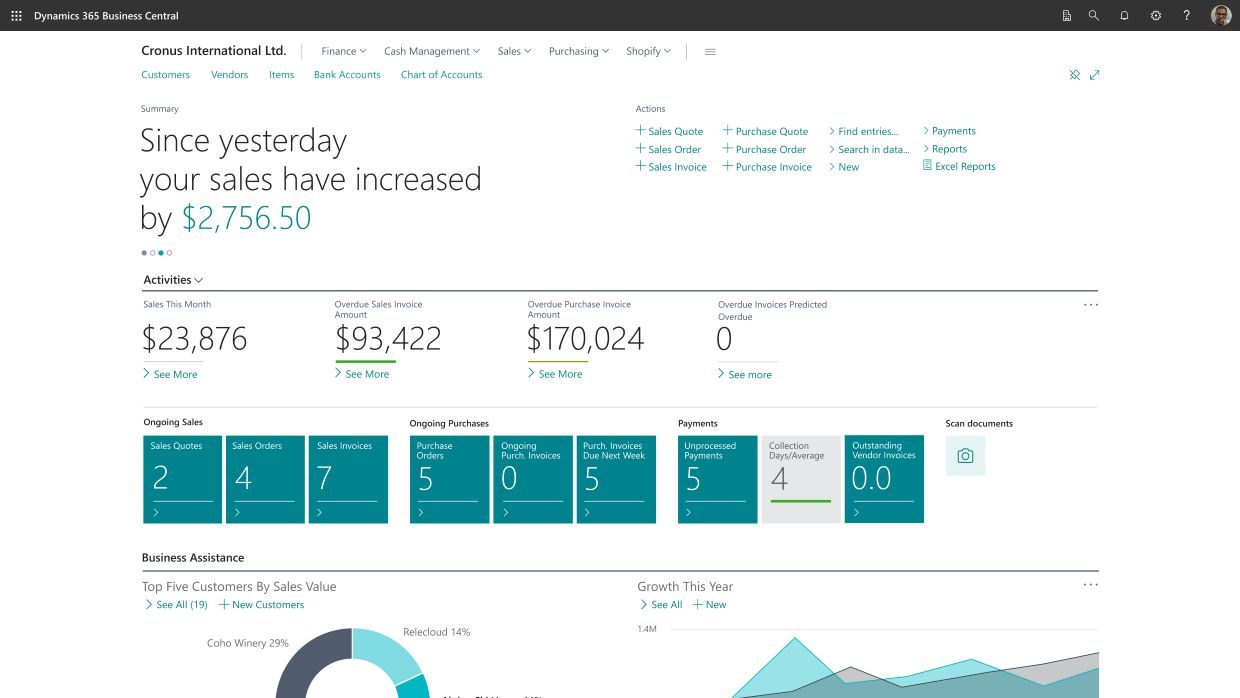
Microsoft's recommended successor to Microsoft GP Dynamics accounting is Dynamics 365 Business Central: the cloud-based ERP that Microsoft has been investing in heavily for the past decade. Here's how the two platforms compare on the dimensions Canadian finance teams care about most.
Deployment → GP runs on-premises, on your own servers or a hosted environment. Business Central is cloud-native (SaaS). Microsoft handles the infrastructure, updates, and security. Some businesses prefer on-premises control; most find that the ongoing IT overhead outweighs that preference once they've done an honest cost comparison.
Updates and Compliance → With GP, updates require manual installation and testing. With Business Central, Microsoft releases two major updates per year (April and October) automatically, plus monthly minor updates. Canadian payroll and tax rule changes come through the regular update cycle, with no separate IT intervention needed.
Integration with Microsoft 365 → Business Central has deep native integration with Microsoft Teams, Outlook, Excel, Power BI, and Power Automate. GP has some integration with the Microsoft stack, but it was built before cloud connectivity was a design priority. The difference in day-to-day usability is significant for anyone who works across multiple Microsoft tools.
Scalability and Multi-Entity → GP scales reasonably well within a single entity, but multi-entity and multi-currency scenarios typically require add-ons. Business Central handles these natively, with Copilot AI features now built in for financial forecasting, reconciliation, and document processing.
Cost Structure → GP typically involves perpetual licensing, annual maintenance fees, server costs, and IT overhead. Business Central uses a per-user, per-month subscription that includes hosting, updates, and support. For most Canadian SMBs, the total cost of ownership over five years favors Business Central once server refresh cycles and GP consultant fees are included in the comparison.
For a deeper breakdown, our Dynamics GP vs Dynamics 365 Business Central article goes through each dimension in detail.
What Canadian SMBs Should Do With Their Microsoft GP Dynamics Accounting System Right Now
The honest answer is: assess before you decide. Not every business running Microsoft GP Dynamics accounting is in the same position. Some have clean environments with minimal customization; for them, migration is relatively straightforward. Others have 15 years of bespoke development, ISV add-ons, and integrations with manufacturing equipment or legacy databases. Their path forward needs a proper roadmap.
Here is how to approach it in four stages:
Stage 1: Understand what you have.
Before making any migration decision, get a clear picture of your GP environment.
- How many modules are in use?
- What customizations exist?
- What third-party integrations are in place?
This inventory is the foundation of every realistic migration plan.
Stage 2: Evaluate your timeline.
If you're on an older version of GP, your support window may be shorter than December 2029. Microsoft's extended dates apply only to version 18.x under the Modern Lifecycle Policy. Businesses on GP 2018 R2 or earlier should treat their situation as more urgent. An ERP software consultant with GP experience can tell you exactly where you stand and what your realistic migration window looks like.
Stage 3: Build the business case.
A migration from Microsoft GP Dynamics accounting to Business Central is a significant project. But staying on a platform with a hard expiry date is also a business risk. The case for migration includes reduced IT costs, eliminated server refresh cycles, improved compliance automation, and access to Copilot AI capabilities that GP will never have.
Stage 4: Choose the right partner.
GP migrations are not generic ERP implementations. They require a partner who understands GP's data model, has experience with the GP-to-Business-Central migration toolkit, and can handle the Canadian-specific requirements (payroll, HST/GST configuration, provincial tax rules) that every Canadian business depends on. Look for a Microsoft Dynamics 365 Business Central specialist in Canada with a track record of completed GP migrations, not just new Business Central rollouts.
At Gestisoft, we've been implementing and supporting Microsoft ERP systems for Canadian businesses for over 20 years. We know where the complexity lives in a GP environment, and we know how to navigate it.
“The tool is really user-friendly and easy to use. It was important to us that the whole team could adopt it quickly.”
What Comes Next for Microsoft GP Dynamics Accounting
Microsoft GP Dynamics accounting has served Canadian businesses well for a long time. The platform earned its loyal installed base. But it is approaching the end of its supported lifecycle, and the window for a well-planned migration is narrowing every month.
The businesses that come through this transition well are the ones that start early. Not out of panic, but because a good ERP implementation takes time to do right. They use that time to clean up their data, map their processes to Business Central's workflows, train their teams, and go live on their own terms.
If your organization is still running Microsoft Dynamics GP accounting and you haven't started the planning conversation, now is a good time.
If you’re ready to talk migration, our team works with Canadian businesses at every stage of the GP journey, from initial assessment through go-live on Business Central. Book a Free Consultation today and start discussing next moves!
-
Microsoft GP Dynamics accounting, also known as Microsoft Dynamics Great Plains, is an ERP solution for small and mid-sized businesses. It covers financial management, accounts payable and receivable, Canadian payroll, inventory, project accounting, and reporting. Microsoft acquired the original Great Plains software in 2001, and the platform has been widely deployed across Canada, particularly in professional services, distribution, and manufacturing.
Explore More
- Dynamics GP vs Dynamics 365 Business Central for Canadian businesses. A detailed side-by-side comparison of features, costs, and migration considerations for Canadian SMBs.
- Migration from Microsoft Dynamics GP to Business Central: Benefits, Risks, and Cost Savings. Everything you need to know before starting your GP migration project.
- ERP Implementation Cost for Mid-Market Businesses Using Dynamics 365 Business Central. A transparent look at what a Business Central project costs and how to budget for it accurately.
- How to Choose an ERP Consultant?. The criteria that matter most when selecting a Microsoft partner for your GP migration.
- Accounting Software vs ERP: Key Differences for Growing Businesses. Understanding where GP sits in the ERP spectrum, and what your next system should be.
Liked what you just read? Sharing is caring.

May 22, 2026 by Conni Guido by Conni Guido Copywriter and Brand Strategist
I started with a degree in Professional Communications and never looked back. Now, I'm a professional storyteller who believes every brand has a story to tell, and every good story should leave you wanting more. You can find me lost in a book club or a writing sprint, baking words into pies...probably both.

