

Key Takeaways:
- A good Microsoft Dynamics 365 CRM implementation partner owns discovery, build, migration, adoption, and post-go-live support. Not just the licence.
- The real cost of picking the wrong partner is not the invoice. It is the year lost to over-customization, junior delivery teams, and no adoption plan.
- Canadian partners handle Law 25, PIPEDA, bilingual UAT, and provincial tax logic natively. Most offshore firms do not.
- Realistic Dynamics 365 CRM projects run three to nine months. Fixed-price quotes at unclear scope are a red flag, not a bargain.
Picking a Microsoft Dynamics 365 CRM implementation partner is the single decision that decides whether your rollout ships on time or quietly dies in month eight. Get it right, and your sales team logs in on day one and stays there. Get it wrong, and you spend a year fighting the system you paid to fix.
This guide walks you through what a Microsoft Dynamics 365 CRM implementation partner actually does, what happens when the wrong one gets hired, and the questions that separate the two on a Canadian rollout.
Get A Second Opinion On Your Rollout Plan
Talk to a certified Microsoft Solutions Partner who will tell you what is realistic before you commit to a scope, a budget, or a shortlist.
 Book a free consultation
What Does A Microsoft Dynamics 365 CRM Implementation Partner Actually Do?
The word "partner" gets thrown around loosely in the Microsoft ecosystem. Some firms resell licences. Some consult on strategy. A real Microsoft Dynamics 365 CRM implementation partner does the actual build, and stays with you afterward.
Discovery, Design, And Scoping The Rollout
This is the phase most partners skip past because it is unbillable at pitch time. Yet it is the one that decides whether your project succeeds.
A real partner sits with your sales, service, and marketing leads. They map how leads actually move today, where deals get stuck, and what "adoption" would look like in practice. They challenge your assumptions before writing a single line of code.
Building And Configuring Your D365 CRM Modules
Dynamics 365 CRM is not a single product. It is a family of modules: Sales, Customer Service, Field Service, and Dynamics 365 Customer Insights for marketing and unified customer data.
A capable partner configures these modules to your workflows, not the other way around. They know when Microsoft's out-of-the-box logic works and when a targeted extension is worth it. The bar is simple. Nothing custom that Microsoft's next release could break.
Data Migration, Testing, And Go-Live
Migrating from HubSpot, Salesforce, Zoho, or a spreadsheet mess is not just a copy-paste job. Duplicate records, orphaned contacts, and inconsistent naming all need cleaning before they land in your new system. A capable partner (like Gestisoft) exports your data into a clean, mapped format first, validates it, then imports it, so nothing breaks silently after go-live.
Then comes user acceptance testing with real people, real scenarios, and real edge cases. Cutover planning covers the weekend where your old system goes off and the new one comes on. This is where most rollouts either build trust or break it.
Adoption, Training, And Post-Go-Live Support
Here is where the gap between a Microsoft Dynamics 365 CRM implementation partner and a plain reseller shows up hardest.
A Microsoft reseller sells you a licence and moves on. A CRM implementation consultant brings the strategy, business analysis, and change management thinking. An implementation partner ties consulting, build, and long-term adoption into one accountable engagement.
That means end-user training in the language your team actually uses. Hypercare in the first weeks after go-live. A named support relationship six months later when someone finds an edge case nobody thought to test.
What Happens When You Hire The Wrong Microsoft Dynamics 365 CRM Implementation Partner?
The invoice from a bad Microsoft Dynamics 365 CRM implementation partner is never the worst part. It is the second-order damage…
Below are three failure patterns we see repeatedly in Canadian re-implementations. Each of them was invisible at signature and painfully obvious by month six. These are the most common CRM implementation challenges that derail rollouts before adoption ever begins.
The Over-Customization Trap
You asked for a small tweak. The partner said yes to everything. Two years later, every Microsoft release breaks something, and every upgrade becomes its own project.
The right Microsoft Dynamics 365 CRM implementation partner tells you "no" more often than "yes" in discovery. They know that heavy customization is the thing that keeps their competitors busy for the next decade.
Gestisoft's AMP deployment for Dynamics 365 Sales puts that discipline in writing: three tiered plans with customization scope defined upfront, so SMEs get an enterprise-grade CRM live in three weeks instead of an open-ended build that keeps growing.
The Bait-And-Switch Team
The pitch team was senior. Certified. Sharp. The delivery team is a group of juniors you have never met, being managed offshore, learning on your project.
You paid senior rates. You got senior invoices. You did not get senior thinking. Fixing what a junior team builds costs more than paying for the right team upfront.
That gap between the pitch and the delivery is exactly what to test for before signing. Gestisoft brings Microsoft Solutions Partner credentials and nearly three decades of Dynamics 365 CRM, Business Central, and Copilot expertise to every rollout, so the depth you see in the pitch is the depth you get on the build.
The "We Are Done At Go-Live" Handoff
Go-live day is a celebration. Two months later, adoption is at 30 percent. Sales reps are back in spreadsheets. Nobody at the partner is answering emails because their contract ended at go-live.
A real Microsoft Dynamics 365 CRM implementation partner treats go-live as the middle of the project, not the end. Gestisoft's engagements include structured training and support after launch, so your team keeps building fluency long after the consultants have finished the configuration work.
Questions To Ask Any Microsoft Dynamics 365 CRM Implementation Partner Before Signing
The best questions to ask a Microsoft Dynamics 365 CRM implementation partner are the ones a weak firm cannot answer without flinching. Ask these on the second call, before any proposal lands. A generic sales deck can survive question one. It rarely survives question seven.
Questions About The Delivery Team
"Who Is Actually On My Project, By Name?"
A confident partner names people, sends bios, and offers a short call with the lead architect. A weak partner offers "our senior consultants" and moves on.
"Show Me The Microsoft Certifications Your Delivery Team Holds, Not Your Sales Team."
Every partner claims certifications. Not every partner can show you the individual credentials of the people who will touch your build.
Questions About Their Process
"Walk Me Through Your Discovery Phase Before Any Code Is Written."
The answer should include process mapping, stakeholder interviews, and a written scope document. If the answer is "we start building in week two," you are the training project.
"How Do You Scope And Price Change Requests During The Build?"
Change is inevitable. A mature partner has a written process. A weak one shrugs and bills you later.
Questions About Delivery And Handoff
"What Does Your Post-Go-Live Model Look Like In Weeks One, Four, And Twelve?"
Hypercare should have a clear structure. Named contact. Response times. A ticketing process. Anything vaguer than that is a coming problem.
"How Do You Handle Bilingual UAT And French End-User Training?"
Even if your team is mostly in English Canada, some of your users, customers, or partners are not. The answer reveals whether they have delivered in French before or are about to learn on you.
The Reference Question That Actually Matters
"Can I Speak To Two Canadian References At My Company Size, In My Industry, Whose Projects Went Live In The Last Two Years?"
Global logos in a slide deck prove nothing about local delivery. Recent, Canadian, comparably sized references prove everything. Weak partners will offer one huge enterprise reference from ten years ago.
That is the tell. This overlaps with broader CRM vendor selection fundamentals: define your goals up front, evaluate cultural fit and post-launch support, and never choose on price alone.
See Where Your CRM Maturity Actually Stands
This free guide helps you spot your current CRM maturity level and shows the practical steps to move up to the next one.

Red Flags To Watch For In A Microsoft Dynamics 365 CRM Implementation Partner
Most red flags are visible in the first two meetings. You have to know what to look for. Below are the five patterns that separate a Microsoft Dynamics 365 CRM implementation partner worth signing from one that will cost you a year.
The Pitch Team Disappears After Signing
Who sold you is not who delivers. That is standard across the industry. The question is whether the pitch team stays involved during discovery or vanishes the moment the SOW is countersigned.
Lock delivery names into the statement of work. If the partner resists, that is your answer.
"We Will Customize Everything You Want"
This is the dream sentence at pitch time. It is the nightmare sentence in year two. Every custom object, every custom workflow, every custom form is a maintenance debt Microsoft will make you repay at every release.
A good partner pushes back on custom code. They know that standard configuration ages better than clever code.
Vague Pricing With No Phase Breakdown
A single lump-sum number with no phases is a risk transfer. Your Microsoft Dynamics 365 CRM implementation partner has moved the risk of a bad estimate onto you, without telling you. When scope slips, you find out through change orders.
Phased pricing with clear deliverables per phase is the honest structure. Everything else is a coin flip.
No Canadian References At Your Size
A partner that names Fortune 500 logos but cannot produce a mid-market Canadian reference has never actually delivered at your scale in your market. The buying context, the tax logic, and the language mix all matter.
Global scale does not translate to Canadian mid-market delivery. Comparing against the top CRM consultants in Canada is one way to sanity-check whether a firm belongs on your shortlist.
Zero Mention Of Change Management Or Adoption
Software goes live. People never log in. If a partner spends the whole pitch on features and zero minutes on adoption, that is the loudest red flag on this list.
Adoption is what turns a project into a system your team actually uses.
Turn Your Shortlist Into A Real Decision
Bring your two or three candidates to a working session. Walk out with a scored comparison and a clear pick.
 Book a free consultation
What A Canadian Microsoft Dynamics 365 CRM Implementation Partner Brings You
"Local" is not a preference. In a Canadian CRM rollout, local is a compliance and delivery advantage. Here is what changes when your Microsoft Dynamics 365 CRM implementation partner is actually built for this market.
Bilingual Delivery For Québec And Beyond
Bilingual delivery is not just "we have someone who speaks French." It is French UAT scripts, French training decks, French end-user support, and French help-desk documentation.
Offshore firms almost always underdeliver here. They quote it. They rarely deliver it. A Canadian Microsoft Dynamics 365 CRM implementation partner has done it enough times to make it routine.
Law 25, PIPEDA, And Data Residency In CRM Workflows
Canadian privacy law is not a policy footnote. Law 25 in Québec and PIPEDA federally shape how consent, data handling, and residency get configured inside your CRM.
A Microsoft Dynamics 365 CRM implementation partner that knows this bakes consent tracking and data-residency controls into the build. A partner that does not ask you to figure it out post-launch. See what separates a genuinely Canadian CRM from one that just happens to be sold here.
Provincial Tax Handling On CRM Quotes And Orders
GST, HST, PST, QST. Four systems, one country. If your CRM writes quotes and orders, those taxes have to flow correctly into your ERP without manual cleanup.
A Canadian Microsoft Dynamics 365 CRM implementation partner sets this up on day one because they see it every project. Offshore firms tend to discover it in UAT.
Same Time Zone, Same Business Calendar
Real-time responsiveness during UAT and go-live is a small thing until you need it at 2 p.m. on a Tuesday. Canadian partners are on your calendar.
Having Canadian offices listed on a website is not the same as delivering in Canadian time zones with Canadian people.
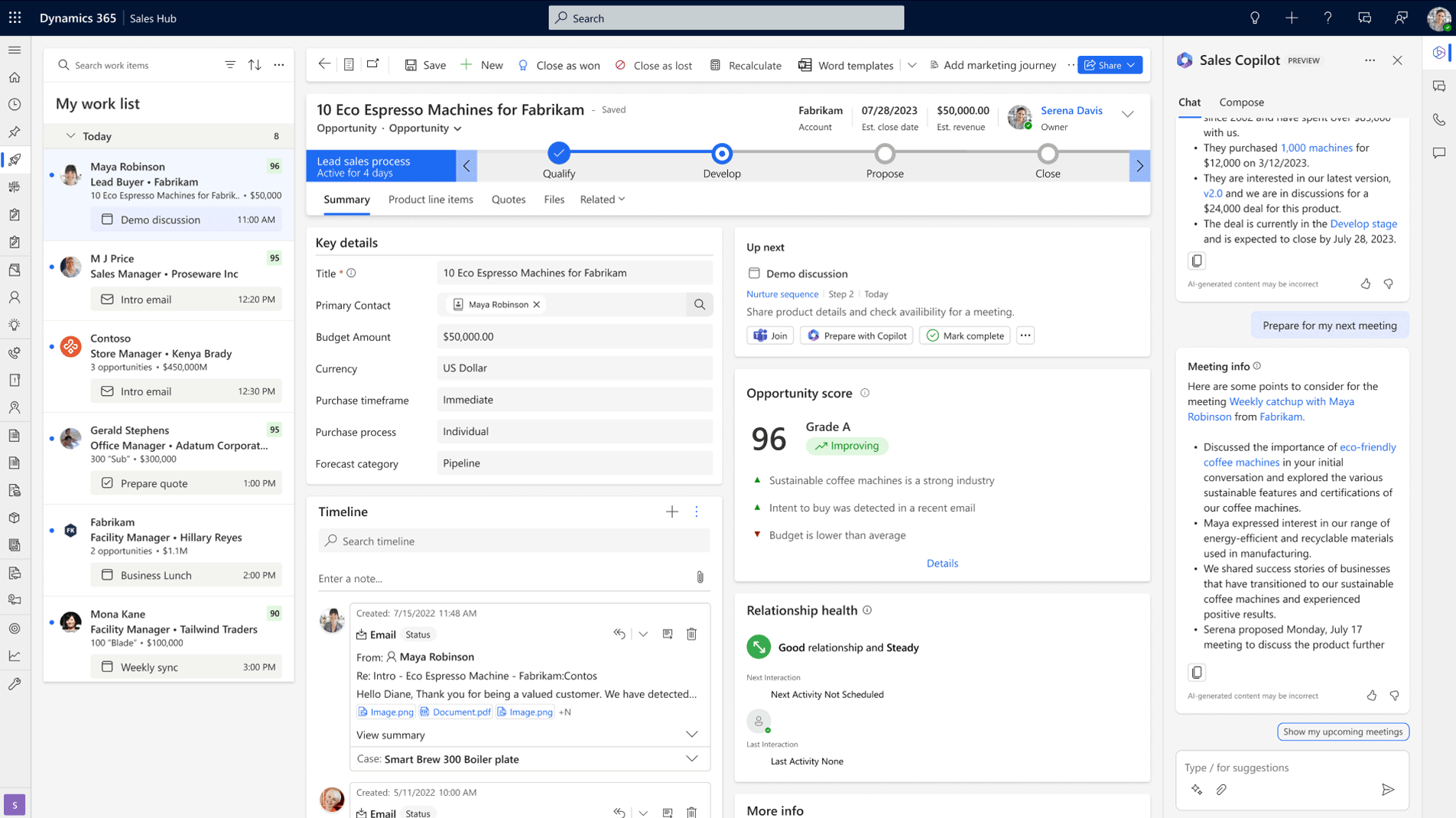
Below is a short demo of what a well-implemented D365 CRM looks like in day-to-day use for a sales team with Copilot enabled.
How Long And How Much Does A Microsoft Dynamics 365 CRM Implementation Partner Cost?
There is no single number. There are honest bands. A Microsoft Dynamics 365 CRM implementation partner who gives you a firm price on a first call has either priced too high to be safe or too low to deliver.
A Realistic Timeline For A Microsoft Dynamics 365 CRM Implementation Partner Project
A focused single-module rollout, like Sales only, with clean data and a small user base, runs about three to four months from kickoff to go-live. Add Customer Service, Field Service, or Customer Insights, and you are looking at six to nine months.
Discovery takes three to six weeks. Design and configuration take another six to twelve. UAT and cutover take four to six. Then hypercare runs four to eight weeks post-live. Anyone promising a two-week rollout is either scoping something very small or setting you up to fail.
What Should A Microsoft Dynamics 365 CRM Implementation Partner Actually Cost?
A Microsoft Dynamics 365 CRM implementation partner’s prices work off four things:
- Scope.
- Data complexity.
- Number of integrations.
- Number of users.
For a Canadian SMB with 20 to 50 users, a single-module rollout typically runs CAD $25,000 to $75,000 in implementation services. Multi-module rollouts with integrations, deeper customization, or migrations from older CRM systems land higher. Enterprise rollouts scale into six figures.
Licensing is separate. Dynamics 365 Sales Professional runs approximately CAD $88 per user per month (roughly USD $65), and Sales Enterprise runs approximately CAD $128 per user per month. Microsoft adjusts these rates on its own cadence.
If a partner offers a fixed price without a written scope, that is not a discount. That is a risk they will collect on in change orders later. See the full Dynamics CRM cost breakdown for licensing, implementation, and total ownership over a multi-year budget.
-
A Microsoft Solutions Partner has met a defined set of performance, skilling, and customer-success benchmarks in a specific solution area, like Business Applications.
A "certified Dynamics 365 partner" is a looser term that often just means someone with individual Microsoft certifications. When vetting a Microsoft Dynamics 365 CRM implementation partner, the Solutions Partner designation is the stronger signal.
Why Gestisoft Is A Microsoft Dynamics 365 CRM Implementation Partner Canadian Teams Trust
Here is how Gestisoft measures up on those criteria.
Microsoft Solutions Partner Since 2004
Gestisoft has been a Microsoft Partner since 2004 and holds the Microsoft Solutions Partner designation for Business Applications. Nearly three decades in the ecosystem means our team has seen the rollouts that succeed and the ones that stall. Both teach a Microsoft Dynamics 365 CRM implementation partner what to do differently.
Canadian Reach, Bilingual By Default
We are B Corp certified and Great Place to Work certified. Our team delivers across Canada and North America in English and French, from offices in Montréal, Toronto, Ottawa, and Québec City.
Our Business Central consultants in Montréal work alongside CRM specialists on the same accounts, so Québec clients get bilingual delivery from one team.
One Team Across CRM, ERP, And Copilot
Because we run the full Microsoft stack, CRM, Business Central, and Copilot, your CRM rollout does not get orphaned from your ERP. Sales quotes flow into invoicing. Customer data unifies across marketing, service, and finance.
This is what CRM consulting actually delivers: strategy, customization, training, and long-term adoption as one continuous engagement.
Take Solem, a Québec microfiber company, founded by sisters Marie-Hélène Doucet and Mylène Lessard. They replaced a scattered Planner setup with Dynamics 365 Sales, implemented by Gestisoft. The rollout gave them structured pipeline tracking, automated tasks, and real-time reporting, so they could focus on expansion rather than admin.
The support we received from Christian and Gestisoft gave us the confidence to integrate and use CRM on a daily basis. It has transformed the way we work.
Marie-Hélène Doucet, Co-founder, Solem
That is the standard we hold ourselves to. If you want the same on yours, let's talk.
Start Your Rollout With The Right People At The Table
Bring your questions. Bring your worries. Our team will map your first phase and show you exactly what year one should look like.
 Book a free consultation
Liked what you just read? Sharing is caring.

July 16, 2026 by Muhammad Ali Iqbal by Muhammad Ali Iqbal SEO Content Strategist & Copywriter
Driven by a passion for search engine optimization, strategic content, and conversion-focused writing. A copywriter and content strategist who lives for content that ranks, engages, and delivers real business results.

