

Most Canadian businesses that struggle with their Dynamics 365 Business Central implementation did not fail because of the software. The software is solid. They failed because they underestimated what a Dynamics 365 Business Central implementation in Canada involves:
- The compliance requirements
- The data migration decisions
- The bilingual training realities
- And the difference between a partner who has configured Business Central for Canadian companies for decades and one who is learning on your project.
This article covers what the process really looks like, what it costs in Canadian dollars, and what separates a Dynamics 365 Business Central implementation in Canada that goes well from one that drags past go-live by months.
If you have already decided Business Central is the right ERP for your organization, good. Now the harder question is how to implement it well.
What Dynamics 365 Business Central Implementation in Canada Is
Dynamics 365 Business Central is Microsoft's cloud ERP for small and mid-sized businesses. It connects finance, inventory, purchasing, sales, operations, and project management inside one platform. Instead of keeping your chart of accounts in accounting software, your inventory in a spreadsheet, and your sales orders in a separate system, Business Central pulls all of it into a single environment with real-time data flowing between functions.
For Canadian businesses specifically, Dynamics 365 Business Central implementation in Canada supports Canadian payroll, handles GST/HST natively, processes transactions in CAD and USD simultaneously, and integrates with the Microsoft tools most Canadian finance teams already use daily: Excel, Outlook, and Teams. The ERP finance module alone handles general ledger, accounts payable, accounts receivable, bank reconciliation, fixed assets, and cash flow forecasting.
It is a strong fit for small businesses and scales into mid-market territory without requiring a full system replacement as you grow.
Talk to a Canadian Business Central Expert Who Can Guide You
Gestisoft's team has been implementing Dynamics 365 Business Central for Canadian businesses since 1997.
 Free discovery call
Dynamics 365 Business Central Implementation in Canada: What Licensing Costs in Canada (Real CAD Numbers)
This is the question most implementation pages bury. Here it is plainly.
As of 2026, Microsoft's retail pricing for Dynamics 365 Business Central in Canada breaks down as follows.
- Business Central Essentials runs approximately CAD $108.50 per user per month. This covers financials, supply chain management, and project management.
- Business Central Premium runs approximately CAD $149.20 per user per month. Premium adds service order management and manufacturing modules on top of Essentials.
- Team Members licenses cover read access and light task completion. These are considerably lower and are useful for roles that only approve invoices or check reports.
Those are the licensing numbers. They are not the total cost.
Total cost of ownership for a Dynamics 365 Business Central implementation in Canada includes implementation services, data migration, integrations, customizations, training, and post-launch support. Implementation projects for Canadian SMBs typically run between $30,000 and $150,000 depending on company size and process complexity. Get this number from your partner upfront, in writing, broken into phases.
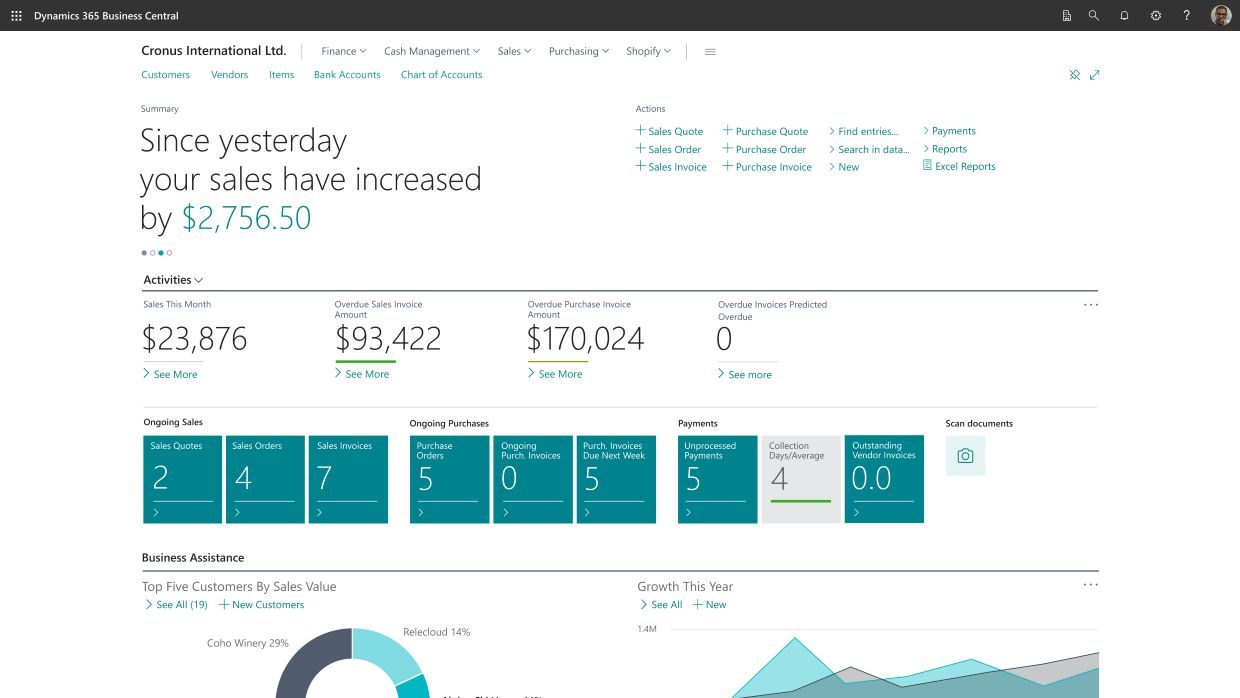
What the Dynamics 365 Business Central Implementation in Canada Process Looks Like
A well-run Dynamics 365 Business Central implementation in Canada follows a structured sequence of phases. The timelines below reflect what Canadian SMBs experience, not the idealized ones on most vendor websites.
Phase 1: Discovery and Needs Assessment (2 to 4 weeks)
Your implementation partner documents your current processes, identifies gaps, and maps what Business Central needs to do differently from your existing system. A good Business Central consultant earns their fee in this phase. Thorough discovery prevents surprises in configuration. Rushed discovery creates them.
At Gestisoft, we use Microsoft's Catalyst framework here. It is a working session where we assess your financial structure, operational workflows, and compliance requirements together before a single configuration is written.
Phase 2: System Design and Configuration (4 to 8 weeks)
Your partner configures Dynamics 365 Business Central implementation in Canada to match your business processes. This includes your chart of accounts, tax codes (GST/HST, QST for Quebec-based businesses), vendor and customer master data, inventory structures, and industry-specific requirements. For manufacturing, this covers production orders, BOMs, and capacity planning. For distribution, it covers warehouse management and multi-location inventory.
This is also when integrations are built. Common integration patterns for Canadian businesses include connecting Business Central to banking feeds for automated bank reconciliation, e-commerce platforms like Shopify, and Microsoft Dynamics 365 CRM for sales pipeline visibility.
Phase 3: Data Migration (runs alongside configuration)
This is the phase most businesses underestimate. Moving your chart of accounts, vendor records, customer files, open transactions, and historical inventory from a legacy system into a Dynamics 365 Business Central implementation in Canada requires careful mapping, cleaning, and validation. Data that went in messy comes out messier. Errors here do not show up immediately. They compound over months.
A structured ERP data migration strategy needs to be documented before migration starts. At Gestisoft, we treat data migration as its own project track, not an afterthought of configuration.
Phase 4: Testing (2 to 3 weeks)
A quality Dynamics 365 Business Central implementation in Canada includes three testing layers. Unit testing verifies individual configurations. Integration testing confirms connected systems pass data correctly. User acceptance testing puts your actual team in the system with real data so issues surface before go-live, not after.
Skipping user acceptance testing is one of the most common ERP implementation mistakes Canadian businesses make. Go-live day should not be the first time your finance team runs a real process in the system.
Phase 5: Training and Change Management
Training is where many Dynamics 365 Business Central implementation in Canada stumble. Off-the-shelf training does not account for how your team works. Role-based training sessions get better adoption than generic walkthroughs.
For Quebec-based businesses with bilingual operations, training needs to be delivered in French and English. An English-only training rollout in a predominantly French-speaking warehouse will result in low adoption and workarounds. Gestisoft's Business Central training is delivered in both official languages, which means your whole team is equipped to use the system.
Phase 6: Go-Live and Stabilization (2 to 4 weeks post-launch)
Go-live is not when the project ends. It is when the next phase begins. The first weeks after launch reveal configurations that need adjustment. A good Dynamics 365 Business Central implementation in Canada partner is available in real time during this window.
Dynamics 365 Business Central Implementation in Canada: The Canadian Compliance Deep Dive Reality
This is the section that separates a Dynamics 365 Business Central implementation in Canada from a generic ERP deployment.
Canadian businesses operate under a compliance layer that most US-focused implementation partners are not deeply familiar with. A partner who has configured Business Central for dozens of US clients and now serves Canadian accounts is not the same as a partner who has built Canadian tax structures, bilingual reporting, and CRA payroll configurations natively from day one.
- GST/HST configuration → in Business Central is not plug-and-play. The federal Goods and Services Tax applies nationally at 5%, but Harmonized Sales Tax rates vary by province: 13% in Ontario, 15% in Nova Scotia, New Brunswick, Newfoundland and Labrador, and PEI. Your Business Central tax posting groups need to be configured correctly for every province you sell into. An error here does not just create accounting headaches. It creates CRA exposure.
- Quebec Sales Tax (QST) → adds another layer. Quebec businesses collect QST at 9.975% on top of the 5% GST. Input tax credits for QST operate differently from GST input tax credits. Business Central can handle this correctly, but only if the tax codes and posting groups are configured by someone who understands how QST works in practice.
- CRA payroll compliance → requires specific payroll tax table configurations, T4 reporting structures, and Record of Employment handling. Business Central supports all of this with the right setup. The right setup depends entirely on your partner.
For businesses in Quebec, these requirements sit alongside Bill 96 language compliance and the expectation that ERP documentation, reports, and user interfaces are accessible in French. Business Central supports French-language interfaces natively. Making sure that capability is turned on and configured for your team is part of what a Dynamics 365 Business Central implementation in Canada partner does as standard.
Dynamics 365 Business Central Implementation in Canada: If You Are Moving From Dynamics GP or NAV
A significant portion of Dynamics 365 Business Central implementation in Canada today are migrations from older Microsoft systems, primarily Dynamics GP (Great Plains) and Dynamics NAV.
Microsoft has confirmed that Dynamics GP will reach end of mainstream support in April 2026, with extended support running to 2029 depending on version. The migration window is open and the timeline is real. Dynamics NAV has been out of mainstream support since 2018 for versions prior to NAV 2018.
The migration path from NAV to Business Central is more structured than most businesses expect. Business Central is a different architecture from NAV, which means data models need to be remapped, custom NAV code may not carry over directly, and NAV add-ons you relied on need Business Central equivalents. Read our Navision migration challenges and best practices before assuming your custom work will transfer cleanly.

Industries Where Dynamics 365 Business Central Implementation in Canada Works Well
These four industries will benefit from implementing Dynamics 365 Business Central:
Manufacturing
Is the clearest use case. Business Central's production order management, BOM structures, capacity planning, and shop floor data collection make it a strong platform for Canadian manufacturers. The ERP for manufacturing fit connects production costs to financial reporting so your true cost per unit is visible in real time, not reconstructed at month-end.
Distribution and Wholesale
These benefit from warehouse management capabilities, multi-location inventory, and purchase order automation. If you are running Excel alongside an ERP for inventory tracking, the gap between what you have and what Business Central provides is significant.
Professional Services
Professional firms use Business Central's project accounting and resource management modules to track project profitability in real time. The project management module connects time tracking, materials, and billing into a single cost ledger so project margin is visible before the engagement closes.
Non-Profits and Associations
These use Business Central for fund accounting, grant tracking, and multi-entity financial consolidation. The fund management structure handles restricted versus unrestricted funds natively, something QuickBooks cannot do without significant workarounds.
For a sharper comparison of where Business Central fits versus competitors, the Dynamics 365 Finance and Operations vs Business Central breakdown is useful if your business is growing toward enterprise scale. The SAP vs Dynamics 365 and NetSuite vs Dynamics 365 Business Central comparisons cover the tradeoffs clearly for businesses evaluating alternatives.
What AI Looks Like Inside a Dynamics 365 Business Central Implementation in Canada Today
Business Central is not the same product it was three years ago. Microsoft has been embedding Copilot AI capabilities directly into the platform in ways that are practically useful.
Copilot in Business Central can generate AI-assisted product descriptions, suggest reorder quantities based on demand patterns, draft collection emails for overdue accounts, and answer questions about your own data in plain language. The AI in ERP integration extends into cash flow forecasting, late payment prediction, and inventory optimization.
The Copilot features available in Business Central expand with each Microsoft release wave. A certified Business Central partner ensures your configuration is set up to access these features as they roll out, not locked out of them because of a legacy configuration decision made at go-live.
Your Dynamics 365 Business Central implementation starts here
Gestisoft's Canadian team handles the full implementation: discovery, configuration, data migration, bilingual training, and ongoing support after go-live.
 Free discovery call
How to Choose Your Dynamics 365 Business Central Implementation Canada Partner
The partner decision is the most important decision in any Dynamics 365 Business Central implementation in Canada. More important than the release date. More important than which module to start with. The software performs according to how it is configured, and it is configured by the people you hire.
- Ask specifically about their GST/HST, QST, and CRA payroll configuration experience.
- Ask how many Canadian companies they have taken live in the past three years.
- Ask what their stabilization window looks like after go-live and whether that support is included or billed separately.
- Ask for a reference from a Canadian company in your industry that went live in the last 18 months.
A partner who deflects these questions or speaks only in generalities is telling you something.
When Bédard HR, a Montreal-based HR firm responsible for processing payroll for over 1,000 people every week, completed their NAV-to-Business Central migration with Gestisoft, the project involved integrating three separate solutions simultaneously. It was not a straightforward rollout. Julie Lachance, their IT and Innovation Manager, described the experience plainly:
Gestisoft had a knack for finding creative solutions. It wasn't easy, but the team never gave up and always managed to come up with solutions while trying to reduce costs as much as possible and bearing in mind the solution ecosystem's durability.
Gestisoft has been a certified Microsoft partner since 1997. Our team of over 100 consultants has implemented Dynamics 365 Business Central for Canadian businesses across manufacturing, distribution, professional services, and non-profit sectors. Our 95% client renewal rate reflects what happens when you build a relationship around outcomes rather than just project delivery.
If you want to understand what a Gestisoft-led Dynamics 365 Business Central implementation in Canada looks like compared to what other partners are proposing, the conversation starts with a free consultation. We assess your current state, give you an honest scope estimate, and tell you clearly what the project involves before you sign anything.
Picking the right Dynamics 365 Business Central implementation in Canada partner can feel like finding the needle in a haystack. But with Gestisoft, you’re not selecting alone. Contact us today for a free consultation and see which one is right for you!
-
Licensing runs approximately CAD $108.50 per user per month for Essentials and CAD $149.20 per user per month for Premium. Implementation services for Canadian SMBs typically add between $30,000 and $150,000 depending on company size and process complexity. Always ask for a phase-by-phase cost breakdown before committing.
Explore More:
What Is Business Central? Complete Directory for Canadian SMBs A plain-language breakdown of what Business Central is, what it costs, and how to know if it is the right fit before implementation begins.
Business Central Consultant: Definition, Benefits, Services What a Business Central consultant does at each stage of an implementation and how to evaluate whether you have the right one.
ERP Implementation Phases: 5 Steps for a Successful Project A deeper look at the phases of an ERP implementation, including what each stage involves and where most projects go wrong.
Why Migrating from NAV to Business Central? A Complete Guide For businesses running Dynamics NAV or GP, this covers the migration path, what carries over, and what needs to be rebuilt.
AI in ERP: From Copilot to Autonomous Agents in Business Central How Microsoft's AI capabilities inside Business Central are changing what Canadian finance and operations teams can do without additional headcount.
Liked what you just read? Sharing is caring.

July 17, 2026 by Conni Guido by Conni Guido Copywriter and Brand Strategist
I started with a degree in Professional Communications and never looked back. Now, I'm a professional storyteller who believes every brand has a story to tell, and every good story should leave you wanting more. You can find me lost in a book club or a writing sprint, baking words into pies...probably both.

