

If your company has outgrown spreadsheets, QuickBooks, or aging accounting software, you have probably been told you need a Business Central specialist. But the title gets used loosely. Sometimes it means an in-house employee who manages your ERP, sometimes a hired expert who runs your implementation, and sometimes a job posting on LinkedIn. So what does a Business Central specialist actually do, how is the role different from a consultant or developer, and how do you find the right one in Canada?
This guide answers those questions. By the end, you will know exactly what a Business Central specialist brings to the table, the benefits of working with one, the Canadian context that matters most, and a practical checklist for choosing the right person or team.
Not sure whether you need a specialist, a consultant, or a full partner?
A 30-minute conversation usually clears it up faster than weeks of research. Our team can map your situation to the right kind of help — no obligation, no jargon.
 Book a free consultation
What is a Business Central specialist?
A Business Central specialist is a professional who implements, configures, customizes, and supports Microsoft Dynamics 365 Business Central— Microsoft's cloud ERP for small and mid-sized businesses. Their job is to translate how your business actually runs (finance, inventory, purchasing, sales, projects) into a working system, then keep that system healthy as your needs change.
In practice, a strong Business Central specialist blends three skill sets: business process knowledge (they understand accounting, operations, and supply chain), platform expertise (they know how Business Central's modules fit together), and a methodical approach to implementation and support. The best ones are usually backed by a certified Microsoft Partner, which is why many companies engage a specialist through a firm rather than hiring one in isolation. If you want the deeper service-level view, our breakdown of what a Business Central consultant does is a useful companion to this article.
A quick, quotable definition: a Business Central specialist is the person who makes Microsoft Dynamics 365 Business Central fit your business — not the other way around.
Business Central specialist vs. consultant vs. developer vs. partner
One reason the role feels confusing is that four overlapping titles get used almost interchangeably. Here is a clear way to tell them apart:
- Business Central specialist — A broad term for someone with hands-on expertise in Business Central. A specialist can configure Business Central modules lists, support users, customize reports, and troubleshoot. It is the umbrella label, and the closest analog in other product lines is an ERP specialist or a CRM specialist.
- Functional consultant — A specialist focused on the business side: gathering requirements, mapping processes, configuring the system, and training users. They typically hold the Microsoft MB-800 certification.
- Developer — A specialist focused on the technical side: building custom extensions in AL, integrating Business Central with other systems, and automating workflows. They typically hold the MB-820 certification.
- Partner — The certified organization that employs these people and stands behind the work with licensing, methodology, and long-term support. Our guide to choosing a Business Central partner explains why the firm behind the specialist matters as much as the individual.
The takeaway: "specialist" describes the expertise, while "consultant," "developer," and "partner" describe how that expertise is packaged and delivered. Most successful projects use a blend of all four.

What does a Business Central specialist do day to day?
The role is broader than "installing software." A typical Business Central specialist will:
- Gather requirements and map your existing finance and operations processes
- Configure core modules — general ledger, accounts payable and receivable, inventory, purchasing, sales, and project management
- Migrate data from legacy systems such as spreadsheets, QuickBooks, or older ERPs, following a structured ERP data migration strategy
- Customize reports, dashboards, and role centers so each team sees what it needs — see our guide to customizing Business Central
- Set up project accountingand job costing for service and professional-services firms, one of the reasons many teams adopt Business Central for project management
- Train end users and provide ongoing support and troubleshooting
- Enable newer capabilities such as Copilot and AI agents, part of the broader shift toward AI in ERP
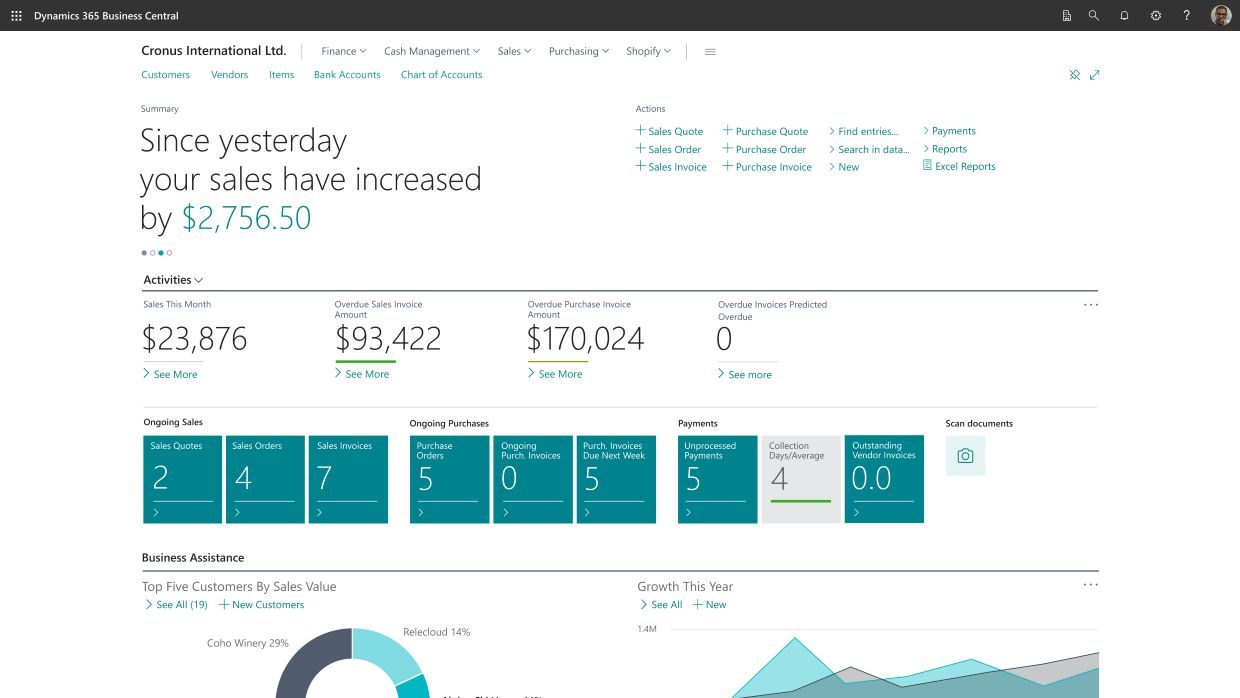
If you have never seen the platform in action, this short introduction demo gives a sense of what a specialist is configuring on your behalf:
The video walks through the Business Central interface — the role-based home screen, navigation, and how finance and operations data live in one connected system. It is a helpful 101 for decision-makers who want to understand what their specialist will be working in before the first planning meeting.
Ready to put a specialist on your project?
Tell us where your operations are stuck today and we will show you what a Business Central specialist would tackle first — and the realistic timeline to get there.
 Free discovery call
Benefits of working with a Business Central specialist
Bringing in a Business Central specialist is about more than a smooth go-live. The real payoff is what happens afterward:
- Fewer disconnected tools. Organizations moving from spreadsheet-and-legacy-software setups to Business Central typically consolidate four to six disconnected tools into one platform, which removes most manual re-keying between systems.
- Faster financial close. With finance configured correctly the first time, many SMBs see month-end close cycles shrink by 30–50%, because reconciliations and reporting stop depending on exported spreadsheets.
- Configuration that fits, not fights. A specialist sets up the system around your real workflows, sidestepping the most common ERP implementation challenges — scope creep, dirty data, and low user adoption.
- A single point of accountability. Instead of juggling vendors, you have one expert (and the partner behind them) who owns the outcome. This is the same value that good ERP consulting delivers across any platform.
- Room to grow. As you add warehouses, entities, or currencies, your specialist scales the system instead of forcing you onto a new one.
Why Canadian businesses need a local Business Central specialist
This is where most of the content ranking online falls short: it is written for a generic, usually American audience. Canadian businesses have specific requirements that a local Business Central specialist understands by default.
- Bilingual operations. Many Canadian organizations need an ERP — and a support team — that works in both English and French. A Québec-based specialist can configure and train users in French, which matters for adoption and, in some cases, for compliance.
- Canadian sales tax. GST, HST, PST, and Québec's QST each behave differently. A specialist who works in Canada will set up tax groups, jurisdictions, and reporting correctly from the start instead of patching it later.
- Canadian payroll and year-end. T4 and T4A reporting, and integrations that respect Canadian payroll rules, are not an afterthought for a local specialist.
- Data residency and trust. Canadian decision-makers increasingly ask where their data lives. A specialist who knows the Microsoft cloud and Canadian expectations can guide that conversation.
For businesses that want a partner who covers all of this, Gestisoft is a certified Microsoft Partner offering a bilingual Microsoft Dynamics 365 Business Central specialist team across Canada.

How to choose a Business Central specialist in Canada
Use this checklist to evaluate any Business Central specialist or partner before you commit:
- Microsoft certifications. Look for the MB-800 (Functional Consultant) and MB-820 (Developer) certifications on the team — not just on the company brochure.
- Relevant industry experience. A specialist who has implemented Business Central for businesses like yours (manufacturing, distribution, professional services) will move faster and make fewer wrong assumptions.
- A real implementation methodology. Ask how they handle requirements, data migration, testing, training, and go-live. Vague answers are a red flag.
- Canadian context. Confirm they handle bilingual rollout, Canadian sales tax, and payroll year-end — see the section above.
- The partner behind the person. A lone freelancer can disappear; a certified partner provides continuity, escalation, and licensing support.
- Support after go-live. The implementation is the beginning, not the end. Clarify response times and ongoing support models.
- References. Ask for at least three references from comparable projects. Our broader guide on how to choose an ERP consultant goes deeper on vetting questions.
It is also worth confirming the specialist knows when Business Central is the right tool at all. If your organization is very large or has complex multi-entity needs, they should be honest about the line between Business Central and its bigger sibling — a distinction we cover in Finance and Operations vs. Business Central — and how Microsoft compares to alternatives like SAP vs. Dynamics 365.
How much does a Business Central specialist cost?
There is no single sticker price, because cost depends on engagement model and scope. The main variables are whether you hire full-time, part-time, or project-based; how much customization and integration you need; and how clean your data is going in. A short, well-scoped implementation costs far less than a sprawling one with heavy custom development.
The more useful way to think about cost is total value: a specialist who configures the system right the first time avoids the expensive rework that comes from a botched DIY setup. Framing the decision as an investment with a measurable return — fewer tools, faster close, better reporting — usually leads to a better outcome than chasing the lowest day rate.
Becoming a Business Central specialist: the career side
Because "Business Central specialist" is also a sought-after job title, it is worth a brief note for anyone considering the career. Microsoft offers two core certifications: the MB-800 Business Central Functional Consultant and the MB-820 Business Central Developer. Many people enter the field from adjacent backgrounds — accounting, warehouse and supply chain, or finance — because domain knowledge is as valuable as technical skill. Demand is strong: a meaningful share of Business Central roles go unfilled, which is good news for career-changers and for businesses that choose to work with an established partner rather than compete for scarce in-house talent.
-
A Business Central specialist is a professional who implements, configures, customizes, and supports Microsoft Dynamics 365 Business Central. They combine business process knowledge with platform expertise to make the ERP fit how your company actually operates, then support it as your needs evolve.
Talk to a Canadian Business Central specialist
Choosing the right Business Central specialist is one of the highest-leverage decisions in your ERP project — it shapes your timeline, your budget, and how much value you get for years afterward. The right expert configures the system around your business, respects Canadian requirements, and stays accountable long after go-live.
If you would like to talk it through, Gestisoft's bilingual, certified team is here to help — with no pressure and no obligation. Book a Free Consultation.
Explore more
- Business Central Consultant: Definition, Benefits, Services — how consulting engagements work and what to expect (MOFU).
- Business Central Partner: definition, benefits, services — why the firm behind the specialist matters (MOFU).
- How to choose an ERP consultant — a deeper vetting framework for any ERP project (MOFU).
- ERP Specialist: roles and responsibilities — the broader specialist role across ERP platforms (TOFU/MOFU).
- Microsoft Dynamics 365 Business Central specialist in Canada — Gestisoft's bilingual specialist team (service page).
Liked what you just read? Sharing is caring.

June 11, 2026 by Kooldeep Sahye by Kooldeep Sahye Inbound Marketing Manager
Specializing in SEO-driven pipeline growth, I combine keyword strategy, content optimization, and inbound tactics to turn organic search into a reliable source of qualified leads. I work at the intersection of traditional SEO and AI search — optimizing for LLMs and AI Overviews alongside Google — pairing data-informed strategy with sharp, story-led copywriting.