

Running a project-based business in Canada is not the same as running one in the US, the UK, or anywhere else. You have GST. HST. PST depending on the province. Multilingual teams in Quebec. CRA reporting requirements that don't bend. And a workforce spread across cities that may be on different tax schedules.
Most of the articles you'll find on project accounting software were written for a global audience, meaning they were written for nobody in particular.
This one is written for you.
If you manage projects and need your finances to keep up, this article explains what this category of software does, when a standalone tool becomes a ceiling rather than a solution, and why Canadian companies choosing Microsoft Dynamics 365 Business Central end up with something fundamentally different from a software subscription.
What Is Project Accounting Software?
Project accounting software tracks the financial performance of individual projects rather than the business as a whole. Where standard accounting tells you how the company is doing, project accounting software tells you how each project is doing: what it cost, what it earned, where the budget went, and whether you made money.
That distinction sounds simple. It changes everything about how a finance team works.
A general ledger records transactions. Project accounting software records transactions and connects them to a specific project, task, resource, or phase. That means you can answer questions your accounting system alone cannot: Is project A profitable? Did we go over budget on phase 2 of project B? Which client engagement is eating margin without anyone noticing?
For companies that take on multiple concurrent projects (construction firms, engineering groups, IT consultancies, professional services teams, manufacturers running custom orders) those questions are not optional. They're the business.
Ready to See How Project Accounting Works in Business Central?
Gestisoft's consultants work exclusively with Canadian businesses. We configure Business Central for your industry, your tax requirements, and your team. Not a template.
 Book a free consultation
How Project Accounting Software Differs from Standard Accounting Software
Standard accounting is aggregate. It looks at your entire company and produces consolidated statements. Project accounting software is granular. It looks inside each project and produces per-project reports.
The specific capabilities that separate project accounting software from general accounting include:
- Per-project budget tracking → You set a budget for a project and track actual costs against it in real time, not at month-end when the damage is already done.
- Work-in-Progress (WIP) accounting → This is where many Canadian businesses get caught. WIP accounting captures the value of work completed but not yet invoiced or closed. Without it, your financial statements don't reflect what's happening in an active project. Business Central handles WIP accounting natively, connecting it directly to your general ledger so every posted project cost flows through immediately.
- Resource cost allocation → Labour, equipment, subcontractors, and materials each carry different cost structures. Project accounting software assigns those costs to the right project and the right task, not just to a general expense category.
- Revenue recognition by project → For fixed-price contracts, time-and-materials work, and milestone-based billing, you need revenue recognition rules that match how you bill. Not one revenue recognition method applied to everything.
- Project profitability reporting → At any point in a project's life, you should be able to see its current margin. Not next quarter. Now.
When a Standalone Tool Stops Being Enough
A standalone project accounting software solution works well up to a point. A small consultancy with five people, ten clients, and straightforward invoicing can run lean on tools like FreshBooks or QuickBooks with a project tracking add-on. That's a reasonable setup.
The ceiling appears when your projects get more complex, your team grows, your compliance requirements expand, or your reporting needs cross into territory that disconnected tools simply cannot handle.
Here's what that ceiling looks like in practice. Your project manager is tracking hours in one system. Your finance team is running invoices in another. Procurement is logging purchase orders somewhere else. At month-end, someone spends two days reconciling those three systems by hand. That's not a workflow problem. It's a structural one. No amount of optimization makes manual reconciliation fast.
An ERP system with integrated project accounting solves this structurally. Time entries, expenses, purchase orders, and invoices all live in the same system. When a team member logs hours against a job, the project budget updates. When a supplier invoice comes in, it posts to the right project automatically. There is no reconciliation because there is no seam.
For growing Canadian companies, that integration becomes a compliance issue as well as an efficiency one. Managing GST/HST across projects with different billing structures, tracking recoverable versus non-recoverable input tax credits per project, and producing CRA-compliant documentation is hard when your data lives across multiple systems. It becomes manageable when your ERP finance module and your project accounting software are the same system.
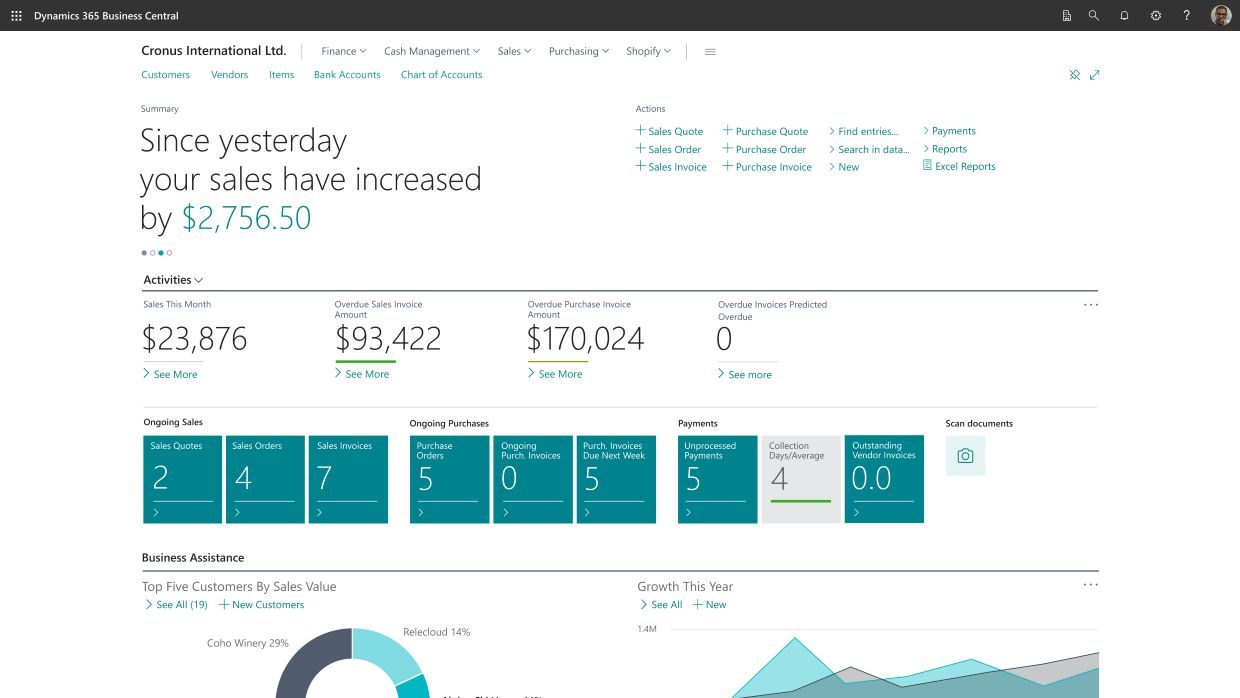
Business Central as Project Accounting Software: What Happens Inside the System
Microsoft Dynamics 365 Business Central uses a module called Jobs to manage project accounting.
A Job is a project: a structured initiative with tasks, budgets, resources, and deliverables tracked over time. The Jobs module connects project activity directly to finance, purchasing, inventory, and reporting, all in one system with no manual bridges.
Here is what that looks like at each stage of a project.
Planning and Budgeting
When you create a new Job in Business Central, you build a task structure that mirrors your actual project phases. Each task has its own budget for labour, materials, equipment, and subcontractors. You can create templates for common project types (installations, implementations, audits) so you're not rebuilding the structure from scratch each time. Planning lines convert into usage lines as work progresses, and your budget dashboard updates in real time.
Resource Management
Business Central tracks resources by cost rate, billing rate, and availability. When a team member logs time against a project task, that time flows immediately into job usage. You see cost and billable hours at the task level, not just at the project level. For Canadian businesses with bilingual teams in Quebec and English-speaking offices elsewhere, this single system removes the coordination friction that often drives up non-billable hours.
Cost Allocation
Materials purchased for a specific project post directly to that job. Subcontractor invoices link to the right task. Overhead can be spread across projects based on rules you configure. Nothing sits in a general expense bucket that needs manual sorting later.
WIP Accounting and Financial Statements
Business Central generates Work-in-Progress entries automatically based on the WIP method you choose: Cost Value, Sales Value, Percentage of Completion, or Completed Contract. These entries ensure your balance sheet reflects what is happening across active projects, not just closed ones. For construction companies and professional services firms with long-running contracts, this is not a nice-to-have. It's required for accurate financial reporting.
Invoicing Flexibility
Business Central supports milestone-based billing, time-and-materials invoicing, and fixed-price contracts. Invoice generation pulls directly from job usage lines, with no re-entering data, no reconciling a project management tool with your accounting system. You send invoices that reflect exactly what was delivered.
Profitability Reporting
Built-in dashboards show job costs, resource utilization, and profitability trends. With Power BI integration, you can build custom views that slice project performance by client, region, service type, or any dimension relevant to your business. That data is live, not a monthly export you have to process and reformat.
The Canadian Compliance Difference for Project Accounting Software
This is the section most project accounting software reviews skip, because most of them aren't written for Canada.
Canadian tax compliance for project-based businesses is layered. You're dealing with GST federally. HST in Ontario, New Brunswick, Newfoundland and Labrador, Nova Scotia, and Prince Edward Island. PST in British Columbia, Saskatchewan, and Manitoba. Quebec Sales Tax (QST) in Quebec. Each province has different rules about what's taxable, what's exempt, and what input tax credits you can claim.
For a company billing clients across multiple provinces, or doing project work in different locations, managing that manually is a real risk. Errors in GST/HST reporting attract CRA attention. Missed input tax credit claims leave money on the table.
Business Central handles Canadian tax structures natively. You configure tax groups by province, and the system applies the correct rates to each transaction automatically. The cost of accounting software implementation often surprises businesses, but so does the cost of tax errors that a properly configured ERP prevents.
For Quebec businesses specifically, the bilingual environment adds another layer. Business Central supports French-language configurations, and Gestisoft has deep experience configuring the system for Quebec-based teams who need their day-to-day operations in French while reporting to English-speaking stakeholders or investors.

Which Industries Benefit Most From Project Accounting Software in Canada
Not every business needs dedicated project accounting software. If you produce and sell a standardized product with a predictable margin, your general accounting tools are probably sufficient. Project accounting software earns its place when revenue and costs are tied to specific, time-bounded initiatives with their own budgets, resources, and deliverables.
The industries where Canadian companies see the strongest impact include professional services firms (consulting, accounting, engineering, architecture), IT services and software development companies billing time and materials, construction and infrastructure businesses managing long contracts, manufacturing companies executing custom orders, and non-profit organizations running programs that require fund-level reporting.
If your accounting for service businesses requires you to know the profitability of each client engagement, not just the company overall, project accounting software is not optional. It's the mechanism that makes that visibility possible.
“We were able to structure our operations and focus on expansion without worrying about administrative details”
The Honest Comparison Between Business Central vs. Standalone Project Accounting Software
People often ask whether Business Central is overkill compared to lighter project accounting software tools. The honest answer depends on where your business is right now and where it's going.
Lighter tools like FreshBooks or QuickBooks with project add-ons are fast to set up, inexpensive to start, and perfectly adequate for small teams with straightforward projects. If you're a three-person consultancy billing under $1M annually, they're a sensible starting point.
Business Central becomes the better answer when your projects involve more people, more complexity, or more regulatory requirements than a standalone tool can cleanly handle.
When:
- You need purchase orders linked to projects.
- You have inventory that gets consumed in project work.
- Your finance team needs consolidated reporting across 20 active jobs simultaneously.
- You produce CRA-compliant documentation on project costs without extracting data from three different systems.
The comparison between Business Central and tools like QuickBooks, Xero, and FreshBooks comes down to this: standalone accounting tools are built for simplicity. Business Central is built for operations that have outgrown simplicity.
The crossover point usually arrives sooner than expected. The cost of staying on a lightweight tool often shows up not in subscription fees but in the hours your team spends working around its limitations. Business Central is designed to scale with small and mid-sized businesses, which means you don't have to rip out your system when your project volume doubles.

How to Choose the Right Project Accounting Software for Your Business
Before committing to any project accounting software solution, it helps to define what you need it to do. Here are the questions that separate a good fit from an expensive mistake.
Can it track costs and revenue at the task level, not just the project level?
Project-level reporting tells you if a project is over budget. Task-level reporting tells you where and why. The second question is the one that lets you fix the problem.
Does it handle your billing model?
Time-and-materials, fixed-price, milestone, and retainer billing all behave differently. The right solution should accommodate your contracts, not force your contracts to fit its billing logic.
Does it connect to your other business systems?
If project accounting software requires a manual export to reach your accounting team, you've created a seam that will cost you time and introduce errors. How you choose an ERP system often comes down to whether the integration story is real or aspirational.
Can it scale with your project volume?
A tool that handles 10 active projects cleanly may buckle at 50. Ask about performance, not just features.
Does it meet Canadian compliance requirements?
GST/HST handling, provincial tax configurations, and CRA-compatible reporting are not afterthoughts. They're requirements. Whatever solution you choose needs to manage them without custom workarounds.
See What Integrated Project Accounting Looks Like in Action
If you're evaluating whether Business Central fits your project-based operation, a live demo is faster than any article.
 Book a free consultation
Common Mistakes Canadian Companies Make When Implementing Project Accounting Software
The software choice is secondary to the implementation. Most project accounting software problems in Canadian businesses aren't product failures. They're configuration and process failures.
The most common mistake is mapping the software to your current process instead of your target process. If your current process involves three separate tools and a weekly reconciliation, implementing a new system that mirrors that process just moves the mess into new software. The implementation should be an opportunity to redesign how project finances flow, not a migration of the existing tangle.
The second most common mistake is under-configuring the tax setup. Project accounting software that handles multi-province billing needs to be configured for every tax jurisdiction you operate in. Skipping that setup because it's complex leads to manual tax adjustments that eat finance team hours every month. Financial automation software only works if the underlying tax configuration is right from day one.
The third mistake is choosing project accounting software based on features without considering the implementation partner. A well-configured Business Central implementation and a poorly-configured one produce completely different outcomes from the same product. Choosing the right Business Central partner is often a more important decision than the software comparison itself.
Why Gestisoft for Project Accounting Software in Canada
Gestisoft has been implementing ERP and project accounting software for Canadian businesses for over 20 years. We work exclusively within the Microsoft ecosystem (Business Central, Dynamics 365, Copilot) and we work exclusively in Canada. That combination means our team knows both the software and the Canadian regulatory environment it needs to work within.
Our implementations cover configuration of the Jobs module for your specific billing model, GST/HST/PST/QST tax setup across all provinces you operate in, Power BI reporting tailored to your project reporting needs, integration with your existing tools where applicable, and training for your finance and project management teams.
We also offer a bilingual service experience for Quebec-based businesses: French-language configuration, French-language training, and ongoing French-language support.
If you're evaluating project accounting software for a Canadian operation, talking to a partner who has done this in your regulatory environment is faster than any product trial.
Our team can walk you through how Business Central handles your specific billing model, tax requirements, and reporting needs in a focused 30-minute call. If you’re ready, talk to a Gestisoft expert about your project accounting needs with a free consultation!
-
Project accounting software tracks revenue, costs, and profitability at the individual project level. Regular accounting software manages your overall business finances in aggregate. The difference is granularity. A dedicated project accounting solution lets you see whether each specific project made money, where costs ran over budget, and which clients are profitable, rather than only seeing the company's overall financial performance.
Explore More
- Project accounting module: definition, benefits, functionalities
- Projects in Business Central: complete guide to managing projects in Dynamics 365
- ERP finance module: definition, benefits, challenges
- Financial management software: definition, benefits, functionalities
- How to choose an ERP system that drives growth and efficiency
Liked what you just read? Sharing is caring.

May 25, 2026 by Conni Guido by Conni Guido Copywriter and Brand Strategist
I started with a degree in Professional Communications and never looked back. Now, I'm a professional storyteller who believes every brand has a story to tell, and every good story should leave you wanting more. You can find me lost in a book club or a writing sprint, baking words into pies...probably both.
