

If you sell physical products in Canada, you've probably discovered the most expensive truth about running a small business: your accounting software and your inventory tool don't really talk to each other. You enter a sale in one place, adjust stock somewhere else, and pray the numbers match at month-end. They rarely do.
This directory is about fixing that. We'll navigate what good accounting and inventory management software for small business looks like in 2026, the seven tools Canadian SMBs are evaluating right now, a five-point framework to choose between them, and the moment you'll know it's time to graduate from a duct-taped stack to a real integrated platform. We'll be specific about Canadian realities, GST/HST, multi-currency CAD/USD, bilingual workflows, because most listicles ranking aren’t.
By the end, you should be able to walk into a vendor demo with a clear list of must-haves and a confident sense of whether the accounting and inventory management software for small business you're looking at will still fit when you double next year.
Not sure where your business sits on the accounting + inventory spectrum?
A 30-minute call with a Gestisoft expert can save you months of evaluation work and tens of thousands in the wrong software choice. We'll listen first, and recommend honestly.
 Free discovery call
Why Accounting and Inventory Management Software for Small Business Is Really Two Problems Disguised as One
The phrase accounting and inventory management software for small business sounds like one product category, but it's hiding two very different jobs.
Accounting software answers what did we earn, what do we owe, and is the CRA happy with us? It tracks invoices, expenses, payroll, taxes, and produces financial statements.
Inventory management software answers what do we have, where is it, what's about to run out, and what is each unit costing us today? It tracks SKUs, locations, reorder points, lead times, and COGS in real time as products move.
Those looking into accounting and inventory management software for small business end up in trouble because they buy the first job (accounting) thinking it covers the second (inventory). Most SMB accounting platforms, QuickBooks, Wave, Sage 50, Xero, do offer inventory features.
But "offers inventory" and "handles inventory at scale" are different statements. The more SKUs, locations, and channels you add, the wider the gap gets. That's why the search accounting and inventory management software for small business is one of the most underserved queries in Canadian SaaS. Companies typing it have already noticed a problem and honestly want a single tool to perform both tasks.
The Hidden Cost of Accounting and Inventory Management Software for Small Business
Before we get to the tool comparison, it's worth understanding what bad accounting and inventory management software for small business setups cost you. Most owners underestimate this number significantly.
In our work with Canadian SMBs migrating off disconnected tools, four hidden costs show up consistently. Manual reconciliation time, small businesses running separate accounting and inventory tools commonly spend 6 to 10 hours per month reconciling stock counts against COGS, roughly $4,000–$7,000 a year in labour for a $1M-revenue company.
Bad inventory data driving bad decisions. When your stock ledger updates on a different cadence than your sales ledger, your balance-sheet inventory value is wrong on any day, and purchasing, lending, and pricing decisions follow that wrong number. Silent stockouts and overbuys reorder points become reactive; you find out you're out of a top SKU when a customer complains. Audit and tax mess, once you cross $30,000 in revenue and register for GST/HST, the CRA expects clean records connecting every sale to the right tax line and the right inventory item. Two systems fighting each other make audits expensive.
The right accounting and inventory management software for small business eliminates all four costs at once, because the inventory ledger and the accounting ledger are literally the same database, updated by the same transaction.
5 Criteria for Choosing Accounting and Inventory Management Software for Small Business in Canada
When selecting the right accounting and inventory management software for small business, it’s important to find the right starting point. Meeting your business where it’s at today and determining where you'll be in 18 months. Here are the five criteria you should consider when evaluating accounting and inventory management software for small business for the Canadian market.
1. Canadian tax compliance, out of the box
GST, HST, PST, and Quebec's QST each have their own rules, rates, and remittance schedules. Any accounting and inventory management software for small business should handle multi-province tax automatically, calculating the right tax on each invoice line, tracking input tax credits, and producing CRA-ready reports. If a tool requires you to configure tax codes manually for every province you sell into, that's a red flag.
2. Multi-location and multi-warehouse inventory
A single location with under 200 SKUs works on almost any tool. The moment you add a second location, a 3PL, a consignment partner, or a Shopify store shipping from a different warehouse, you need a system that tracks stock by location, transfers between locations with proper accounting entries, and shows total available inventory across the network at a glance.
3. Multi-currency handling for CAD and USD
Most Canadian SMBs that sell physical goods buy some inventory in USD and sell some in CAD. The accounting and inventory management software for small business you choose has to handle dual-currency transactions natively, foreign-currency value, CAD equivalent at the day's rate, and realized/unrealized gain or loss at settlement. This is one of the biggest reasons small businesses outgrow Wave or basic QuickBooks.
4. Scalability beyond 10 employees
The tool perfect for a solo founder at $200K is rarely the right tool at $2M with eight staff. Ask the vendor what pricing and complexity look like at 25 users. At 100. Are there hard ceilings on transaction volume, SKU count, or locations? Many small business tools quietly cap out around 10–25 users, and migration off them later is expensive.
5. Integration with Microsoft 365, banking, and your existing stack
If your team already lives in Outlook, Excel, and Teams, your accounting and inventory management software for small business should plug into that environment instead of fighting it. Look for native bank feeds with major Canadian banks (RBC, TD, BMO, Scotia, CIBC, Desjardins), automatic bank reconciliation, and bidirectional sync with the e-commerce, CRM, and payment tools you use today. A useful exercise: write your top three integrations on a sticky note before any demo. If the vendor can't show those three working live, move on.
Want a structured way to evaluate these criteria?
Our experts have helped 500+ Canadian SMBs choose the right system. We'll review your current setup, map your real requirements, and tell you straight whether you need to upgrade, if your current tool can stretch.
 Free discovery call
The 7 Best Accounting and Inventory Management Software for Small Business in Canada
Below is an honest, no-spin walkthrough of the seven tools Canadian SMBs are seriously evaluating in 2026. We'll tell you who each is genuinely good for, and where it falls apart. The goal isn't to crown a winner; it's to help you match the right accounting and inventory management software for small business to your stage, complexity, and growth plans.
1. Microsoft Dynamics 365 Business Central
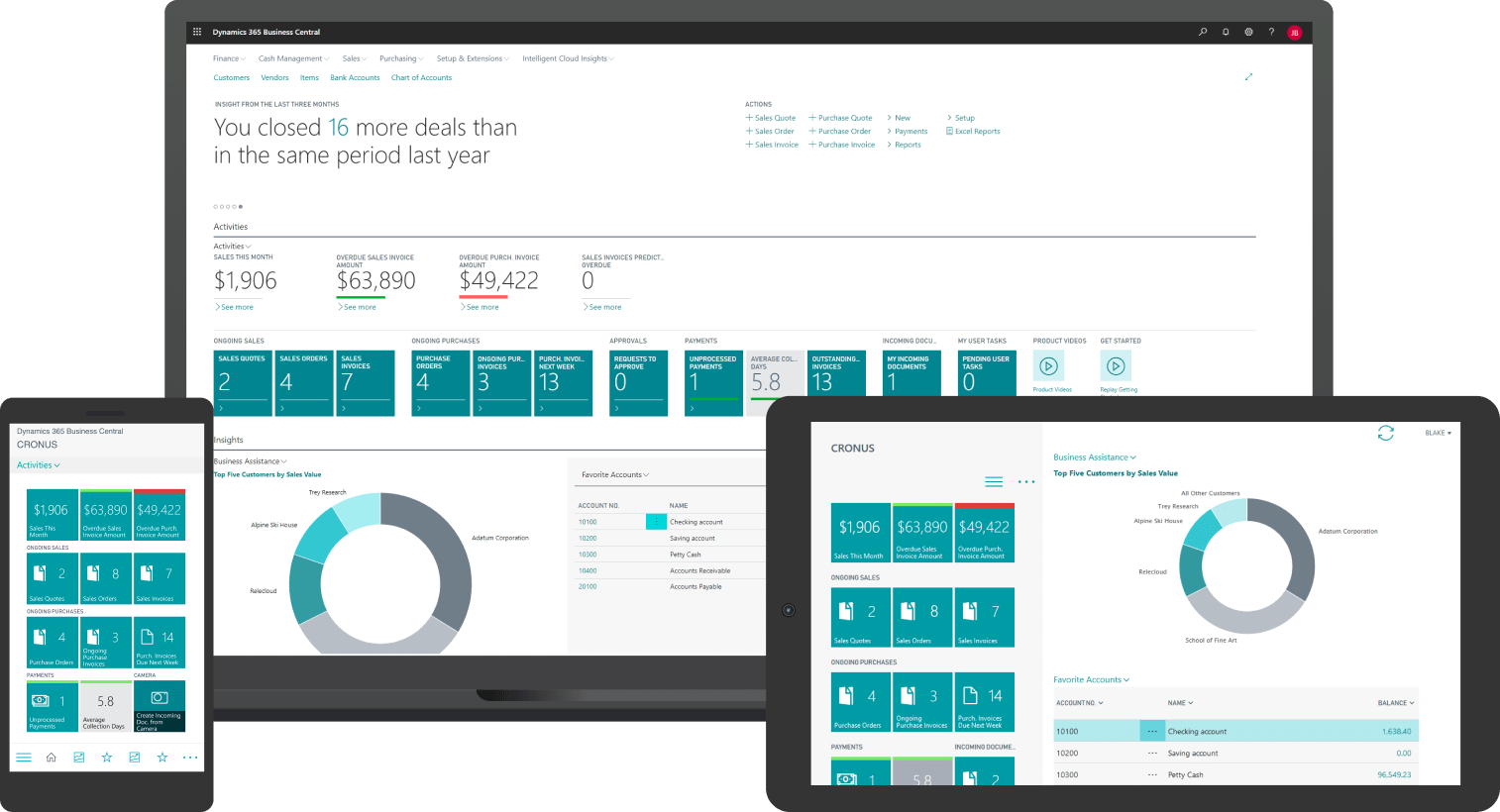
Business Central is Microsoft's all-in-one cloud ERP for SMBs. It unifies accounting, inventory, purchasing, sales, project management, and operations in one database, meaning the inventory ledger and the general ledger are the same system. It handles multi-location, multi-warehouse, multi-currency, GST/HST/PST/QST, manufacturing, and full bilingual operation.
Best for: Canadian SMBs that have outgrown QuickBooks/Sage/Xero, businesses approaching $2M+ revenue, multi-location operations, manufacturers, distributors, and any company already standardized on Microsoft 365.
Where it falls short: it's not the cheapest option and it's overkill for a true micro-business. Business Central is a real ERP, implementation matters, and it's most successful with a partner who knows Canadian compliance. (Full disclosure: this is what Gestisoft has been implementing for Canadian SMBs since 1997.) It's the most complete answer to the accounting and inventory management software for small business question once you pass the "I just need to track invoices" stage.
2. QuickBooks Online (Plus or Advanced)
QuickBooks Online is the most-used accounting platform for Canadian SMBs; inventory tracking is unlocked on Plus and Advanced. It tracks quantity on hand, calculates COGS using FIFO, supports multi-currency, and handles GST/HST cleanly.
Best for: service-led businesses with light inventory (under 500 SKUs), single location, fewer than five employees, mostly Canadian customers.
Where it falls short: multi-location and multi-warehouse transfers are clunky, bill-of-materials and assembly tracking is shallow, and once you cross a few hundred SKUs across channels, syncing breaks down. Most product businesses past $1M revenue outgrow QuickBooks within 12–18 months.
3. Xero
Xero is the closest direct competitor to QuickBooks in Canada and has a cleaner UI. It supports multi-currency, includes basic inventory ("tracked items"), GST/HST, and integrates with hundreds of third-party apps including dedicated inventory tools like Cin7 Core (formerly DEAR).
Best for: service businesses, simple product businesses, Canadian SMBs that prefer modern UX over feature depth.
Where it falls short: native inventory is even thinner than QuickBooks. The real answer for product businesses is "Xero plus a dedicated inventory tool plus a paid integration" a more expensive monthly stack than it first appears, and one that reintroduces the two-system problem this accounting and inventory management software for small business search is trying to solve.
4. Sage 50cloud / Sage Intacct
Sage 50cloud (formerly Simply Accounting) has deep Canadian roots and remains popular with accountants. It handles inventory, GST/HST, payroll, and multi-currency. Sage Intacct is the cloud-native, mid-market upgrade.
Best for: established Canadian SMBs whose accountant already knows Sage, businesses with bilingual needs, operations that prefer desktop-first software.
Where it falls short: the UX is dated compared to cloud-native competitors. Web and mobile experience lag QuickBooks/Xero. Inventory features are functional but not real-time. Moving from Sage 50 to Sage Intacct is essentially a re-implementation, not an upgrade.
5. Wave
Wave is a Canadian-built, free accounting tool that has won huge market share with solo founders. It handles invoicing, expenses, basic GST/HST, and bank reconciliation for free.
Best for: solo entrepreneurs, freelancers, and pre-revenue businesses where inventory is non-existent.
Where it falls short: Wave does not have real inventory management, no SKU tracking, no COGS calculation tied to stock, no multi-warehouse, no purchase orders. The moment you have physical inventory you need to manage, Wave stops being the right answer. It's on this list not because it's competitive accounting and inventory management software for small business, but because so many Canadian small businesses start there and then need to move.
6. Zoho Books + Zoho Inventory
Zoho's strength is the bundle. Zoho Books handles accounting; Zoho Inventory handles inventory; they talk to each other; and Zoho Books has a free tier for businesses under $50K revenue.
Best for: cost-conscious small businesses, e-commerce-first sellers, and teams already using other Zoho apps.
Where it falls short: GST/HST handling is functional but less polished than QuickBooks or Sage. Bilingual (French) support is limited. Integrations between Zoho products are good; integrations to non-Zoho tools and Canadian banks are inconsistent. A viable middle option, rarely the best one.
7. NetSuite (for comparison)
Canadian SMBs evaluating Business Central often look at NetSuite as the alternative. NetSuite is a fine product, but it's significantly more expensive, more complex, and since the Oracle acquisition, less SMB-friendly than it was a decade ago. For most Canadian businesses under 100 employees, total cost of ownership tilts toward Business Central. See our detailed Business Central vs NetSuite comparison for the side-by-side.
“I always had all the information I needed to pass on to my staff. The Gestisoft team was very responsive and proactive in resolving any internal issues we faced and ensured that we met our objectives.”
When You've Outgrown Your Accounting and Inventory Management Software for Small Business
There's a predictable moment in every product business when the accounting and inventory management software for small business that worked for years suddenly stops working. The signs are consistent across hundreds of Gestisoft implementations: spreadsheets propping up the system because the tool can't do it alone; month-end close stretching past three days; a new location, 3PL, or currency starting to miss; no real-time inventory valuation without exporting and merging reports in Excel (our Excel vs ERP for inventory management breakdown will look familiar); and the first operations or finance hire asking "where is the system?" without getting a straightforward answer.
When two or more of those signals hit, the conversation changes. You're no longer looking for better accounting and inventory management software for small businesses; you're looking for an ERP that does accounting and inventory natively, alongside everything else. That's where Microsoft Dynamics 365 Business Central comes up.
Get Our 10 ERP Selection Criteria Guide
Before you commit to any ERP, Business Central, NetSuite, or otherwise, use this free guide. Ten clear evaluation criteria, what to ask vendors, and how to score the answers. Built from 25+ years of Canadian SMB ERP implementations.

Final Thoughts on Accounting and Inventory Management Software for Small Business
The most common mistake Canadian SMBs make when choosing accounting and inventory management software for small business is choosing for who they are today instead of who they'll be in 18 months. QuickBooks at $200K revenue feels perfect. At $1.5M with two locations, it's a daily tax, and the migration off it costs more than choosing right the first time would have.
The five-criteria framework above: Canadian tax compliance, multi-location, multi-currency, scalability, Microsoft 365 integration, is designed to surface that future shape early. Use it before any vendor demo, and make the vendor prove their tool fits where you're going, not just where you are.
If you'd like a Canadian-Microsoft-Partner perspective on which accounting and inventory management software for small business fits your situation, that's what we do every day. We'll tell you honestly when QuickBooks is the right answer, when a hybrid Xero + Cin7 stack makes sense, and when it's time to move to Business Central. No scripted demos, no pressure.
Ready to find the right system for the next stage of your business?
Talk to a Canadian Microsoft Partner who has implemented accounting and inventory platforms for 500+ SMBs since 1997. 30-minute call, no commitment, straight talk.
 Free discovery call
Frequently Asked Questions About Accounting and Inventory Management Software for Small Business
What is the best accounting and inventory management software for small business in Canada?
There's no single "best", it depends on stage. Solo founders: Wave (free) or QuickBooks Self-Employed. SMBs with under 500 SKUs and one location: QuickBooks Online Plus or Xero. Multi-location operations, manufacturers, or any business approaching $2M+ revenue: Microsoft Dynamics 365 Business Central is the most complete Canadian-ready option.
Does QuickBooks have inventory management?
Yes! QuickBooks Online Plus and Advanced include inventory tracking with FIFO costing, low-stock alerts, and bundle/kit support. It works well for a few hundred SKUs in a single location. Multi-warehouse, manufacturing assemblies, and high-volume e-commerce require either a third-party add-on or a full ERP.
What's the difference between accounting software and ERP?
Accounting software focuses on financial transactions, invoices, expenses, payroll, taxes, reports. ERP (Enterprise Resource Planning) unifies accounting with inventory, purchasing, sales orders, manufacturing, projects, and operations. In an ERP the inventory ledger and the general ledger are the same database. In a stack of accounting + inventory tools, they're two databases trying to stay in sync.
How much does accounting and inventory management software for small business cost in Canada?
Entry-level cloud accounting and inventory management software for small business starts around $20–$40 CAD/month per user (Wave is free, QuickBooks Simple Start ~$25). Mid-tier platforms with real inventory run $70–$200/user/month. Full ERPs like Business Central start around $90/user/month with implementation costs of $15K–$80K. The right comparison is total cost of ownership over three years, not sticker price.
When should I upgrade from QuickBooks to an ERP like Business Central?
Clearest signals: (1) second location or warehouse, (2) significant multi-currency business, (3) 5+ employees needing system access, (4) month-end close taking more than three days, (5) hiring a controller or operations manager. When two or more apply, an ERP pays for itself within 12–18 months.
Explore More
- Top 5 Accounting Software in Canada for SMBs — Focused comparison of leading Canadian accounting platforms.
- Top 10 Free Accounting Software in Canada for Small Businesses — Zero-cost options for pre-revenue and bootstrap-stage businesses.
- Inventory Management Software for Shopify — Why Microsoft Dynamics 365 anchors the most resilient e-commerce stacks.
- What Is an ERP System in Accounting? — A foundational explainer for buyers who want to understand "ERP" before evaluating one.
Bank Reconciliation with Business Central: Complete Guide — One of the highest-leverage workflows when you unify accounting and inventory.
Liked what you just read? Sharing is caring.

May 14, 2026 by Conni Guido by Conni Guido Copywriter and Brand Strategist
I started with a degree in Professional Communications and never looked back. Now, I'm a professional storyteller who believes every brand has a story to tell, and every good story should leave you wanting more. You can find me lost in a book club or a writing sprint, baking words into pies...probably both.
