

If you run an accounting firm in Canada, you've probably heard the term ERP thrown around a lot lately. Maybe a software vendor pitched it to you. Maybe a colleague mentioned it at a CPA Canada event. Maybe you Googled it at 11 p.m. after another brutal month-end close and thought: there has to be a better way.
There is!
But ERP for accounting firms is a very different conversation than ERP for manufacturing companies or retail chains, and most of what's written on the topic doesn't reflect that. This is strategically written specifically for Canadian CPA practices, bookkeeping firms, and Client Accounting Services (CAS) providers who want to understand what ERP can do for their own operations.
What Exactly Is ERP for Accounting Firms?
ERP stands for Enterprise Resource Planning, a single, unified platform that connects all the moving parts of your business: financials, operations, people, projects, and reporting.
But here's where the conversation gets muddled. Most articles about ERP for accounting firms are talking about ERP for your clients, the manufacturing companies, distribution businesses, and professional services firms you help advise.
While that’s valuable, that’s not the conversation we’re having here.
This is about ERP for your firm. About replacing the tangle of disconnected tools: billing software, time-tracking, spreadsheets, payroll with something that talks to itself.
This means having a system that manages engagement profitability, tracks WIP billing, handles trust accounting, consolidates financials across multiple partners or offices, and provides real-time visibility into firm performance. And in Canada, the stakes are a little different than they are for firms in the US.
Not Sure If ERP for Accounting Firms is Right for Yours?
Talk to a Gestisoft specialist and get an honest assessment of whether ERP makes sense for your size, your workflows, and your growth plans.
 Free discovery call
Why Canadian Accounting Firms Have Unique ERP Needs
ERP for accounting firms in Canada isn't just a translation of the American conversation. There are real, structural differences that affect which platforms make sense and what features matter most.
GST/HST Compliance is Non-Negotiable
Canadian accounting firms deal with GST/HST on virtually every client invoice, and across provinces you're navigating different HST rates and rules. Your ERP needs to handle this natively, not as an afterthought or a third-party plugin.
CRA Reporting Requirements Shape Your Workflow
T4s, HST remittances, trust account reconciliations under CPA Canada's rules of professional conduct, these are obligations American ERP content never mentions. Your ERP needs to be built around them from day one.
Bilingual Requirements Matter, Especially in Quebec
If your firm serves French-speaking clients or operates in Quebec, your ERP needs to function in French. This eliminates several platforms outright and should be an early filter in any evaluation.
ASPE vs. IFRS Matters for How Your ERP Handles Reporting
Many Canadian private companies follow ASPE rather than IFRS. If your firm provides compilation or review engagements, your ERP's reporting framework needs to support the right chart of accounts and disclosure formats, not assume IFRS by default.
Multi-Provincial Payroll is Genuinely Complex
Multiple offices mean different CPP2 rules, provincial tax rates, and vacation pay calculations. If your ERP isn't configured for this, it's a compliance risk on every single payroll run.
All of this means that ERP for accounting firms in Canada requires more careful platform selection than most online guides will tell you. A system built for US CPA firms, or a generic mid-market ERP with no Canadian configuration, can create as many problems as it solves.
ERP for Accounting Firms vs Practice Management Software
It's worth drawing a clear line between ERP software and practice management software because many Canadian firms have one but not the other, and the two are not interchangeable.
Practice management tools like Karbon, Canopy, or TaxDome handle client onboarding, task management, workflow automation, document collection, and team collaboration. They're excellent at what they do.
This goes deeper into the financial and operational layer. Where practice management tracks what work is being done, ERP tracks what that work costs, earns, and contributes to the firm's overall health general ledger, partner equity, WIP valuation, multi-entity consolidation, and financial reporting.
For most small firms, practice management plus a cloud accounting platform is enough. But as firms grow past 20-30 staff, or add service lines and offices, the cracks show. Data lives in too many places. Month-end takes too long. Billing gets inconsistent. Partner profitability is hard to see. That's when everything starts making economic sense.
The Core Features to Look For in ERP for Accounting Firms
Not all ERP systems are built for professional services firms, let alone accounting firms specifically. When evaluating, here are the capabilities that matter most for your context.
Engagement and WIP Management
Your firm's primary asset is billable time. A well-configured ERP tracks time at the engagement level, calculates WIP in real time, and gives partners visibility into realization rates. Without this, you're flying blind on profitability.
Trust Accounting
If your firm handles client funds, common for firms with real estate or legal accounting clients, trust accounting is essential. CPA Canada's rules are strict, and your ERP needs to enforce segregation automatically, not rely on someone remembering to do it manually.
Multi-Entity and Multi-Office Consolidation
Many growing Canadian firms carry more than one legal entity: a professional corporation, a management company, a holding company. Your ERP should handle intercompany transactions and produce consolidated statements without hours of manual work.
Partner Equity and Compensation Tracking
Partner structures in CPA firms are complex. Capital contributions, profit allocations, draw schedules, and buyout provisions need to live somewhere. ERP for accounting firms handles this inside the platform, not in a spreadsheet that only one person understands.
Billing and Accounts Receivable
Your billing workflow needs to connect directly to time-tracking and WIP data, and should generate invoices from approved time entries, apply retainers, track receivables by client and partner, and produce aged AR reports without manual assembly.
Real-Time Financial Dashboards
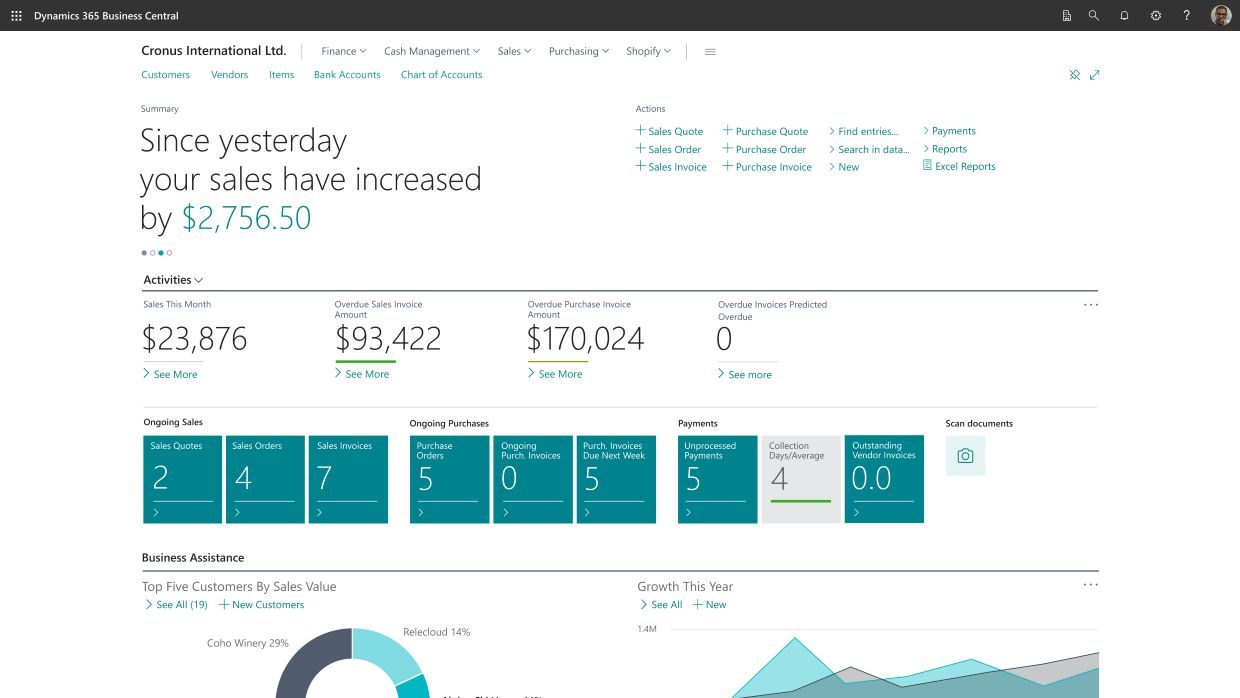
One of the most practical benefits is the shift from backward-looking reports to real-time visibility. Instead of waiting for month-end, partners see revenue, WIP, utilization, and cash position on a live dashboard, updated as time is entered and invoices go out.
Canadian Tax and Payroll Compliance
Table stakes for any ERP for accounting firms in Canada. GST/HST handling, CRA-compliant payroll, T4 generation, and province-specific rules need to be built into the system, not bolted on as workarounds.

ERP for Accounting Firms, by Firm Size
ERP for accounting firms is not a one-size-fits-all category. The right platform depends heavily on your firm's size, complexity, and growth trajectory.
Here's a digestible breakdown:
Small Firms (Under 20 Staff)
At this size, a full ERP is likely overkill. Most small Canadian accounting firms are better served by a strong cloud accounting platform QuickBooks Online Advanced, Xero, or Sage 50cloud, paired with a purpose-built practice management tool. That said, if your firm has unusual complexity, multiple entities, trust accounting, or rapid growth plans, it's worth starting the ERP conversation early rather than migrating off a legacy system under pressure later.
Mid-Size Firms (20–100 Staff)
This is the sweet spot where this ERP delivers the strongest ROI. At this size, firms typically have enough operational complexity to justify ERP but not so much legacy infrastructure that implementation becomes a multi-year project.
Good platforms to evaluate at this tier include:
Microsoft Dynamics 365 Business Central (especially strong for Canadian compliance and bilingual support), Sage Intacct (well-regarded for professional services and multi-entity reporting), and NetSuit (strong on consolidation and real-time reporting, though it requires more configuration for Canadian tax).
Large and Multi-Office Firms (100+ Staff or Multiple Locations)
At this scale, ERP for accounting firms is a requirement, not a choice. The volume of intercompany transactions, the complexity of partner equity structures, and the need for consolidated reporting across offices make disconnected systems untenable.
Larger firms typically look at Microsoft Dynamics 365 Finance, SAP Business One, or continue with Sage Intacct or NetSuite at a more extensive configuration level.
Plan for 9 to 18 months and budget accordingly.
What ROI Looks Like for ERP in Accounting Firms
This is the section most articles skip entirely, so let's be direct.
Month-end close time.
Firms that implement ERP for accounting firms typically report a 30–50% reduction in time required to close their own books. When financial data is unified in one system rather than assembled from exports across three platforms, reconciliations happen faster and with fewer errors.
Billing Realization Rates
According to ProNexus LLC, disconnected billing systems routinely cause firms to under-bill time entries, fall through the cracks, retainers aren't applied correctly, and write-offs happen for avoidable reasons. Firms with integrated WIP management often see realization rates improve by 5–10 percentage points. At a 40-person firm billing $4M annually, that's $200,000 to $400,000 in recovered revenue.
Staff Time on Administration
Partners and managers spend a surprising amount of time chasing time entries, pulling reports, and reconciling billing discrepancies. ERP automates much of this, freeing senior staff for client work and business development.
Partner Decision-Making
When partners see real-time profitability by client, service line, and staff member rather than waiting for a monthly report pricing gets tighter, underperforming relationships get addressed sooner, and staff deployment improves.
According to ERP for Private Equity, the honest caveat: ERP for accounting firms requires upfront investment. For a mid-size firm, total costs typically range from $50,000 to $200,000 CAD. Payback period is generally 18 to 36 months.
What Would Business Central Save Your Firm?
Stop guessing. Download Gestisoft's free ROI calculator and plug in your own numbers: staff count, current software costs, and billing hours to see exactly what investing in Business Central could mean for your bottom line.

Choosing the Right ERP for Accounting Firms in Canada
The platform you choose matters, but the partner who implements it may matter even more. A poorly matched partner is the single most common reason for under delivery. The Canadian market has cautionary tales from firms that chose the cheapest option and spent the following year paying for it.
When evaluating implementation partners for ERP for accounting firms, ask these questions:
- Do they have experience with accounting or professional services firms? Not ERP in general. Accounting firms specifically. Partners who specialize in manufacturing or retail will configure your system with assumptions that don't apply to a CPA practice. Ask for reference clients who are accounting firms.
- Do they understand Canadian compliance? GST/HST configuration, CRA payroll, and provincial rules need to be built in from day one, not added later. An ERP partner without Canadian expertise will cost you in remediation work.
- What does their discovery process look like? A good partner spends meaningful time understanding your workflows before recommending anything. If they jump straight to a demo without asking about your billing process or partner structure, that's a red flag.
- What ongoing support do they offer? ERP for accounting firms is not a set-it-and-forget-it investment. Understand what post-go-live support looks like before you sign anything.
At Gestisoft, we've supported Canadian businesses through over 500 ERP implementations across 29 years. Our 110+ specialists support over 6,200 users coast to coast. When you work with Gestisoft on ERP for your accounting firm, you're not a test case; you're working with a team that has seen this project before and knows where the complexity hides.
What Does ERP for Accounting Firms Implementation Look Like?
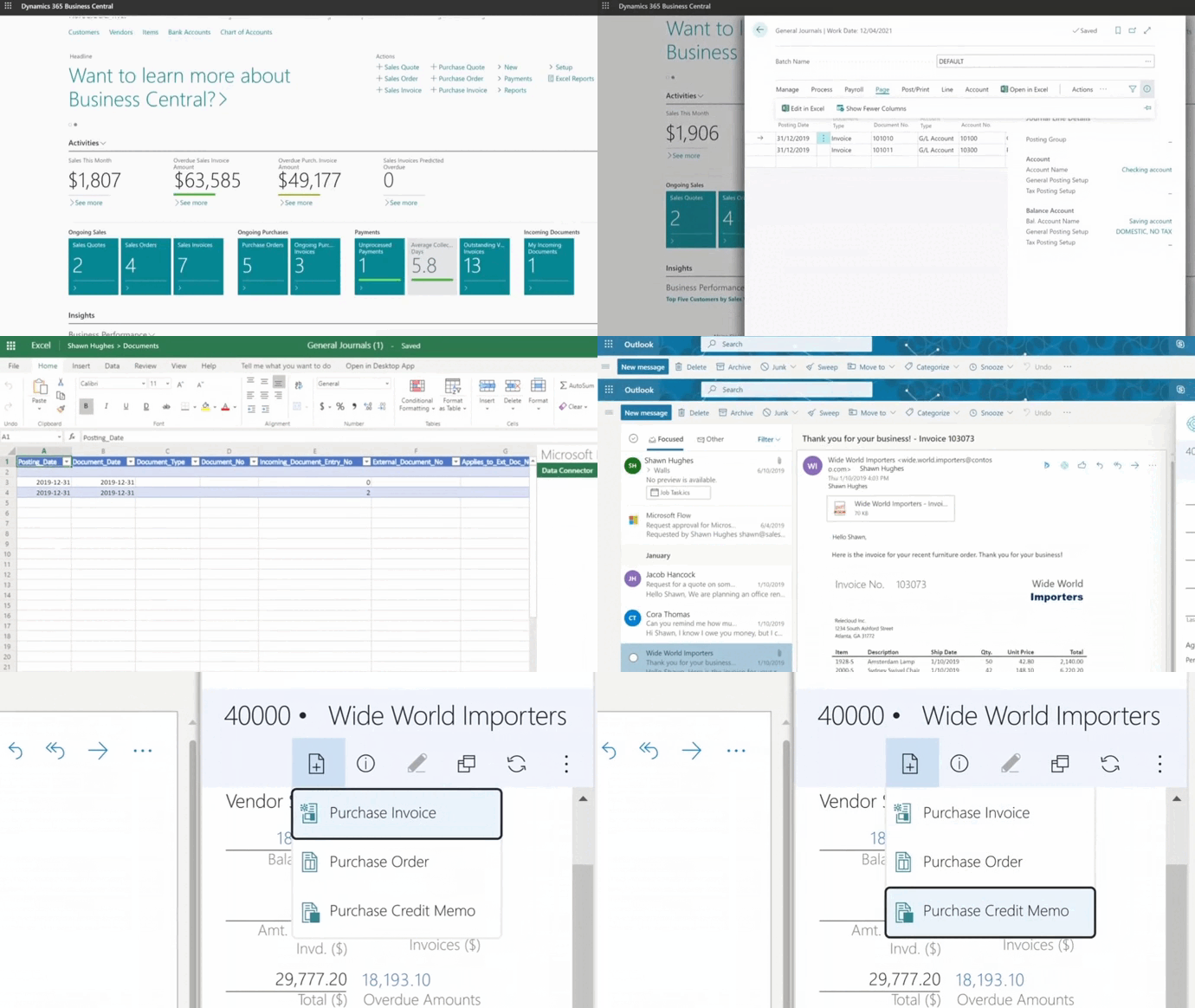
The short answer: it’s a significant project. Firms that go in with unrealistic expectations tend to struggle, so take a look at what a timeline could look like for your firm:
Discovery and scoping (4–8 weeks) – A good implementation starts with mapping your current workflows, identifying integration requirements, cleaning up your chart of accounts, and defining what success looks like. For ERP in accounting firms, this phase should include a thorough review of your billing workflow, trust accounting process, and partner reporting needs.
Data migration (4–6 weeks) – Moving historical data from legacy systems is almost always more work than expected. Client data, historical WIP, open AR, and opening balances all need to migrate accurately. Don't underestimate this phase.
Configuration and testing (6–12 weeks) – This is where your ERP gets built to your specifications chart of accounts, billing templates, reporting dashboards, user permissions, and Canadian tax configuration. Thorough testing before go-live is essential, particularly for trust accounting and payroll.
Training and go-live (2–4 weeks) – Staff adoption is the most common reason ERP implementations underperform. Invest in proper training for every user, not just partners and managers. Time-entry habits, billing approvals, and expense workflows all need to be trained consistently from day one.
Post-go-live stabilization (30–90 days) – Expect a stabilization period after launch. A good ERP partner stays closely engaged during this window rather than disappearing after go-live.
ERP for Accounting Firms: Common Mistakes to Avoid
Now, let's take a look at the common mistakes that you need to avoid when choosing an ERP for accounting firms in Canada.
Choosing a Platform Built for Your Clients, Not Your Firm.
ERP for accounting firms requires a different configuration than ERP for a manufacturing client. Don't default to what you recommend to clients without evaluating whether it fits your own operations.
Under-Investigating in Change Management
The human side, communicating why the change is happening, training thoroughly, and holding staff accountable, determines whether it delivers its promised benefits. Technology alone won't do it.
Going Live All at Once
A phased approach almost always outperforms a big-bang go-live. Start with financials and billing, stabilize, then add payroll and client portal modules.
Skipping the Data Cleanup
If your client database has duplicates, your chart of accounts has years of clutter, and your WIP data is unreliable, clean it up before migration, not after. Garbage in, garbage out.
Imagine this scenario:
- A 35-person CPA firm picks an ERP partner who came highly recommended by a manufacturing company
- Six months in, the billing module is configured around production runs, not engagement-based time entries
- Trust accounting was never scoped
- Go-live happens on schedule, but the system doesn't reflect how the firm works
- The next year is spent fixing what a better-matched partner would have gotten right the first time
- This is what happens when ERP for accounting firms gets treated like any other ERP project.
Get Expert Advice for ERP for Accounting Firms
With 29 years of experience and 500+ implementations across Canada, Gestisoft knows what works for accounting firms. Book a free consultation and find out what the right ERP solution looks like for yours.
 Book a free consultation
ERP for Accounting Firms: Is Yours Ready?
Know the signs if your firm is ready; here are a few to look out for:
- Month-end close consistently takes longer than it should
- Billing errors and write-offs are increasing as the firm grows
- Partners can't easily see real-time profitability by client or service line
- You're managing multiple entities or offices with disconnected systems
- You're planning meaningful growth in headcount or service lines in the next two to three years
If several of these sound familiar, they’re worth a serious evaluation. If only one or two apply, optimizing your existing tools first is probably the smarter move.
Contact Us Today and Learn More On ERP for Accounting Firms
ERP for accounting firms is one of the most consequential technology decisions a Canadian practice can make.
Done well, it reduces overhead, sharpens profitability, and creates a foundation for sustainable growth.
Done poorly, it becomes an expensive distraction.
The difference is almost never the software. It's the preparation, the partner, and the process.
With the right platform and team, this ERP delivers measurable, lasting value, faster closes, more accurate billing, and better decisions. We've seen it happen for Canadian firms of every size, from 20-person practices to multi-office firms operating coast to coast.
If you're evaluating ERP for your accounting firm and want an honest read of your situation, Gestisoft is here to help. We'll tell you whether ERP makes sense for where you are right now, what it would involve, and what to watch out for.
-
Regular accounting software records transactions and keeps your books in order. ERP for accounting firms goes further, connecting your financials to time tracking, billing, engagement management, payroll, and partner equity in one unified platform. Accounting software tells you what happened; ERP for accounting firms tells you why it happened and what it means for profitability. Most firms feel the gap around 20 to 40 staff, when stitching together separate tools starts costing more time than it saves.
Liked what you just read? Sharing is caring.

April 29, 2026 by Conni Guido by Conni Guido Copywriter and Brand Strategist
I started with a degree in Professional Communications and never looked back. Now, I'm a professional storyteller who believes every brand has a story to tell, and every good story should leave you wanting more. You can find me lost in a book club or a writing sprint, baking words into pies...probably both.
