

Key Takeaways:
- The typical total Business Central implementation cost for a Canadian SMB ranges from CAD $40,000 to $250,000+ in year one, depending on user count, integrations, and industry complexity.
- Microsoft Canada licensing is CAD $108.50/user/month for Essentials and CAD $149.20/user/month for Premium, paid yearly. Licensing is usually 20 to 30 percent of your year-one total, not the majority.
- The largest cost line is implementation services (discovery, configuration, data migration, integrations, training, go-live), typically two to four times the annual license spend in year one.
- Cleaning your data before migration, phasing the rollout, and starting with out-of-the-box functionality are the three biggest levers to keep your Business Central implementation cost predictable.
Three Microsoft partners quote your Business Central implementation cost. One says $65,000. Another says $180,000. The third says $310,000. Same scope, same requirements.
The number you actually pay depends less on your users and modules than on three specific decisions: how clean your data is, how much you customize before you have to, and which pricing model you sign under.
This guide breaks down real Canadian ranges by company size, the six line items that quietly inflate quotes, and the red flags that separate an honest scope from a bad one.
Get a Straight Answer on Your Real Number
Skip the vague ranges. Our team gives Canadian SMBs a clear, itemized budget for their exact situation on a single call.
 Book a free consultation
What's Actually Included in a Business Central Implementation Cost?
Your Business Central implementation cost has three parts: the Microsoft license fees, the partner's implementation services, and everything most quotes conveniently leave off the first page.
Miss any of these three, and your budget will be wrong before you even start.
Licensing: The Smallest Slice of Your Business Central Implementation Cost
Microsoft Canada lists Business Central Essentials at CAD $108.50 per user per month, paid yearly, and Premium at CAD $149.20 per user per month. Team Members, for users with limited access to read data, approve workflows, and update select records, run CAD $10.90 per user per month.
Essentials covers finance, sales, purchasing, inventory, warehouse management, supply chain planning, and project management. Premium adds manufacturing and service order management. For most Canadian SMBs, licensing works out to roughly 20 to 30 percent of the year-one total.
Choosing the right tier matters more for functionality than for cost. A broader look at ERP pricing helps you compare Business Central to alternatives before you commit.
Implementation Services: Where Most of the Money Goes
Implementation services are what your partner charges to turn Business Central from a blank tenant into a working ERP for your business. This is where most of your Business Central implementation cost actually lives.
The work breaks into six blocks:
- Discovery and process mapping
- Configuration and setup
- Data migration
- Integrations
- User training
- Go-live support
For a Canadian SMB, this bucket usually runs two to four times your annual license spend in year one. A 25-user Essentials setup with light integrations might spend around CAD $32,500 on annual licenses and CAD $80,000 to $130,000 on implementation services.
The Line Items Most Quotes Leave Out
The three costs that quietly show up later are third-party add-ons, ongoing support after go-live, and the internal time your own team spends on the project.
If you're comparing quotes and one is dramatically cheaper, one of these three is usually missing. If a custom-built ERP is also on your shortlist, our guide walks through when it makes sense, real Canadian cost ranges, and the implementation roadmap.
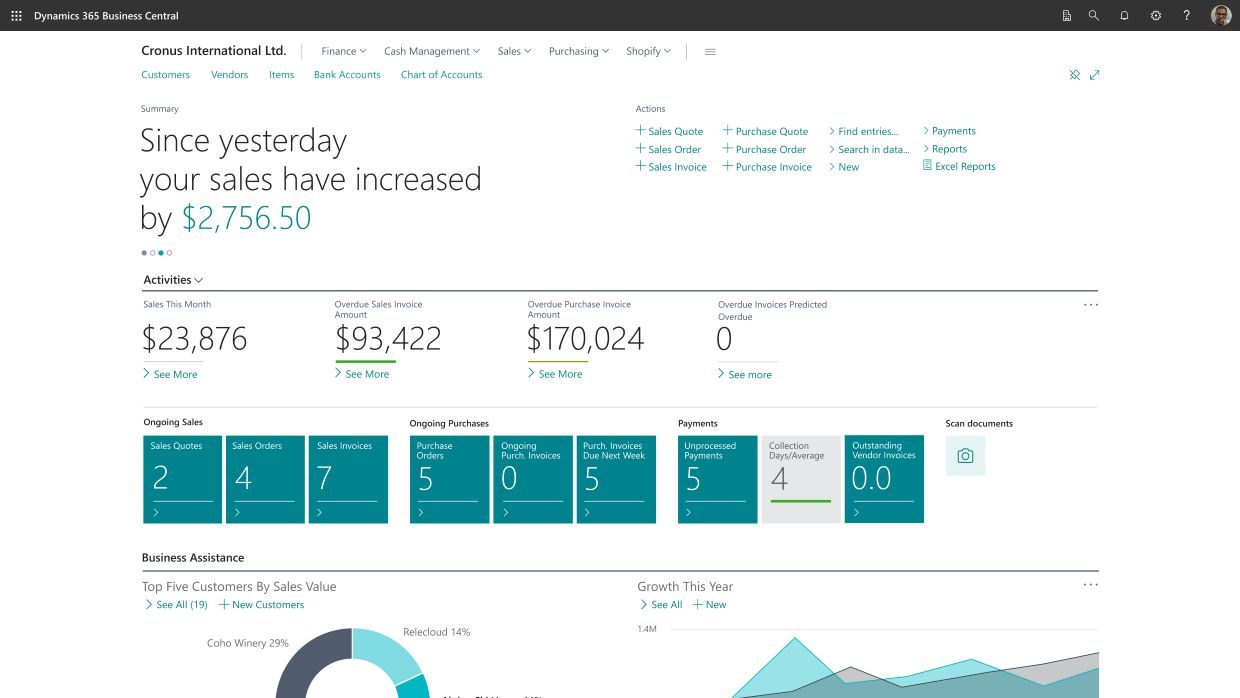
How Much Does a Business Central Implementation Cost in Canada? Real Ranges by Company Size
The single biggest driver of your Business Central implementation cost is not the size of your business. It's the complexity of what you're asking Business Central to do.
A 10-person company with three complex integrations can easily cost more than a 60-person company with a clean, standard setup. Use these ranges as starting points, not fixed numbers.
Small Business Central Implementation Cost (5 to 15 users)
For a small Canadian SMB with standard finance, sales, and light inventory needs, a Small Business Central implementation cost usually lands between CAD $25,000 and $60,000 for services, plus annual licenses of roughly CAD $10,000 to $25,000.
At this size, a fixed-fee scope with an experienced ERP implementation consultant like Gestisoft usually protects you best against surprises. Timelines run three to five months (or more, sometimes depending on various factors).
Mid-Market Business Central Implementation Cost (15 to 75 users)
A Mid-Market Business Central implementation cost typically ranges from CAD $75,000 to $175,000 in services, plus licensing that usually sits between CAD $25,000 and $95,000 annually.
This band covers most Canadian distributors, manufacturers, and multi-branch service businesses. It's also where integration work (CRM, e-commerce, EDI, warehouse scanning) adds real dollars.
If you're a distributor, our overview of Business Central for distribution walks through what the platform actually replaces in your current stack.
Larger Business Central Implementation Cost (75+ users)
A Larger Business Central implementation cost for Canadian mid-market companies typically starts at CAD $175,000 and can pass CAD $400,000 for multi-entity groups with complex intercompany, manufacturing, or field service needs.
At this scale, phasing the rollout matters more than shaving a small percentage off the total. A staged approach protects cash flow and lets your team absorb change one module at a time.
6 Hidden Fees That Inflate Your Business Central Implementation Cost
Most horror stories about ERP projects come down to the same handful of missed line items. Here are the six that push your Business Central implementation cost past the original quote, and how to spot each one before you sign.
For the wider view of why these projects go sideways, our breakdown of the top ERP implementation challenges covers the issues that most often derail a project and practical tips to prepare for each one.
Data Migration and Cleanup
Your legacy data is almost never as clean as you think. Duplicate customers, unbalanced GL accounts, missing item units of measure, orphaned open orders. All of it has to be found, fixed, mapped, and loaded.
Budget CAD $5,000 to $30,000 for this, depending on the state of your data. If your quote does not itemize it separately, ask why.
Integrations With Your Other Systems
Every system Business Central needs to talk to (CRM, e-commerce, shipping, payroll, banking, EDI) is a separate cost. Simple connectors range from CAD $2,000 to $8,000. Custom integrations can run CAD $10,000 to $50,000+.
User Training and Change Management
If your team does not know how to use the system on day one, the ROI clock never starts. Training typically adds CAD $3,000 to $15,000. Cutting it is the fastest way to sabotage the whole project.
Post Go-Live Support (The First 90 Days)
The 60 to 90 days after go-live are when things break, users panic, and processes need adjusting. Expect CAD $2,000 to $8,000 per month in dedicated support. Some partners include a warranty period. Others charge from day one.
Third-Party Apps and Add-Ons
AppSource extensions for advanced warehouse, Canadian payroll, EDI, or industry modules can add CAD $500 to $5,000 per user per year. They're often essential and rarely on the first quote.
Internal Team Time (The Cost No One Puts on Paper)
Your finance lead, ops manager, and IT staff will each spend 5 to 15 hours a week on this project for months. Cost that at their loaded rates, and the number gets real, fast.
Stop Guessing on the Real Total
Bring your current setup, and we'll map exactly where the money goes for a business your size.
 Book a free consultation
How to Reduce Your Business Central Implementation Cost (Without Cutting Corners)
You cannot negotiate your Business Central implementation cost down by squeezing your partner's hourly rate. What actually works is reducing the scope of phase one, and doing your homework before the meter starts running.
Three levers do most of the work. Each one is inside your control before you sign a statement of work.
Clean Your Data Before Your Partner Touches It
If your partner has to fix broken customer records, you're paying senior consulting rates for data entry. Do the cleanup with your own team first, then hand over a validated file.
Migrating clean data is half the battle. Our step-by-step guide to building an ERP data migration strategy walks through what to prep before the technical work starts, and it can save you thousands.
Phase Your Rollout Instead of Buying Everything Day One
You do not need warehouse management, manufacturing, and service in phase one. Start with finance and sales. Add modules over the next 12 to 18 months.
A phased Business Central implementation cost lets you spread investment, absorb change, and course-correct before you double the scope.
Use What's Already in the Box Before You Customize
Every customization adds cost now and costs forever (upgrades, testing, maintenance). Most SMBs use only a fraction of what Business Central already does out of the box.
Try the standard workflow for 60 days. If it truly does not fit, customize then. Cloud-native platforms make this easier, and the benefits of cloud ERP software go well beyond just cost savings.
If you want to see what you're actually paying for before you commit, the walkthrough below shows how Business Central looks and feels day-to-day for a typical finance team.
Fixed-Fee vs Hourly: Which Business Central Implementation Cost Model Wins?
Every partner will offer one of two Business Central implementation cost structures: a fixed fee for the whole project, or a time-and-materials rate. Neither is universally better. The right choice depends on how well-defined your project is.
When a Fixed-Fee Business Central Implementation Cost Makes Sense
Fixed fee works best when your scope is clear, your data is reasonably clean, and you have a standard industry setup (finance, sales, light inventory, a couple of integrations).
You get budget certainty. Your partner absorbs the risk of scope creep, which forces both sides to be crisp about what's in and what's out. Most small and mid-market Canadian SMBs land here.
When Time-and-Materials Makes More Sense
Time-and-materials is better when the scope is genuinely unclear, when you're doing significant process redesign, or when the project involves heavy custom development.
You keep flexibility. You also carry the risk. If you go this route, insist on weekly burn-rate reports and monthly change-order reviews.
Choosing the right ERP consultant matters as much as choosing the pricing model. A good partner (like Gestisoft) will tell you honestly which model your project actually needs.

What Makes a Canadian Business Central Implementation Cost Different?
Most Business Central implementation cost guides online are written from a US perspective. The Canadian reality has four line items that quietly change your budget.
Bilingual EN/FR Training and Configuration
If your team includes French-speaking users (Quebec, New Brunswick, or bilingual national teams), you need training materials, user documentation, and support in both languages.
Budget 15 to 25 percent extra on training. A Business Central consultant in Montreal or another bilingual partner will handle this natively.
GST, HST, QST, and PST Setup
Configuring sales tax for Canadian entities is genuinely more complex than US state tax. Multi-province operations, QST self-assessment, and mixed HST/GST/PST provinces each need dedicated tax configuration and testing.
Budget an extra CAD $2,000 to $6,000 for tax setup and validation. Skipping this creates real audit exposure with the CRA and Revenu Québec.
Canadian Payroll and Banking Integrations
Canadian payroll (T4, ROE, source deductions) is not native to Business Central. Most Canadian SMBs use a third-party payroll integration or ISV. Bank feed integrations with Canadian banks work well but need CAD-specific configuration.
Provincial Compliance and Reporting
Depending on your industry, you may need provincial reporting for CNESST, WSIB, WCB, or industry-specific bodies. Building these reports adds CAD $1,500 to $8,000, depending on complexity.
5 Red Flags in a Business Central Implementation Cost Quote
Comparing quotes is where most SMBs get it wrong. The cheapest number usually hides the biggest problem. Here are five signals that a Business Central implementation cost quote will cause pain later.
A Suspiciously Low Fixed Price
If one partner comes in 40 percent below the others, they're either underestimating scope on purpose (change orders will come later) or planning to use junior staff for senior work. Ask them to walk you through their assumptions, in writing.
No Detailed Discovery Phase
Any quote without a discovery phase built in (typically 20 to 60 hours) is a guess. Serious partners insist on discovery, because it's the only way to scope accurately.
Missing Data Migration and Training Line Items
If data migration and training are lumped into "implementation" without a specific budget, they'll get squeezed when the project runs late. Both should appear as their own itemized costs.
Vague "TBD" Phases and Placeholders
"TBD," "to be scoped," and "estimate only" clauses spread across multiple line items add up to a quote that isn't really a quote. Push for specifics before you sign.
Zero Post Go-Live Support Included
Go-live is not the finish line. If the quote ends the day you flip the switch, expect a support scramble in weeks two through eight. Look for at least 30 to 90 days of stabilization support included.
The Case for Cloud
Grab our free eBook, "5 Reasons to Adopt a Cloud ERP," and see why most Canadian SMBs never look back after moving off legacy systems.

-
A typical Canadian SMB spends between CAD $40,000 and $200,000 in year one, including licenses, implementation services, data migration, and training. Ongoing costs run 20 to 30 percent of year one, mostly for licenses and support.
Why Gestisoft Is a Trusted Business Central Implementation Cost Partner in Canada
Gestisoft has been a Microsoft Partner for nearly three decades, working with Canadian SMBs across manufacturing, distribution, services, and municipal government. We're a B Corp certified, Great Place to Work certified Canadian team with offices in Montreal, Toronto, Ottawa, and Quebec City.
Every proposal we send is a clear, itemized Business Central implementation cost breakdown in Canadian dollars. Our team is bilingual EN/FR, and every project starts with a real discovery phase...
Take Elemental Container, the North American arm of packaging leader Tournaire Group. They moved from Sage X3 to Business Central with our team. The project went live on time and on budget, with warehouse efficiency up by as much as 50 percent.
Here's what Chris Miller, their Director of Operations, said:
You get a lot of implementation guys who are in their cubicle in front of their monitor and they do it based on what the monitor tells them to do. He really took the time to understand from a user what we needed.
Chris Miller, Director of Operations, Elemental Container
Read the full Elemental Container case study for the complete breakdown.
When you're ready to see what a straight, itemized budget for your business looks like, our Business Central specialists across Canada are one call away.
Ready for a Real Conversation
One call, one honest scope, and a budget your CFO can actually plan against. That's how we work.
 Book a free consultation
Liked what you just read? Sharing is caring.

July 28, 2026 by Muhammad Ali Iqbal by Muhammad Ali Iqbal SEO Content Strategist & Copywriter
Driven by a passion for search engine optimization, strategic content, and conversion-focused writing. A copywriter and content strategist who lives for content that ranks, engages, and delivers real business results.

