

ZipBooks made a lot of sense when you started. Free tier, clean interface, basic invoicing done. Zero complaints.
Then your business grew. Suddenly, you needed to reconcile GST/HST across provinces, track inventory, run payroll, or just get a report that didn't require you to manually export data into a spreadsheet to make sense of it. And ZipBooks said, “sorry, that's not us.”
That's why you're now looking at ZipBooks alternatives. You're not alone. Thousands of Canadian small business owners hit this exact wall every year, and the options can feel overwhelming when every ZipBooks alternatives comparison article just lists 20 tools without telling you which one is right for a business in Canada with real tax compliance requirements.
This article cuts through the noise. We'll look at the best ZipBooks alternatives depending on where your business is right now, what Canadian-specific factors to weigh, and when it stops making sense to look at accounting tools at all. If you want a structured framework to help you think through the decision, the ERP finance module overview is a useful read once you've narrowed your options.
Why Canadian Businesses Are Looking into ZipBooks Alternatives
Before jumping into ZipBooks alternatives, it helps to understand why Canadian businesses tend to hit ZipBooks' ceiling sooner than their US counterparts, and why picking the wrong ZipBooks alternative just pushes the problem six months down the road.
Canadian tax compliance is more complex than most people expect. You're dealing with GST, HST, PST, and QST depending on your province and where your customers are. If you sell across provincial lines, the tax rules change. ZipBooks was built primarily for the US market, and while it technically supports Canadian bank accounts, it was not designed with the CRA in mind.
Add to that bilingual requirements for Québec businesses, multi-currency needs for companies selling to US clients, and the fact that many Canadian SMBs grow quickly from one-person operations to multi-location companies, and you start to see why the tools that work at $200K in revenue start to feel like a straitjacket at $1M.
The most common complaints Canadian businesses have about ZipBooks aren't really about ZipBooks being bad. It's that the software was designed for a different user at a different growth stage. No accounts payable automation. No inventory tracking. Reporting that doesn't give you the clickable, drillable detail you need when your CFO or accountant asks for a breakdown. And a mobile app that's been discontinued in the US market.
Knowing this helps you pick the right ZipBooks alternative instead of just picking the next ZipBooks alternative on a list.
Need to have the ZipBooks Alternatives Conversation?
Our team works with Canadian SMBs every day on this exact question. Contact us today to start talking about your alternatives for ZipBooks.
 Book a free consultation
ZipBooks Alternatives for When You've Outgrown Accounting Software Entirely
Here's the conversation most ZipBooks alternatives comparison articles skip.
At some point, the problem isn't which of the ZipBooks alternatives you pick. The problem is that you're comparing tools that all share the same fundamental limitation: they're accounting tools, not business management platforms. They track money in and money out. They don't connect your finance data to your operations, inventory, purchasing, or sales pipeline.
The signals that you've crossed this line are pretty consistent.
You're:
- Running multiple locations and reconciling data manually between them.
- Have inventory that needs to be tracked in real time and connected to your general ledger.
- Approaching $2M in annual revenue and your month-end close takes two weeks because nothing talks to anything else.
- Need GST/HST/PST automation that's built specifically for how Canadian tax law works, not bolted on as an afterthought.
When those signals appear, the right move isn't to try another ZipBooks alternative in the same tier. It's to look at what an accounting software vs ERP comparison looks like for a Canadian business your size. That's a different decision with different stakes, and it's one that pays off significantly faster than most business owners expect.
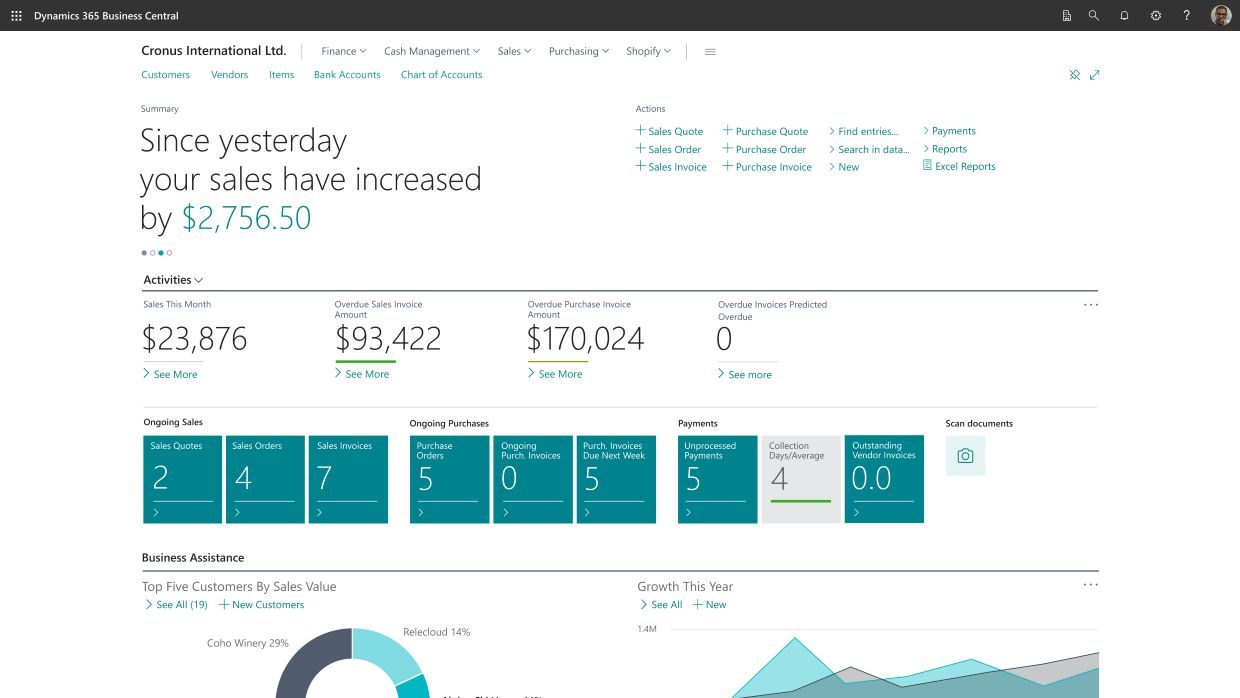
Why Microsoft Dynamics 365 Business Central is One of the Strongest ZipBooks Alternatives for Canadian SMBs
This is Gestisoft's specialty! We've been implementing Business Central for Canadian businesses since 1997, and we believe it's the strongest option for SMBs that have outgrown ZipBooks alternatives in the small-tool tier.
Full disclaimer: Business Central is not the right answer for everyone, and we'll tell you honestly when it's not.
Business Central is Microsoft's cloud ERP for small and mid-sized businesses. It unifies accounting, inventory, purchasing, sales, project management, and operations in a single database. The inventory ledger and the general ledger are the same system, which eliminates the reconciliation problems that come from running separate tools.
Business Central also supports multi-currency natively, handles GST/HST/PST/QST for Canadian compliance, runs fully bilingual for Québec operations, and integrates natively with Microsoft 365, meaning your finance data connects directly to Excel, Teams, and Outlook without any middleware.
For a Canadian business that has hit the ceiling with ZipBooks alternatives in the small-tool tier, Business Central is the most complete option available. It's used by companies across Canada in manufacturing, distribution, professional services, and retail, and the implementation timeline from a certified partner is typically eight to sixteen weeks depending on complexity.
Where it falls short: it's not the right call for a true micro-business or a solo operator. It's a real ERP, implementation takes planning, and the best results come from working with a Business Central partner who understands Canadian compliance requirements. If you're at $300K in revenue and your main complaint about ZipBooks is the price, Wave is a better answer for you right now.
But if you're approaching a million dollars in revenue, managing inventory across more than one location, or watching your accounting team spend their days moving data between disconnected systems, Business Central is the platform to be evaluating.
“The tool is really user-friendly and easy to use. It was important to us that the whole team could adopt it quickly.”
Additional ZipBooks Alternatives for Businesses Still in Early Growth
If you're a freelancer, a solo operator, or a small team under $500K in revenue, you don't need to overspend on software. Here are the ZipBooks alternatives that make sense at this stage.
Wave
This platform is the most common first stop when looking at ZipBooks alternatives in Canada, and for good reason. It's free for core accounting features, it supports GST, HST, and PST for Canadian businesses, and it handles invoicing and expense tracking without requiring an accounting degree. The catch is that payroll and payment processing cost extra, and the reporting is still fairly limited. But if your main pain point with ZipBooks is the price, Wave solves it immediately. As ZipBooks alternatives go, it's hard to beat for a true micro-business.
FreshBooks
FreshBooks works well for service businesses. Designers, consultants, agencies, and contractors tend to like it because the invoicing experience is cleaner than most, and time tracking is built in. Among ZipBooks alternatives for anyone billing by the hour, FreshBooks is one of the more polished options. The downside is that FreshBooks is built around service revenue and doesn't handle inventory or complex reporting well. If your business has any physical product component, you'll hit that wall quickly.
Xero
This platform is where you look when you need something more collaborative. It supports multi-user access without paying per seat the way some tools do, connects to over a thousand apps, and handles multi-currency better than either Wave or FreshBooks. For Canadian businesses working with US clients or operating across provinces, Xero is one of the stronger ZipBooks alternatives in the small-business tier. That said, GST/HST handling in Xero is functional but requires setup, and French-language support is limited, which is a real issue for Québec-based businesses.
Zoho Books
Zoho Books is a reasonable pick if you're already using other Zoho products. The free tier covers businesses under $50K in annual revenue, and it connects cleanly to Zoho Inventory if you need basic stock tracking. For cost-conscious businesses that need a bit more than ZipBooks offered, Zoho Books sits in a reasonable middle ground among ZipBooks alternatives.
How to Choose the Right ZipBooks Alternatives for Your Situation
The choice depends on two things:
- Where your business is today
- Where it needs to be in eighteen months
If you're a freelancer or a very small team, the decision is between Wave (free, good enough for basic compliance), FreshBooks (better for service billing), and Xero (better for multi-user access and integrations). Any of these ZipBooks alternatives will serve you well at this stage. The differences between them matter less than the fact that you pick one and stick with it long enough to get clean data.
If you're a growing SMB with inventory, multiple users, or cross-provincial tax complexity, the conversation shifts. Xero or Zoho Books can carry you a bit further as ZipBooks alternatives, but you'll want to be honest about your eighteen-month trajectory. If you're adding headcount, opening new locations, or your product mix is becoming more complex, you may be better served starting the ERP conversation now rather than doing another tool migration in a year. The cost of accounting software implementation is always lower when you plan it proactively than when you migrate under pressure.
If you're already past the growth inflection point, meaning month-end close is painful, your teams are working out of disconnected systems, and your accountant keeps asking why the inventory numbers don't match the financials, then the ZipBooks alternatives conversation is the wrong one to be having. The financial management software question you need to answer is whether it's time to move to a platform that connects everything.
One thing that applies at every stage: don't choose whofor you are today. The most common mistake Canadian SMBs make when switching accounting tools is optimizing for their current pain point and ignoring the growth they're planning for. A tool that solves your problem today but requires another migration in twelve months costs you twice, in money and in disruption.
For businesses that want a structured way to evaluate the ERP question, the 10 key ERP selection criteria Gestisoft uses with Canadian clients is a good starting point before you talk to any vendor.
With Gestisoft, We’re Here to Talk Options for Your ZipBooks Alternatives!
Tell us where your business is right now and we'll meet you where you’re at. Find the right ZipBooks alternative for you by booking a free call today!
 Book a free consultation
A Word on Other ZipBooks Alternatives That Come Up
When looking into ZipBooks alternatives, we at Gestisoft believe you should have all options available to you so you can make the best educated decision for you possible. Here are a few other names that appear frequently in ZipBooks alternatives searches, and each deserves a quick take.
QuickBooks Online
QuickBooks Online is the most common landing spot for Canadian businesses leaving ZipBooks. It's well-supported, CRA-recognized, has a large Canadian accountant community, and handles GST/HST better than most tools in the same tier. If you need something familiar and you're not yet ready for an ERP conversation, QuickBooks Online is a reasonable choice among ZipBooks alternatives.
The downside is that costs add up quickly as you add users and features, and scaling to inventory management means paying for QuickBooks Enterprise, which is a significant jump. If you're already considering that jump, the QuickBooks to Business Central migration path is something many Canadian businesses evaluate at that stage.
Sage 50
Sage 50 has been around long enough to have deep Canadian compliance roots, but it's a desktop-first product in a cloud-first world. If your team needs to access financial data remotely or collaborate in real time, look at Sage 50 alternatives before committing to it.
NetSuite
NetSuite comes up when Canadian businesses research ERP options. It's a strong product, but it's significantly more expensive than Business Central, more complex to implement, and since the Oracle acquisition, less SMB-friendly than it was a decade ago. For most Canadian businesses under 100 employees, NetSuite vs. Dynamics 365 Business Central almost always tilts toward Business Central on total cost of ownership.
If you’re ready to find out which path makes sense for your business, Gestisoft has helped Canadian companies make this decision for well over 20 years. Book a free consultation today and let us know where you are, and we’ll tell you where to go next.
-
Wave is the strongest free option for Canadian small businesses. It supports GST, HST, and PST, handles invoicing and expense tracking, and connects to Canadian bank accounts. The core accounting features are free. Payroll and payment processing cost extra.
Explore More
Liked what you just read? Sharing is caring.

May 25, 2026 by Conni Guido by Conni Guido Copywriter and Brand Strategist
I started with a degree in Professional Communications and never looked back. Now, I'm a professional storyteller who believes every brand has a story to tell, and every good story should leave you wanting more. You can find me lost in a book club or a writing sprint, baking words into pies...probably both.
