

Running a manufacturing business in Canada involves a financial burden that generic accounting tools fail to address. You're tracking raw materials, managing work-in-progress, calculating overhead absorption, and trying to close the books accurately every month, all while staying compliant with GST/HST rules that vary by province, or QST if you're operating in Québec.
Most manufacturing accounting software on the market's developers designed it for US businesses with simpler tax structures. Drop it into a Canadian manufacturing environment and the gaps show up fast.
This article breaks down what manufacturing accounting software needs to do, why Canadian manufacturers have specific requirements that most platforms ignore, and which solutions are worth evaluating in 2026.
Ready to Talk to a Manufacturing ERP Expert?
Running production and finance from two disconnected systems is costing you more than you think. Our team has been implementing manufacturing accounting software for Canadian businesses since 1997.
 Book a free consultation
What Manufacturing Accounting Software Does
Standard accounting software handles invoices, bank reconciliation, and tax filing. That covers maybe 30% of what a manufacturer needs.
Manufacturing accounting software handles the other 70%: the financial side of production.
That includes job costing, tracking the true cost of producing a finished good by capturing direct materials, direct labour, and overhead allocations per production run. It also includes work-in-progress (WIP) reporting, which tells you the financial value of everything currently on the shop floor that isn't finished goods yet. It includes variance analysis, so you can see the gap between what you expected a product to cost and what it costs to make.
These aren't nice-to-haves. If you're pricing products without accurate job costing data, you're guessing your margin. If your WIP isn't tracked properly, your balance sheet is wrong. If you can't analyze cost variances, you can't find where production is bleeding money.
Accounting software built for general businesses doesn't track any of this. That's the core difference between generic accounting tools and software.
Good software also connects financial data to operational data. When a production order closes, costs should flow into the general ledger automatically. Updating inventory valuation occurs automatically upon raw material consumption. When a customer order ships, revenue recognition fires without a spreadsheet in between. That level of integration is what separates manufacturing accounting software from a patched-together stack of disconnected tools.
What Canadian Manufacturers Need From Their Manufacturing Accounting Software
This is where most articles stop serving you. They list global software options without acknowledging that operating in Canada adds a layer of complexity most of those tools were never built for.
Here's what Canadian manufacturing companies need that generic manufacturing accounting software often misses.
GST/HST on inputs vs. outputs. Manufacturers claim input tax credits (ITCs) on raw materials and components, then charge GST/HST on finished goods sold. The tax treatment depends on the product category, the province of sale, and whether the customer is registered for GST/HST. Your software needs to handle this automatically, not require manual adjustments on every transaction.
QST for Québec operations. If you manufacture in Québec or sell into Québec, you're dealing with a dual tax system. QST and GST run in parallel, with their own registration requirements, reporting periods, and input tax refund rules. Manufacturing accounting software that doesn't support QST natively creates a compliance nightmare.
Bilingual reporting. Federal regulations and Québec law both have provisions around bilingual documentation for businesses operating in both languages. If your manufacturing accounting software can only produce financial reports and customer-facing documents in English, you have a gap.
CRA audit readiness. The Canada Revenue Agency audits manufacturers more frequently than most sectors because of ITC claims on capital equipment, raw materials, and production costs. Your manufacturing accounting software needs to maintain a complete, traceable audit trail without requiring you to reconstruct anything manually.
Canadian data residency. Under PIPEDA and provincial privacy legislation, some manufacturers have data residency requirements or client contracts that specify where financial data can be stored. Not every cloud-based manufacturing accounting software platform stores data in Canada. This matters more than most buyers realize until it's too late. If you're weighing cloud deployment, our overview of the benefits of ERP software on the cloud covers what to look for — and what to ask vendors before signing.

The 5 Best Manufacturing Accounting Software Options for Canadian SMBs
No two manufacturers have the same requirements, so the right manufacturing accounting software depends on your production model, company size, and how much operational complexity you're managing. That said, the Canadian market narrows the field considerably once you factor in tax compliance, bilingual support, and implementation availability.
1. Microsoft Dynamics 365 Business Central
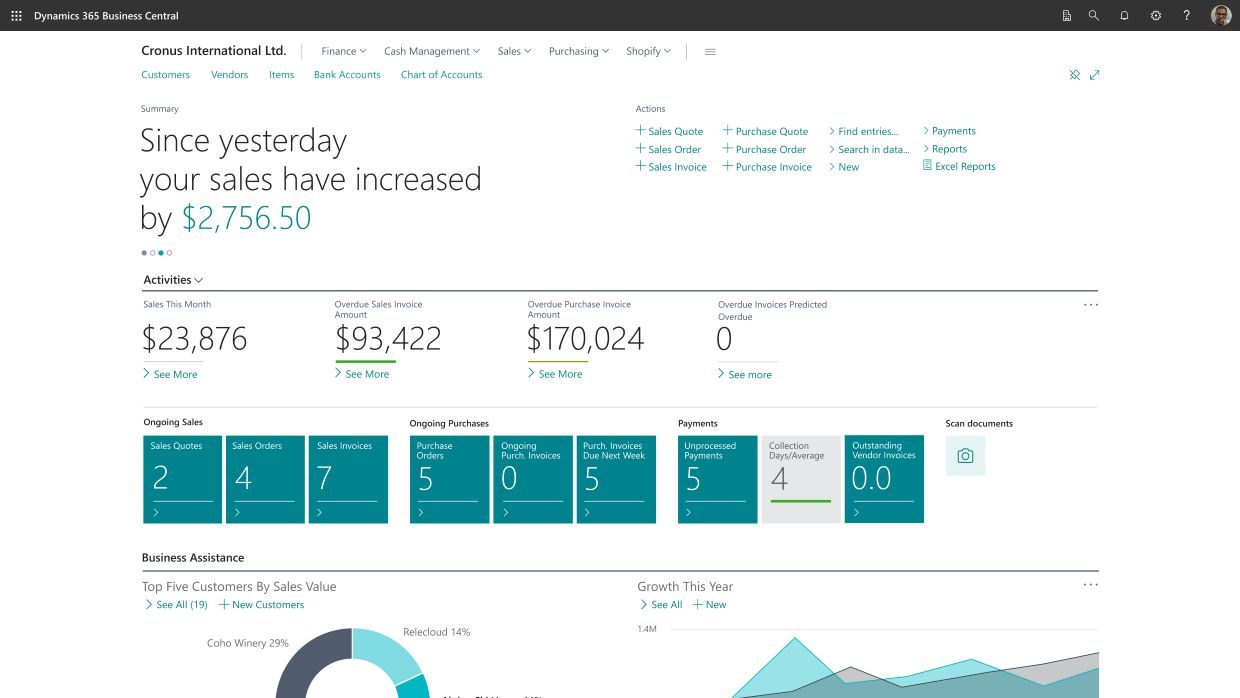
Business Central is the top-rated manufacturing accounting software for Canadian SMBs that have outgrown basic tools and need a real ERP. It handles the full production cycle — bills of materials, production orders, machine centres, routing, capacity planning — alongside a complete financial management module that includes job costing, cost accounting, WIP reporting, and multi-entity consolidation.
On the Canadian compliance side, Business Central's finance module includes native GST/HST and QST support with automated tax calculations, ITC tracking, and CRA-ready reporting. It's also available in both English and French, which is a big deal if you're running a bilingual operation or required to produce French-language documents for Québec customers.
The Microsoft ecosystem integration is a real advantage for manufacturers already using Microsoft 365. Financial data flows directly into Excel for analysis, approvals route through Teams, and Power BI connects to your production and financial data for real-time dashboards without manual exports.
Gestisoft has been implementing Business Central as a manufacturing accounting software solution for Canadian businesses for over 27 years. A typical go-live runs 8 to 16 weeks depending on production complexity and the number of entities involved. That's faster than most ERP projects and predictable enough to plan around.
See the 38 benefits of manufacturing ERP that companies see after moving from disconnected tools to a platform like Business Central.
2. Sage X3
Sage X3 is a mid-market manufacturing accounting software platform that handles process manufacturing well, food and beverage, chemicals, pharmaceuticals. It has stronger batch traceability and recipe management than Business Central out of the box, which matters for regulated manufacturing environments. Canadian tax support exists but requires configuration. Implementation is more complex and typically takes longer than Business Central. Best suited for manufacturers with 50–250 employees and specific process manufacturing requirements.
3. QuickBooks Enterprise (with manufacturing add-ons)
QuickBooks Enterprise is where many Canadian manufacturers start. It handles inventory, purchase orders, and basic costing, and it's familiar to most accountants. The manufacturing edition adds assembly management and basic job costing. However, QuickBooks Enterprise is not a true manufacturing accounting software platform — it's a general accounting tool with manufacturing features bolted on. When your production volume grows, your SKU count climbs, or you need real WIP tracking and production order management, it runs out of road. There are also a number of ERP myths manufacturers carry that keep them on QuickBooks longer than they should be. We cover exactly where QuickBooks hits its ceiling for manufacturers in our accounting software comparison, if you're evaluating the two side by side.
4. Acumatica Cloud ERP
Acumatica is a cloud-native manufacturing accounting software platform with strong discrete manufacturing capabilities. It uses a consumption-based pricing model rather than per-user licensing, which can be cost-effective for manufacturers with large teams. Canadian tax support is available but not as deeply native as Business Central. Implementation partners in Canada are less common than Microsoft partners, which affects both implementation quality and ongoing support availability.
5. SAP Business One
SAP Business One targets manufacturers in the 20–150 employee range who need strong MRP and production planning capabilities. The manufacturing accounting software functionality is solid, and the platform handles multi-currency and cross-border transactions well. The main limitation for Canadian SMBs is cost, both implementation and licensing run higher than Business Central, and the implementation pool of qualified SAP B1 partners in Canada is thinner outside major cities.
When Your Current Manufacturing Accounting Software Isn't Enough
Most manufacturers don't start with a true manufacturing accounting software platform. They start with QuickBooks or Sage 50, add an inventory tool, maybe a production scheduling spreadsheet, and patch it together as they grow. It works until it doesn't. The top ERP implementation challenges usually trace back to exactly this kind of deferred migration, the longer a manufacturer waits, the messier the data cleanup.
Here are the signals that your current setup has hit its limit.
Your month-end close takes over five business days because someone has to reconcile inventory, production costs, and financials manually. Your job costing relies on estimates rather than actual production data because the accounting system and the shop floor system don't talk to each other. You've had a CRA audit and had to reconstruct transaction histories manually because your system doesn't maintain a complete audit trail. Your product margins look fine until the end of the year, when actual costs don't match what the books say.
These aren't just efficiency problems, they're financial risk. Understanding the true cost of accounting software implementation often reveals that the cost of staying on the wrong platform outweighs the cost of upgrading to software that fits.
The inflection point for most Canadian manufacturers is somewhere between $5M and $15M in annual revenue. Below that, a patched-together stack is manageable. Above it, the cost of inaccurate financial data starts showing up in bad pricing decisions, missed margins, and audit exposure.
Ready to Move Past Your Current Setup?
If your accounting tools and your production operations don't share the same data, you're already losing money. Gestisoft has helped Canadian manufacturers at every stage make this transition cleanly.
 Book a free consultation
How to Evaluate Manufacturing Accounting Software as a Canadian SMB
Before signing a contract for any manufacturing software platform, run through this checklist.
- Canadian tax compliance out of the box - GST/HST and QST should be native, not a configuration project. Ask the vendor to demonstrate tax calculation on a cross-provincial sale and a Québec sale in the same demo.
- Job costing at the production order level - You need to see actual material costs, actual labour hours, and overhead absorption tracked per production order — not just per product. If the software only does average costing at the SKU level, it's not real manufacturing accounting software.
- WIP reporting - Ask to see a WIP report showing the financial value of open production orders. If the vendor can't demo this clearly, the functionality is probably shallow.
- ERP integration or native ERP - Manufacturing software that sits beside your operations system rather than inside it will always have data synchronization problems. Either choose a platform where accounting and production are the same system (like Business Central), or verify the integration between the two tools is real-time, not batch.
- Canadian implementation partner availability - Global software with no qualified implementation partners in Canada is a support risk. For discrete manufacturing ERP implementations especially, the quality of the implementation partner determines whether you get a system that matches your production model.
- Total cost of ownership over five years - Licensing fees are one line item. Professional services, training, customization, and the annual cost of support are the rest. Our guide on what manufacturing ERP implementation costs walks through the full picture.
“The software is our working tool. With our previous solution, it was like having a stone hammer. We could accomplish our tasks, but the tool was outdated. With Business Central, if we decide to move into the Industrial 4.0 era, it’s possible. We now have an up-to-date solution that meets our needs. We’ve really taken a step forward, and we can see all the possibilities we could do in the future.”
Business Central as Manufacturing Accounting Software: What Gestisoft Brings to the Table
Business Central is Microsoft's manufacturing accounting software platform for SMBs, and it's the solution Gestisoft recommends for Canadian manufacturers who need real financial and operational integration.
The reason comes down to what the platform does natively. Production orders connect directly to the general ledger. When you close a production order, material costs, labour costs, and applied overhead post automatically to the appropriate accounts.
WIP accounts update in real time. Variance accounts capture the difference between standard and actual costs without a manual journal entry. For manufacturers who have been running job costing in spreadsheets, this is a meaningful change.
On the Canadian compliance side, Gestisoft configures Business Central specifically for the Canadian tax environment. GST/HST calculations, QST handling for Québec, and CRA-compliant audit trails are all part of the standard implementation. If you're operating across multiple provinces with different tax treatment, Business Central handles the complexity without requiring separate workarounds. And if you're migrating from a legacy system, building an ERP data migration strategy early is the single biggest factor in keeping go-live on schedule.
For manufacturers evaluating whether they need accounting software or a full ERP, Business Central resolves the question by being both — a complete financial management system that also manages production, inventory, purchasing, and sales in the same platform.
Canadian manufacturers have specific requirements that generic software doesn't cover. Gestisoft has been implementing manufacturing accounting software for Canadian businesses since 1997. We know what your books need to look like. Want to learn more? Book a Free Consultation Today!
-
It is a financial management platform built to handle the accounting requirements specific to production environments, job costing, WIP tracking, overhead absorption, bills of materials, and production order costing. It differs from general accounting software by connecting financial data directly to production operations, so costs flow into the books automatically as manufacturing activity happens.
Explore More
ERP System for Manufacturing: Definition, Types, Benefits Understand the full scope of what a manufacturing ERP does before you start evaluating platforms.
30 Benefits of Manufacturing ERP: Optimize Your Operations from A to Z A comprehensive look at what manufacturers gain after implementing a proper ERP system.
Business Central vs QuickBooks, Xero & FreshBooks: A Comparison If you're currently on a basic accounting platform and evaluating whether to upgrade, this comparison covers the key differences.
Accounting Software vs ERP: Key Differences for Growing Businesses When does accounting software stop being enough? This article answers the question clearly.
Understanding the True Cost of Accounting Software Implementation Licensing is one line item. This guide covers what implementation costs so there are no surprises.
Liked what you just read? Sharing is caring.

May 22, 2026 by Conni Guido by Conni Guido Copywriter and Brand Strategist
I started with a degree in Professional Communications and never looked back. Now, I'm a professional storyteller who believes every brand has a story to tell, and every good story should leave you wanting more. You can find me lost in a book club or a writing sprint, baking words into pies...probably both.
