

Every project-driven company in Canada has lived through a version of the same nightmare. The project wraps up. The team feels good. Then finance runs the numbers and finds that what looked profitable on paper ate into the margin quietly, week by week, in ways nobody caught until it was too late.
Missed billable hours. Cost overruns nobody tracked in real time. Revenue recognized in the wrong period. A CRA-compliant invoice that went out two months after the work was done.
That's not a people problem. That's a tool problem.
Cloud project accounting software exists specifically to close that gap, bringing project management and financial management together in one place so Canadian businesses can see exactly where every dollar is going before the damage is done.
This article covers what cloud project accounting software does, why it's become essential for Canadian SMBs, and how Microsoft Dynamics 365 Business Central delivers it as part of a complete cloud ERP built for the way Canadian businesses operate.
Ready to See Cloud Project Accounting in Action?
Talk to a Gestisoft expert about how Business Central can bring your project financials and operations together in one platform.
 Book a free consultation
What Is Cloud Project Accounting Software?
It’s a financial management tool that tracks the costs, revenues, time, and billing associated with individual projects, all hosted online, accessible from anywhere, and connected to the rest of your business operations in real time.
Unlike standard accounting software, which tracks transactions at the company level, it works at the project level. Every expense, every hour logged, every purchase order and invoice ties back to a specific project, so you always know whether that project is making money.
The "cloud" part matters more than people realize. When cloud project accounting software lives in the same ecosystem as your payroll, CRM, and operations tools, data flows automatically. No manual exports, spreadsheet bridges, or end-of-month reconciliation marathons.
For Canadian businesses managing multiple projects across teams, locations, or even provinces, that kind of real-time visibility changes how decisions get made.
Cloud Project Accounting Software vs. Regular Accounting: What's the Difference?
Standard accounting software tells you how the company is doing. Cloud project accounting software tells you how each project is doing.
That distinction sounds simple. The operational gap it creates is not.
With regular accounting software, your income statement shows you revenue and costs across the whole business. You know your total payroll. You know your total materials spend. What you don't know is whether Project A subsidized Project B, or whether a particular client type consistently erodes your margins.
It breaks all of that down at the job level. The key concepts it handles that standard tools don't:
Work in Progress (WIP) accounting → When a project spans multiple accounting periods, revenue recognition becomes complicated. This accounting software manages WIP balances properly so you're reporting income in the right period, not just when the invoice goes out. For Canadian businesses with CRA filing requirements, getting this right isn't optional.
Project-level P&L → Every project gets its own profit and loss picture. Labor, materials, subcontractors, overhead allocations, all tracked against the original budget so you can see the variance in real time, not after the fact.
Cost allocation → It lets you allocate shared costs, equipment usage, and overhead to specific projects based on actual consumption rather than rough estimates.
Project billing → Whether you bill time and materials, fixed fee, milestone-based, or some combination, this accounting software generates the right invoice at the right time with the right supporting data.
None of that works well in a general ledger alone. And none of it works at all in a spreadsheet once you're running more than a handful of projects at once.
Why Canadian Businesses Are Moving to Cloud Project Accounting Software Now
The timing isn't random. Several things converged in the Canadian market over the past few years that pushed cloud project accounting software from nice to have → we need to deal with this.
1. The QuickBooks Desktop Discontinuation
Intuit Canada ended new QuickBooks Desktop sales and killed support for earlier versions in 2025. For thousands of Canadian businesses that had been running project tracking in Desktop with a pile of workarounds, that forced the question of what do we move to? Many of those businesses are now evaluating proper accounting software for the first time.
2. Remote and Hybrid Teams
When your project manager is in Vancouver, your resource team is in Montréal, and your client is in Toronto, desktop accounting software isn't a tool anymore; it's a liability. Cloud project accounting software lets every stakeholder access the same data from wherever they're working.
3. CRA Compliance Pressure
The Canada Revenue Agency's requirements around HST/GST on project-based billing, revenue recognition, and audit documentation have only gotten more precise. Cloud project accounting software that's configured for Canadian tax handling removes a significant compliance risk.
4. Growth Beyond Spreadsheets
Canadian professional services firms, construction companies, and consulting organizations that grew through their early years on QuickBooks and Excel eventually hit a ceiling. The cost of accounting software implementation is real, but so is the cost of staying on tools that can't keep up with the business.
The pattern Gestisoft's implementation team sees repeatedly: companies running 3-6 disconnected tools for project management, time tracking, billing, and accounting. Migrating to software inside a proper ERP typically consolidates all of those into one platform.
“I see that Gestisoft is always moving forward, keeping up with the latest trends, and that gives us confidence. I'm happy to be with a supplier like Gestisoft because I know they'll grow with my solution”
What to Look for in Cloud Project Accounting Software
Not all software is built for Canadian mid-market businesses. Here's what separates a solution that works from one that just looks good in a demo.
- Real-time budget vs. actual tracking: You need to see the variance the moment it's happening, not when the accountant runs the monthly report. Cloud project accounting software should show you committed costs, actual costs, and remaining budget in real time.
- Flexible billing methods: Canadian project-driven businesses use every billing model imaginable. Fixed fee, T&M, cost-plus, milestone, retainer. Your cloud project accounting software needs to handle all of them without forcing you to manage the exceptions manually.
- GST/HST compliance built in: Canadian tax is not an afterthought you configure after the fact. Cloud project accounting software serving Canadian businesses should handle GST/HST on project invoices natively, including the rules around zero-rated services and inter-provincial billing differences.
- Resource and time management: Billing starts with time. Cloud project accounting software that doesn't connect time tracking to project billing creates a gap where hours fall through. You want time logged by your team to automatically flow into the billing calculation.
- WIP and revenue recognition: For businesses following Canadian accounting standards (ASPE or IFRS), revenue recognition on long-term projects is non-trivial. Your software needs to handle percentage-of-completion or milestone-based recognition without requiring manual journal entries every period.
- Integration with the rest of your operations: Cloud project accounting software that works in isolation is half a solution. It should connect to your payroll, procurement, CRM, and reporting tools so data flows in one direction automatically. This is where cloud ERP platforms have a structural advantage over standalone tools.
- Bilingual support: If you operate in Québec or serve a French-speaking client base, your cloud project accounting software and its reporting need to work in French. Not a toggle, actually bilingual, from the interface to the documents.

How Business Central Handles Cloud Project Accounting
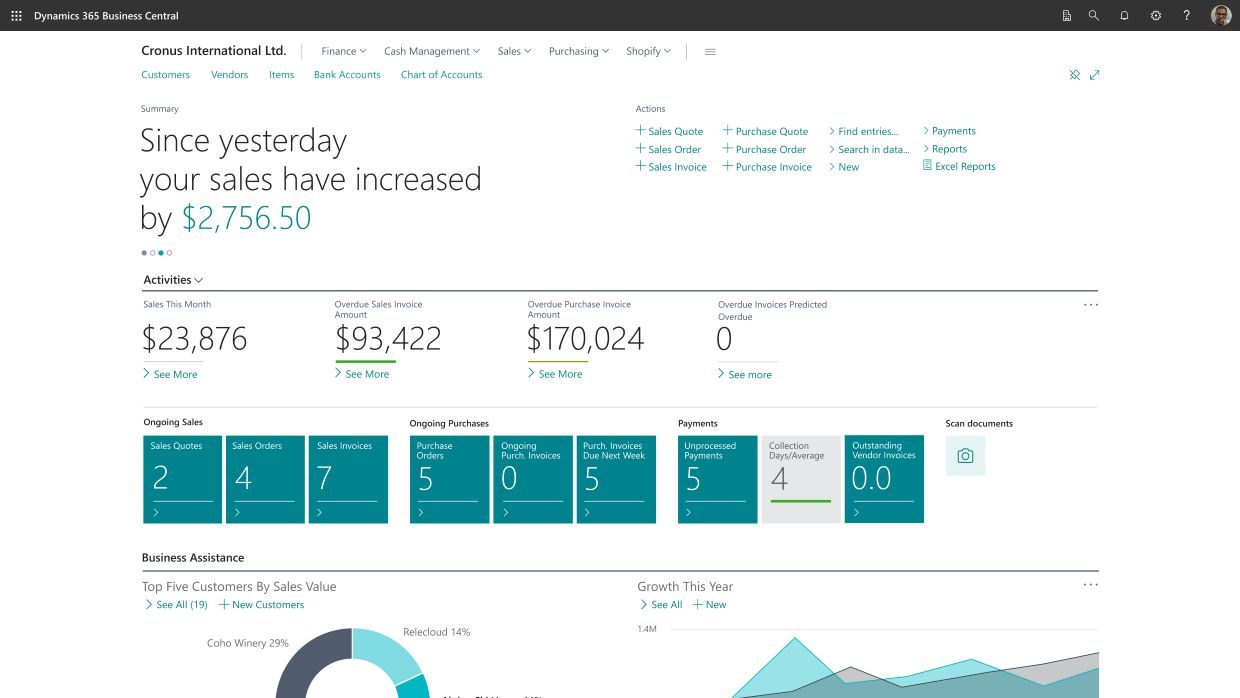
Microsoft Dynamics 365 Business Central is a cloud ERP built for small and mid-market companies. It's also, once you look past the general ERP label, a capable platform, and one that's been adopted by thousands of project-driven Canadian businesses.
Here's how it works in practice:
The Jobs Module
In Business Central, cloud project accounting runs through the Jobs module. A "Job" is a project: a structured initiative with tasks, budgets, resources, equipment, and deliverables tracked over time. This is not a lightweight project tracker bolted onto accounting software; it's a proper cloud project accounting software environment where financial and operational data live together.
You can read a complete breakdown of how this works in the projects in Business Central guide.
Budget vs. Actual in Real Time
Every Job in Business Central carries a budget. As resources log time, materials are consumed, and expenses are posted, the system updates your budget-to-actual variance automatically. No manual reconciliation. Project managers and finance teams see the same numbers at the same time.
This is software doing what it should: giving you the information to course-correct before a project goes underwater, not after.
WIP Accounting
Business Central's cloud project accounting handles Work in Progress through configurable WIP methods. You can choose percentage-of-completion, contract value, or other recognized methods depending on your accounting standards and client contracts. The system posts WIP entries automatically and reverses them when the project closes, which is exactly the kind of accounting accuracy Canadian businesses need to stay clean for CRA audits.
Project Invoicing
From within the Jobs module, you can generate project invoices in multiple formats: fixed fee, time and materials, or by task milestone. Business Central's cloud project accounting software connects billing to the underlying time and cost entries, so every invoice is tied to documented work. That matters a lot when a Canadian client pushes back on a bill or when CRA wants to see the documentation for an HST remittance.
Resource Management
Business Central's cloud project accounting connects to your resource planning. You can see which team members are allocated to which projects, where capacity is tightest, and whether you have the availability to take on new work before you commit to a client. The 7 reasons to adopt Dynamics 365 Business Central project management article covers this in more depth.
Power BI Reporting
This is only as useful as the insights you can pull from it. Business Central integrates natively with Power BI, so your project profitability reports, utilization dashboards, and billing summaries don't require a separate reporting tool. Everything lives in one ecosystem. You can learn more about this in Gestisoft's article on ERP with Power BI integration.
What a Canadian Implementation Partner Does That Cloud Project Accounting Software Alone Can't
It’s not a plugin you activate on a Tuesday afternoon. The configuration decisions you make at the start, how Jobs are structured, which WIP method you use, how resources connect to billing, how Canadian tax codes are set up - affect how the system performs for years.
This is where working with a certified Canadian Microsoft Partner like Gestisoft makes a concrete difference, not an abstract one.
Gestisoft's implementation team has deployed Business Central as cloud project accounting software for professional services firms, construction companies, and consulting organizations across Canada. The work includes mapping your existing project workflows to the Jobs module, configuring GST/HST handling for your specific billing model, setting up bilingual reporting where needed, and training your team so the adoption sticks.
The alternative: buying Business Central direct, skipping the configuration work, and figuring it out as you go, is a path that often ends with cloud project accounting software that technically runs but doesn't actually serve the business. You can read more about what that configuration process involves in Gestisoft's Business Central Consultant guide.
The benefits of cloud ERP software don't materialize automatically. They come from a system configured correctly for how your business actually works.
Get the Right Configuration from the Start
Gestisoft's Canadian implementation team sets up Business Central's cloud project accounting for how your projects actually run - including Canadian tax handling, bilingual reporting, and your specific billing model.
 Book a free consultation
Cloud Project Accounting Software: The Canadian SMB Checklist
Before choosing a cloud project accounting software platform, run through these questions:
- Does the software handle GST/HST natively on project invoices, including inter-provincial rules?
- Can it manage WIP accounting in a way that aligns with ASPE or IFRS requirements?
- Does time tracking connect directly to billing, or is there a manual step in between?
- Can the system produce bilingual reports and invoices if you operate in Québec?
- Does it integrate with your payroll, procurement, and CRM, or does it live in isolation?
- Will the vendor or implementation partner provide Canadian-specific configuration support?
If the answer to any of those is "no" or "we'd need to check," that's important to know before you sign.
Do You Need Cloud Project Accounting Software?
For Canadian businesses running projects, whether you're a professional services firm, a construction company, an IT consultancy, or anything in between, the question isn't whether you need cloud project accounting software. You do. The question is whether your current setup is actually delivering it or just approximating it with workarounds.
Business Central gives you an environment that connects project management to finance, billing to time tracking, and reporting to the data that actually drove the numbers. Gestisoft configures and implements it for Canadian businesses, with the compliance handling, bilingual capability, and local expertise that generic implementations skip.
Let's Build Your Cloud Project Accounting Foundation Gestisoft's team works with Canadian businesses to configure Business Central for real project financial management, not just out-of-the-box software, but a system built for how your projects actually run. Book a Free Consultation.
-
Cloud project accounting software is a financial management platform that tracks costs, revenues, time, and billing at the individual project level, hosted online so every team member accesses the same real-time data from anywhere. Unlike standard accounting tools, it gives you a profit and loss picture for each project, not just the company as a whole.
Explore More
- Projects in Business Central: complete guide to managing projects in Dynamics 365 - Everything you need to know about setting up and running projects in Business Central's Jobs module.
- Project accounting module: definition, benefits, functionalities - A deep dive into what a project accounting module does and why it matters for project-driven businesses.
- 7 reasons to adopt Dynamics 365 Business Central project management - The practical case for bringing project management into your ERP.
- The benefits of ERP software on the cloud - Why cloud ERP delivers advantages that on-premise and desktop solutions can't match.
- Business Central Partner: definition, benefits, services - What to look for in a Business Central implementation partner and what Gestisoft brings to the table.
Liked what you just read? Sharing is caring.

May 22, 2026 by Conni Guido by Conni Guido Copywriter and Brand Strategist
I started with a degree in Professional Communications and never looked back. Now, I'm a professional storyteller who believes every brand has a story to tell, and every good story should leave you wanting more. You can find me lost in a book club or a writing sprint, baking words into pies...probably both.
