

In the early stages of growth, most businesses may not need an accounting software consultant.
In fact, it’s typically enough for a business owner or manager to use an accounting platform directly themselves. Large accounting softwares such as QuickBooks, Xero or Sage provide intuitive structure, visibility and control that are beginner friendly and present a low learning curve to use effectively.
However, growth often introduces complexity. As a business reaches medium sized territory, it needs adequate systems that can handle more transactions, products and customers.
Gradually, that simplicity that once made your accounting software initially easy to use may start to introduce friction instead.
It’s at this stage where an accounting software consultant can help better structure and personalise your accounting software and any adjacent tools (such as Shopify) to match your current business stage of growth.
In this article, we’ll present six clear signs your business is likely to benefit from an accounting software consultant, in addition to when these signs may indicate it’s time to move beyond accounting software entirely to a more integrated ERP (Enterprise Resource Planning) system.
Is your financial system slowing down business growth?
An experienced accounting software consultant can help overcome financial friction.
 Free discovery call
1. Your Financial Reports Take Longer Than They Used To
One of the earliest signs you may need an accounting software consultant is that reporting simply takes longer.
What used to be a straightforward process, for instance pulling a profit and loss statement or reviewing monthly performance, starts requiring additional steps.
This might mean doubt starts to creep in, which means numbers need re-checking, reports need further refining, and your finance team spends more time preparing data than interpreting it.
This often happens as transaction volume increases as, although your accounting software is still doing its job, the effort required to extract meaningful insights grows alongside your business.
So in practice, this often shows up as a lag between finance and leadership, as instead of reviewing performance in real time, reports are delivered days later; often with caveats or manual adjustments.
That delay may seem small at first, but over time it compounds, as decisions become reactive rather than proactive, and the finance function shifts from guiding the business to simply reporting on what has already happened.
At this stage, an accounting software consultant can help streamline how reports are structured and generated, which can help remove unnecessary complexity before it compounds further.
2. You’re Relying on Spreadsheets to Fill the Gaps
Most businesses may insidiously start to depend on spreadsheets over time as a backup to fill in the gaps.
For instance, a finance team may export data from Shopify to analyse margins, but inventory is tracked separately to understand product performance. Thus, reports must be adjusted manually before being shared with leadership.
Individually, these workarounds may work, but collectively, they signal that your accounting software is no longer capturing the full picture.
An accounting software consultant will typically identify these gaps quickly and, more importantly, they’ll help eliminate the need for manual fixes by improving how your systems interact in the first place.
3. Your Team Spends Too Much Time on Reconciliation
Even with integration, reconciliation doesn’t just disappear— it just changes form.
Take MapleStride, a fictitious growing Canadian eCommerce brand. They process roughly 1,200 orders per month and generate around $180,000 CAD in revenue. Their accounting software QuickBooks is fully integrated with Shopify.
Yet, their finance team still spends hours each week reconciling:
Shopify payouts arriving in lump sums
Transaction fees varying per order
Refunds appearing separately in QuickBooks
Despite having the “right” tools in place, the structure of the data doesn’t align with how reporting needs to happen.
This is where an accounting software consultant becomes particularly valuable, because rather than treating reconciliation as an unavoidable task, they redesign how transactions are recorded, overall reducing the need for manual intervention altogether.
A Subtle Shift: When Optimisation Isn’t Enough
Up to this point, the issues are manageable. An accounting software consultant can optimize your current setup and remove inefficiencies.
But for many growing businesses, it’s not about how well your accounting software is working, but whether it’s still the right foundation altogether.
Still relying on disconnected systems to manage your finances?
An accounting software consultant can help you simplify and scale with clarity.
 Free discovery call
4. Your Systems Don’t Communicate Cleanly
As businesses scale, they rarely operate on a single platform.
For instance, sales might live in Shopify, financials in accounting software such as Xero, QuickBooks or Sage, and inventory in a separate system.
However, even with integrations, these systems don’t always communicate efficiently.
For our fictitious company MapleStride, this meant pulling data from multiple sources just to understand basic performance metrics. Sales data didn’t align perfectly with financial records, and inventory costs weren’t reflected in real time.
The real cost is fragmentation of data and wasted time.
An accounting software consultant can help improve integration, but they’ll also recognise when fragmentation is system structural rather than technical.
5. You Lack Real-Time Visibility Across the Business
At a certain stage, delayed insights become a problem.
If your leadership team has to wait for reports before making important decisions, or even question their accuracy in the first place, it becomes difficult to act quickly.
Opportunities are missed not because the data isn’t available, but because it isn’t accessible in real-time.
This is where many businesses start to feel a disconnect between operations and decision-making.
This gap becomes especially noticeable during periods of growth or uncertainty. Leadership teams may ask simple questions—such as current cash position, product profitability, or regional performance—but the answers require multiple data pulls and manual validation.
When visibility depends on effort rather than access, it creates hesitation. And hesitation, in a growing business, often translates into missed opportunities.
An accounting software consultant can improve reporting workflows, but they can also highlight a more fundamental limitation: your accounting software is designed for financial tracking, not full operational visibility.
6. Strategic Decisions Are Slowing Down
This is often the clearest signal. Your business may be growing, but decisions take longer than you want.
Take these commonly important business expansion decisions:
- Do you expand into a new region?
- Increase inventory spend?
- Invest in a new product line?
The answers exist in your data, but extracting them requires time, validation, and often manual effort.
For our company MapleStride, imagine they’re now considering expanding into the US market. On paper, demand looks strong, but without clear visibility on margins, shipping costs, and currency impact, the decision becomes delayed.
What could be a confident data-led decision may quickly turn into a cautious estimate, simply because the underlying systems don’t provide a confident answer quickly enough.
At this point, the role of an accounting software consultant shifts, because it’s no longer just about improving your current setup, it’s about recognising that your systems may no longer support the level of decision-making your business requires.

When Accounting Software May Struggle
Tools like QuickBooks, Xero, and Sage are excellent starting points— they provide structure, automation, and accessibility, especially in the early stages of growth.
But they are fundamentally designed to manage financial records, rather than unify all departments into one usable system.
For instance, they may struggle to cater for operations between:
- Inventory
- Sales operations
- Purchasing
- Multi-entity reporting
- Real-time performance tracking across departments
This is the point where an accounting software consultant will often guide businesses toward a broader solution.
The Natural Next Step: Moving Toward ERP
For businesses experiencing these challenges, the conversation naturally shifts toward ERP (Enterprise Resource Planning) systems.
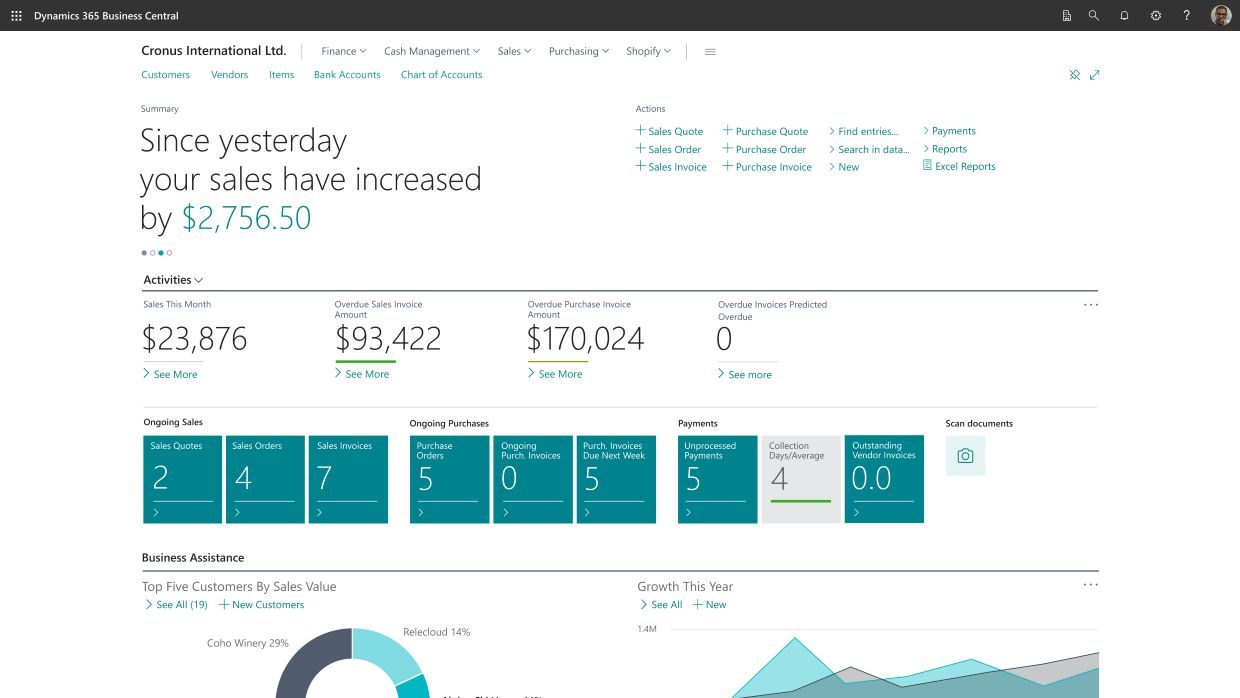
Unlike traditional accounting software, ERP platforms bring all core business functions into a single environment, such as Microsoft Dynamics 365 Business Central.
This is often the natural next step for businesses that have outgrown tools like QuickBooks and require a more structured system.
Instead of integrating multiple tools, an ERP system connects finance, inventory, sales, and operations from the ground up. This fundamentally changes how the business operates, as:
- Financial data updates in real time.
- Inventory and sales are automatically aligned.
- Reporting reflects the entire business—not just financials.
What makes this shift significant is that it provides clarity. Instead of stitching together reports from multiple systems, decision-makers operate from a single source of truth.
Finance, operations, and inventory no longer need to be reconciled manually as they’re already inherently aligned.
For many businesses, this is the point where finance transitions from a reporting function into a strategic driver of growth.
An accounting software consultant can play a key role in this transition by helping determine when the shift makes sense, and how to approach it without disrupting current operations.
Real-World Perspective: MapleStride’s Transition
Let’s return to our fictitious company MapleStride: before working with an accounting software consultant, MapleStride’s systems were functional, but increasingly difficult to manage.
How did this show up in their workflows?
- Reconciliation required 6–8 hours per week
- Month-end close took several days
- Reports needed manual validation before use
But after transitioning into an ERP model, the improvements were noticeable:
- Reconciliation reduced to a few hours
- Reporting became real-time
- Leadership could make decisions with confidence
This complete operational overhaul of their current business systems now provides the foundations for sustainable business growth.
The Role of an Implementation Partner
While an accounting software consultant can guide strategy, many businesses choose to work with implementation partners like Gestisoft to execute the transition.
An implementation partner typically helps companies using the following timeline:
- Map existing systems and data
- Design a scalable structure
- Ensure a smooth transition with minimal disruption
- Support team adoption
This is particularly valuable when moving beyond accounting software into ERP, where both technical and operational considerations need to align.
Curious about the real impact of an integrated ERP like Business Central?
Download our calculator to find out the real ROI of implementing Business Central with an accounting software consultant.

Accounting software consultant: Bringing It All Together
To conclude, the need for an accounting software consultant rarely comes from a single issue.
It tends to be the accumulation of small inefficiencies, such as slower reporting, manual workarounds, and fragmented systems, that gradually impact how your business operates.
At first, these can be optimised. But eventually, they point to something larger: a system that no longer fits the business it supports.
Recognising that moment is where an accounting software consultant adds the most value, and can best advise whether to continue using your current accounting software, or suggest a shift to a more integrated system like an ERP.
-
An accounting software consultant helps businesses optimise, integrate, and scale their financial systems to improve efficiency and reporting.
Looking to scale with the right systems in place?
Book a discovery call to see how an accounting software consultant can support your next stage of growth.
 Book a free consultation
Liked what you just read? Sharing is caring.

April 27, 2026 by Kooldeep Sahye by Kooldeep Sahye Inbound Marketing Manager
Specializing in SEO-driven pipeline growth, I combine keyword strategy, content optimization, and inbound tactics to turn organic search into a reliable source of qualified leads. I work at the intersection of traditional SEO and AI search — optimizing for LLMs and AI Overviews alongside Google — pairing data-informed strategy with sharp, story-led copywriting.