

Key Takeaways::
- Method choice counts early on: most small businesses can use the cash method, but incorporated businesses and anyone required to follow GAAP need accrual accounting for small business reporting to be accurate.
- GST/HST registration isn't optional past $30,000: know the threshold before the CRA finds it for you.
- Payroll compliance (CPP, EI, income tax) is where owners get caught off guard, especially once they hire their first employee.
- There's a clear tipping point where accounting for small business needs to move from spreadsheets or basic software into a connected system, and most owners cross it later than they should.
Most small business owners didn't start their company because they love reconciling bank statements. They started it because they were good at something else: building furniture, writing code, running a clinic, importing coffee. Then a year in, the CRA sends a letter, or a client asks for a proper invoice, or the bookkeeper quits, and suddenly accounting for small business stops being an afterthought and becomes the thing keeping them up at night.
Here's the good news. Accounting for small business in Canada follows a fairly predictable path, and most of the panic comes from not knowing what's coming next. This article walks through what needs tracking, what the CRA expects at each stage of accounting for small business, the mistakes that quietly cost owners money, and the point where spreadsheets and basic software stop being enough.
Take the Guesswork Out of Financial Reporting
Tax season shouldn't feel like archaeology. Talk to a Gestisoft expert about setting up systems that track compliance automatically.
 Free discovery call
What Accounting for Small Business Really Means
Accounting and bookkeeping get used interchangeably, but they're doing different jobs. Bookkeeping is the recording layer: every sale, every expense, every bank transaction, entered and categorized. Accounting for small business takes that raw data and turns it into something usable: financial statements, tax filings, cash flow forecasts, decisions about whether you can afford to hire.
A small business handling its own books typically needs to track four things consistently:
- Income
- Expenses
- Receivables (money owed to you)
- Payables (money you owe)
Miss any one of these for a few months, and the picture gets blurry fast. This is why so many owners describe their finances as "fine until suddenly they're not." The shoebox of receipts works until tax season arrives and nobody can remember what charges from March was for.
Setting up accounting for small business properly from day one means opening a dedicated business bank account, choosing an accounting method, and picking a way to record transactions, whether that's a spreadsheet, off-the-shelf software, or eventually something more robust. Skipping the setup step is the single most common reason bookkeeping turns into a mess by year two.
Cash vs. Accrual: Which Method Fits Your Accounting for Small Business?
Every business doing accounting for small business in Canada has to pick between two methods, and the choice affects how your financial picture looks month to month.
The Cash Method
The cash method records income when you receive the money and expenses when you pay them. It's simple; it matches your bank balance closely, and it's why most sole proprietors and freelancers default to it.
The Accrual Method
The accrual method records income when it's earned and expenses when they're incurred, regardless of when cash changes hands. If you invoice a client in November but get paid in January, accrual accounting counts that revenue in November. This method gives a more accurate picture of profitability, but it takes more discipline to maintain.
Here's the part competitors gloss over: incorporated businesses in Canada are expected to use accrual accounting for small business reporting to comply with accepted accounting principles, particularly once a lender, investor, or the CRA wants a full financial statement. If you're still a sole proprietor with straightforward transactions, cash accounting is usually fine. The moment you incorporate or start managing inventory, revisit the method with an accountant before it becomes a bigger cleanup job later.

The GST/HST Reality Every Small Business Owner Needs to Know for Accounting for Small Business
This is where a lot of small businesses get caught off guard. According to the CRA, once your business earns more than $30,000 in revenue over four consecutive calendar quarters, you're required to register for a GST/HST account and start charging tax on your sales. Below that threshold, registration is optional, though some businesses register early anyway to claim input tax credits on their own purchases.
Once registered, the rate you charge depends on the province where the sale takes place, not necessarily where your business is located. Ontario, for example, applies a 13% HST, while Alberta has no provincial sales tax and only the 5% GST applies. Businesses that sell across provinces need to track this carefully, since applying the wrong rate is a common and expensive mistake.
Filing frequency (monthly, quarterly, or annually) depends on your revenue level, and missing a filing deadline brings penalties on any balance owing, calculated as a percentage of the unpaid amount plus a monthly charge for as long as it stays unpaid.
Good accounting for small business means building GST/HST tracking into your bookkeeping from the start rather than reconstructing it at filing time, since accounting for small business teams that leave tax tracking until year-end almost always lose hours they didn't have to lose.
Payroll, CPP, and EI: The Compliance Side of Accounting for Small Business
Hiring your first employee changes everything about how accounting for small business works day to day. According to the CRA, beyond paying a salary, you're now responsible for deducting income tax, Canada Pension Plan (CPP) contributions, and Employment Insurance (EI) premiums from every paycheque, then remitting those amounts to the CRA on a schedule that depends on your business size.
Employers also match a portion of CPP and pay an additional EI premium on top of what's deducted from the employee. Miss a remittance deadline and the penalty starts at 3% of the amount and climbs the longer it stays unpaid, reaching 10% for more serious or repeated failures, with a further 20% penalty possible if a second failure in the same calendar year is deemed knowing or grossly negligent. This is one of the areas where small businesses most often decide to bring in a bookkeeper or payroll service, since the compliance risk outweighs the cost of getting help.
Payroll isn't the only recurring payment obligation that catches owners off guard. Once you're running payroll on a schedule, paying vendors on a schedule is the natural next habit to build, and automated vendor payments exist specifically to take manual cheque runs and email approvals out of the process. Businesses that later move to a connected system often set up EFT payments for both vendor and payroll disbursements so nothing depends on someone remembering to print and mail a cheque.
Anyone doing accounting for small business with even one employee should also track vacation pay accrual, statutory holiday pay, and any provincial employment standards specific to where the employee works. These aren't optional extras. They're legal obligations that get audited.
Four Common Mistakes of Accounting for Small Business That Cost Small Businesses Money
A few patterns show up again and again in accounting for small business, and they're almost always fixable once someone points them out.
#1. The Most Frequent Offender: Mixing Personal and Business Expenses
It muddies the financial picture, complicates tax filing, and can create real problems if the CRA ever audits the business, since personal charges run through a business account raise questions about the legitimacy of other deductions.
#2. Not Tracking Receivables Closely Enough
A business can look profitable on paper while quietly running out of cash because customers are taking 60 or 90 days to pay. Accounting for small business needs to include an aging report, even a basic one, so overdue invoices don't get forgotten. Businesses that manage a lot of client relationships alongside their books often find it helps to look at 5 reasons for implementing an accounting CRM, since a system that tracks both the relationship and the invoice tends to catch overdue payments faster than a spreadsheet ever will.
#3. Under-claiming Eligible Deductions is Common Too
Particularly home office expenses, vehicle use, and professional development costs. Owners either don't know what qualifies or don't keep the documentation to back it up.
#4. Falling Behind on Reconciliation
Meaning not regularly matching your books against actual bank and credit card statements, lets small errors snowball into large ones. A business that reconciles monthly catches a duplicate charge or a missing invoice fast. A business that reconciles once a year discovers it during tax season, when there's no time left to fix it cleanly.

Curious What a Connected System Could Save You?
Our Business Central ROI calculator shows the real cost comparison between your current setup and a connected finance platform, no sales call required to see the numbers.
 Download your ERP ROI calculator now
Signs You've Outgrown DIY Accounting for Small Business
There's a point where the tools that got a small business through its first two or three years stop being enough for accounting for small business needs, and recognizing it early saves a lot of frustration.
- If your bookkeeper is spending hours reconciling data between disconnected systems (sales in one place, inventory in another, accounting in a third), that's a signal.
- If month-end close takes more than a few days, or your financial reports are always a few weeks out of date by the time anyone reads them, that's another.
- If you're making pricing or hiring decisions based on a gut feeling because you can't get real-time numbers, accounting for small businesses has quietly become a bottleneck rather than a support function.
This isn't a hypothetical pattern. It's what happened at AmNor Industries, a Quebec-based industrial cleaning company that grew to nearly 150 employees while still running its books across disconnected spreadsheets, PDFs, and paper files.
As their Corporate Finance Director, Sonia Préville, put it: "We didn't want to suffer in our inefficiency any longer." Their team moved to Business Central and cut the time it took to produce financial statements by more than 80%, going from reports that were consistently late to numbers available in real time.
The full AmNor case study is a good read if any of the symptoms above sound familiar.
None of this means the business is doing anything wrong. It means the business has grown past the stage where a spreadsheet or an entry-level accounting tool can keep up, and that's a normal, even encouraging, milestone.
Choosing the Right Accounting for Small Business Software
Most businesses start with something like QuickBooks or Sage, and for good reason. Both are solid at the basics of accounting for small business: invoicing, expense tracking, GST/HST reporting, bank reconciliation. If you're a sole proprietor or a business with a handful of transactions each month, either one likely covers your needs without a fuss.
Where these platforms tend to fall short is the moment a business adds complexity: multiple locations, inventory that needs to sync with sales, project-based costing, or a finance team that needs real-time visibility instead of end-of-month reports. At that point, businesses often patch the gap with spreadsheets, and the patch becomes its own maintenance burden.
If you're comparing options at the entry level, our breakdown of free accounting software for small businesses in Canada covers the tools to test before committing to a paid plan. If you're already past that stage and weighing what comes next, our comparison of accounting software alternatives to QuickBooks walks through the options, including where AmNor landed. And before committing to any switch, read through what accounting software implementation really costs, since licensing is only one line item in a much longer budget.
When Accounting for Small Business Becomes Accounting for a Growing Business
There's a natural progression most Canadian small businesses follow: spreadsheets, then entry-level software like QuickBooks or Sage, then eventually a connected ERP system once the business has outgrown what those tools can handle. If you're not sure what that term covers beyond the marketing language, this explainer on what an ERP system means for accounting is a useful starting point, and this overview of what Business Central includes covers the specific platform Canadian SMBs land on most often.
What Business Central Adds to Accounting for Small Business
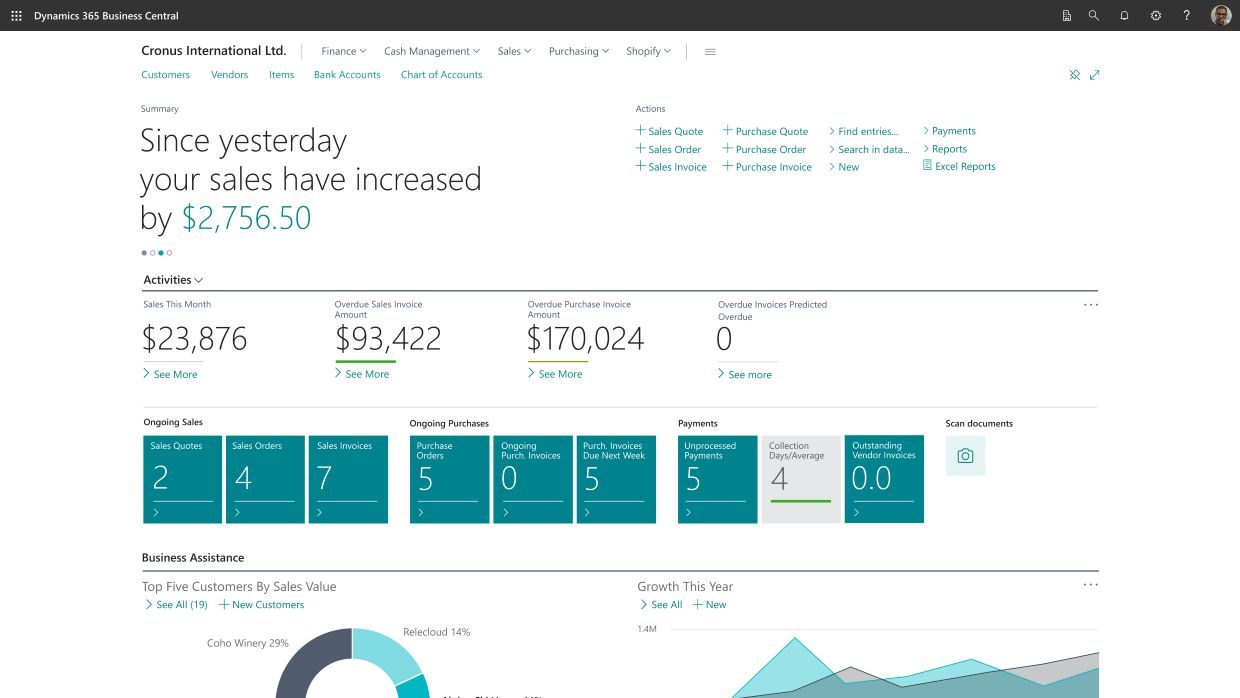
This is where Business Central's financial management module tends to enter the conversation. Rather than treating accounting as a standalone function, Business Central connects it to sales, inventory, and operations, so a change in one area shows up automatically in your financial reports instead of requiring a manual update somewhere else. The platform is organized into distinct functional areas, and Business Central's module breakdown is a good reference if you want to see exactly what's included before evaluating a switch. For a business managing multiple entities, currencies, or locations, that connection is often the difference between a finance team that spends its time compiling data and one that spends its time analyzing it.
Business Central is also built with smaller and mid-sized businesses in mind, not just large enterprises, which is part of why Canadian SMBs moving off QuickBooks or Sage often land there next. Gestisoft, as a Canadian Microsoft Partner, implements Business Central with local tax rules, bilingual support, and Canadian payroll requirements already built into the setup, so businesses aren't reconfiguring an American or global template to fit CRA rules after the fact. Once the system is live, teams typically go through role-based Business Central training so staff aren't just handed a new tool without knowing how their daily tasks map onto it.
AI and Automation in Accounting for Small Business
A growing part of this progression is AI. AI for accounting inside Business Central combines Copilot with intelligent agents that handle repetitive tasks like reconciliations and data entry, with every suggestion still subject to human review. On the Microsoft 365 side, Copilot for Finance extends that same automation into everyday tools like Outlook and Excel, and this deeper look at using Copilot for Finance in Dynamics 365 covers specific use cases like collections follow-ups. None of this replaces a finance team's judgment, but it does remove a meaningful chunk of the manual work that makes accounting for small business feel heavier than it needs to.
Businesses further along this path are also automating financial close and reporting more broadly. Financial automation software covers this category in more depth, comparing what SMBs typically need against what enterprise finance teams measure.
Still Have Questions About Your Financial Setup?
Every business's accounting needs look a little different. Book time with a Gestisoft advisor to talk through what makes sense for yours.
 Book a free consultation
Growing Beyond One Entity or Currency
Not every small business stays a single entity in one currency forever. If you're opening a second location, adding a related company, or starting to invoice in USD, accounting for small business starts to intersect with structures that spreadsheets were never built to handle. Multi-company and multi-currency accounting in Business Central centralizes financial operations across entities while keeping each one's records separate for compliance purposes, and financial consolidation with multi-entity accounting software explains what that looks like once you need a combined view across the group. If currency alone is the trigger, accounting software built for multi-currency operations breaks down what to look for before revenue in a second currency starts complicating your reports.
Choosing the Right Implementation Partner for Accounting for Small Business
Making the jump from accounting software to a full ERP system usually means bringing in outside expertise, and that decision deserves its own scrutiny. What ERP consulting involves, and what it costs is a fair place to start if you've never gone through an implementation before, and the benefits of working with an ERP consultant lays out what a good partner adds beyond just installing software. For businesses whose accounting and sales teams work closely together, it also helps to read about how a connected CRM supports finance and compliance, since receivables and client relationships are often managed by two different teams using two different tools, and accounting for small business gets messy fast when those two systems don't talk to each other.
Your Accounting for Small Business has needs, no matter what stage it’s at. Gestisoft will meet your business where it’s at to help guide you on your best course. Contact us today and speak to a Gestisoft representative!
-
Bookkeeping is the day-to-day recording of transactions. Accounting for small business takes that data and turns it into financial statements, tax filings, and the kind of reporting an owner uses to make decisions.
Explore More:
- Top 10 Free Accounting Software in Canada for Small Businesses: A practical comparison for businesses still evaluating entry-level tools.
- What Makes Business Central Such a Good Fit for Small Businesses?: A closer look at how Business Central scales with a growing business.
- 7 Accounting Software Alternatives to QuickBooks: For businesses ready to compare what comes after entry-level software.
- How AmNor Completely Changed Its Accounting System in 90 Days: A real Canadian small business's transition from disconnected spreadsheets to Business Central.
- Business Central Financial Management: Gestisoft's product page for connected financial management.
Liked what you just read? Sharing is caring.

July 27, 2026 by Conni Guido by Conni Guido Copywriter and Brand Strategist
I started with a degree in Professional Communications and never looked back. Now, I'm a professional storyteller who believes every brand has a story to tell, and every good story should leave you wanting more. You can find me lost in a book club or a writing sprint, baking words into pies...probably both.

