

Picking the right wholesale software distributors in 2026 has become harder, not easier, because every vendor sounds the same in a demo. You sit through slick presentations, nod at the AI features, then go home unsure what actually fits your warehouse, your team, and your budget. The market is loud, and the gap between what a system promises on stage and what it delivers on the floor is wider than most buyers realize.
This guide is built for distributors who do not have time to compare 30 platforms but want a shortlist they can trust. We will walk through the 7 wholesale software distributors Canadian buyers should compare this year, what each one is genuinely good at, where each one falls short, and the real questions to ask before you sign anything.
Get A Clear Path Forward With A Free Discovery Call
Talk through your distribution operations with a Microsoft Partner and walk away with real direction on what fits your business...
 Book a free consultation
The 7 Best Wholesale Software Distributors For Canadian Businesses In 2026
These are the 7 platforms Canadian distributors shortlist most often, ranked by fit for mid-market wholesale operations.
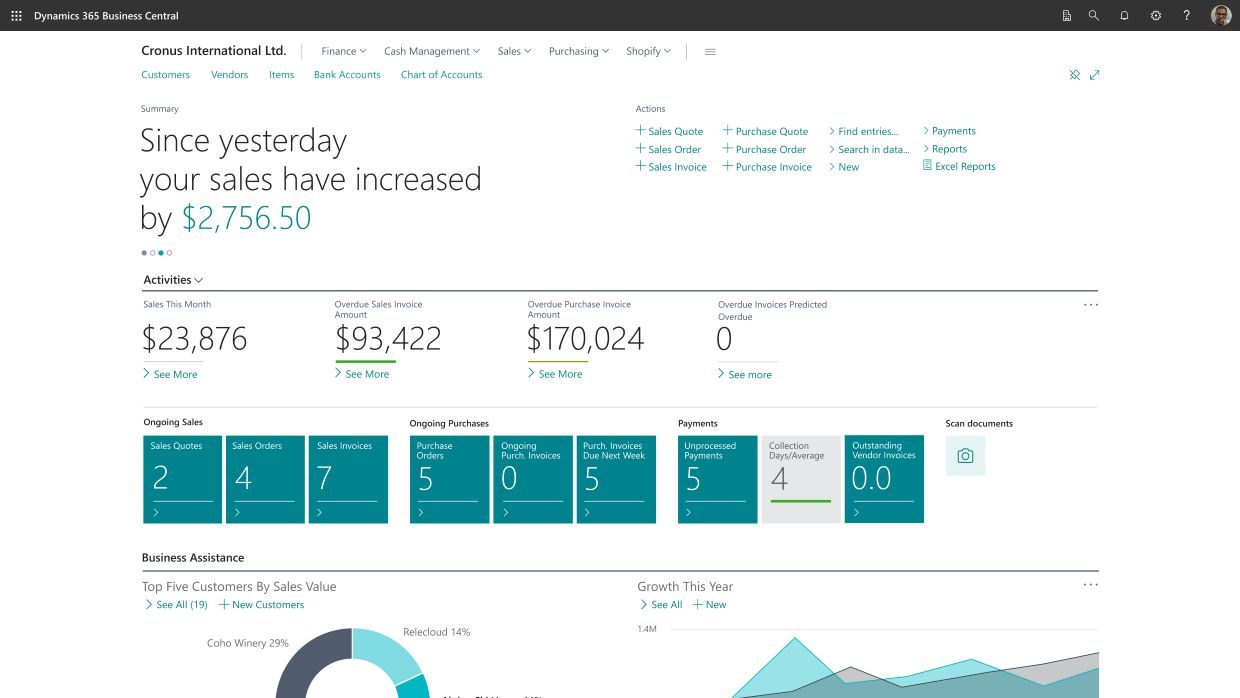
1. Microsoft Dynamics 365 Business Central
Best fit for small to mid-market Canadian distributors who want a full ERP that handles finance, inventory, warehousing, and sales in one place without enterprise complexity.
Business Central runs in the cloud, connects natively with Microsoft 365 and Power BI, and supports multi-currency, multi-warehouse, and bilingual operations. Among the wholesale software distributors aimed at SMBs, it offers strong native ERP warehouse management, real-time inventory across locations, and Copilot AI built into daily workflows.
Trade-offs are real too. Advanced warehouse features like wave picking need WMS add-ons, and complex pricing structures may need partner extensions. For most Canadian SMB distributors, the combination of Microsoft ecosystem fit and depth out of the box makes it a strong starting point.
2. NetSuite
Best fit for growing distributors who plan to scale into multiple subsidiaries, international operations, or complex consolidation.
NetSuite is a cloud ERP built originally for distribution, so the bones are solid. It handles multi-entity finance, demand planning, warehouse management, and B2B portals well, and the SuiteCommerce module gives you native e-commerce. Strengths include deep customization, strong global tax handling, and a mature partner ecosystem.
The trade-offs sting, though. Costs run higher than other wholesale software distributors in this comparison, and customization adds up fast. Implementations also tend to run longer than Business Central or Acumatica projects, which can stretch your ROI timeline.
3. SAP Business One
Best fit for distributors with 50 to 500 employees who want enterprise-grade structure without paying for full SAP S/4HANA.
It handles inventory, purchasing, financials, and CRM in a single system, and SAP's reputation gives leadership comfort during board conversations. Strengths include solid manufacturing and distribution modules, strong reporting, and a mature global ecosystem if you ship internationally.
The trade-offs are where buyers often get surprised. The interface feels dated next to cloud-native wholesale software distributors, the user experience lags Business Central and NetSuite, and you typically need a certified partner for most configuration work.
4. Acumatica Cloud ERP
Best fit for distributors who want unlimited user licensing and strong mobile access for warehouse and field teams.
Acumatica's consumption-based model rewards companies with high headcounts but uneven transaction volumes. The Distribution Edition handles multi-warehouse inventory, matrix items, and customer-specific pricing well, and the mobile app gives warehouse teams full ERP access on handheld devices.
Among cloud-native wholesale software distributors, it stands out for a modern interface and strong workflow automation without code. Trade-offs include a smaller Canadian partner network than Microsoft, which can matter when you need local implementation support, and e-commerce connectors that take more configuration work than out-of-the-box options on other platforms.
5. Sage X3
Best fit for established Canadian distributors with complex pricing, multi-location inventory, and a need for granular financial reporting across entities.
Sage X3 sits between Sage 300 and full enterprise ERP, so it handles serious operational depth without the cost of Tier 1 systems. Strengths include strong batch and lot tracking, mature manufacturing integration for distributors who also assemble or kit, and comprehensive multi-currency and multi-language support.
Trade-offs are worth flagging when comparing it to newer cloud-native systems. The interface feels older than its peers, mobile capabilities lag the field, and implementations tend to lean heavily on partner customization. It suits companies with budget for a longer-term deployment.
6. Infor CloudSuite Distribution
Best fit for industry-specific wholesale distributors in building materials, electrical, industrial, food service, and HVAC who want pre-built workflows for their vertical.
Infor's distribution suite was built specifically for these segments, so out-of-the-box functionality is closer to what wholesalers need on day one. Strengths include strong demand forecasting, embedded AI for pricing and parts matching, and a tier-1 warehouse management system that competes with dedicated WMS vendors.
Trade-offs include a smaller direct presence in Canada than other wholesale software distributors on this list, which means partner selection matters more than usual. It is typically aimed at upper mid-market and enterprise distributors, so smaller operations may find it heavy for their stage.
7. Blue Link ERP
Best fit for small to mid-sized Canadian wholesalers and distributors, especially businesses that import, export, or sell through both B2B and retail channels.
Blue Link is Canadian-built, headquartered in Ontario, and designed from the ground up for distribution. It offers native landed cost tracking, lot and serial tracking, EDI support, and a built-in e-commerce module for B2B portals. The team understands Canadian sales tax and cross-border realities, which removes a lot of friction in implementation.
Trade-offs include a smaller global footprint than the Tier 1 vendors and less depth for companies planning aggressive international expansion. For smaller Canadian distributors who want a system built around their reality, it remains one of the most relevant shortlist entries.
A short look at how a real warehouse workflow runs inside Business Central will tell you more than any feature list.
What To Look For In Wholesale Software Distributors Before You Shortlist
Before you book any demos, get clear on what your operation actually needs. Most buyers skip this step and end up with wholesale software distributors that demo well but break during peak season. The broader category of ERP distribution software covers more ground than a pure inventory tool, so define your scope first.
7 Non-Negotiables For Any Wholesale Software Distributors Worth Your Time
- Real-time inventory visibility across every warehouse, not delayed batch updates that leave your sales team selling out-of-stock items.
- Native multi-channel order management so wholesale, retail, and e-commerce orders land in one queue with consistent pricing rules.
- Built-in landed cost tracking that pulls duty, freight, and currency adjustments into your true unit cost.
- Bilingual support and Canadian tax handling for PST, GST, HST, and QST without bolt-on workarounds.
- Strong vendor and purchase order management, since most distributor margin pressure comes from procurement, not sales.
- Reporting and analytics you can actually use, ideally with native Power BI or equivalent BI integration.
- A partner network in Canada with real distribution implementation experience, not just generalist consultants.
If a platform fails on two or more of these, take it off your list before the demo. Buyers who get this right usually start by mapping their current stack against what software for distributors typically covers, then narrow from there.
Score Every Vendor On The Same 10 Criteria
A focused guide that walks you through the 10 most important criteria for choosing the right ERP, so your shortlist is judged on what actually matters, not what's loudest in the demo.

How To Choose Between Wholesale Software Distributors Without Regret
Once you have a shortlist of 3 wholesale software distributors, the work shifts from features to fit. The right system on paper still fails if the implementation team does not know your industry, or if your own team does not have bandwidth to adopt it.
Spend more time on the vendor's customer references than on the demo itself. Ask to speak with a Canadian distributor of similar size who went live in the past 18 months. If the vendor cannot produce one, that tells you something about where you would fall on their priority list once contracts are signed. This is also why side-by-side comparisons of the best ERP software for distribution matter more than any single demo.
Questions To Ask Every Vendor Before You Sign
- What does a typical implementation look like for a distributor of my size, in months and total cost?
- Who on your team will actually run my project, and can I meet them before signing?
- How does the system handle a customer-specific price list with 200 SKUs and tiered volume discounts?
- What is the real cost of adding a warehouse in year two, including licensing, configuration, and training?
- Show me how a return from a wholesale customer flows from receipt to credit memo, end to end.
- What integrations with our e-commerce or EDI partners are pre-built versus custom?
- What is your churn rate among customers in our industry over the past 3 years?
The questions you do not ask in the sales cycle become problems in month four of implementation. This is true for every shortlist of wholesale software distributors, not just one vendor.
Compare Your Shortlist With A Microsoft Partner
Run your top picks past consultants who implement ERP for distributors across Canada every week. Get a clearer view of what truly fits and what's just marketing fluff.
 Book a free consultation
Common Mistakes Buyers Make With Wholesale Software Distributors
Most buyers approach wholesale software distributors like they are shopping for a single product. They are not. They are buying a long-term operational system, and the mistakes below are the ones that cost real money and real timeline.
Treating Software Selection Like A Product Purchase
The biggest mistake is treating ERP selection like a software purchase when it is really an operational change project. Buyers fixate on feature checklists and forget that 70 percent of implementation outcomes depend on the partner, the project plan, and internal adoption, not the software itself. The wholesale software distributors that win deals are not always the ones that fit best. They are often the ones with the slickest demo.
Underestimating Data Migration Work
A close second is underestimating data migration. Years of messy SKU records, duplicated customer files, and inconsistent units of measure do not magically become clean inside a new system. Plan and budget for data cleanup work up front. Most vendors will not flag this for you, because clean data is your job, not theirs, and bad data is a fast way to a stalled go-live.
Skipping The Change Management Conversation
Buyers often skip the change management conversation entirely. The warehouse manager who built her workflow in the old system over 12 years will not adopt the new one because of a launch email. Plan training, gradual rollouts, and feedback loops before go-live, not after. No amount of feature depth from your chosen wholesale software distributors will fix poor user adoption on the floor.
Picking Software Without Vetting The Implementation Partner
Many companies pick a vendor without checking the implementation partner. Experienced ERP consultancy services in Canada often make the difference between an on-time rollout and a 2-year stall. Two distributors can buy the same software and get completely different results based on the partner sitting beside them.
Realistic Costs Of Wholesale Software Distributors In Canada
Software licensing is the smallest line in your total cost of ownership, usually 20 to 30 percent of your year-one spend on wholesale software distributors. Implementation, data migration, integrations, training, and customization typically make up the rest.
For a Canadian distributor with 25 to 100 users, here is a realistic range to plan against when budgeting for wholesale software distributors. Cloud licensing on most major platforms lands in the same general band per user per month, with mid-market platforms running higher than SMB-focused options.
Implementation for a mid-market distributor typically costs between 75,000 and 350,000 CAD, depending on complexity, integrations, and how much custom development is involved. Add 10 to 20 percent of your first-year cost annually for support, optimization, and minor enhancements after go-live.
These numbers feel high until you compare them with the cost of staying on disconnected tools. Most distributors who switch from a patchwork of spreadsheets, accounting software, and standalone inventory tools recover their investment in wholesale software distributors within 18 to 36 months through reduced errors, faster order cycles, and better margin visibility.
-
The biggest red flag is a vendor who cannot put you on the phone with a current Canadian customer of similar size and industry. Demos are scripted. Reference calls are not. If the vendor stalls on references, that usually means recent implementations have not gone well, and you are about to become the next case study they hope works out.
Choosing Gestisoft To Implement Your Wholesale Software Distributors Stack
If your shortlist includes Business Central, the implementation partner you pick will shape whether it actually works for your business. Gestisoft has been a Microsoft Partner since 1997, with bilingual consultants across Montreal, Toronto, Ottawa, and Quebec City. Our team focuses on distribution, manufacturing, and services for Canadian SMBs, and our 95 percent renewal rate in 2024 reflects how clients tend to stay once we go live together.
We are B Corp certified, recognized as a Great Place to Work in Canada, and listed among Canada's Most Admired Corporate Cultures. More important than any badge is what our distribution clients say about working with us.
“Gestisoft's consultants come from the industry, so when we worked together, we spoke the same language and shared the same vision of what was important and necessary. They guided us in implementing industry best practices. Throughout the project, their industry expertise eliminated any potential irritants that might have risen from inexperience in the distribution environment.”
If that is the kind of partner you are looking for, the next step is straightforward
Map Your Next Steps With A Real Distribution Expert
A free call gives you a clear path forward, your gaps, your fit, your timeline, built around how your business actually runs.
 Book a free consultation
Liked what you just read? Sharing is caring.

May 21, 2026 by Muhammad Ali Iqbal by Muhammad Ali Iqbal SEO Content Strategist & Copywriter
Driven by a passion for search engine optimization, strategic content, and conversion-focused writing. A copywriter and content strategist who lives for content that ranks, engages, and delivers real business results.
