

Choosing the right ERP system is one of the most important decisions a distribution company can make. The right software connects your sales, inventory, warehouse, and finance teams in one system. It gives you real‑time visibility, fewer mistakes, and faster order fulfillment.
But with so many options, how do you find the best ERP software for distribution? This guide will help you understand what to look for, compare leading systems, and decide which solution fits your business size and needs.
Whether you run a small wholesale operation or manage multi‑warehouse logistics, you'll find clear, practical answers here.
What Is the Best ERP Software for Distribution for Your Situation?
There is no single "best" ERP for every distributor. The best ERP software for distribution is the one that fits your size, complexity, and growth plans.
Before you compare systems, ask yourself:
- What is your annual revenue?
- How many users and warehouse locations do you have?
- How many SKUs do you manage?
- What channels do you sell through (phone, email, EDI, eCommerce, marketplaces)?
- Do you have special compliance needs (food, chemicals, medical)?
Common distributor profiles:
1- Small and growing distributors:
Under $10M revenue, single or dual warehouse, fewer than 25 users. Need simple setup, low upfront cost, and room to grow.
2- Established mid‑market distributors:
$10M–$100M revenue, multi‑warehouse, 25–150 users. Need strong inventory control, automated workflows, and solid reporting.
3- Complex or enterprise distributors:
$100M+ revenue, global operations, hundreds of users. Need deep customization, multi‑entity financials, and advanced supply chain tools.
4- eCommerce‑heavy distributors:
Selling through multiple online channels (web stores, marketplaces, B2B portals). Need tight integration between ERP and commerce platforms.
Most small and mid‑market distributors fit profiles 1 or 2. For them, Microsoft Dynamics 365 Business Central is often the best choice.
Knowing your profile helps you shortlist the right systems and avoid paying for features you don't need.
Let's Map Your Distribution ERP Implementation
Connect with our team to map out your timeline, budget, and migration strategy for a smooth go-live.
 Free discovery call
8 Best ERP Software For Distribution: Top Systems Compared
Here are the 8 best ERP software for distribution in 2026. We start with Microsoft Dynamics 365 Business Central because it delivers the best balance of features, cost, and scalability for most small and mid‑market distributors.
1. Microsoft Dynamics 365 Business Central

Business Central is a cloud‑based ERP built for small and mid‑size businesses. It handles financials, sales, purchasing, inventory, and warehouse operations in one system.
Best for: Small and mid‑market distributors, multi‑warehouse operations, growing companies.
Key strengths for distribution:
- Real‑time inventory tracking across all locations
- Multi‑warehouse visibility and transfer orders
- Automated reorder suggestions and demand planning
- Strong financial management and reporting
- Tight integration with Microsoft 365 (Outlook, Excel, Teams)
- Power BI dashboards for sales, inventory, and margins
- Large ecosystem of add‑ons for EDI, WMS, eCommerce, and shipping
- Regular cloud updates with no downtime
- Scalable pricing that grows with your business
When it may not fit:
Very large global enterprises with highly complex custom processes may need additional customization or more specialized platforms.
Deployment: Cloud (SaaS) or on‑premises.
2. Oracle NetSuite

NetSuite is a well‑known cloud ERP for mid‑market and enterprise distributors. It offers strong financials, inventory management, and supply chain tools.
Best for: Fast‑growing mid‑market distributors with higher transaction volumes.
Key strengths:
- Demand planning and forecasting
- Multi‑location inventory control
- Real‑time supply chain visibility
- Deep financial consolidation for multi‑entity businesses
Limits:
Can be expensive and complex to implement. Best for companies ready to invest in a larger platform.
Deployment: Cloud only.
3. Acumatica Cloud ERP

Acumatica is a flexible, modern cloud ERP with unlimited user licensing. It's popular with distributors who want a clean interface and strong mobility.
Best for: Growing distributors who need flexibility and want to avoid per‑user costs.
Key strengths:
- Warehouse management and order processing
- Purchasing automation
- Real‑time tracking dashboards
- Easy customization and add‑ons
Limits:
Smaller ecosystem than Business Central or NetSuite.
Deployment: Cloud only.
4. SAP Business One

SAP Business One is designed for small and mid‑size companies. It offers inventory, procurement, production, and financials in one system.
Best for: Growing SMBs that need solid inventory control and simple supply chain tools.
Key strengths:
- Serial, lot, and batch tracking
- Integrated supply chain management
- Warehouse automation
- Simple, scalable interface
Limits:
Originally built for on‑premises deployment, now shifting more to cloud. Some users find the innovation cycle slower compared to cloud‑native platforms.
Deployment: Cloud or on‑premises.
5. Sage X3

Sage X3 is a mid‑market ERP with strong inventory and financial management. It works well for distributors with moderate complexity.
Best for: Mid‑market distributors needing configurable processes and solid financials.
Key strengths:
- Lot and batch tracking
- High‑level inventory control
- Advanced financial tools
- Good for food, chemical, and industrial distribution
Limits:
Smaller partner network. Implementation can be slower.
Deployment: Cloud or on‑premises.
6. Epicor Prophet 21

Epicor Prophet 21 is built specifically for wholesale distributors. It offers deep industry functionality for complex operations.
Best for: Industrial and MRO distributors with high‑volume, complex workflows.
Key strengths:
- Strong EDI capabilities
- Warehouse control and automation
- Vendor and supplier collaboration tools
- Industry‑specific features for distribution
Limits:
Some users find the interface less modern than newer cloud‑first ERPs.
Deployment: Cloud or on‑premises.
7. Infor CloudSuite Distribution

Infor CloudSuite is designed for mid‑market and enterprise distributors with complex, high‑volume operations.
Best for: Large distributors with multi‑warehouse operations and advanced planning needs.
Key strengths:
- AI‑driven supply chain planning
- Built‑in analytics
- Multi‑warehouse optimization
- Mobile inventory tools
Limits:
Higher cost. Best for larger operations.
Deployment: Cloud.
8. Odoo ERP

Odoo is an open‑source, modular ERP that's affordable and flexible. It's a good fit for startups and small wholesale companies.
Best for: Small distributors with tight budgets who want flexibility.
Key strengths:
- Low cost
- Modular apps for warehouse, sales, and inventory
- Open‑source flexibility
Limits:
Smaller support network. May need custom development for advanced features.
Deployment: Cloud or self‑hosted.
Why Choosing the Best ERP Software For Distribution Matters
Many distributors still rely on spreadsheets, QuickBooks, and disconnected apps. This creates problems like stockouts, wrong shipments, and slow reporting. When your systems don't talk to each other, your team wastes time fixing errors instead of serving customers.
The best ERP software for distribution brings everything together. It tracks inventory in real time across all your warehouses. It automates ordering, picking, packing, and shipping. It connects your sales team, warehouse staff, and accounting department in one place.
Problems without a distribution ERP:
- Stock levels are wrong or outdated
- Orders are delayed or incomplete
- Pricing and rebates are hard to manage
- Reporting takes days instead of minutes
- Teams can't see what's happening in other departments
Benefits with the right distribution ERP:
- Real‑time inventory across all locations
- Faster, more accurate order processing
- Automated reordering and demand planning
- Clear dashboards for sales, costs, and margins
- One system for sales, warehouse, finance, and purchasing
A good ERP helps you cut costs, serve customers faster, and grow without adding chaos.
Start Your Business Central Implementation Today
Get a detailed roadmap, timeline, and pricing tailored to your distribution operation.
 Free discovery call
How to Choose the Best ERP Software For Distribution Step by Step
Picking the right ERP can feel overwhelming. Follow these simple steps to make the process easier.
Step 1 – Map Your Key Processes
Start by writing down your main workflows:
- Quote‑to‑cash: How do you create quotes, turn them into orders, pick and pack, ship, and invoice?
- Purchase‑to‑pay: How do you order from suppliers, receive goods, and pay invoices?
- Warehouse operations: How do you receive, put away, pick, pack, and ship products?
Knowing your current process helps you see where an ERP will make the biggest difference.
Step 2 – Set Your Budget and Timeline
ERP costs include software subscriptions and implementation services. Budget expectations vary widely based on company size, number of users, complexity of operations, and level of customization needed. Implementation timelines also depend on your specific requirements and readiness.
A realistic timeline for most distributors is 3 to 6 months. Rushing the project increases risk.
Step 3 – Shortlist the Best ERP Software For Distribution
Use the profiles from earlier:
- If you're a small or growing distributor, start with Business Central, Acumatica, or Odoo.
- If you're established mid‑market, compare Business Central, NetSuite, and Sage X3.
- If you're complex or enterprise, look at NetSuite, Infor, or specialized platforms.
Don't shortlist more than five systems. You'll waste time on demos that don't fit.
Step 4 – Use a Simple Demo Scorecard
During demos, rate each system on:
- Ease of use for warehouse and sales teams
- Fit with your real scenarios (not generic examples)
- Reporting and dashboards
- Integration options (EDI, shipping, eCommerce)
- Partner quality and local support
Pick the system that scores highest on the features that matter most to your daily operations.
Implementing the Best ERP Software For Distribution Without Disruption
Implementation is where many ERP projects go wrong. Here's what to expect and how to reduce risk.
What to Expect When Implementing the Best ERP Software For Distribution
Most projects follow these phases:
- Discover: Your implementation partner learns your processes and goals.
- Design: You map out how the ERP will work for your business.
- Configure: The partner sets up the system with your data, workflows, and reports.
- Migrate data: You move inventory, customer, and supplier data into the new system.
- Test: Your team tests key workflows to catch issues before go‑live.
- Train: Warehouse, sales, and finance staff learn the new system.
- Go‑live: You switch from the old system to the new ERP.
Common Risks for Distributors
- Poor inventory data: If your current stock counts are wrong, your new ERP will be wrong too. Run a full physical count before migration.
- Lack of training: Warehouse and customer service teams need hands‑on training, not just manuals.
- Too much customization: Start with standard features. Add customizations only after you've used the system for a few months.
How a Good Partner Reduces These Risks
A strong implementation partner will:
- Give you a clear project plan with milestones
- Help you clean up your data before migration
- Provide simple, role‑based training
- Offer ongoing support after go‑live
Choosing the right partner is just as important as choosing the right ERP.
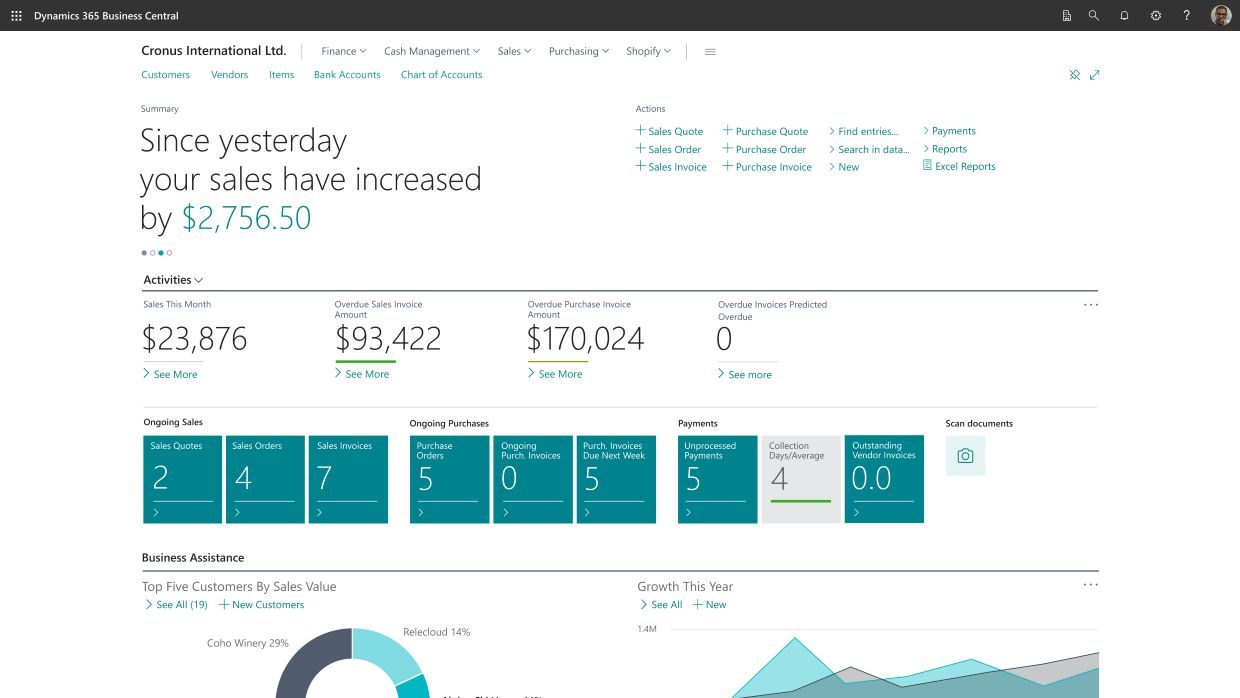
Why Microsoft Dynamics 365 Business Central Is Often the Best ERP Software For Distribution
For most small and mid‑market distributors, Business Central offers the best combination of features, cost, and growth potential.
Why Business Central stands out:
- Built for growing businesses: Business Central scales from 5 users to hundreds without needing a system change.
- Strong distribution features: Real‑time inventory, multi‑warehouse transfers, automated reordering, and clear stock visibility.
- Deep Microsoft integration: Works seamlessly with Outlook, Excel, Teams, and SharePoint. Your team can work in familiar tools.
- Power BI reporting: Build custom dashboards for sales, margins, inventory turns, and fill rates without hiring a developer.
- Power Platform flexibility: Use Power Apps and Power Automate to add workflows and mobile apps without custom coding.
- AI and Copilot ready: Microsoft is adding AI features that help with forecasting, data entry, and insights.
- Large ecosystem: Hundreds of pre‑built add‑ons for EDI, WMS, eCommerce, and shipping integrations.
- Regular cloud updates: Microsoft adds new features every quarter with no downtime or upgrade projects.
Real outcomes for distributors:
- Less manual data entry means fewer errors and faster orders.
- Better stock visibility reduces stockouts and overstock.
- Clear dashboards help managers make faster, smarter decisions.
- Seamless integrations eliminate double entry between systems.
If you're a small or mid‑market distributor looking for a modern, flexible ERP that won't break your budget, Business Central is often the best choice.
Why Gestisoft for the Best ERP Software For Distribution
Choosing the right ERP is only half the battle. You also need a partner who understands distribution, knows Business Central inside out, and can guide you through a smooth implementation.
Gestisoft is a trusted Microsoft partner with deep expertise in Business Central ERP. We work with distributors, manufacturers, and other industries across Canada and beyond.
What makes Gestisoft different:
- Proven experience: We've helped dozens of distribution companies move from legacy systems and spreadsheets to Business Central.
- End‑to‑end service: We support you through every stage, from initial analysis and system design to implementation, data migration, team training, and ongoing support.
- Bilingual team: Our team works in English and French, supporting businesses across Canada with local knowledge and presence.
- Focus on your success: We don't just install software. We help you streamline your workflows, improve visibility, and grow profitably.
How we work with distribution companies:
We start by understanding your business, challenges, and goals. Then we design a Business Central solution that matches your real processes, not the other way around.
During implementation, we configure the system, migrate your data carefully, and test everything with your team.
Training is practical and role‑based, so your warehouse, sales, and finance staff know exactly what to do. After go‑live, we stay with you to ensure smooth operations and answer questions as they come up.
Our clients see real results: faster order processing, better inventory accuracy, and clear financial visibility.
If you're ready to explore Business Central for your distribution business, we're here to help.
Talk to a Gestisoft Expert About Your Next ERP
Get a free consultation and see how Business Central can transform your distribution operations.
 Free discovery call
-
For most small and mid‑market distributors, Microsoft Dynamics 365 Business Central is often the best ERP software for distribution. It offers strong inventory, warehouse, and financial tools at a reasonable cost with excellent scalability.
Liked what you just read? Sharing is caring.

February 25, 2026 by Muhammad Ali Iqbal by Muhammad Ali Iqbal SEO Content Strategist & Copywriter
Driven by a passion for search engine optimization, strategic content, and conversion-focused writing. A copywriter and content strategist who lives for content that ranks, engages, and delivers real business results.
