

Inventory systems for warehouses have moved far past the simple stock counters of a decade ago. Today they handle bin locations, multi-site transfers, mobile scanning, and live tie-ins to your finance system.
For a Canadian SMB, picking the right one is less about feature lists and more about fit. The wrong choice costs you twice: once on the licence, and again on the implementation when your team gives up.
This guide compares eight inventory systems for warehouses that actually work for Canadian operations. You will see what each tool does best, where it breaks, and what it really costs in CAD.
Plan Your Warehouse Setup With a Canadian Microsoft Partner
Get an honest second opinion on your warehouse and inventory plan before you sign anything. Gestisoft has been a Microsoft Solutions Partner for over 20 years and works exclusively with Canadian SMBs.
 Book a free consultation
8 Best Inventory Systems for Warehouses to Compare in 2026
The eight inventory systems for warehouses below cover the realistic shortlist for most Canadian operations, from a 1-person stockroom to a multi-site distributor. Each one solves a different problem, so read the fit signals carefully before you book demos.
1. Microsoft Dynamics 365 Business Central
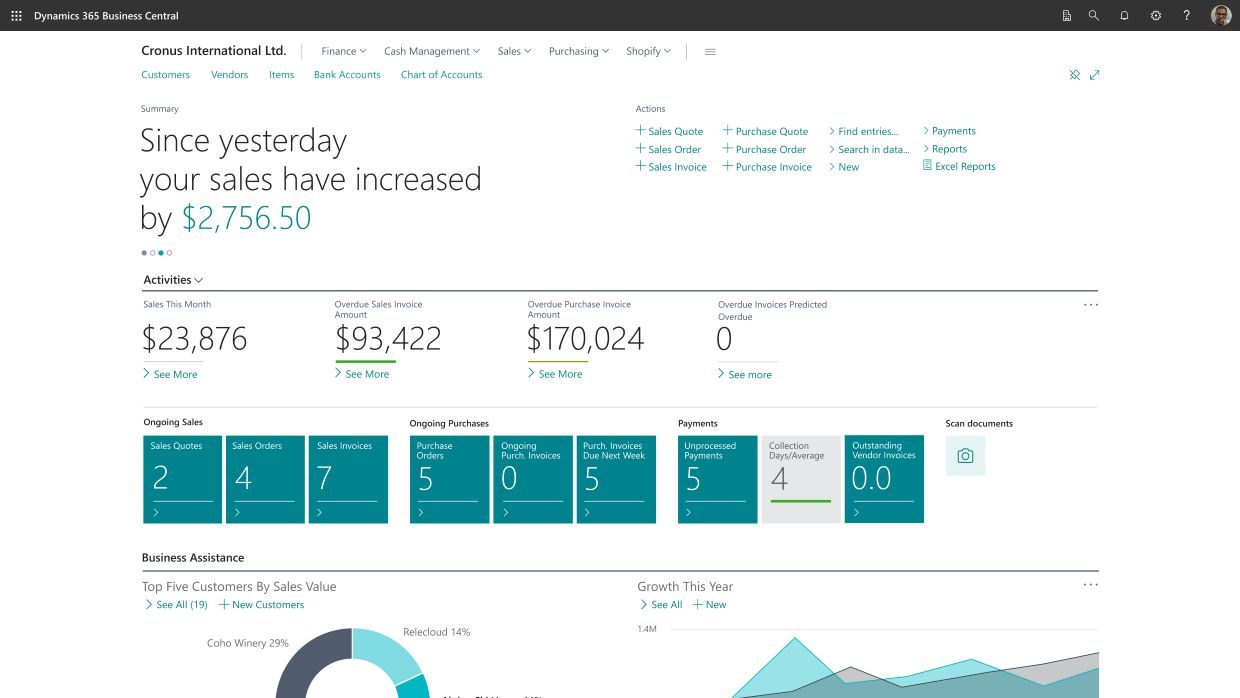
Business Central is the inventory and ERP system most Canadian SMBs land on once spreadsheets and QuickBooks stop scaling. It covers finance, sales, purchasing, and warehouse in one place, with native multi-bin and directed put-away.
It also handles GST, HST, QST, and PST out of the box, plus full bilingual operation. Pricing starts at CAD $108.50 per user per month for Essentials, which fully covers warehousing. Premium is CAD $149.20, required only if you also need manufacturing or service management.
The catch: You will need an implementation partner. Business Central is powerful but it is not a sign-up-and-go tool.
Upgrade trigger: Inventory lives in QuickBooks plus three spreadsheets and your team spends Mondays reconciling stock.
2. Oracle NetSuite WMS
NetSuite WMS is the warehouse module bolted onto Oracle NetSuite ERP. It is strong on wave picking, mobile RF scanning, and multi-location inventory if you are already running NetSuite or shopping for a full cloud ERP.
The downside is the total cost. NetSuite uses annual licence pricing plus a one-time implementation fee, and most Canadian SMBs find it priced for the upper-mid market. For a deeper side-by-side, see our NetSuite vs Dynamics 365 Business Central comparison.
The catch: Standalone WMS pricing is not published, and NetSuite WMS only works on top of NetSuite ERP.
Upgrade trigger: You already use NetSuite and your warehouse is bottlenecking fulfillment.
3. SAP Business One
SAP Business One is the SMB-focused sibling of full SAP. It covers inventory, warehouse setup, and bin management with strong manufacturing and distribution roots. Many product-led businesses with a European footprint default to it.
It is reliable but feels heavier than Business Central for smaller Canadian operations. The interface is dated, and add-ons are usually needed for modern mobile scanning and picking flows. Implementations also tend to take longer than comparable mid-tier options.
The catch: Most warehouse workflows need a third-party WMS add-on, which adds licence and integration costs. If that stretches your budget, see our SAP Business One alternatives guide.
Upgrade trigger: You have global operations, multi-currency complexity, and an existing SAP footprint elsewhere.
4. Fishbowl Warehouse
Fishbowl is the most popular QuickBooks add-on for warehouse inventory. It covers receiving, picking, barcode scanning, and basic manufacturing. If you are committed to QuickBooks but outgrowing it, Fishbowl is the obvious next step.
While it positions itself as an affordable SMB bridge, Fishbowl now uses a recurring monthly subscription model. Once you add users, modules, and implementation fees, the math gets close to mid-tier ERPs without the financial depth those platforms offer.
The catch: You are still anchored to QuickBooks, which means QuickBooks is still your database and financial bottleneck.
Upgrade trigger: Inventory has outgrown QuickBooks but you are not ready for a full ERP migration.
5. inFlow Inventory
inFlow is built for small Canadian businesses (the company is based in Toronto) that need simple inventory and light warehouse features without ERP-level complexity. It includes barcode generation, mobile scanning, and basic multi-location support.
It connects to QuickBooks, Xero, Shopify, and over 90 other apps. For a single-warehouse SMB doing under a few thousand orders a month, it is genuinely good value.
The catch: No real finance backbone. You will outgrow it if you start running multi-entity, multi-currency, or complex production.
Upgrade trigger: You need warehouse basics today and you are not ready to commit to a full ERP build.
6. Zoho Inventory
Zoho Inventory sits inside the broader Zoho One ecosystem. It handles multi-warehouse stock, sales order management, and integrations with Amazon, Shopify, and eBay. The free tier and low entry pricing make it popular for ecommerce sellers.
The trade-off is depth. Zoho is wide rather than deep, and serious warehouse workflows like wave picking or advanced put-away strategies are not its strength. Reporting is also lighter than dedicated ERPs.
The catch: Best for ecommerce-first businesses, not for distributors managing complex bin logic or multi-entity finance.
Upgrade trigger: You already use Zoho CRM or Books and want everything under one login.
7. Cin7 Core
Cin7 Core (formerly DEAR Systems) is built for product sellers running multiple sales channels. It does inventory, light manufacturing, B2B portals, and connects to most ecommerce platforms and accounting tools.
It is a solid pick for wholesalers and DTC brands shipping from one or two warehouses. Pricing is structured in monthly tiers that include generous user caps, which works well for small teams that want to avoid paying for every seat.
The catch: Reporting is shallower than full ERPs. Customizing workflows often means stacking integrations rather than building inside the platform.
Upgrade trigger: You sell through 3+ channels and need a single source of truth for stock across them.
8. Katana
Katana is built for small manufacturers who also run a warehouse. It is visual, simple, and integrates with Shopify, QuickBooks Online, and Xero. Production scheduling and live stock sit on one screen.
It is not designed for pure distribution. If you assemble or produce anything, it deserves a look.
The catch: Light on finance and advanced warehouse logic. You will need QuickBooks or Xero behind it. For makers who outgrow it, see our Katana alternatives breakdown.
Upgrade trigger: You make products and your spreadsheet planning is breaking.
Get a Practical Read on Which of These Fits Your Warehouse
Eight tools is a lot. A short conversation with a Canadian implementation partner can narrow it down to two based on your warehouse size, channels, and finance setup.
 Book a free consultation
How to Choose Inventory Systems for Warehouses for Your Operation
Picking between inventory systems for warehouses comes down to three filters. Run yours through each one before you sit through a demo.
Match Inventory Systems for Warehouses to Your Warehouse Type
A 2,000-square-foot stockroom does not need the same tool as a 50,000-square-foot distribution centre. Match your shortlist of inventory systems for warehouses to your real operation, not your aspirations.
Single-site, low-SKU operations can usually run on inFlow, Zoho, or Cin7 Core. Multi-warehouse setups with directed put-away and wave picking belong on Business Central, NetSuite, or SAP. Manufacturers with assembly steps lean toward Katana or Business Central.
Check Multi-Bin and Multi-Warehouse Support
If you plan to grow, multi-bin and multi-warehouse should be on your shortlist on day one, not added later as an upgrade.
A tool that handles only one location forces a painful migration the moment you open a second site or split your warehouse into zones. The serious inventory systems for warehouses (Business Central, NetSuite, SAP) have this built in. The lighter tools often charge extra or simply lack the depth.
Look at Bilingual and Canadian Tax Handling
If you operate in Quebec or sell across provinces, your inventory systems for warehouses need to speak French and handle GST, HST, QST, and PST without bolt-ons.
Most US-built tools handle basic sales tax but stumble on Canadian complexity. Business Central, Cin7 Core, and SAP Business One all support this natively. The smaller US tools usually do not.
Want to see what real-time picking looks like inside Business Central? This short walkthrough shows the pick-and-ship flow in action.
What to Look for in Inventory Systems for Warehouses
Features matter less than how they fit together. The four capabilities below separate real inventory systems for warehouses from glorified spreadsheets. Skip any of them and you are buying a stock counter, not a system.
Why Inventory Systems for Warehouses Need Real-Time Stock Visibility
Real-time visibility means your stock counts update the moment a scan happens, not at the end of the shift. Without it, your sales team promises product you do not have, and your buyers reorder things you already received.
Look for live updates to bins, locations, and parent-system records on every transaction. If the demo shows batch syncs or overnight refreshes, walk.
Receiving, Putaway, and Picking Workflows
Good inventory systems for warehouses guide your team through receiving, put-away, and picking, not the other way around.
That means barcode-driven receiving against POs, directed put-away based on bin rules, and mobile picking lists that update as items are scanned. If your team is keying SKUs by hand, the system is doing the wrong half of the job. For a deeper look, see Gestisoft's guide on components of a warehouse management system, which walks through each module in detail.
Cycle Counting and Inventory Accuracy
Cycle counting is the discipline that keeps your book stock matching what is on the shelf. A good system schedules counts by ABC class, location, or velocity, and posts variances to the right accounts automatically.
Without it, you are running a full physical inventory once a year and shutting the warehouse for two days. With it, accuracy stays above 98% all year.
Integration With Sales, Purchasing, and Finance
Inventory does not live alone. A sale should drop stock, a receipt should update payables, and a return should reverse both. If your inventory tool is not natively connected to sales, purchasing, and finance, you are building bridges that break.
This is where ERP-based systems like Business Central or NetSuite pull ahead. For a deeper read, see Gestisoft's guide on ERP software inventory management.
Compare Inventory Tools With a Free ERP Selection Guide
A free guide built on 10 evaluation criteria most Canadian buyers underweight when shortlisting ERP and warehouse inventory tools.

What to Avoid When Choosing Inventory Systems for Warehouses
Most failed rollouts of inventory systems for warehouses trace back to one of these four mistakes. Each one is avoidable if you slow down at the shortlist stage.
Buying for Today's Volume, Not Tomorrow's Growth
A tool that fits perfectly today often breaks at 2x volume. Forecast 24 months out, not 6, when you size up vendors.
If you expect to double SKUs, open another warehouse, or add a sales channel, make sure your shortlist handles it. Switching ERP or WMS systems mid-growth is one of the most expensive moves a Canadian SMB makes.
Ignoring Bilingual and Canadian Tax Requirements
US-built tools often promise "Canadian support" but mean USD-priced licences with basic tax fields. That is not the same thing.
Real Canadian support means bilingual screens, full QST handling, CRA-ready reporting, and CAD-native pricing. Ask for a demo in French and watch what happens.
Picking a Standalone Tool That Can't Talk to Finance
Standalone inventory tools force you to reconcile stock to finance every month, by hand. That cost is rarely on the licence comparison sheet.
If your warehouse, sales, and finance teams are not pulling from the same database, you will pay for it in late closes, missed margins, and arguments between departments. A short list of warehouse system risks, including this one, is covered in disadvantages of warehouse management system, which is worth a quick read before signing anything.
Underestimating Implementation and Training Time
Most rollouts of inventory systems for warehouses slip by 30% to 50%. The licence is usually the smallest line item in the total cost.
Plan for at least 90 days of implementation of a serious mid-market tool, plus another 30 days of team training. If a vendor promises 2 weeks, ask what they are leaving out.
How Much Do Inventory Systems for Warehouses Cost in Canada?
Costs of inventory systems for warehouses vary by tier, but the patterns below hold for most Canadian SMBs in 2026. All figures are in CAD unless noted.
Entry-Level Pricing (Light Inventory Tools)
Tools like Zoho Inventory and entry-level inFlow land between CAD $50 and CAD $440 per month total for a small team. If you step up to Cin7 Core, the baseline shifts higher, starting around CAD $480 per month. Implementation is usually self-serve or under $5,000 for light data-migration help.
These platforms fit single-warehouse operations managing under a few thousand orders a month. Past that volume, businesses start hitting hard limits on user caps, sales channels, or multi-location warehouse logic.
Mid-Tier Pricing (Integrated Inventory and ERP)
Business Central Premium sits at CAD $149.20 per user per month, with implementation usually running between $25,000 and $80,000 for a mid-sized warehouse. SAP Business One operates in a similar mid-market space but often carries higher implementation fees and rigid upfront licensing costs.
This tier is where most Canadian SMBs with genuine warehouse complexity end up shopping for inventory systems for warehouses. Unlike lighter inventory add-ons, these platforms unite inventory, advanced warehousing, sales, purchasing, and a deep financial ledger in one place.
Enterprise Pricing (Custom Quote Required)
NetSuite WMS, SAP S/4HANA, and full Infor WMS deployments start in the six figures annually for licence alone. Implementation often doubles that.
These make sense for multi-entity, multi-country, or high-SKU distributors. Most Canadian SMBs under 200 employees do not need this tier.
Hidden Costs to Plan For
Licence costs are visible 30% of the total. The other 70% is implementation, training, integrations, hardware (scanners, label printers), data migration, and ongoing partner support.
A clear breakdown of these line items is in WMS software cost, which is worth reading before you finalize a budget number with your CFO.
-
An inventory system tracks what you have and where. A warehouse management system (WMS) adds workflow logic: directed put-away, wave picking, mobile scanning, and labour task management. Most modern inventory systems for warehouses include light WMS features, which blur the line for SMBs choosing between them.

Why Gestisoft Is the Right Partner for Inventory Systems for Warehouses
Gestisoft is a Canadian Microsoft Solutions Partner with nearly 30 years of helping SMBs in manufacturing, distribution, fashion, and municipal sectors run on Microsoft Dynamics 365 Business Central. The firm is B Corp certified and Great Place to Work certified, with offices in Montreal, Toronto, Ottawa, and Quebec City.
What separates Gestisoft for inventory systems for warehouses is the focus on Canadian operations: bilingual rollouts, CAD pricing, full GST/HST/QST/PST handling, and a team that has implemented Business Central across dozens of Canadian warehouses.
“The solution delivered to us has significantly improved our production visibility. We are now able to track our production in real time, and have more accurate data on the costs of each production run.”
That same real-time visibility and accurate costing is what Canadian SMBs come to Gestisoft for when their warehouse and inventory data starts costing them margin.
Map Your Warehouse Inventory Setup With Gestisoft
A free discovery call with a Canadian Microsoft Partner. See how Business Central handles your warehouse, finance, and Canadian tax in one system, with no obligation.
 Book a free consultation
Liked what you just read? Sharing is caring.

July 03, 2026 by Muhammad Ali Iqbal by Muhammad Ali Iqbal SEO Content Strategist & Copywriter
Driven by a passion for search engine optimization, strategic content, and conversion-focused writing. A copywriter and content strategist who lives for content that ranks, engages, and delivers real business results.

