

Katana alternatives are usually searched by manufacturers who liked Katana early on, then hit a wall as they scaled. The wall looks familiar: production grew, finance got messier, a second entity appeared, or the monthly bill quietly doubled once add-ons stacked up.
This guide skips the generic listicle pattern. It focuses on what Canadian SMB manufacturers actually need from Katana alternatives in 2026, including the signals it's time to switch and the platforms that match different growth stages.
Talk to a Microsoft Partner Before You Switch ERPs
Choosing between platforms gets expensive when the shortlist is wrong. A short call with a Gestisoft expert helps you skip the dead ends and focus on what actually fits.
 Free discovery call
The 9 Best Katana Alternatives in 2026
The Katana alternatives below were selected because each one solves at least one known Katana limit, whether that's deeper finance, multi-entity ops, complex BOMs, or full Canadian tax handling.
1. Microsoft Dynamics 365 Business Central: The Best Katana Alternative for Growing Canadian Manufacturers
Business Central is Microsoft's cloud ERP for small and mid-sized businesses. It covers finance, inventory, manufacturing, sales, and project management in one platform.
Compared with Katana, it goes deeper on accounting, multi-entity reporting, GST/HST/QST handling, and integration with Microsoft 365, Power BI, and Copilot.
Best fit when Katana add-ons push monthly cost past $700 and you still need real general ledger depth. Essentials pricing starts at USD $80 (CAD $108.50) per user per month, with a partner-led implementation.
2. Unleashed Software: A Lightweight Katana Alternative for Inventory-Heavy Brands
Unleashed is cloud inventory and light manufacturing software used by product brands selling across multiple channels. It handles BOMs, batch tracking, and warehouse transfers, and connects cleanly with Shopify, Xero, and QuickBooks.
It works well when inventory accuracy is the main pain and you don't need deep finance built in. Unleashed pairs with a separate accounting platform rather than replacing it.
Pricing starts around USD $380 per month on the Medium plan, with users billed separately and discounts available on annual commitments.
3. Cin7 Core: Best Pick for Multi-Channel Sellers
Cin7 Core (formerly DEAR Systems) is inventory and order management software built for businesses selling across e-commerce, retail, and wholesale at the same time.
It covers manufacturing workflows, warehousing, B2B portals, and POS integrations in one place. Compared with Katana, it handles multi-channel complexity more naturally and includes light accounting features.
It's a strong choice when SKUs, sales channels, and warehouse locations all multiply at once. Pricing starts around USD $349 per month for the Standard plan, with caps on users and connected integrations.
4. MRPeasy: Low-Cost MRP for Small Manufacturers
MRPeasy is a cloud MRP system aimed at small manufacturers running between 10 and 200 employees. It covers production planning, BOMs, inventory, and CRM in a single platform.
Compared with Katana, MRPeasy is lighter on slick UI but stronger on production routing detail and shop floor scheduling. It connects with Xero, QuickBooks, and Shopify for downstream needs.
Plans start near USD $49 per user per month for Starter, with feature unlocks at higher tiers. A free trial gives a fast feel for whether the workflow fits.
5. Fishbowl: For QuickBooks-First Operations
Fishbowl is inventory and manufacturing software built around tight QuickBooks integration. It supports manufacturing orders, multi-warehouse tracking, kitting, and POS workflows.
It's a strong Katana alternative when QuickBooks is already the financial backbone and the team doesn't want to migrate accounting. Fishbowl extends manufacturing depth without forcing a full ERP swap.
Pricing is quote-based, with Fishbowl Drive starting near USD $349 per month and Fishbowl Advanced near USD $399, both for two users included. Implementation usually involves a partner or in-house IT support.
6. NetSuite: Enterprise-Grade Cloud Suite
NetSuite is Oracle's cloud ERP, covering finance, inventory, manufacturing, CRM, and e-commerce on one database. It's a serious step up from Katana in scope and complexity.
It fits manufacturers planning to operate across multiple subsidiaries, currencies, or countries within the next few years. Customization options are extensive but require certified partners or developers.
Pricing is quote-based, typically starting around USD $999 per month plus per-user fees. Implementation cost and timeline tend to exceed Business Central for similar functional scope.
7. Odoo: Open-Source Flexibility
Odoo is a modular open-source ERP with manufacturing, inventory, accounting, CRM, and e-commerce apps that can be turned on as needed.
Compared with Katana, Odoo offers more functional breadth at the cost of higher configuration effort. Self-hosting is possible, but most users go with Odoo Online or Odoo.sh.
Standard plan pricing is per user, starting near USD $24.90 per user per month as a first-year promotional rate and renewing closer to USD $31.10. Custom development is typically billed through a certified Odoo partner.
8. Craftybase: Maker and Small-Batch Friendly
Craftybase is inventory and manufacturing software built for small batch producers, particularly in cosmetics, candles, food, and crafts. It tracks COGS by recipe and supports compliance documentation.
It's a fit when the business is still owner-operated, the SKU count is manageable, and accurate landed cost matters more than scalability. It can replace Katana when the operation is small but compliance-heavy.
Pricing starts around USD $20 per month on the Pro plan (annual billing) and scales up to USD $349 on Growth for high-volume operations, with no per-user fees on any tier.
9. Acumatica: Cloud ERP With Consumption-Based Pricing
Acumatica is a cloud ERP suite with strong manufacturing, distribution, and construction editions. It uses consumption-based pricing rather than per-user licensing, which can favour teams with many light users.
Compared with Katana, Acumatica handles deeper finance, multi-entity, and complex manufacturing scenarios. It's often shortlisted alongside Business Central and NetSuite in the mid-market.
Pricing is quote-based and varies with resource consumption, modules, and partner support. Implementation runs through certified Acumatica partners across Canada and North America.
Why Most Manufacturers Start Looking for Katana Alternatives
Katana is genuinely good at what it does. The reasons buyers start searching for Katana alternatives are usually less about Katana's weaknesses and more about what the business has become since the original sign-up.
These are the five most common decision triggers. If any two are firing at the same time, the search is rarely premature.
The Monthly Bill Keeps Climbing
Katana's Core plan starts around USD $299 per month, but traceability, manufacturing routings, and warehouse modules are paid add-ons. Real-world cost often lands between USD $747 and USD $1,095 once add-ons stack up.
Finance Depth Runs Out
Katana handles light accounting via integrations but doesn't replace a full ERP. Multi-entity consolidation, tax provisions, and detailed cost accounting tend to expose gaps as the business scales.
A Second Entity Appears
Acquiring another company, opening a U.S. branch, or splitting a division usually breaks single-tenant inventory tools. Most Katana alternatives at the ERP end of the spectrum handle this natively.
BOMs Get Too Complex for Katana
Multi-level BOMs with sub-assemblies, variant manufacturing, and detailed labour costs push past Katana's design intent. Manufacturers running engineer-to-order or configure-to-order work feel this fast.
Canadian Tax and Bilingual Operations
GST, HST, QST, multiple provincial sales tax accounts, and bilingual document outputs are non-negotiable for many Canadian SMBs. Most Katana alternatives serving the Canadian market have this built in.
How to Pick Between Katana Alternatives Without Six Months of Demos
The honest reason ERP selection drags is that buyers compare feature lists instead of business fit. A faster path uses five questions, in order.
Where Does Finance Need to Live?
If the chosen platform must also be the source of truth for general ledger, tax, and consolidations, most light MRP options drop off the list immediately.
How Many Entities, Currencies, and Tax Regimes?
One Canadian entity is different from a Canada + U.S. split. The answer cuts the shortlist in half before anyone sees a demo.
How Complex Is the Manufacturing?
Make-to-stock with simple BOMs is one decision. Engineer-to-order with sub-assemblies and routings is another. Different Katana alternatives win in each scenario.
A quick distinction worth flagging: MRP focuses on production planning while a full ERP covers finance, sales, and operations too. If that's still unclear, the full ERP vs MRP breakdown goes deeper.
What's the Microsoft Stack Story?
Teams already standardized on Microsoft 365, Outlook, Teams, and Excel often save real time with a platform that lives natively in that ecosystem.
Who Will Implement It?
A self-serve platform like Katana lives or dies by the in-house team. ERP-class Katana alternatives almost always need a partner. The partner matters as much as the software.
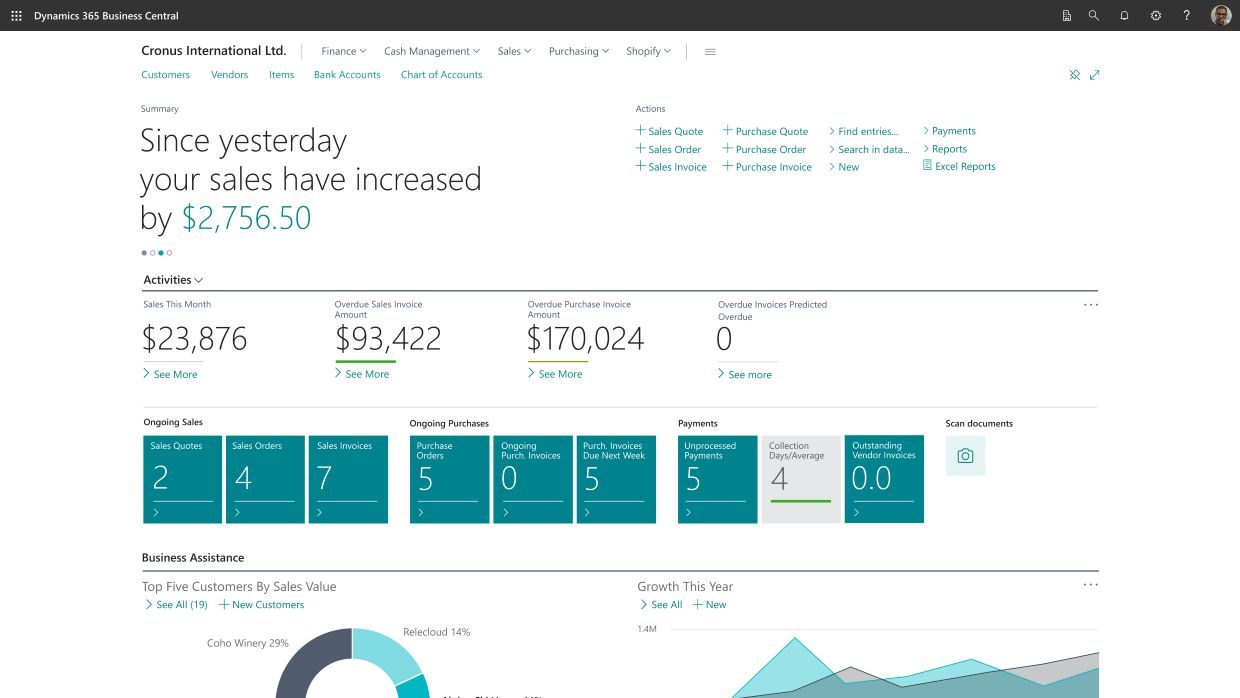
A short look at the Business Central interface gives a clearer feel for how the day-to-day differs from Katana's UI.
Where Business Central Pulls Ahead of Other Katana Alternatives
Most Katana alternatives are inventory-first platforms with manufacturing layered on. Business Central inverts that. It's an ERP first, with inventory and manufacturing as native modules, which changes what the system can carry on a single platform.
Finance You Don't Outgrow
Business Central runs the full general ledger, intercompany postings, and Canadian sales tax across provinces. There's no second accounting platform to maintain in parallel.
Multi-Entity Without Workarounds
Adding a U.S. subsidiary or a second Canadian entity is configuration, not a system replacement. Consolidations and intercompany reporting work out of the box.
Native Microsoft 365 Integration
Invoices, sales orders, and reports flow into Outlook, Teams, and Excel without third-party connectors. For teams already standardized on Microsoft, this is hours saved every week.
Copilot Inside the ERP
Copilot in Business Central lets users ask questions about their own data in plain language, retrieve records like sales orders or invoices instantly, and get guided help inside the ERP. The full Chat with Copilot in Business Central guide walks through what's available today.
Manufacturing That Scales With the Business
Production BOMs, work centers, routings, and capacity planning are all included. The discrete manufacturing ERP overview shows how this plays out in production environments.
Partner-Led Implementation, Not Vendor Handoff
Business Central is implemented through Microsoft Partners, so the team that scopes the project is the same team that delivers it.
For teams comparing this against the suite-level option, the NetSuite vs. Business Central head-to-head covers the trade-offs in detail.
Get a Straight Answer on Business Central Fit
Find out in one conversation whether Business Central matches your production, finance, and multi-entity needs, with no implementation pressure.
 Free discovery call
Mistakes to Avoid When Switching to a Katana Alternative
The most expensive mistakes when picking Katana alternatives happen before contracts are signed. These four show up most often in post-mortems.
Treating It Like a Software Swap
A move from Katana to a full ERP is a process change too. Workflows, roles, and reporting habits all shift. Teams that plan only the technical migration end up rebuilding processes mid-implementation.
Skipping the Data Audit
Item masters, BOMs, and historical transactions in Katana are rarely as clean as the team assumes. A pre-migration audit pays for itself many times over. Teams escaping spreadsheet workflows feel this hardest; the Excel vs. ERP comparison for inventory management shows where spreadsheets break down at scale.
Choosing the Platform Before the Partner
For ERP-class Katana alternatives, the partner team often matters more than the software. A great product implemented badly underperforms a good product implemented well.
Underestimating Change Management
Operators, finance, and warehouse leads need time, training, and a clear reason to switch. Skipping change management is the most common cause of stalled go-lives across Katana alternatives at every price point.
Download the 10 Key ERP Selection Criteria Guide
The free guide walks through the 10 criteria that matter most when picking an ERP, with the trade-offs each one creates before you commit.

-
For small manufacturers staying lean, MRPeasy and Craftybase are the closest like-for-like Katana alternatives in feel and price. For teams ready to consolidate accounting and operations, Business Central is the more durable choice.

Why Gestisoft Is a Trusted Partner for Katana Alternatives in Canada
Gestisoft is a Canadian Microsoft Solutions Partner that has been helping manufacturers across Canada and North America implement Microsoft Dynamics solutions, including Business Central, for nearly three decades. The team is bilingual, B Corp certified, and Great Place to Work certified.
What this means in practice for businesses comparing Katana alternatives: the same team scopes the project, configures the platform, runs the data migration, and supports the system after go-live. There's no vendor handoff and no fragmented accountability.
The focus is on Canadian SMBs, which means real expertise in provincial sales tax, bilingual reporting, and the production-to-finance integration that matters most for manufacturers leaving Katana.
“The solution delivered to us has significantly improved our production visibility. We are now able to track our production in real time, and have more accurate data on the costs of each production run.”
That same production visibility is what most manufacturers are really chasing when they search for Katana alternatives. The next step is figuring out whether Business Central fits your specific operation.
Move From Shortlist to Decision With Confidence
Gestisoft's team has spent nearly three decades helping Canadian manufacturers get real value from Microsoft Dynamics. One call clarifies what fits and what doesn't.
 Book a free consultation
Liked what you just read? Sharing is caring.

June 22, 2026 by Muhammad Ali Iqbal by Muhammad Ali Iqbal SEO Content Strategist & Copywriter
Driven by a passion for search engine optimization, strategic content, and conversion-focused writing. A copywriter and content strategist who lives for content that ranks, engages, and delivers real business results.
